


Get a Free WorkTrek Demo
Let's show you how WorkTrek can help you optimize your maintenance operation.
Try for freeKey Takeaways:
- More than 50% of maintenance teams regularly run out of critical spare parts.
- In 2018, poor SOPs led the upkeep team to release an aircraft for service when it wasn’t yet airworthy.
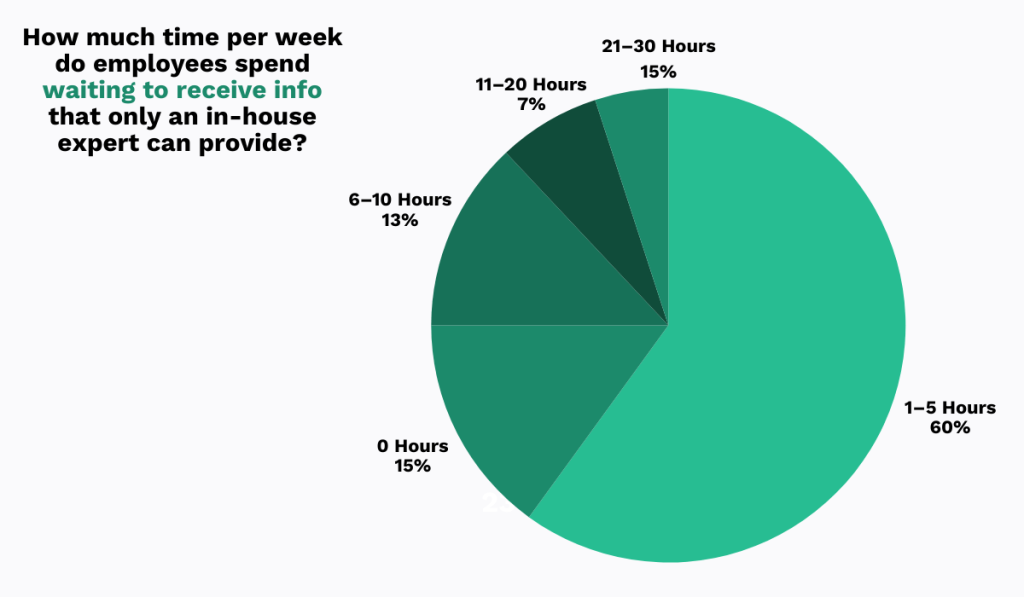
- Employees spend up to 30 hours per week waiting to receive information they need for work.
In 2018, unclear maintenance procedures led a maintenance team to release an aircraft to service before it was fully airworthy, resulting in an uncommanded in-flight engine shutdown.
In 2025, another maintenance team suffered burn injuries because procedures were incomplete and failed to address all potential hazards.
Different years. Different teams. Different industries. The same root cause: poorly written maintenance procedures.
If you want to prevent something similar from happening in your organization and protect your operational efficiency, worker safety, and reputation, read on.
In this article, you’ll find seven straightforward steps to developing an effective SOP, complete with examples, expert insights, and industry research.
Let’s begin.
1. Define the Purpose of the Procedure
First, clearly define what equipment or system the procedure covers, what type of maintenance is being performed, and the intended outcome.
Here, you are essentially explaining why this procedure exists in the first place.
This keeps the document focused, ensuring technicians understand its intent and helping you as the writer to avoid overcomplicating it or drifting away from reliability goals.
In this section, you need to strike that perfect balance.
It shouldn’t be overly long and distract readers from the core of the procedure, but it also can’t be too vague, answering at least some of these questions:
- Why the procedure exists
- What problem it prevents or solves
- What success looks like
- When and under what conditions it should be used
You shouldn’t dedicate an entire page to this section, but it’s also not enough to write, “The purpose of this procedure is to maintain the pump.”
For inspiration, take a look at the equipment maintenance procedure document by the University of Alberta’s Department of Agricultural, Food, and Nutritional Science.
It states:
“The purpose of this procedure is to regulate the planning and maintenance of equipment, to minimize and prevent downtime and to enhance safety and peak production for AFDP personnel and clients.”
This clearly defines both the purpose and the goal.
The document also includes separate sections for responsible personnel and maintenance frequency.
You can structure your procedure similarly, separating each piece of information into a different section, or you can include everything under a single “Purpose” section using a formula like this:
“This procedure defines the [maintenance type] for [equipment name/ID] located in [location/system] to achieve [desired outcome] and reduce the risk of [specific failure or hazard]. It is performed [frequency/trigger].”
It’s clear, concise, and to the point, providing enough context for readers to understand what the document covers without taking up unnecessary space.
2. Identify Safety Requirements
Now, it’s time to list all relevant safety information.
This includes:
- Required PPE
- Required permits
- Environmental precautions
- Lockout/Tagout (LOTO) procedures
- Hazard identification (electrical, hydraulic, chemical, stored energy)
Never assume that technicians already know this.
Making that assumption is a serious mistake for two major reasons: it can lead to accidents and injuries, and it exposes the company to the risk of regulatory noncompliance.
An incident onboard the Aframax oil tanker Wisdom Venture in 2025 clearly demonstrates how omitting even a single piece of information can result in serious harm.
During maintenance on a cargo heating system steam valve, three engineering crew members sustained burn injuries.
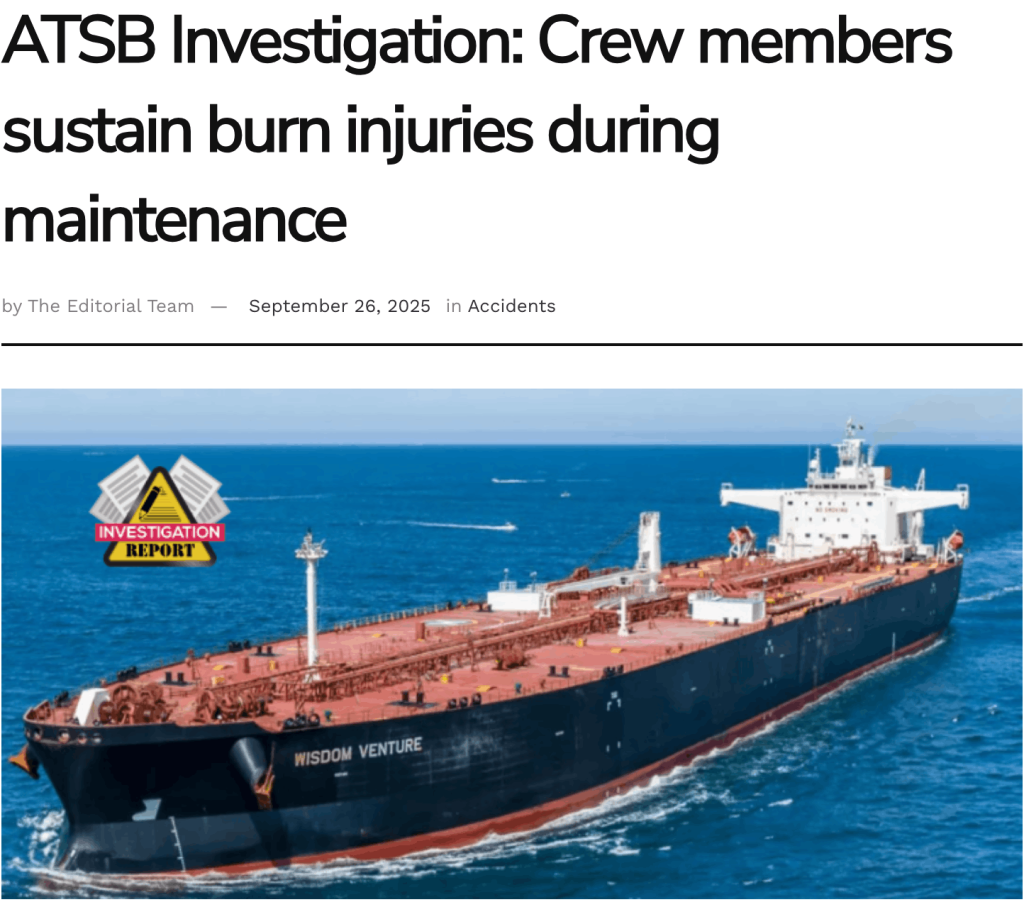
One contributing factor to this incident was that a drain line in the warm-up bypass line had been permanently modified without formal approval or documentation.
As a result, the incoming engineering team was unaware of the altered configuration and the associated hazards.
That’s why your procedure needs to put safety front and center, keeping it clear, easily visible, and up to date.
Take, for instance, the Overhead Crane Maintenance and Operations Procedure by Suncor Energy Inc., a Canadian integrated energy company based in Calgary:
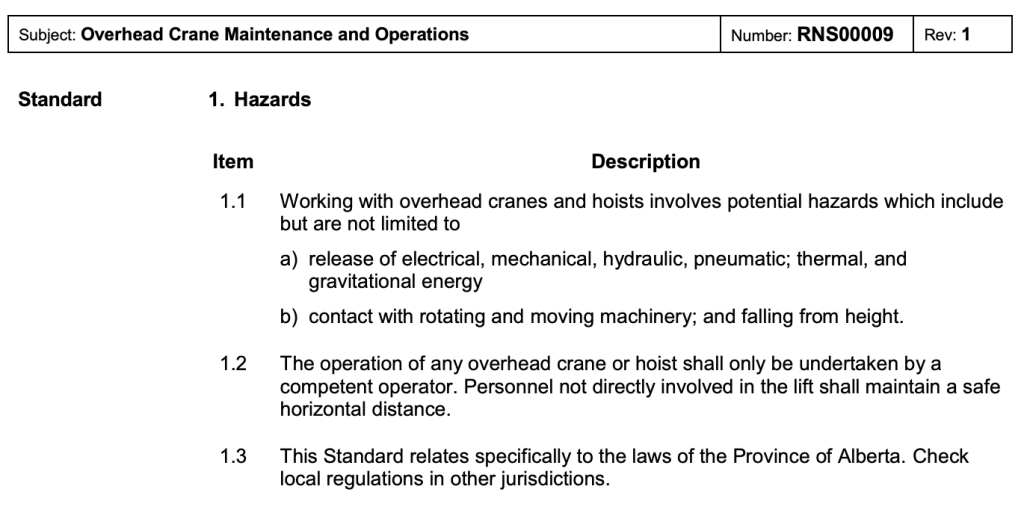
Although the document lists hazards, regulatory requirements, and qualification requirements for operators, inspectors, and maintenance personnel, this information is scattered throughout the document.
It isn’t highlighted in any way either, making it blend in with the rest of the text.
As such, it’s very easy to overlook.
A much stronger example is the conveyor maintenance procedure developed by Spire Safety Consultants, an Australia-based firm providing Work Health and Safety services:
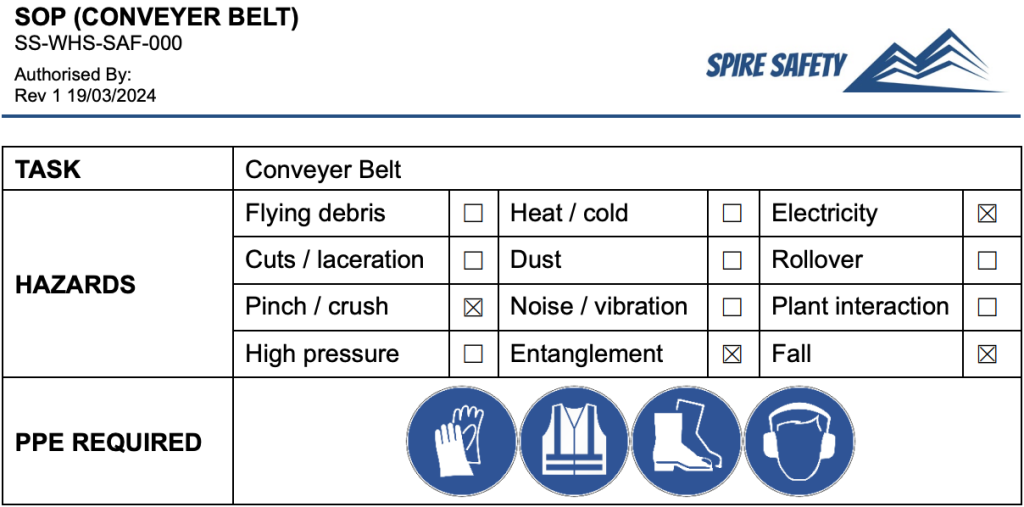
In this procedure, hazards, PPE requirements, and safe operating and inspection instructions are clearly presented at the beginning of the document and prominently displayed.
It makes expectations clear for technicians and operators and leaves no ambiguity about the potential risks.
3. Break Down the Task into Sequential Steps
This is the core of the procedure.
Here, you will write clear, logical, and easy-to-follow instructions for performing the task, ensuring that different technicians achieve the same result every time.
Doing this right matters more than you might think.
For example, in 2018, confusing and ambiguous procedures led maintenance personnel to release an aircraft to service when, in fact, it was not airworthy just yet.
The aircraft subsequently experienced an uncommanded in-flight engine shutdown after metal debris was detected by the engine’s chip detector.
The Australian Transport Safety Bureau (ATSB) Director of Transport Safety, Stuart Macleod, stated:
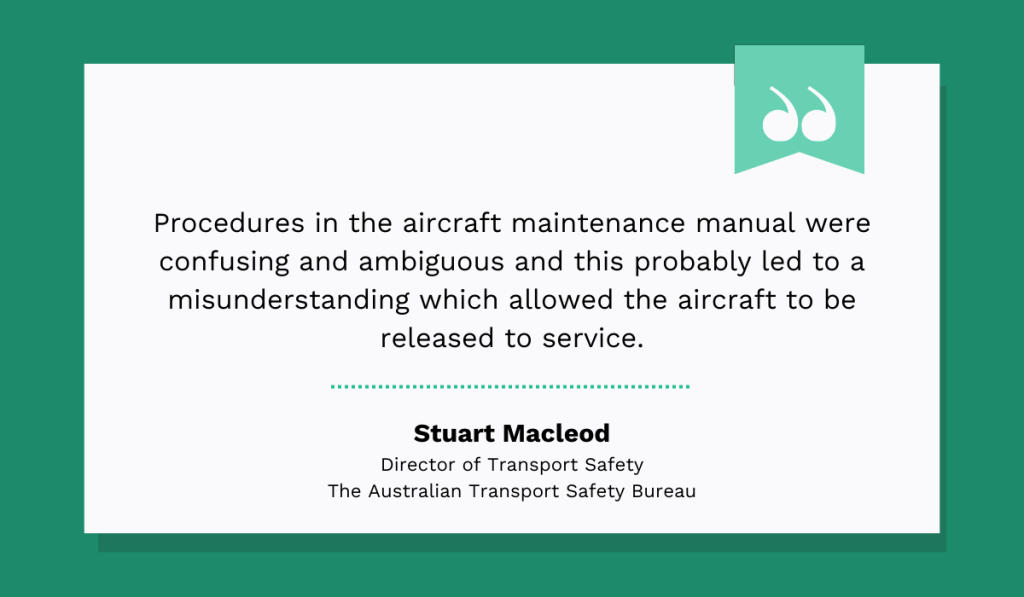
As it turns out, maintenance personnel were aware of the debris but incorrectly concluded it didn’t need to be considered due to unclear procedures.
Don’t make the same mistake.
Protect your workers and operational stability by ensuring your procedures are clear, concise, and leave no room for guesswork.
You can design this section in several ways, including step-by-step checklists, diagrams, or flowcharts.
However, avoid purely text-based SOPs written in long paragraphs, as they can become wordy, unclear, and difficult to navigate.
A step-by-step format, as shown in the example below, is usually more effective.
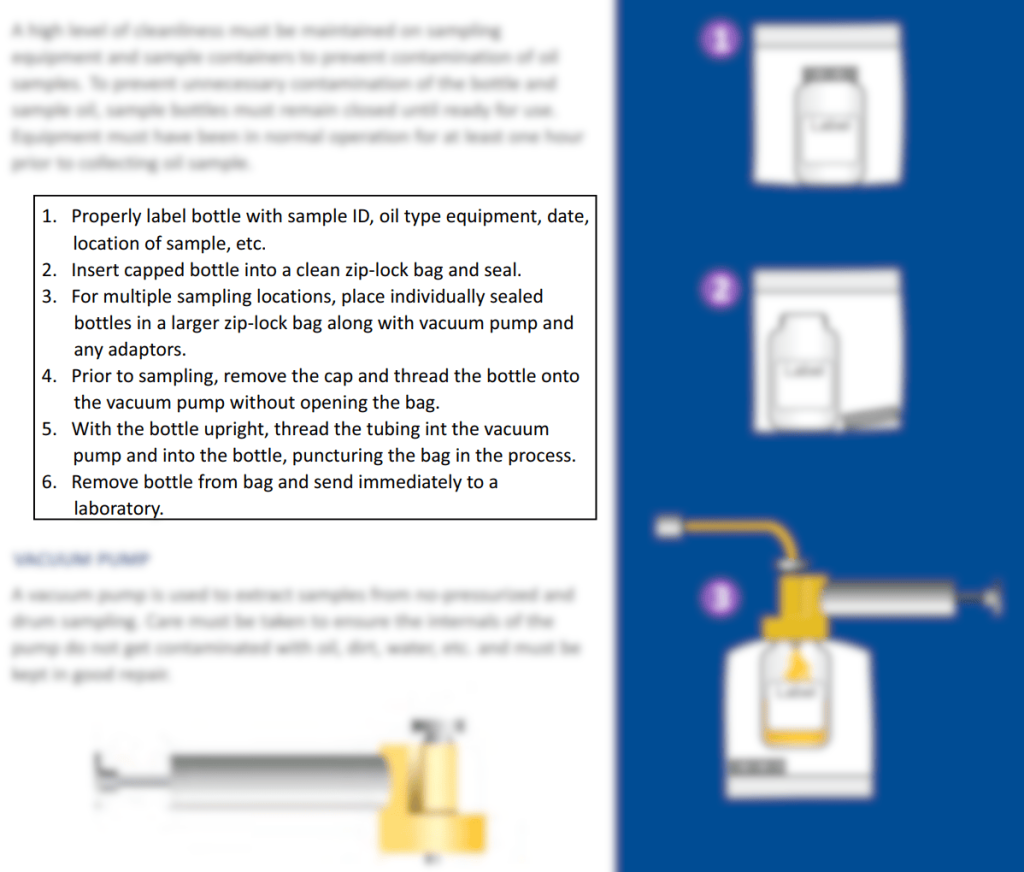
As you can see, each step begins with an action verb, contains only one action, and is written as a short, clear sentence.
You’ll likely find that this format works well for most of your needs.
However, if a process you’re describing is complex, includes multiple steps and substeps, or requires branching logic, a flowchart or hierarchical SOP may be more appropriate.
Regardless of the format, though, your top priority must always be ease of use and clarity.
4. Write Out a Complete Parts List
Here, you document the spare parts, consumables, and special tools required to perform the task.
This supports effective planning and inventory control, helping you prevent delays and avoid emergency procurement.
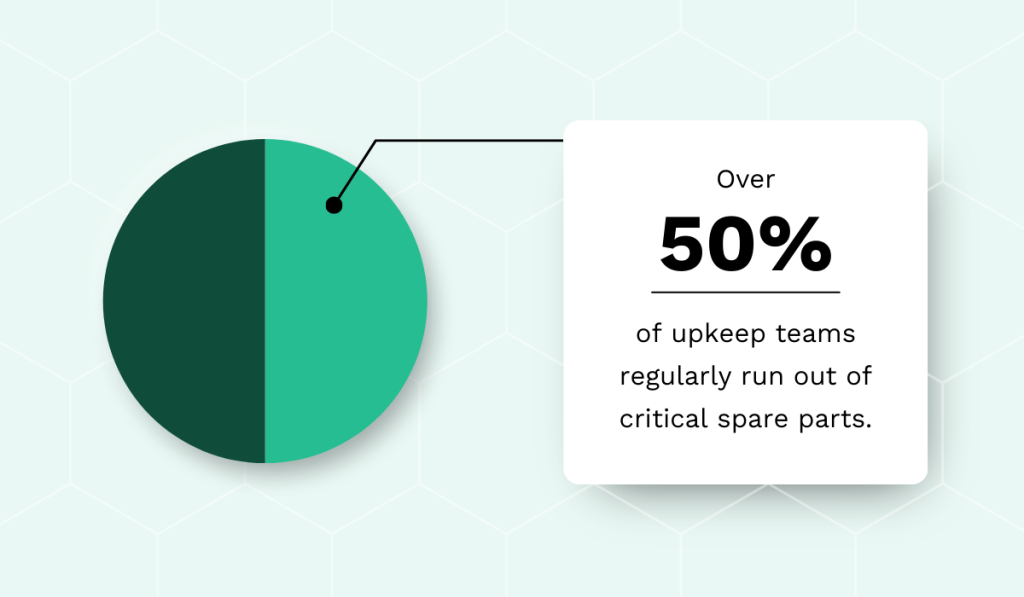
The fact that more than 50% of maintenance teams regularly run out of critical spare parts highlights how important this section truly is.
Think of it as creating a shopping list, only far more thorough, because you can’t simply run to the store if you realize you forgot to purchase something mission-critical.
So, try to be as detailed and specific as possible; no component is too small to include.
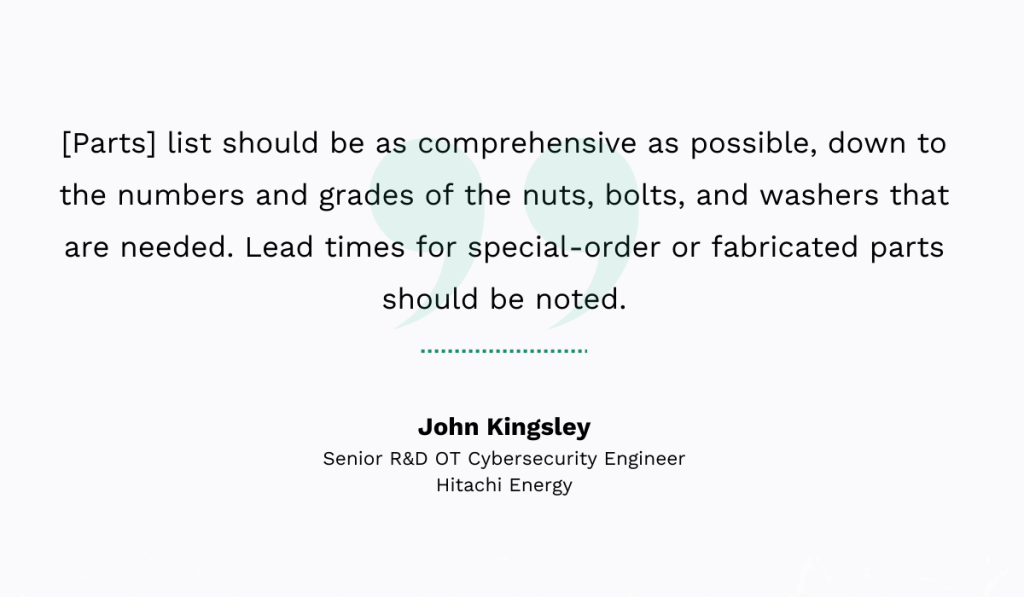
John Kingsley, Senior R&D OT Cybersecurity Engineer at Hitachi Energy, a global leader in power technologies and electrical infrastructure, agrees:
You may also want to include part numbers, descriptions, quantities, storage locations, and approved equivalents, if permitted.
Anyone reading the document should immediately understand what is needed, where to find it, and the quantity required.
If they need to contact you or someone else for clarification, it means the section isn’t doing its job.
For additional clarity, you could also reference specific parts within individual steps, as shown in the example below:
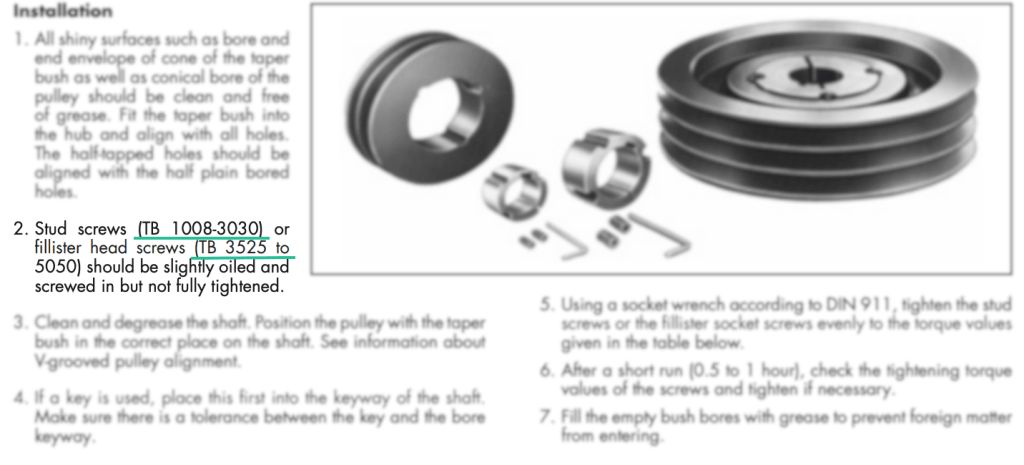
Just remember that this alone isn’t enough.
You still need a dedicated spare parts section that consolidates all relevant details.
Without it, these important components may get lost within the body of the text and be completely overlooked.
5. Add Images Wherever Possible
We say that a picture is worth a thousand words for a reason.
Visual guidance can significantly reduce interpretation errors and speed up task completion, especially for less experienced technicians.
Therefore, ensure you include high-resolution images in your documents wherever they add value.
This can include photos of actual equipment, annotated component images, before-and-after condition examples, and more.
For example, you may add exploded diagrams that are often featured in OEM manuals, like the one shown below:
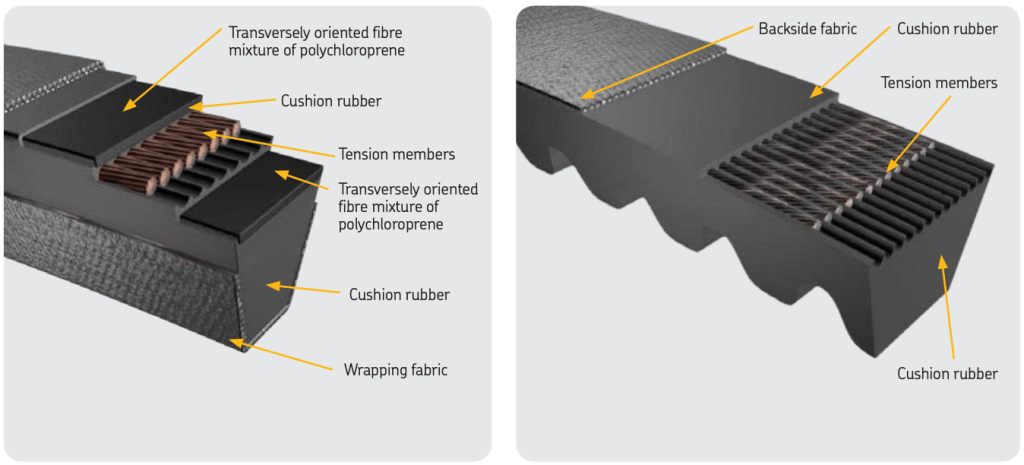
These are excellent for helping readers understand a specific component, its individual parts, and how those parts fit together, particularly elements that are typically hidden from view.
However, it’s best to supplement these diagrams with real equipment photos whenever possible.
Real-world images show the actual assets technicians work with and reflect the conditions they encounter every day, making them more practical and valuable.
That said, the images must be high quality and clear, not blurry or poorly lit.
Take, for instance, the photo below, taken from an SOP by Johnson Controls, a global leader in HVAC, security, and building automation systems:
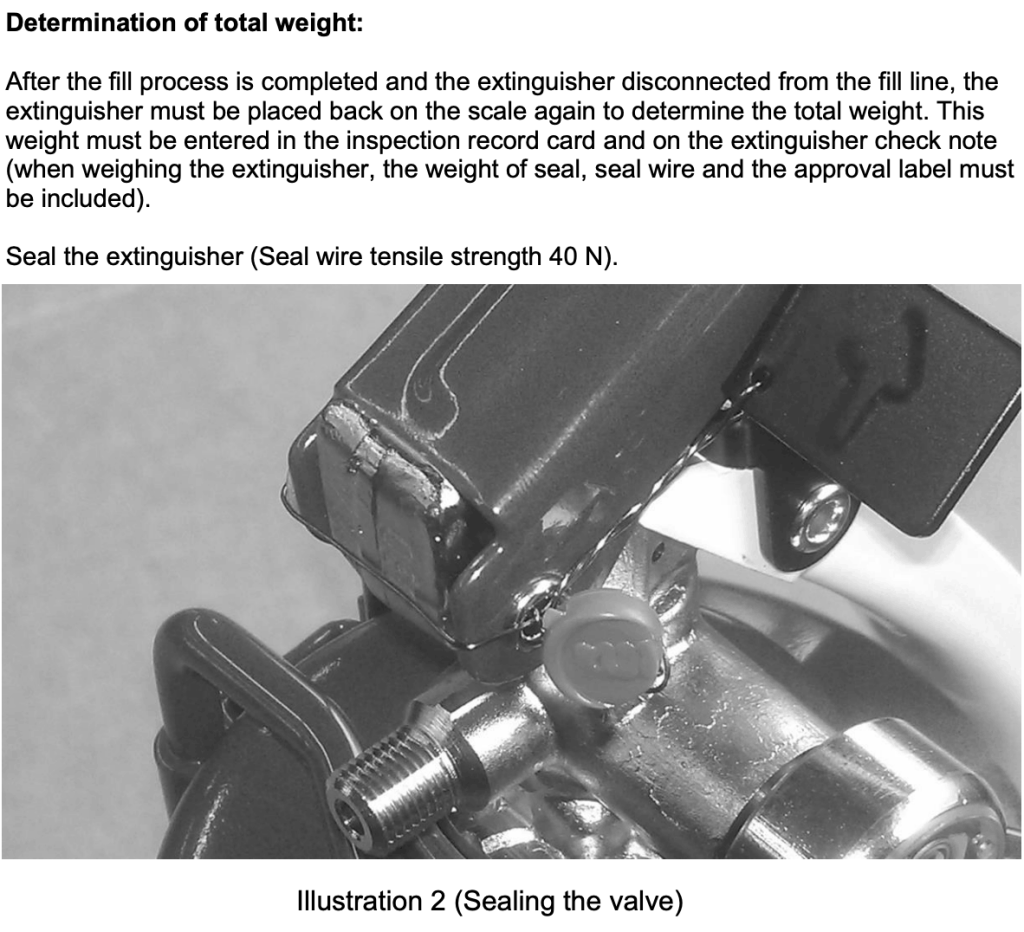
It shows real equipment and includes helpful annotations, but it’s printed in black and white, which reduces clarity. This was likely due to concerns about printing costs.
Today, however, there is no need to compromise on image quality or color, thanks to digital maintenance management systems, which enable you to upload all files to the cloud.
Ultimately, what matters most is that each image clearly shows the subject and is properly annotated, with a brief but clear explanation of what the image represents.
6. Review With the Technicians
Before finalizing the document, have experienced technicians review the draft or even perform a trial run using it.
After all, they are the ones who know all the real-world challenges, risks, and shortcuts worth noting.
In fact, they may be the only ones who know these details, which means that, without capturing their insights at this point, this knowledge could be lost forever when they leave.
This is exactly the problem one Redditor describes at their company:
“[…] a lot of our procedures […] are incorrect or have been “revised” due to modifications to the equipment or the equipment is just so old and haggard that the SOPs from the manuals don’t work as expected. There is a lot of tribal knowledge, pretty frustrating at times, […].”
In other words, knowledge stored in technicians’ heads is often far more reliable than what exists in SOPs or manuals.
Sure, this may not be an issue for experienced staff, but what about new hires?
They could ask for help, but the Panopto survey shows this can be highly inefficient.
Its respondents reported spending 5 to 30 hours per week waiting to receive information, support, training, or other insights that only an in-house expert can provide.
To avoid such inefficiencies, capture this unique knowledge in your procedures by involving technicians in the review process.
Not only does this improve the accuracy and applicability of the document, but it also ensures that valuable knowledge isn’t lost when personnel change.
7. Make the Document Easily Accessible
Last but certainly not least, you need to ensure technicians can access procedures exactly when they need them.
If they have to drive from the field to the office only to sift through mountains of paperwork or scroll endlessly through files on a computer, chances are they won’t bother using it at all.
Magnus Campbell, Founder of Remark Interactive, mobile software for process and documentation optimization, puts it perfectly:

This entails having the right information, in the right order, with all the right details, which we’ve already covered.
But it also entails making that documentation easily accessible. For that, a CMMS solution like WorkTrek is your safest bet.
WorkTrek digitizes and centralizes all your maintenance-related data, including work orders, invoices, reports, PM schedules, and, of course, SOPs.
Everything is in one place, making it easy to find, access, and update as needed.
You can even create forms and checklists directly within the system: choose from multiple question types, organize them into sections, and quickly customize each to fit your needs.
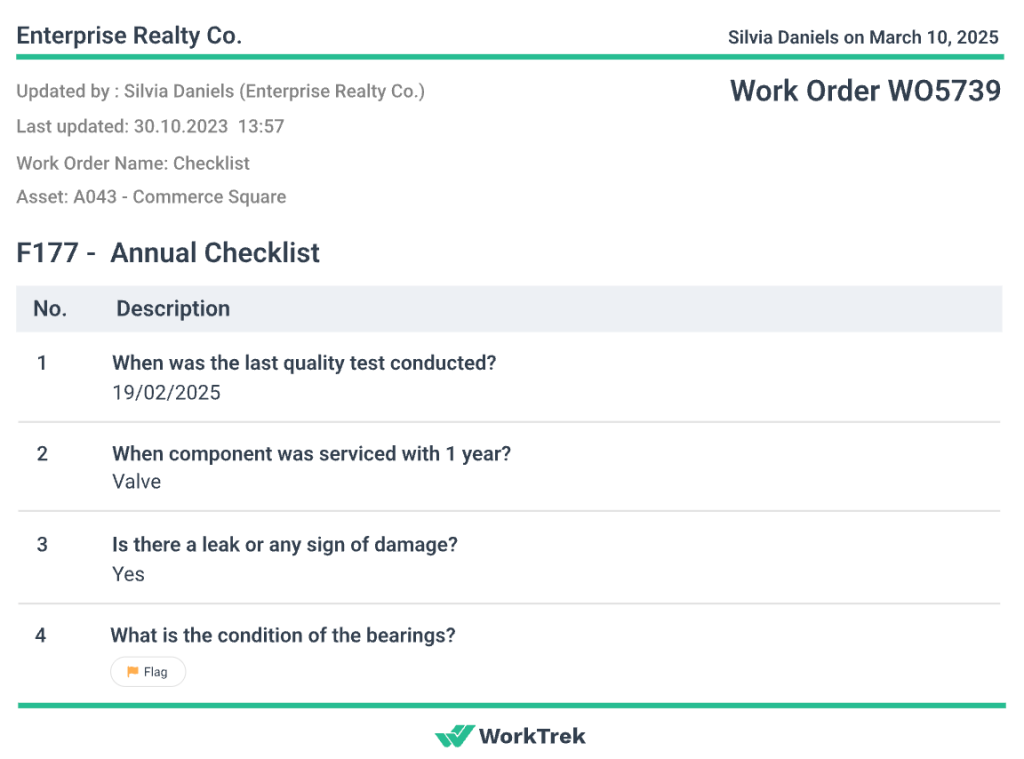
Brand them with your logo, fonts, and colors to align with your branding and documentation standards, and export them as MS Word or PDF documents.
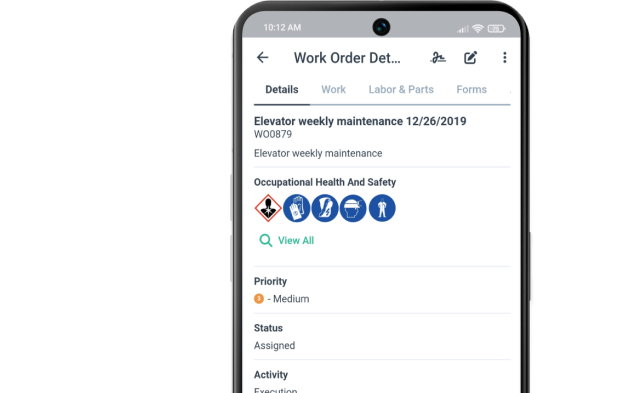
Most importantly, WorkTrek enables you to embed all vital information, such as instructions, photos, hazard warnings, PPE requirements, and safety procedures, directly into work orders.
So, when a worker is assigned a task, they no longer need to search separately for the work order and the SOP.
Everything is in the system and accessible on a computer, tablet, or phone, even without an internet connection.
Conclusion
Maintenance procedures may seem like simple documents on the surface, but they can have a significant impact on a company’s overall safety, efficiency, and reputation.
And in most cases, they aren’t that difficult to develop.
Typically, the real challenge is getting workers to actually use them. That’s where you’ll likely need to invest more effort.
Employees need to be trained on how to use the procedures, how to access them, and why they matter in the first place.
It can also help to share real-world examples of how poor SOP practices have led to serious damage or failures.
But most importantly, these documents must be easily accessible. Workers need to be able to retrieve them at any time, from anywhere, with minimal effort.
Even the most perfectly written procedure is worthless if it can’t be found when it’s needed most.