

Blog

Operations & Maintenance
Predictive Maintenance Analytics: The Full Guide
Key Takeaways: When equipment fails it can be expensive. But what if you could predict failures before they happen? That’s exactly what predictive maintenance analytics delivers: The ability to anticipate equipment failures, optimize maintenance schedules, and significantly reduce unplanned downtime through data-driven insights. This is the opposite of reactive maintenance, where you fix things after […]
Key Takeaways:
The global predictive maintenance market is projected to grow from $10.6 billion in 2024 to $47.8 billion by 2029, with a CAGR of 35.1%
Fortune Global 500 companies lose approximately $1.4 trillion annually due to unplanned downtime
Predictive maintenance analytics can reduce maintenance costs by 5-10% and increase equipment uptime by 10-20%
When equipment fails it can be expensive. But what if you could predict failures before they happen?
That's exactly what predictive maintenance analytics delivers: The ability to anticipate equipment failures, optimize maintenance schedules, and significantly reduce unplanned downtime through data-driven insights.
Source: WorkTrek
This is the opposite of reactive maintenance, where you fix things after they break. Preventive maintenance, on the other hand, while superior to reactive maintenance, follows rigid schedules.
Predictive maintenance, on the other hand, utilizes real-time data, machine learning algorithms, and advanced analytics to inform you precisely when equipment requires attention.
This guide will walk you through everything you need to know about predictive maintenance analytics, from basic concepts to advanced implementation strategies.
What is Predictive Maintenance Analytics?
https://youtu.be/gRC7K-s2feM
Predictive maintenance analytics is a data-driven approach that uses historical data, real-time monitoring, and advanced algorithms to predict when equipment failures are likely to occur.
Unlike traditional maintenance strategies, predictive maintenance relies heavily on continuous monitoring and data analysis to identify patterns that indicate potential equipment problems.
At its core, predictive maintenance analytics combines several key elements:
Sensor data collection from critical assets and rotating equipment
Historical data analysis to identify failure patterns
Machine learning models that learn from past equipment performance
Real-time monitoring to detect anomalies as they develop
Predictive insights that enable a proactive maintenance strategy
The fundamental difference between predictive maintenance and other maintenance strategies lies in its approach to data.
While preventive maintenance follows predetermined schedules and reactive maintenance responds to failures, predictive maintenance utilizes data analytics to optimize maintenance timing based on the actual condition of the equipment.
Source: WorkTrek
This proactive maintenance approach enables maintenance teams to perform maintenance only when necessary, reducing both maintenance costs and the risk of unexpected equipment failures.
How Predictive Maintenance Analytics Works
Predictive maintenance analytics operates through a sophisticated process that transforms raw data into actionable maintenance insights. Here's how the process works:
Data Collection and Continuous Monitoring
The predictive maintenance journey begins with comprehensive data collection from multiple sources:
IoT sensors monitor vibration, temperature, pressure, and other critical parameters
SCADA systems provide operational data from industrial processes
CMMS systems contribute historical repair and failure data
Equipment performance metrics track overall equipment effectiveness
With continuous monitoring, predictive maintenance creates a comprehensive asset health assessment.
Advanced Analytics and Machine Learning
Once data is collected, predictive maintenance systems employ various analytical techniques:
Machine Learning Algorithms
These systems learn from historical data to identify patterns that precede equipment failures. The algorithms continuously improve their predictions as more data becomes available.
Illustration: WorkTrek / Data: OpenTexts Blogs
Artificial Intelligence
AI processes vast amounts of sensor data in real-time, identifying subtle changes that might indicate developing problems.
Predictive Models
These mathematical models utilize statistical analysis to predict when equipment is likely to fail, allowing maintenance teams to plan effective interventions.
Pattern Recognition and Anomaly Detection
One of the advanced technologies that enables predictive maintenance is pattern recognition and anomaly detection.
The system can continuously compare current performance against established baselines, flagging anomalies that could indicate potential problems.
For example, a gradual increase in bearing temperature or changes in vibration patterns might signal impending mechanical failure.
With pattern and anomaly detection, maintenance teams can get notified early of a potential catastrophic failure. This can reduce downtime.
Predictive Maintenance vs. Preventive and Reactive Approaches
Let's cover the differences in the various maintenance strategies.
The three most popular strategies are Predictive, Preventive, and Reactive maintenance.
Reactive maintenance waits for equipment to break down completely before making repairs. This approach leads to unexpected downtime and emergency repair costs.
Preventive maintenance, on the other hand, follows fixed schedules regardless of actual equipment condition. This approach potentially wastes money on unnecessary maintenance and replacement parts.
Predictive maintenance is different from both approaches. It bases decisions on real equipment conditions and performance data rather than schedules or breakdowns.
Source: WorkTrek
The Benefits of Predictive Maintenance Analytics
Several organizations implementing predictive maintenance analytics report significant operational and financial improvements.
Reduced Unplanned Downtime
According to Siemens' 2024 True Cost of Downtime report, the 500 biggest companies globally lose approximately $1.4 trillion annually due to unplanned downtime. This is equivalent to 11% of their total revenues.
In the automotive sector alone, an idle production line in a major plant can cost up to $2.3 million per hour.
Companies that implement predictive maintenance analytics can anticipate equipment failures and schedule maintenance during planned downtime windows.
With predictive maintenance, organizations can significantly reduce the frequency and duration of unplanned outages.
Research shows that companies implementing predictive maintenance strategies experience substantial improvements.
On average, plants now suffer 25 monthly downtime incidents, down from 42 in 2019, with average large plants losing 27 hours per month to unplanned downtime.
This is a significant decrease from 39 hours in 2019.
Optimized Maintenance Costs
With predictive maintenance, organizations can optimize their maintenance expenses in several ways:
Reduced Emergency Repairs
By identifying potential failures early, maintenance teams can avoid costly emergency interventions that often require overtime labor and expedited parts delivery.
Extended Equipment Life
Proper timing of maintenance activities helps maximize asset lifespan, delaying expensive equipment replacements.
Source: WorkTrek
Improved Resource Allocation
Maintenance teams can allocate personnel and materials more efficiently when they know exactly when and where maintenance will be needed.
According to research, predictive maintenance can reduce maintenance costs by 5-10% and increase equipment uptime by 10-20%.
Improved Operational Efficiency
Implementing predictive maintenance analytics transforms how maintenance teams operate:
Better maintenance schedules based on actual equipment condition rather than arbitrary time intervals
Improved equipment performance through optimal maintenance timing
Increased overall operational efficiency by eliminating unnecessary maintenance tasks
Enhanced equipment reliability through proactive intervention
Safety Improvements
Every maintenance organization wants to improve safety. The good news is that predictive maintenance can contribute significantly to workplace safety by:
Identifying potential safety hazards before they become dangerous
Reducing the likelihood of catastrophic equipment failures
Enabling maintenance in controlled conditions rather than emergencies
Providing early warning of critical equipment degradation
Technologies and Components of Predictive Maintenance
Successful predictive maintenance implementation relies on several integrated technologies. These technologies work together to collect, process, and analyze equipment data.
IoT Sensors and Data Collection
The foundation of any predictive maintenance program lies in comprehensive data collection:
Vibration Analysis
Sensors monitor rotating equipment for changes in vibration patterns that could indicate bearing wear, misalignment, or other mechanical issues.
Temperature Monitoring
Thermal sensors detect overheating conditions that often precede equipment failure.
Oil Analysis
Chemical analysis of lubricants reveals equipment wear patterns and contamination issues.
Pressure Sensors
Monitor hydraulic and pneumatic systems for performance degradation.
Current Sensors:
Detect electrical anomalies in motors and other electrical equipment.
These sensors continuously collect data, creating a comprehensive picture of the health of all critical equipment assets.
Source: WorkTrek
Computerized Maintenance Management Systems (CMMS)
Modern computerized maintenance management systems like WorkTrek serve as the nerve center for predictive maintenance analytics.
An ideal CMMS platform will include the following features:
Integrate data from multiple sensor sources
Stores historical maintenance data and equipment performance metrics
Provides analytics capabilities for identifying trends and patterns
Automates work order creation when maintenance is predicted
Tracks key performance indicators related to maintenance effectiveness
Role of Artificial Intelligence and Machine Learning
AI can transform raw sensor data into actionable maintenance insights. Machine learning is the underlying technology that powers AI, which can learn normal equipment behavior patterns and identify when conditions deviate from expected ranges.
Anomaly Detection Algorithms
Compare current sensor readings against historical baselines. When values fall outside normal parameters, the system flags potential issues for investigation.
Predictive maintenance algorithms use multiple data sources to forecast failure timelines. These algorithms consider factors like operating hours, environmental conditions, and maintenance history.
Deep learning models can identify complex patterns that traditional analysis might miss. They excel at processing image data from thermal cameras or analyzing complex vibration signatures.
Machine learning systems improve accuracy over time as they process more data. Initial deployment might achieve 70% accuracy, but systems often reach 90% or higher after several months of operation.
Neural networks can simultaneously analyze data from dozens of sensors to create comprehensive equipment health assessments. This multi-sensor approach provides more reliable predictions than single-point monitoring.
Supervised Learning
Algorithms are trained on historical failure data and learn to recognize patterns that precede equipment problems.
Unsupervised Learning
Systems can automatically identify anomalies without prior knowledge of what constitutes normal or abnormal behavior.
Cloud Computing and Edge Analytics
Modern predictive maintenance systems need an underlying technology to analyze all of this data. That is where cloud and edge computing come in:
Cloud Platforms
Provide scalable computing power for complex analytics and long-term data storage. They remove the need for organizations to worry about hardware or managing server equipment.
Illustration: WorkTrek / Data: Oxmaint
Edge Computing
Edge computing occurs when analytics are performed close to the equipment. Instead of pushing your raw data to the cloud, with Edge computing, you can perform analysis close to the equipment. This reduces the need for bandwidth or latency of pushing data back and forth to cloud servers.
Hybrid Architectures
This is when you combine edge and cloud computing to optimize both response time and analytical depth.
Data Analytics and Predictive Models
Data analytics platforms process massive amounts of sensor information to create predictive models. These systems identify failure patterns and estimate remaining equipment life.
Statistical models
Analyzes historical failure data to identify common failure modes and their warning signs. These models help establish maintenance intervals based on actual equipment performance rather than manufacturer recommendations.
Regression Analysis
Can predict future equipment performance based on current trends. If bearing temperatures are gradually increasing, regression models can estimate when replacement will be necessary.
Time Series Analysis
Examines how equipment conditions change over time. This analysis helps distinguish between normal wear patterns and accelerated degradation.
Machine Learning Models
Can process data from multiple equipment types simultaneously to identify fleet-wide maintenance trends. This approach helps optimize spare parts inventory and maintenance scheduling.
Advanced analytics platforms can integrate weather data, production schedules, and operator behavior to create more accurate predictions. This comprehensive approach considers all factors that affect equipment performance.
Building a Predictive Maintenance Strategy
A successful predictive maintenance strategy starts with understanding current practices and equipment needs.
Organizations should start by evaluating their existing maintenance approach and select the right assets to monitor for maximum impact.
Assess Current Maintenance Practices
Many facilities employ a combination of reactive and preventive maintenance approaches.
Start by documenting the current maintenance challenges before implementing predictive systems.
Common issues to evaluate are unexpected downtime, high repair costs, and inefficient maintenance scheduling.
Key areas to evaluate:
Current maintenance costs per asset
Average equipment downtime per month
Maintenance team workload and capacity
Existing technology, like CMMS or ERP systems
It is nearly impossible to build a predictive maintenance program without a CMMS system like WorkTrek.
With a CMMS you can track work orders and maintenance history in a single system.
On the other hand, enterprise resource planning systems manage a broader range of operational data. These existing systems can integrate with predictive maintenance platforms.
Cultural and Maintenance Maturity
Implementing predictive maintenance requires understanding current maintenance maturity levels.
Organizations using run-to-failure approaches need to change their approach and start tracking different metrics.
Data-driven maintenance decisions only become possible when organizations understand their baseline performance and the overall culture and approach of their maintenance teams.
Selecting Equipment and Assets
The common industry practice is to start by identifying the equipment that is most critical to your organization.
However, critical assets may not be the best starting point for new programs despite seeming like obvious choices.
Better candidates for predictive monitoring:
Equipment that fails frequently
Assets with multiple identical units
Machines with predictable failure patterns
Equipment with moderate repair costs
Frequently failing equipment provides more learning opportunities than critical assets that rarely break down.
A machine that fails once every five years won't provide enough sensor data for a 12-month pilot program.
One approach is to identify multiple identical assets. This allows maintenance teams to compare performance and refine their procedures.
A facility with 100 conveyor motors can monitor 20 units and see patterns and cost savings quickly.
Equipment characteristics to consider:
Failure frequency: Monthly vs. yearly breakdowns
Repair complexity: Simple motor replacement vs. major overhauls
Business impact: Production line shutdown vs. minor delays
Replacement cost: $500 parts vs. $50,000 components
The goal is building confidence through multiple successful predictions rather than waiting for one critical failure. This will also provide the machine learning models with the necessary data to create predictions.
Small wins create stakeholder buy-in and prove the system works before expanding to more complex assets.
Setting Maintenance Goals and KPIs
Any new project should include goals and KPIs that you can track. These goals should align with current organizational capabilities and expected outcomes.
KPIs by maintenance maturity level:
Source: WorkTrek
Operational efficiency improvements go beyond just maintenance savings. Equipment performance metrics should track both technical and business outcomes.
Technical metrics include vibration levels, temperature readings, and failure prediction accuracy.
Business impact measurements:
Maintenance schedule optimization
Reduced overtime costs
Improved equipment lifespan
Better production planning
Soft metrics can demonstrate value to different stakeholders.
Maintenance can greatly benefit from actionable insights that improve daily operations. Management needs clear cost savings and productivity gains.
Challenges in Implementing Predictive Maintenance Analytics
While predictive maintenance analytics offers significant benefits, organizations face several challenges during implementation.
Data Integration and System Compatibility
Many organizations struggle with integrating predictive maintenance analytics into existing systems:
Legacy Equipment
Older machinery often lacks built-in sensors or connectivity options, requiring expensive retrofitting.
Data Silos
Information stored in separate systems makes it difficult to create comprehensive analytics.
System Integration
Connecting CMMS platforms, sensor networks, and analytics tools requires careful planning and technical expertise.
According to industry research, 31% of companies still manage their asset registers in spreadsheets. This clearly presents a major challenge of moving from reactive to predictive maintenance strategies.
Skills and Expertise Requirements
Illustration: WorkTrek / Data: Infraspeak Blog
Successful predictive maintenance analytics implementation requires specialized knowledge and staff training:
Data Science Skills
Organizations need personnel capable of developing and maintaining machine learning models.
Domain Expertise
Understanding equipment behavior and failure modes is essential for effective analytics.
Change Management
Training maintenance teams to use new technologies and interpret predictive insights.
According to maintenance professionals, the major challenges include hiring, onboarding, and retaining staff (48%), streamlining processes (27%), and adopting technology (25%).
Cost and ROI Considerations
While predictive maintenance analytics delivers significant long-term value, initial implementation costs can be substantial:
Technology Investment
Sensors, software platforms, and computing infrastructure require upfront capital.
Training Costs
Personnel need training on new systems and analytical techniques.
Integration Expenses
Connecting existing systems and retrofitting legacy equipment adds complexity and cost.
Organizations must carefully evaluate the return on investment, considering both implementation costs and expected benefits.
Data Security and Privacy
As predictive maintenance systems collect and process vast amounts of operational data, security becomes a critical concern:
Cybersecurity Risks
Connected sensors and IoT devices create potential entry points for cyber attacks.
Data Protection
Sensitive operational data requires robust security measures to prevent unauthorized access.
Compliance Requirements
Organizations must ensure predictive maintenance systems comply with relevant data protection regulations.
How CMMS Can Help with Predictive Maintenance Analytics
A modern computerized maintenance management system serves as the backbone of successful predictive maintenance analytics programs.
By centralizing data collection, analysis, and maintenance execution, CMMS platforms enable organizations to leverage the power of predictive insights fully.
Centralized Data Management
CMMS platforms excel at integrating data from multiple sources:
Sensor Integration: Modern CMMS solutions like WorkTrek can connect directly with IoT sensors and monitoring equipment to automatically collect performance data
Historical Data Storage: All maintenance records, equipment specifications, and performance metrics are stored in a centralized database
Real-Time Monitoring: Continuous data collection enables immediate detection of performance anomalies
Data Standardization: CMMS platforms ensure consistent data formats and quality across all equipment and locations
Automated Analytics and Alerting
Advanced CMMS platforms include built-in analytics capabilities that transform raw data into actionable insights:
Condition-Based Triggers
The system automatically generates work orders when sensor readings indicate potential problems
Trend Analysis
Historical data analysis identifies a gradual performance degradation that might otherwise go unnoticed
Predictive Alerts
Machine learning algorithms analyze patterns to predict failures before they occur
Customizable Dashboards
Maintenance managers can view key performance indicators and equipment health status at a glance
Integration with Existing Systems
WorkTrek's flexible architecture enables seamless integration with existing systems:
ERP Integration: Connect with enterprise resource planning systems for comprehensive asset management
SCADA Connectivity: Pull operational data directly from industrial control systems
Third-Party Sensors: Support for multiple sensor types and communication protocols
Cloud and On-Premise Options: Deploy in the configuration that best meets your organization's needs
Predictive Maintenance Workflow in WorkTrek
Here's how WorkTrek streamlines the predictive maintenance process:
Data Collection: Sensors and integrated systems continuously feed data into WorkTrek's analytics engine
Pattern Recognition: Machine learning algorithms identify anomalies and predict potential failures
Automatic Scheduling: The system generates maintenance recommendations and schedules work orders
Resource Planning: WorkTrek ensures the right technicians, parts, and tools are available when needed
Execution Tracking: Mobile applications guide technicians through maintenance procedures and capture completion data
Continuous Improvement: Analytics identify opportunities to optimize maintenance schedules and procedures
With this integrated approach, maintenance managers can ensure that predictive insights translate directly into effective maintenance actions.
A Step-by-Step Guide for Implementing Predictive Maintenance
As we described in this article, any successful predictive maintenance analytics requires careful planning and systematic execution.
Below is a step-by-step guide on how to start and implement predictive maintenance:
Step 1: Assess Current Maintenance Practices
Start by evaluating your existing maintenance strategies:
Inventory Current Assets
One of the first steps in the process should be a full inventory of all critical assets and their condition
Analyze Maintenance Data
Once you have the full equipment inventory, review all your maintenance records to ensure they are accurate and up to date. It is important to look at all success & failure patterns, along with costs.
Identify Critical Assets
Focus on prioritizing critical equipment that is important to your operation. This includes equipment that, if it fails, can be critical to operations or have a safety and financial impact on the operation.
Evaluate Current Technologies
Assess existing sensors, monitoring equipment, and maintenance management systems.
Step 2: Develop a Predictive Maintenance Strategy
Once you've identified all your critical assets and evaluated your current technologies, it is now time to start developing your predictive maintenance plan.
Define Objectives
It should all start by establishing clear goals for reducing downtime, optimizing costs, and improving reliability. Define the KPIs that you want to track as part of your plan.
Select Initial Assets:
There is no reason to go all in at the start. Start by choosing a manageable subset of critical equipment for your pilot program. Also, get buy-in from all the equipment users.
Determine Success Metrics
Define analytical ways to track success. Define the most important key performance indicators to measure program effectiveness and continuously monitor this progress.
Establish Budget
Plan for technology investments, training costs, and ongoing operational expenses. This could include costs for the CMMS platform and sensors.
Step 3: Choose the Right Technology Platform
Selecting the appropriate CMMS and analytics platform is key to your program's success:
Evaluate CMMS Options:
Look for platforms that offer predictive maintenance capabilities, sensor integration, and advanced analytics
Consider WorkTrek
As the leading solution for predictive maintenance analytics, WorkTrek offers the comprehensive capabilities necessary for a successful implementation.
Source: WorkTrek
Plan Integration
Any system you choose should easily integrate with existing systems and sensor networks.
Scalability Planning
Select solutions that can grow with your predictive maintenance program. Evaluate how the application is hosted and ask for performance reports.
Step 4: Install Monitoring Equipment and Sensors
The next step in the process is to start deploying sensors on all the equipment you've selected for your pilot program.
Vibration Sensors
These can be installed on rotating equipment to monitor mechanical condition.
Temperature Sensors
These sensors can report when equipment falls outside of safe operating temperatures. Deploy throughout facilities to detect overheating conditions.
Pressure Monitors
These are ideal for placement on hydraulic and pneumatic systems.
Current Sensors
These sensors are designed to be placed on electric circuits to monitor electrical equipment for performance anomalies
Environmental Sensors
Track ambient conditions that affect equipment performance.
Step 5: Configure Analytics and Machine Learning Models
The CMMS system that you choose should have extensive analytical capabilities that will help drive your predictive insights:
Historical Data Loading
Your system should be configured to import and record all maintenance records and equipment performance data. More importantly, this data needs to be easily accessible.
Model Training
The historical data collected by your CMMS system can then be used to train the predictive maintenance models.
Threshold Setting
Each piece of equipment should have specific failure thresholds. While the predictive maintenance systems can use machine learning to define these numbers, this process can take a few months before the systems learn. It will be helpful to start by establishing alert levels for various equipment parameters.
Validation Testing
Test, test & test. All of these automated systems can take some time to train. Do manual spot checks on specific failures to make sure that the systems are accurately predicting failures.
Step 6: Train Your Maintenance Team
It would be impossible to launch a successful predictive maintenance program without a well-trained maintenance team:
System Training
Start by selecting a user-friendly CMMS system, such as WorkTrek. However, that alone is not sufficient. Set up a training program to teach your staff how to use the systems in place effectively and translate the predictive insights.
Data Interpretation
Along with alerts and reports, predictive maintenance helps technicians understand what various sensor readings and alerts mean
Workflow Changes
Modify maintenance procedures to incorporate predictive insights
Continuous Learning
Establish ongoing training programs to keep skills current
Step 7: Launch Pilot Program
Begin with a controlled, smaller implementation to validate your approach:
Start Small
Focus on a limited number of critical assets for initial implementation. This will make it easier to measure progress and is less disruptive to the overall operation.
Monitor Results
Track key performance indicators to measure program effectiveness.
Gather Feedback
Collect input from maintenance technicians and management. This should include both negative and positive feedback. Also, do this consistently.
Refine Processes
Keep iterating and adjust procedures based on early experience and results. It is not easy to get it right the first time.
Step 8: Scale and Optimize
Once you've gained experience and collected sufficient data, start looking at scaling your predictive maintenance plan.
Add Equipment
Gradually start to include more assets in the predictive maintenance program.
Enhance Analytics
Continue to monitor and improve models based on the data and analytics from your CMMS.
Process Improvement
Continuously optimize maintenance workflows and procedures. Keep iterating and evaluating your process.
ROI Measurement:
Use the results to regularly assess the financial benefits of predictive maintenance analytics.
Key Performance Indicators to Track
There are a number of key performance indicators that you can track for predictive maintenance.
They are broken up into reliability, cost, Performance, and operational KPIs. Below is a list of the ones you should be tracking:
Equipment Reliability Metrics
Mean Time Between Failures (MTBF)
Measures average operating time between equipment failures, with increasing MTBF indicating improved reliability.
Mean Time to Repair (MTTR)
MTTR tracks the average time required to restore equipment to operation, with decreasing MTTR showing maintenance efficiency improvements
Overall Equipment Effectiveness (OEE)
OEE combines availability, performance, and quality metrics to provide a comprehensive measurement of equipment productivity.
Equipment Availability:
This measures the percentage of time equipment is available for production, which is directly impacted by effective predictive maintenance.
Source: WorkTrek
Maintenance Cost Optimization
Maintenance Cost per Unit of Production
Relates maintenance spending to output that enables cost optimization analysis.
Planned vs. Unplanned Maintenance Ratio
Generally, higher ratios of planned work indicate better predictive maintenance effectiveness.
Maintenance Cost as a Percentage of Replacement Asset Value
This is a great KPI to help you identify over- or under-investment in maintenance activities
Emergency Repair Frequency
With a successful predictive maintenance plan in place, you should be able to reduce your emergency repair frequency. If this ratio is increasing, evaluate your predictive maintenance plan.
Predictive Analytics Performance
Prediction Accuracy:
Measures how often predictive models correctly identify impending failures.
False Positive Rate
Tracks unnecessary maintenance actions triggered by incorrect predictions.
Lead Time Accuracy
Predictive maintenance should provide you with accurate predictions of failure. Evaluates how precisely the system predicts when failures will occur. If accuracy decreases, adjust the program accordingly.
Condition Monitoring Coverage
Measure the percentage of critical assets under continuous monitoring.
Operational Impact Metrics
Unplanned Downtime Reduction
Measures the decrease in unexpected equipment outages. A successful predictive maintenance plan should reduce downtime. If that is not the case,e then adjust your plan.
Inventory Optimization
Not having the right parts in stock slows down repairs, and having too many increases expenses. With better failure prediction, you should see an improvement in spare parts management.
Source: WorkTrek
Energy Efficiency Improvements
Monitors equipment energy consumption optimization through predictive maintenance.
Safety Incident Reduction
Safety is critical to all organizations. Measures a decrease in maintenance-related safety incidents.
The Future of Predictive Maintenance Analytics
The technology underlying predictive maintenance is quickly evolving. As AI and machine learning models evolve, and there is an improvement in IoT sensors the prediction models will improve.
Below are a few technologies to look for in the coming years:
Artificial Intelligence Advancement
AI and machine learning algorithms are continuing to evolve and improve.
Improved Accuracy
With better AI models, predictions will improve and false positives will reduce.
Automated Model Training
As AI technology involves models that will become smarter and will continuously enhance their predictive capabilities.
Multi-Modal Analysis:
Instead of building models per IoT type, new models can manage data from various data sources, reducing overall complexity.
Natural Language Processing
As these models involve, new AI systems can interpret maintenance notes and technical documentation. It will also enable maintenance teams to ask questions through a chatbot and get results.
IoT Expansion
IoT devices are constantly improving and covering more equipment types.
Cloud Computing Integration
Cloud platforms are enabling smaller organizations to access sophisticated analytics. This reduces the need to set up a complex computing infrastructure locally to support predictive maintenance.
Scalable Computing Power
Access to advanced analytics without large infrastructure investments.
Software as a Service:
Predictive maintenance capabilities are available through subscription models. This enables organizations to start with lower capital investment.
Data Storage Solutions
Cloud providers can provide secure, scalable storage for large volumes of sensor and maintenance data at reasonable cost.
Digital Twin Technology
Digital twins create virtual replicas of physical assets for advanced simulation and prediction. This reduce the need to test on production equipment reducing downtime.
Illustration: WorkTrek / Data: Interplay Learning
Real-Time Modeling
Virtual equipment models that mirror actual operating conditions
Scenario Testing
Ability to test maintenance strategies without affecting actual equipment
Optimization Algorithms
Using digital twins you can optimize maintenance timing and resource allocation.
Predictive Simulation
Testing various operating scenarios to predict equipment behavior
Conclusion
Predictive maintenance analytics is a fundamental shift from reactive and preventive approaches.
As this article has outlined, it leverages real-time data, advanced analytics, and machine learning algorithms to optimize maintenance.
The evidence is compelling: with the global predictive maintenance market projected to grow from $10.6 billion in 2024 to $47.8 billion by 2029. With Fortune Global 500 companies losing $1.4 trillion annually due to unplanned downtime the business case for predictive maintenance analytics has never been stronger.
Predictive maintenance isn't just about technology; it requires an organizational transformation.
Implementing the right tools, training, and commitment, predictive maintenance can transform your maintenance operations and deliver significant competitive advantages.

Operations & Maintenance
Property Maintenance: Types, Benefits & Best Practices
Key Takeaways:
Property maintenance depends on property type, regulatory requirements, management considerations, and the right maintenance strategy.
Strong programs use a mix of reactive, preventive, risk-based, and condition-based maintenance to ensure tenant safety and comfort while protecting property value.
Well-maintained properties see 20–30% fewer emergency calls and 15–25% lower maintenance costs.
Success comes from combining digital tools, standardized workflows, well-trained staff, and IoT monitoring.
Property maintenance might not always take center stage, but it’s essential for keeping buildings and their surroundings safe, functional, and valuable.
Effective maintenance ensures occupant satisfaction, reduces safety risks, and preserves property value.
In this guide, we explain what property maintenance involves, its main types, the benefits it offers, and best practices for managing it effectively.
What is Property Maintenance?
Property maintenance, often equated with building maintenance, refers to the ongoing care and repair of a building, its systems, and its surroundings.
The goal is to ensure the safety and comfort of occupants, while also preserving the long-term value of property owners.
Property maintenance is a subset of property management, which encompasses broader responsibilities, including leasing, tenant relations, and financial oversight.
To highlight this distinction, the following visual illustrates the difference between property management and property maintenance activities.
Source: WorkTrek
The list of activities on the right indicates that a property maintenance team is responsible for a wide variety of upkeep tasks.
Some of them, such as cleaning common areas, landscaping, pest control, or plumbing, are often outsourced to specialized contractors.
The balance between in-house staff and external providers usually depends on the property’s size, type, and budget considerations.
It’s also important to consider that different property types require different maintenance approaches.
Below, you can see some common commercial and residential property types, which help property managers understand how responsibilities may vary across settings.
Source: WorkTrek
For example, larger commercial buildings, apartment complexes, or mixed-use facilities often employ dedicated maintenance teams to manage daily operations, inspections, and minor repairs.
In contrast, smaller residential buildings or single-family homes typically rely more on external contractors for specialized services.
Regardless of the approach, property maintenance regulations are another factor to consider.
Most countries enforce their own building codes, safety standards, and maintenance regulations.
In the U.S., many local authorities follow the International Property Maintenance Code (IPMC), developed and published by the International Code Council (ICC).
Source: ICC
The IPMC is a model code, updated annually, that establishes minimum requirements for maintaining and using existing buildings.
When local authorities in the U.S. adopt the IPMC, its provisions become legally binding within that jurisdiction.
Source: Oregon Ohio
Beyond the U.S., many countries adopt similar principles into national laws to ensure building safety and consistent standards for property maintenance.
In many cases, the work itself is not the only aspect regulated.
Whether in-house or outsourced, some property maintenance staff, such as electricians, plumbers, and HVAC technicians, are also subject to licensing and certification requirements.
Types of Property Maintenance
Property managers implement various maintenance approaches. The approach depends on whether their goal is to prevent problems, respond quickly to breakdowns, or reduce expenses by concentrating on high-impact areas.
Broadly, property maintenance falls into four categories:
Reactive maintenance
Preventive maintenance
Risk-based maintenance
Condition-based maintenance
Each approach contributes to keeping properties safe, functional, and cost-effective.
To understand when and why these strategies matter, let’s first look at the most common issues property managers deal with every day.
Below are the top 10 most frequent property maintenance issues compiled by PropertyMeld:
Illustration: WorkTrek / Data: PropertyMeld
As you can see, plumbing dominates the workload, which highlights why property maintenance teams need a mix of strategies.
While some plumbing issues can be prevented with routine checks, many incidents, such as sudden leaks, burst pipes, or clogged drains and toilets, occur without warning and must be addressed immediately.
This is reactive maintenance, which involves responding to unexpected breakdowns or failures as they occur.
Other examples include elevator malfunctions, HVAC system failures, or electrical outages.
However, many of these problems can be prevented through planned preventive maintenance (PM or PPM).
Ryan Windsor, co-founder of HMO Architects, explains what PM is about:
Illustration: WorkTrek / Quote: HMO Architects
He adds that PPM can lead to improved operations, fewer costly failures, and a more profitable property portfolio.
Preventive maintenance involves routine tasks that keep a property running smoothly and reduce unexpected repairs.
Common examples include:
Regular building system servicing (HVAC, elevators, etc.)
Routine inspections for leaks or wear (walls, ceilings, roof, etc.)
Cleaning common areas and landscaping (gutters, walkways, grounds, etc.)
Inspecting safety equipment (smoke detectors, sprinklers, fire extinguishers, etc.)
With preventive measures in place, property managers can implement risk-based maintenance, which prioritizes assets whose failure carries the highest risk.
Air-conditioning failure is a typical example that often affects resident satisfaction.
Tim Choate, CEO of RedAwning, a solution for vacation rental owners, recommends this risk-based approach:
Illustration: WorkTrek / Quote: Coast
Choate adds that a robust risk-based property maintenance plan should also include PM measures, such as routine system checkups and safety protocol inspections.
This demonstrates why property maintenance teams employ a mix of strategies, the last of which is condition-based maintenance.
This method focuses on monitoring equipment or building systems for early warning signs of failure, such as unusual noises, vibrations, or wear patterns.
For example, sensors can track elevator system performance variables like vibration, temperature, and load.
When readings indicate excessive wear or anomalies, maintenance is scheduled to replace or repair components before a failure occurs, as illustrated below.
Source: NCD
Today, with IoT sensors and AI, condition-based maintenance evolves into predictive maintenance, enabling teams to anticipate issues before they arise.
By combining reactive, preventive, risk-based, and condition-based strategies and leveraging modern technology, property maintenance teams can optimize operations and stay ahead of potential problems.
When these approaches are combined effectively, they form a comprehensive maintenance framework that delivers tangible benefits.
Benefits of Property Maintenance
Organized property maintenance offers numerous benefits, including enhanced property safety, increased efficiency, and improved long-term value.
One of the most immediate advantages is a reduction in unexpected equipment breakdowns.
As previously discussed, preventive and predictive maintenance strategies enable property teams to:
Identify issues early
Avoid costly emergency repairs
Keep critical building systems operating reliably
According to Gatewise, properties with strong preventive maintenance programs report measurable improvements, such as fewer emergency calls, lower costs, and longer system lifespans, all resulting from reduced equipment breakdowns.
Illustration: WorkTrek / Data: Gatewise
A well-structured maintenance program also helps avoid costly liabilities tied to accidents and safety incidents.
When critical assets like elevators, fire systems, or plumbing are neglected, the risks extend beyond property damage. Tenants, visitors, and even maintenance staff can be exposed to serious harm.
One example comes from the CPWR report, which found that elevators cause about 17,000 injuries and 30 fatalities each year in the U.S.
To illustrate the risks, here’s just one of many news stories linked to alleged property maintenance failures.
Source: casino.org
Examples like these show that property maintenance is ultimately about people as much as buildings.
When tenants and visitors feel safe, they are more likely to trust property managers and remain satisfied with their experience.
Reliable HVAC, consistent lighting, and smoothly operating elevators all directly contribute to daily comfort.
This comfort has a strong influence on tenant satisfaction, which is one of the primary drivers of retention.
A study by Maastricht University of more than 2,900 U.S. office buildings found that even a 1-point increase in satisfaction yields measurable advantages for landlords:
Illustration: WorkTrek / Data: Eres
This also shows why effective property maintenance directly impacts property value and investment returns.
Well-maintained buildings require fewer costly repairs over time, slow depreciation, and support better energy efficiency.
Addressing issues promptly prevents minor problems from escalating into major structural or system failures.
As Zoe Harper from Steadily, a landlord insurance company, notes:
“A well-maintained property not only retains its value but also attracts and keeps good tenants.”
When responsive building management, timely repairs, cleanliness, and safety are all in place, they create a reinforcing cycle of satisfaction and reliability.
Ultimately, a well-designed and implemented property maintenance program delivers long-term financial and operational benefits for owners, managers, and tenants.
Now, let’s explore some best practices that make these outcomes possible.
Best Practices for Property Maintenance
Effective property maintenance requires systems and processes that keep residents safe, satisfied, and confident in the property’s management.
One of the most impactful best practices is enabling tenants to report issues through multiple channels, ensuring problems are addressed quickly and efficiently.
Beyond in-person requests and phone calls, this includes allowing residents and on-call staff to report issues digitally from their smartphones or computers.
A mobile maintenance management app (CMMS) facilitates this by enabling:
Property occupants to submit maintenance requests
Property managers to create and assign work orders
Staff and technicians to receive requests and report on completion
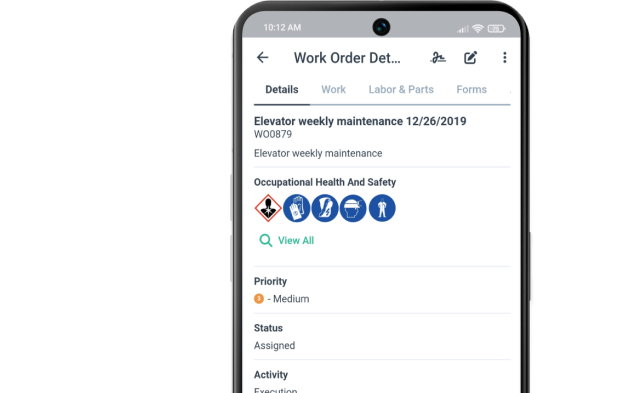
Our CMMS, WorkTrek, further streamlines reporting with QR codes that link tenants to a web request form.
You also have the option to create a branded app for your property.
Source: WorkTrek
Once a maintenance request is submitted, the property manager reviews and approves it.
Depending on the type and urgency of the issue, they then create a work order, assign it to available in-house technicians or outsourced providers, and set the appropriate priority level.
This streamlined process ensures that no request is overlooked and that critical issues are addressed promptly.
Source: WorkTrek
From there, managers can track the status of all work orders.
They can also plan costs and compare planned versus actual expenses to keep the financial side under control.
Beyond digital apps, modern property management increasingly leverages IoT sensors, AI, and predictive maintenance tools.
These technologies monitor equipment and building systems in real-time, detect anomalies, and help anticipate potential failures.
For example, a CMMS integrated with IoT sensors can trigger alerts not only on a time-based schedule (e.g., every month) but also based on meter readings (e.g., temperature exceeding a set threshold).
Source: WorkTrek
Another critical best practice focuses on people.
A significant part of property management is how janitors, in-house staff, and external vendors interact with tenants and collaborate.
Their professionalism and technical expertise are equally important.
To ensure effectiveness and consistency, property teams should:
Ensure staff and providers hold the appropriate qualifications and certifications
Provide adequate training and the right tools to perform their jobs efficiently
Standardize workflows and SOPs, such as digital checklists
Here’s an example of a checklist for elevator inspection, which illustrates how standardized workflows help ensure consistency and compliance.
Source: WorkTrek
Digital tools, IoT-enabled monitoring, standardized workflows, and well-trained staff are essential for property teams who want to resolve issues efficiently, maintain high safety and comfort standards, and enhance tenant satisfaction.
Finally, the effectiveness of any property maintenance program depends on tracking outcomes and measuring resident or occupant satisfaction.
Metrics like completed work orders, response times, and tenant feedback help property managers identify where processes can be refined and improvements made.
In summary, adopting these best practices creates a sustainable cycle of operational excellence, protects property value, and keeps tenants safe and satisfied.
Conclusion
Having covered the essentials, a few final notes remain.
First, property maintenance goes beyond cleanliness and fixing what’s broken. It also includes service performance, risk management, and tenant satisfaction.
Second, the right technology, structured processes, and skilled staff enable managers to establish proactive maintenance.
This ensures resident safety and comfort, protects long-term property value, and maximizes returns.
All this makes investing in effective maintenance one of the smartest decisions property owners can make.

Operations & Maintenance
How Predictive Maintenance Drives Cost Savings
Key Takeaways
Predictive maintenance reduces overall maintenance costs by 18-25% compared to traditional approaches while delivering 8-12% savings over preventive maintenance alone
Organizations experience 30-50% reduction in unplanned downtime, preventing losses that average $260,000 per hour across industries
95% of organizations implementing predictive maintenance report positive returns, with 27% achieving full payback within 12 months
Modern CMMS platforms like WorkTrek enable predictive maintenance workflows through IoT sensor integration, automated work orders, and advanced analytics
A number of industry studies show that predictive maintenance delivers 18-25% maintenance cost reductions and up to 40% savings over reactive maintenance strategies.
Illustration: WorkTrek / Data: ProValet
According to McKinsey research, leading organizations achieve 10:1 to 30:1 ROI ratios within 12-18 months of implementation on top of reducing costly downtime.
The study also demonstrates that companies embracing predictive maintenance can achieve 30-50% downtime reduction. All this while extending equipment lifespan by 20-40%.
The move from reactive to predictive maintenance is one of the most impactful operational transformations available to modern organizations.
Fundamentals of Predictive Maintenance
Predictive maintenance uses a combination of condition monitoring data, machine learning algorithms, advanced analytics, and Artificial Intelligence (AI) to forecast equipment failures.
While most traditional maintenance relies on scheduled intervals or equipment breakdowns, predictive maintenance analyzes vast troves of data in real-time to predict equipment failure. Maintenance tasks are then targeted to equipment that requires service, vs reactive or schedule-based maintenance.
A typical modern predictive maintenance system combines multiple data sources to predict failure.
These data generally come from vibration sensors, thermal imaging, oil analysis, and continuous monitoring sensors.
Source: WorkTrek
These devices can identify patterns in equipment behavior that precede failures. This allows maintenance teams to perform timely repairs during planned downtime that can reduce costly emergencies.
All of this data is then fed into machine learning algorithms that can be trained to detect anomalies.
These advanced analytics platforms can now process vast amounts of machine data from IoT sensors, SCADA systems, and equipment controllers to identify patterns that human technicians might miss.
Cost Savings of Predictive Maintenance
Reduced Unplanned Downtime
Costly unplanned downtime is the single largest opportunity for predictive maintenance cost savings.
Aberdeen Group research reveals that unplanned equipment failures cost organizations an average of $260,000 per hour, with large industrial operations facing potential losses of $532,000 per hour when critical production lines shut down unexpectedly.
The financial impact of downtime goes well beyond production losses.
Unnecessary downtime can trigger cascading costs, including idle workforce expenses, expedited shipping for emergency repairs, premium pricing for urgent parts procurement, and potential penalties for missed delivery commitments.
Manufacturing facilities typically lose 323 production hours annually due to unplanned outages, resulting in a total economic impact of $172 million per plant.
Early Detection to the Rescue
Predictive maintenance addresses these challenges through early detection of equipment anomalies.
This predictive approach enables maintenance technicians to schedule repairs during planned maintenance windows.
With constant monitoring of equipment conditions, maintenance teams can get advanced warning of potential failures.
On average, predictive maintenance can typically offer 5-7 days' notice for critical components and 2-4 weeks for gradually degrading systems.
This advance notice enables teams to plan repairs during scheduled downtime, order parts at standard pricing, and coordinate with production schedules to minimize disruptions.
Optimize Maintenance Cost
With traditional maintenance methods, equipment is only fixed or replaced after failure.
Predictive maintenance eliminates this by providing data-driven insights into actual equipment condition.
IBM research indicates that 30% of preventive maintenance tasks are unnecessary. This can lead to higher maintenance expenditures.
Predictive maintenance eliminates this waste by forecasting equipment failures based on actual condition rather than fixed schedules. On average, this delivers 8-12% cost savings over preventive maintenance approaches.
Maintenance organizations can reduce repair costs if they intervene before a critical failure occurs.
It is no surprise that emergency repairs typically cost 3-5 times more. This is because during emergency maintenance, teams have to pay premium parts pricing, overtime labor costs, and additional shipping fees.
Source: WorkTrek
Another benefit is that predictive maintenance enables repairs during regular business hours, thereby reducing overtime labor costs.
Predictive maintenance can also help manage spare parts costs and inventories.
It does that by helping organizations optimize resource allocation by forecasting parts demand based on equipment condition trends.
This approach can reduce inventory carrying costs while ensuring critical components remain available when needed.
Extend Equipment Lifespan
Organizations can extend equipment lifespan through predictive maintenance, which delivers significant capital cost savings by maximizing return on asset investments.
Traditional maintenance approaches can often contribute to premature equipment wear through improper timing.
Over-maintenance can introduce unnecessary stress and component wear, while under-maintenance can degrade equipment lifespan.
Critical assets, in particular, benefit from predictive maintenance strategies.
A steel manufacturing facility achieved $1.5 million in first-year savings while preventing a $3 million transformer loss through the implementation of predictive analytics. The system successfully identified gradual degradation patterns.
This empowered the maintenance teams to implement proactive intervention before a critical failure occurred.
When it comes to asset reliability improvements, compound over time. This is because predictive systems learn from historical performance data and end up with improved suggestions.
Machine learning algorithms become more accurate at predicting optimal maintenance intervals, leading to progressively better asset performance and longer operational life.
Vibration analysis, thermal monitoring, and oil analysis provide comprehensive insights into the health of equipment.
This enables maintenance teams to address minor issues before they cause serious damage.
Industry Examples
Manufacturing operations achieve remarkable returns
Manufacturing equipment is the sweet spot for predictive maintenance. This is mainly due to the high costs of production line shutdowns and the critical nature of continuous operations.
Industrial operations implementing predictive strategies report some of the most impressive cost savings and operational improvements.
Packaged Goods
A consumer packaged goods company achieved $5 million in annual maintenance cost savings through the comprehensive deployment of sensors and predictive analytics.
Source: WorkTrek
The system correlated high-speed camera data with vibration sensor readings to detect packaging equipment issues before they caused product quality problems.
Automotive Manufacturing
When the line goes down, automotive manufacturing facilities face particularly high downtime costs. Some production lines can generate as much as $22,000 per minute in value.
Notably, predictive maintenance has enabled these operations to reduce unplanned stoppages by 45-60% while improving overall equipment effectiveness scores.
Food Processing Operations
Another industry that benefits from predictive maintenance is food processing operations. They mainly benefit from the ability of predictive maintenance to prevent contamination risks and improve quality.
Food processing operations benefit from the ability of predictive maintenance to prevent contamination risks and quality issues.
Source: WorkTrek
Equipment failures in these environments can require extensive cleaning and sterilization procedures. This can multiply downtime costs.
Predictive systems help maintain consistent production while ensuring compliance with food safety regulations.
Oil and Gas Industry
The petrochemical sector can also greatly benefit from implementing predictive maintenance strategies.
One facility prevented $600,000 in potential losses through early detection of compressor misalignment.
The vibration sensors identified vibration patterns indicating bearing wear, enabling planned maintenance before catastrophic failure occurred.
Power Generation and Utilities
Power generation facilities operate under extreme reliability requirements. A single equipment failure can affect the entire power grid.
Predictive maintenance is the key to maintaining operational excellence while managing aging infrastructure.
Along the same lines as power generation companies, utility companies face unique challenges. These facilities have geographically distributed assets and limited maintenance windows.
Predictive maintenance helps optimize maintenance scheduling by detecting faults early and optimizing calendar-based schedules.
Wind energy operations have adopted predictive maintenance to mitigate the high costs associated with accessing remote turbine locations.
Siemens reports 25% maintenance cost reduction through IoT sensor deployment that enables condition-based maintenance scheduling, reducing unnecessary service visits while preventing costly component failures.
Oil and Gas
Oil and gas operations normally operate in harsh environments where equipment failures can have environmental and safety implications.
Source: WorkTrek
Offshore platforms particularly benefit from predictive strategies. Maintenance organizations can minimize the need for expensive helicopter transportation and reduce personnel safety risks.
Transportation & Logistics
Fleet management operations can achieve significant cost savings through predictive maintenance of vehicles and support equipment.
Organizations report 45% increases in vehicle uptime and 30% reduction in maintenance costs through condition monitoring and predictive analytics.
Aviation
Aviation maintenance represents one of the most advanced applications of predictive maintenance, where safety requirements demand exceptional reliability.
Illustration: WorkTrek / Data: Number Analytics
GE Aviation reports a 15% reduction in engine failures through the use of quantum sensors and advanced analytics. This delivers substantial cost savings while improving safety margins.
Rail Operations
Rail operations have rapidly adopted predictive maintenance strategies. According to recent studies, 42% of rail facilities reached advanced predictive maintenance maturity by 2017.
The industry benefits from predictive maintenance's ability to prevent track and rolling stock failures. This could significantly reduce service disruptions or safety incidents.
Maritime & Shipping Operations
Maritime operations utilize predictive maintenance to optimize vessel performance and reduce port downtime.
Predictive systems can monitor engine performance, propulsion systems, and auxiliary equipment to schedule maintenance during planned port calls.
This approach greatly reduces emergency dry-dock visits.
How CMMS enables predictive maintenance cost savings
Computerized Maintenance Management Systems, like WorkTrek, are the foundation for successful predictive maintenance programs.
These systems provide the data infrastructure, workflow automation, and analytics capabilities necessary to maximize cost savings.
Modern CMMS platforms have evolved beyond simple work order management to become complete predictive maintenance enablement systems.
Advanced CMMS solutions easily integrate with IoT sensors, condition monitoring equipment, and industrial automation systems to create comprehensive equipment health information.
This level of integration automates work order generation when there is data that indicates equipment operating outside predefined parameters.
Source: WorkTrek
This ensures that maintenance teams receive immediate alerts about potential issues.
Research indicates that 53% of facilities currently utilize CMMS for maintenance monitoring, with 80% reporting improvements in equipment lifespan.
The correlation between CMMS adoption and the success of predictive maintenance is clear: organizations with CMMS platforms regularly achieve higher ROI and faster implementation of predictive maintenance strategies.
How to Maximize Cost Savings
Selecting the right strategic assets is the first step in the process.
Organizations should prioritize critical assets where failures cause immediate production losses, safety risks, or environmental impacts.
These high-impact assets typically deliver the fastest ROI and most substantial cost savings.
To get accurate failure data, you need equipment with sufficient historical data.
Assets with documented maintenance history, known failure modes, and regular performance data offer the best opportunities for pattern recognition and failure prediction.
When installing new equipment, it can take between 6 and 12 months of operational data before predictive models achieve optimal accuracy.
Vibration monitoring, thermal analysis, oil condition monitoring, and electrical signature analysis are core monitoring technologies that provide comprehensive visibility into equipment health.
Technology Integration and Data Quality
Edge computing capabilities enable the real-time processing of condition monitoring data. This reduces latency and improves response times for critical alerts.
Illustration: WorkTrek / Data: STL Partners
Local processing reduces bandwidth requirements and improves system reliability in industrial environments with limited connectivity.
Data standardization and integration across multiple systems ensure predictive maintenance platforms receive consistent, high-quality information.
Organizations should review and address data silos and establish protocols for sharing information between maintenance management systems, process control systems, and business applications.
Machine learning algorithms require sufficient training data to achieve optimal prediction accuracy. Organizations should expect a lag in data collection before predictive models deliver reliable results.
Change management and workforce development
Don't skip on training your team. Maintenance team training ensures technicians understand how to interpret predictive maintenance alerts and take necessary action.
Successful implementation requires skills development in data interpretation, diagnostic techniques, and predictive technologies.
Part of training should include an emphasis on cultural change. Some organizations are slow to switch from reactive to predictive maintenance due to a lack of acceptance by the maintenance teams. It is always hard to switch from what you already know.
This change requires a significant organizational transformation that requires executive support and clear communication of benefits.
Additionally, maintenance workflows must evolve to incorporate predictive insights while maintaining focus on safety and reliability.
Continuous improvement processes enable organizations to optimize predictive maintenance programs over time.
Regular review of prediction accuracy, cost savings achievement, and operational optimization opportunities ensures maximum return on predictive maintenance investments.
Predictive Maintenance KPI
How do you measure success in any predictive maintenance program?
Start with Key performance indicators that measure maintenance cost reduction, unplanned downtime elimination, equipment availability improvement, and asset lifespan extension.
Maintenance organizations should establish baseline measurements before implementation to accurately assess improvement.
Financial impact tracking requires comprehensive cost accounting that captures both direct maintenance savings and indirect benefits such as improved operational efficiency, reduced inventory costs, and enhanced competitive advantage.
Many organizations underestimate total benefits by focusing only on maintenance cost reductions.
Illustration: WorkTrek / Data: WashMetrics
One popular strategy is benchmarking against industry standards, which helps organizations assess their predictive maintenance performance relative to best-in-class facilities.
Overall equipment effectiveness (OEE) metrics provide standardized comparison points across industries and operational contexts.
Advanced analytics platforms empower organizations with sophisticated ROI analysis. This is done by correlating maintenance activities with production performance, quality metrics, and financial outcomes.
These insights support data-driven decision-making about future predictive maintenance investments and expansion opportunities.
Conclusion
As outlined in this article, the benefits of predictive maintenance are undeniable to most industries and maintenance organizations.
Predictive maintenance drives substantial cost savings through dramatic downtime reduction. Additionally, it can optimize maintenance timing and extend equipment lifespan.
Studies show that leading organizations are achieving 18-25% maintenance cost reductions and 10:1 to 30:1 ROI ratios.
Modern CMMS platforms like WorkTrek serve as the never center for predictive maintenance success, providing the data integration, workflow automation, and analytics capabilities necessary to maximize cost savings.
Studies show that organizations implementing comprehensive predictive maintenance programs report a 30-50% reduction in downtime and significant improvements in operational efficiency within 12-18 months of deployment.

Operations & Maintenance
5 Types of Predictive Maintenance You Need to Know About
Key takeaways:
• Vibration analysis provides 2-6 months warning of rotating equipment failures
• Oil analysis extends lubricant life while preventing catastrophic mechanical damage
• Thermal imaging detects electrical and mechanical problems before visible damage occurs
• Acoustic monitoring offers the earliest detection of bearing failures in low-speed equipment
• Motor circuit analysis evaluates entire electrical drive systems in under 2 minutes
The manufacturing sector loses over $50 billion annually to unplanned equipment downtime, yet only 51% of plants currently use predictive maintenance strategies.
Illustration: WorkTrek / Data: RingCentral Pulse
This is a staggering disconnect between problem and solution, which represents one of the biggest missed opportunities in modern industrial operations.
What can be done?
Recent studies show that organizations implementing comprehensive predictive maintenance programs consistently achieve 25-30% reductions in maintenance costs, 40-50% decreases in unplanned downtime, and ROI of 8:1 within the first year.
Source: WorkTrek
This article highlights the five core predictive maintenance approaches. Each one offers unique capabilities for detecting different failure modes.
Predictive Maintenance Fundamentals
Predictive maintenance is a major paradigm shift in maintenance. The foundation of PM is based on leveraging advanced technologies, which include IoT sensors, machine learning algorithms, and predictive models.
Illustration: WorkTrek / Data: IIoT World
These technologies are then used to analyze data and create equipment performance patterns.
With this data-driven approach, maintenance teams can see equipment failures weeks or months before they occur.
What is the result?
Predictive maintenance dramatically reduces maintenance costs, increases equipment reliability, and eliminates unnecessary maintenance tasks.
1. Vibration Analysis
Vibration analysis is likely the most widely adopted predictive maintenance technique.
Equipment has a general heartbeat or vibration pattern. When those patterns change, these devices can detect issues long before a human will notice.
The way it works is by measuring vibration levels and frequencies to analyze machine conditions.
Illustration: WorkTrek / Data: Soar
In simple terms, the technology operates on the principle that all rotating equipment generates characteristic vibration signatures, which change when problems develop.
Fast Fourier Transform Analysis
Another detection method vibration sensors utilize is using accelerometers and advanced Fast Fourier Transform (FFT) analysis to convert time-domain vibration signals into frequency-domain patterns.
These frequency signatures are fingerprints for different failure modes. For example, unbalance appears at 1x running speed, misalignment shows at 2x and 3x frequencies, and bearing defects create specific frequencies related to bearing geometry.
The technology is most effective in manufacturing plants, oil and gas facilities, and power generation, where high-speed rotating equipment operates continuously.
Industry Examples
General Motors achieved remarkable success implementing vibration analysis across 7,500+ robots, preventing 100 predicted failures over two years. This approach led to a savings of $20 million annually in maintenance costs.
Machine Learning
Machine learning algorithms then analyze the data from vibration sensors. Using the large volume of data generated by these sensors.
Illustration: WorkTrek / Data: DISIGHTS
ML models can be trained to detect even the smallest anomalies. Another benefit of these models is that they reduce the need for specialized staff members on the team to analyze this data.
Automating Work Flows
One of the biggest benefits of predictive maintenance is the ability to automate work order generation.
Source: WorkTrek
Imagine a scenario where a vibration sensor detects an anomaly. The automated system can then connect to a CMMS and auto-generate the work order and assign it to a maintenance technician.
This approach can save maintenance teams a lot of time and, more importantly, improve operations.
Future Proof
At this point, you might be asking how good these sensors are? How much advance notice will I get before the equipment fails?
The good news is that vibration sensors can predict equipment failure2-6 months before they actually occur.
2. Oil Analysis
Another type of predictive maintenance is oil analysis. These are sensors that consistently test lubricants in critical equipment, looking for anomalies.
This analysis evaluates oil health and can detect contamination.
Illustration: WorkTrek / Data: TestOil
Some advanced analysis includes atomic emission spectroscopy for measuring wear metals, infrared spectroscopy for detecting molecular changes, and particle counting for contamination assessment.
The goal is to detect specific failure modes developing within equipment, such as iron particles which can indicate cylinder wear, copper suggests bearing problems, and water contamination points to seal failures or condensation issues.
Industry Examples
Shell uses oil analysis regularly as part of their predictive maintenance strategy.
As an example, they can process 20+ billion data rows weekly from oil monitoring systems.
The result was that this predictive maintenance program achieved 40% reduction in equipment failure incidents and $2 billion annual savings in maintenance costs. (WorkTrek).
Ideal Industries
There are several ideal industries that could benefit from using oil analysis. They generally include industries that operate in harsh operating conditions, such as mining, marine, and oil and gas.
Illustration: WorkTrek / Data: Future Market Insights
Another type of industry that can benefit from oil analysis is industries that operate in contaminated environments. These environments make manual inspection difficult, and generally experience accelerated wear due to harsh operating conditions.
CMMS to the Rescue
Like most IoT devices, oil analysis generates a substantial amount of raw data.
To successfully analyze this data you need a modern computerized maintenance management system like WorkTrek.
Source: WorkTrek
CMMS platforms can automatically schedule sampling routes, track historical data, and generate maintenance recommendations based on test results.
Predictive models can then analyze trending data to optimize oil change intervals and predict optimal maintenance timing.
Waste Reduction
Using oil analysis, organizations can reduce lubricant waste and save costs. This is primarily because of the shift from time-based to predictive maintenance.
Illustration: WorkTrek / Data: History Tools
Instead of performing lubricant changes on a schedule, maintenance organizations will only perform them when the oil has deteriorated and needs replacing.
Depending on the size of the organization, this can lead to cost savings of 20-30%.
3. Thermal imaging
Instead of using vibrations or sound, thermal analysis uses infrared cameras to detect patterns. Comparing those heat patterns to the baseline can help detect problems before visible damage occurs.
A lot of equipment generates localized heating. This makes thermal imaging an ideal early warning system for both electrical and mechanical failures.
Source: WorkTrek
This approach is ideal for equipment that is difficult to reach, due to safety concerns, or to inspect.
Thermal imaging systems can detect loose electrical connections, overloaded circuits, and failing components. It does this by identifying temperature variations that signal the development of problems.
Industry Example
BASF implemented comprehensive thermal monitoring across its chemical manufacturing facilities. This required deploying 100+ condition variables monitored continuously across 63 substation assets.
The result was that this thermal monitoring system reduced catastrophic electrical failures and optimizes maintenance scheduling through early problem detection.
Ideal Industries
The technology works across diverse applications. This includes electrical panels, motors, heat exchangers, and process equipment.
Manufacturing plants are an ideal area to utilize thermal cameras.
These cameras can be used for routine inspections, enabling the detection of problems during normal operation without disrupting production processes.
Data Analysis
Similar to other IoT devices, such as vibration sensors and thermal imaging devices, these devices can generate a large amount of data that requires analysis.
This data is analyzed using machine learning algorithms that can automate thermal pattern recognition. This can significantly reduce the specialized training traditionally required for thermographic analysis.
Along with machine learning, AI algorithms establish normal thermal signatures and automatically flag anomalous patterns requiring investigation.
Another benefit is the ability to receive real-time sensor data, which can automatically alert when temperatures exceed established thresholds.
4. Acoustic analysis
While thermal imaging uses cameras to detect anomalies, acoustic analysis monitors equipment-generated sound frequencies.
This predictive maintenance technique capitalizes on high-frequency sounds generated by friction, impact, turbulence, and electrical discharge within machinery.
Illustration: WorkTrek / Data: Test4Less
The way this works is by monitoring equipment ultrasonic ranges above human hearing, to detect performance problems and pinpoint their sources.
The technology utilizes ultrasonic detectors that convert inaudible sounds to audible frequencies for analysis.
In a way, this enables technicians to "hear" developing problems.
Where acoustic analysis shines is with low-speed rotating machinery, where vibration analysis may lack sensitivity. It is also ideal for detecting leaks in pressurized systems.
Industry Example
Duke Energy Renewables achieved outstanding results using acoustic monitoring for wind turbine maintenance, developing models that provide one hour's warning of contactor failures that typically cause 2-10 day outages.
Their acoustic analysis system achieved zero false positives during validation and saved hundreds of thousands of dollars per prevented failure event.
Acoustic analysis excels at bearing monitoring across all speed ranges. It can even detect lubrication problems before damage occurs.
For example, normal bearings produce rushing or hissing sounds. However, when a bearing is missing lubricants, it can create a loud rushing sound with roughness. Additionally, damaged bearings generate characteristic crackling or clicking sounds.
Steam trap testing is another type of acoustic analysis. The way it works is that with failed steam traps, it creates a distinctive acoustic signatures that enable quick identification.
Ideal Industry
This is particularly popular in the oil and gas industry, where acoustic monitoring is used for pipeline leak detection and valve monitoring.
Data Analysis
Like other IoT devices, sensor data from acoustic monitoring systems can integrate with maintenance management platforms.
Using the massive troves of data generated by these sensors, CMMS platforms like WorkTrek can enable trend analysis that predicts optimal maintenance timing.
Source: WorkTrek
Machine learning algorithms are the underlying mechanism that ingests this data and can analyze troves of data to provide pattern recognition.
One of the benefits of acoustic monitoring is that it is non-intrusive. It enables inspection during normal operation without sensor installation or equipment contact in hazardous areas. This can reduce overall downtime.
5. Motor Circuit Analysis
Motor circuit analysis (MCA) and electrical signature analysis (ESA) are sophisticated approaches to evaluating motor and electrical system health.
In simple terms, MCA performs deenergized testing using low-voltage impedance measurements, while ESA analyzes voltage and current signatures of energized motors to detect both electrical and mechanical faults.
Illustration: WorkTrek / Data: BES Group
This predictive maintenance technique treats motors as transducers, devices that convert energy from one form to another, to reveal information about entire drive systems.
Definition of MCA & ESA
Motor circuit analysis can identify insulation degradation, rotor defects, winding faults, and cable problems between motor control centers and motors.
All of this is accomplished through electrical testing performed at motor control centers.
A typical MCA test completes in under 2 minutes per motor. This makes it highly efficient for larger facilities.
This makes the technology invaluable for manufacturing plants, water treatment facilities, and any operation dependent on motor-driven equipment.
Electrical signature analysis, on the other hand, can detect mechanical issues, including unbalance, misalignment, bearing defects, and process problems like cavitation.
This capability complements mechanical monitoring techniques.
When it comes to health and safety, the advantages of motor circuit analysis cannot be overstated. Technicians can perform a comprehensive motor system evaluation from motor control centers without direct contact with potentially hazardous rotating equipment.
This approach aligns and improves modern safety protocols.
Data Analysis
The data that is generated by motor circuit analysis is then fed into machine learning models for analysis and anomaly detection.
These algorithms analyze motor signatures to identify subtle changes that precede failures, often detecting problems months before conventional methods.
Integration with CMMS like WorkTrek enables automated motor testing routes, historical trending, and predictive analytics. This data will optimize maintenance schedules based on actual motor condition rather than arbitrary time intervals.
CMMS systems enable comprehensive predictive maintenance programs
Computerized Maintenance Management System platforms like WorkTrek serve as the central nervous system that transforms predictive maintenance data into actionable maintenance strategies.
Modern CMMS solutions can seamlessly integrate with IoT sensors and monitoring devices. These systems analyze the data to create comprehensive equipment health management systems.
WorkTrek is an optimal CMMS solution for organizations implementing predictive maintenance programs.
Source: WorkTrek
Unlike complex platforms that require extensive training and customization, WorkTrek's intuitive design enables maintenance teams to deploy predictive maintenance capabilities quickly and efficiently.
WorkTrek can easily integrate with various sensors, which include vibration monitors, thermal cameras, oil analysis equipment, and other monitoring devices.
Organizations implementing WorkTrek CMMS for predictive maintenance typically achieve a 20-30% reduction in maintenance costs within the first year, while unplanned downtime decreases by 40-50%.
The platform's comprehensive approach enables maintenance teams to allocate resources more effectively while extending equipment life through optimal maintenance timing.
Industry Statistics for Predictive Maintenance
The predictive maintenance market demonstrates explosive growth, with projections ranging from $47.8 billion by 2029 to $70.73 billion by 2032.
This represents compound annual growth rates between 26-35%. This rapid expansion is due to the growing recognition of predictive maintenance's proven value across industries.
A study by McKinsey reveals some staggering benefits for organizations that use predictive maintenance. Organizations achieved 30-50% reductions in machine downtime, a 20-40% increase in machine life, and 10-20% increase in equipment uptime after implementing predictive maintenance.
Predictive Maintenance Cost Savings
Implementing predictive maintenance leads directly to bottom-line savings.
As an example, the US Department of Energy reports 25-30% reductions in maintenance costs and 70-75% decreases in equipment breakdowns.
Manufacturing downtime can be expensive and continues to escalate, with median costs reaching $125,000 per hour according to recent studies. Unplanned downtime in industrial manufacturing creates $50 billion in annual losses, making predictive maintenance programs essential for competitive operations.
Industry Acceptance
There are significant opportunities when implementing predictive maintenance.
A recent study showed that 84% of organizations recognize predictive maintenance benefits, but only 51% of plants actively use these strategies.
This adoption gap represents a significant untapped opportunity for organizations ready to leverage data analytics and predictive maintenance solutions.
Predictive Maintenance ROI
95% of companies implementing predictive maintenance report positive returns, with 27% achieving full payback within 12 months.
Amazingly, these organizations average an ROI of 250%, which reflects the substantial value creation possible through strategic predictive maintenance implementation (Siemens).
Illustration: WorkTrek / Data: IoT Analytics
One of the biggest beneficiaries of predictive maintenance is the Oil and gas industry. The operations face particularly high stakes.
For example, a typical oil and gas facility faces $38 million annual loss from unplanned downtime, and $500,000 per hour downtime cost.
Leading companies, such as Shell, have achieved $2 billion in annual savings through comprehensive predictive maintenance programs.
Future Outlook for Predictive Maintenance
Similar to all other technical innovations, predictive maintenance continues evolving rapidly.
IoT sensors are becoming more affordable, and machine learning algorithms are growing more sophisticated.
Edge computing capabilities enable real-time processing of sensor data closer to the source equipment. This approach does not require cloud connectivity, making predictive maintenance viable in remote locations.
Digital twin technology increasingly integrates with predictive maintenance systems. You can create virtual models that simulate equipment behavior under different operating conditions.
Illustration: WorkTrek / Data: Anvil Labs
These simulations enable maintenance tasks optimization and "what-if" scenarios that improve maintenance planning. These models can detect subtle patterns that human analysts might miss, improving failure prediction accuracy.
Rotating equipment monitoring benefits from advances in wireless sensor technology that eliminate cabling requirements and reduce installation costs. Battery-powered sensors with multi-year operating life make rotating machinery monitoring economically viable for smaller equipment.
The benefits of predictive maintenance extend beyond traditional maintenance metrics. This is mainly because organizations have recognized connections between equipment condition, product quality, energy efficiency, and environmental compliance. This holistic view drives broader adoption across industries.
Conclusion
The five types of predictive maintenance, vibration analysis, oil analysis, thermal imaging, acoustic monitoring, and motor circuit analysis, each offer unique capabilities.
Organizations that implement these technologies strategically through modern CMMS platforms like WorkTrek can consistently achieve substantial returns on investment while transforming their operational reliability.
The evidence is overwhelming. With $50 billion in annual losses from unplanned downtime and a proven ROI of 8:1 within 12 months, the question isn't whether to implement predictive maintenance. Still, how quickly can you realize these benefits in your operations?

Operations & Maintenance
Elevator Maintenance: Everything You Need to Know
Key Takeaways:
In the US, elevators cause 31 deaths and 17,000 serious injuries each year.
Over 80% of Chinese elevator accidents are linked to poor maintenance.
Preventive maintenance is three times more cost-effective than reactive repairs.
US elevator technicians’ jobs are projected to grow 6% by 2033.
Most people step into an elevator without a second thought, until something goes wrong.
A sudden jolt, a stuck door, or a malfunction can turn a routine ride into a serious hazard.
Behind the scenes, elevator maintenance is what keeps these systems safe, compliant, and cost-effective.
In this guide, we will explain why elevator maintenance matters, who is qualified to perform it, how it has evolved, and much more.
Why Elevator Maintenance Matters
Elevator maintenance is critical for several reasons. Here are the three most important ones.
Safety
How safe is the elevator you step into every day?
The answer depends entirely on whether it has been maintained properly.
In the United States alone, incidents involving elevators and escalators cause 31 deaths and around 17,000 serious injuries each year, according to an analysis by CPWR.
Elevators are responsible for most of these tragedies, accounting for about 90% of fatalities and 60% of serious injuries.
Many victims are not passengers at all but maintenance and repair workers who are in or near the shafts when something goes wrong.
Illustration: WorkTrek / Data: CPWR
The danger is not confined to one country.
In China, government figures show that 48 elevator accidents in 2016 claimed 41 lives.
Peng Jinsheng, Director of the Beijing Elevator Commerce Committee, said that the majority of them were linked to poor maintenance or repairs:
“Over 80% of accidents are due to poor maintenance or repairs.”
Moreover, media report says that cost-cutting and weak oversight have left five out of every 100 lifts or escalators posing a safety hazard.
Source: SCMP
These statistics underline a simple truth.
When maintenance is skipped or done improperly, the risks climb sharply.
Elevator maintenance failures can kill, and both passengers and maintenance workers are at risk if procedures and inspections are not followed to the letter.
Compliance
Elevator maintenance is not just a safety issue.
In most countries, it is a matter of strict legal compliance.
National and local regulations dictate how often inspections must take place, what specific checks are required, and who is authorized to carry them out.
In North America, for example, the ASME A17.1–2022 and CSA B44–2022 safety codes set detailed standards, while OSHA requires thorough annual inspections along with additional monthly checks to ensure proper operation.
Source: OSHA
In Europe, rules are based on the Lifts Directive 2014/33/EU, enforced through national oversight bodies.
In India, the Bureau of Indian Standards sets its safety framework.
Compliance is not optional.
Technicians must follow established procedures, such as those in the ASME A17.2 Inspection Guide, and building owners are legally responsible for ensuring that work is performed and documented.
When these responsibilities are ignored, the consequences can extend far beyond fines, as the example below illustrates.
Source: Duvar English
In Turkey, four employees of a maintenance company were sentenced to prison after a fatal elevator accident was linked to maintenance negligence.
Cost Avoidance
The financial side of maintenance is just as important.
According to Industry Arc, a preventive maintenance contract for elevators in a small building costs between $3,500 and $5,000 per year, while a high-rise building could require $8,000 to $10,000 annually.
Illustration: WorkTrek / Data: Industry Arc
These figures may seem significant, but they pale in comparison to the cost of emergency repairs and component replacements.
Zach Williams, engineering manager at Kito Crosby Australia, the global leader of the lifting and securement industry, sums it up clearly:
“Proactive maintenance is nearly three times more cost-effective than reactive maintenance.”
The real savings, however, often come from avoiding the fallout of poor maintenance.
Consider the recent case in Oakland, California, where an elevator in a six-story apartment building remained out of service for more than a month.
Source: ABC7 News
Tenants, many of them elderly or with mobility issues, repeatedly reported the problem to the maintenance provider, but nothing was done.
The issue eventually reached the city attorney, triggering penalties under Oakland’s new Elevator Maintenance in Residential Buildings Ordinance.
This law mandates prompt repairs, temporary housing for affected residents, and fines that can reach thousands of dollars per day for noncompliance.
Source: ABC7 News
Incidents and regulations like this make the value of regular maintenance impossible to ignore.
Beyond safety and compliance, it is a safeguard against reputational damage, operational disruption, and the cascading losses that follow a single preventable failure.
Who Can Perform Elevator Maintenance
Not everyone is qualified to maintain an elevator.
The work requires technical knowledge, practical skills, and formal certification.
In most countries, only licensed and trained professionals can legally perform the job, and their credentials must align with national or local regulations.
In the US, the National Association of Elevator Contractors (NAEC) and the National Association of Elevator Safety Authorities International (NAESA) offer key certifications:
CertificationIssued byEligibility highlightFocusCertified Elevator Technician (CET)NAECTraining program or 10,000 hours of on-the-job experienceTechnical theory, industry codesCertified Accessibility and Private Residence Lift Technician (CAT)NAECTraining program or 6,000 hours of on-the-job experiencePrivate residence elevators, accessibility codesQualified Elevator Inspector (QEI)NAESAEducation plus experience requirementsInspection standards, safety compliance
The demand for such professionals is only growing.
The US Bureau of Labor Statistics projects that employment for elevator and escalator installers and repairers will rise by 6% from 2023 to 2033, a rate faster than the average for all occupations.
Source: BLS
Around 2,200 job openings are expected each year during this period, many created by retirements or career changes.
This steady need reflects the essential role maintenance plays in both safety and business continuity.
As more commercial buildings, residential complexes, and specialized facilities rely on elevators, the demand for skilled technicians will remain strong, and so will the need for their work to meet the highest possible standards.
How Elevator Maintenance Has Evolved
Historically, elevator service followed a fixed-interval approach.
Technicians visited on a monthly or quarterly schedule to check for wear, lubricate components, and replace parts that were visibly worn.
While simple, this method often led to reactive repairs because issues were only discovered during a scheduled visit.
The introduction of Computerized Maintenance Management Systems, or CMMS, brought much-needed structure.
With CMMS platforms like WorkTrek, service teams can schedule tasks, track maintenance histories, and store compliance documents digitally.
Take a look at the image below. It shows how a maintenance request for an elevator can be turned into a detailed work order.
Source: WorkTrek
Photos can be attached, a priority level assigned, and the task scheduled on a shared calendar.
The technician then receives a notification on their phone with all the necessary information, including past service history, reported problems, supporting images, and a checklist.
Source: WorkTrek
These features make organizing work faster and more transparent.
Damir Fabijanković, Service Manager at METUS, has seen the difference firsthand:
“As an elevator maintenance company, we had many challenges working in the field, such as a large amount of work orders and their organization. With the WorkTrek mobile application, our technicians have a clearer division of work tasks, which improves their efficiency.”
Today, the industry is rapidly moving toward predictive maintenance powered by IoT sensors and artificial intelligence.
These systems continuously monitor factors such as door speed, motor vibration, hydraulic pressure, and ride quality.
The data is analyzed by machine learning models that can detect unusual patterns long before they cause downtime.
For example, N2 Infotech has developed an AI-driven predictive maintenance system specifically for elevators.
Source: Elevator World
CTO Boeun Nam explains the idea behind it:
“In the past, there was no way to measure elevator usage quantitatively, so maintenance schedules mostly relied on engineer experience and intuition. With our system, we overcome these limitations using sensors and AI analysis to enable more systematic and precise maintenance.”
This shift in the industry is reflected in market trends.
According to Fact.MR, the global IoT in elevators market was valued at $33.13 billion in 2024 and is projected to grow at an annual rate of 11.4%, reaching $97.53 billion by 2034.
Illustration: WorkTrek / Data: Fact.MR
As these innovations become standard, elevator maintenance will progress toward a fully digitized strategy that keeps people safer and systems running longer.
What Is Involved in Elevator Maintenance
Elevator maintenance includes mechanical, electrical, and safety checks to keep the system operating safely and in compliance with regulations.
While exact steps depend on the elevator type, age, and jurisdiction, a typical service visit covers the following:
LocationTypical tasksInside the carInspect lighting, ventilation fan, control panel, door operation, and emergency alarm; check for noise and vibrationOutside the car (landings)Check door panels, sensors, and interlocks; test floor indicators; verify car levelingIn the machine roomInspect the controller, motor, drive system, and main disconnect; check oil levels and electrical connectionsOn top of the carInspect safety gear, guide shoes, cables, and overspeed governor; test inspection station operationIn the pitCheck buffers, safety switches, lighting, ladder, and access door condition, and cleanliness
For a more extensive list, check our ultimate elevator maintenance checklist.
Now, a CMMS can store these checklists digitally.
Beyond that, it can display relevant PPE and SOPs for each task, and record inspection results for compliance audits.
Source: WorkTrek
For example, EN 81-20:2014 requires stricter safe-access measures for pits deeper than 2.5 meters, including approved ladders and, in some cases, an access door.
In a CMMS, these requirements can be added directly to the relevant inspection task.
When the technician opens the work order on-site, the safety instructions appear on their mobile device, reminding them of the standard before they begin work.
This reduces the risk of oversight and improves safety and compliance.
Warning Signs of Trouble
Small changes in how an elevator behaves are rarely random. They’re often early warnings of a bigger problem.
If you notice any of these, the clock may already be ticking:
Doors hesitate, bounce, or close more slowly than usual
The car stops just above or below floor level
Grinding, rattling, or humming noises
Ignoring these symptoms can turn a quick fix into days of downtime, expensive repairs, or even safety hazards.
The fastest way to act is to report them the moment they appear.
With WorkTrek, anyone from building staff to tenants can submit a service request on the spot through the WorkTrek app, web portal, or even a branded app.
Source: WorkTrek
A quick description and a photo are enough to trigger an immediate alert to the maintenance team.
Updates go out automatically to everyone involved, so no one has to chase status updates by phone or email.
You get quicker responses, fewer emergencies, and a clear record of recurring issues, all of which keep the elevator running safely and reliably.
Conclusion
Hopefully, we made it clear that elevator maintenance is a critical safeguard for safety, compliance, and reliability.
A well-structured elevator maintenance program backed by digital tools can keep elevators working properly, extend their service life, and protect everyone who steps inside.
If you’re in charge of elevator maintenance, remember that the effort you invest today can prevent accidents, reduce downtime, and save significant costs tomorrow.

Operations & Maintenance
8 Trends Shaping the Future of Predictive Maintenance
Key Takeaways
Predictive maintenance market growing from $10.93B (2024) to $70.73B (2032) at 26.5% CAGR
95% of adopters report positive ROI, with 27% achieving full amortization within one year
Organizations achieve 25-30% maintenance cost reduction and 35-50% downtime reduction
10x return on investment possible with comprehensive CMMS implementation
The global predictive maintenance market is experiencing unprecedented growth, reaching $10.93 billion in 2024 and projected to surge to $70.73 billion by 2032 at a compound annual growth rate of 26.5%.
This expansion is a fundamental shift in how organizations approach equipment management, moving from reactive firefighting to intelligent, data-driven maintenance strategies.
What is even more amazing is that 95% of predictive maintenance adopters report positive ROI, with 27% achieving full amortization within just one year, according to recent industry studies.
Illustration: WorkTrek / Data: itefy
For maintenance organizations, the stakes couldn't be higher.
On average, industrial manufacturers lose $50 billion annually to unplanned downtime, with median costs exceeding $125,000 per hour across industries.
In semiconductor manufacturing, each hour of unexpected downtime costs over $1 million.
Given these staggering statistics, it is clear that traditional maintenance methods cannot compete with the precision and efficiency of modern predictive maintenance solutions that can reduce maintenance costs by 25-30% while cutting unplanned downtime by 35-50%.
As we look toward 2025 and beyond, eight transformative trends we are covering in this article are reshaping the predictive maintenance landscape.
1. Artificial intelligence (AI)
AI is dominating the news. AI, built on machine learning algorithms, has reached a tipping point for the maintenance industry.
Based on a recent study, AI-driven predictive analytics can increase failure prediction accuracy up to 90% while reducing maintenance costs by 12%.
Illustration: WorkTrek / Data: InsightAce Analytics
Modern machine learning algorithms can quickly analyze large quantities of sensor data, historical maintenance records, and operational parameters. Using this data, these models can identify patterns invisible to human operators.
Companies have already started implementing AI-powered predictive maintenance solutions. Recent reports show dramatic improvements in operational performance.
Industry Studies
One example is Rolls-Royce. Using AI-powered predictive analytics, they managed to cut costs by 30%.
Another study shows that data centers utilizing neural networks achieved a 30% reduction in false alarms and 40% increase in detection accuracy.
The AI systems are designed not only to process data, but also to learn from it continuously. This helps improve future failures.
Technology Behind Predictive Maintenance
What powers predictive maintenance and the technology behind it revolves around advanced machine learning algorithms, particularly Long Short-Term Memory (LSTM) deep learning networks.
Illustration: WorkTrek / Data: Research Gate
This new approach can significantly enhance the accuracy of predictive maintenance compared to traditional statistical methods.
One recent study shows that these systems are smart enough to predict equipment failures with weeks of advance notice.
This enables maintenance teams to plan interventions during scheduled downtime, rather than responding to emergency breakdowns.
What makes AI particularly powerful in predictive maintenance is its ability to identify subtle correlations across multiple data points that would otherwise go unnoticed.
By analyzing vibration patterns, temperature fluctuations, energy consumption, and dozens of other variables simultaneously, AI systems create comprehensive equipment health profiles that enable unprecedented predictive insights.
2. Internet of Things (IoT)
IoT is transforming how organizations monitor their physical assets.
The technology is projected to go through explosive growth. That expansion is currently projected at a 28% compound annual growth rate according to a recent study by Prom Wad Electronics Design.
Illustration: WorkTrek / Data: IoT Mag
Modern facilities now deploy thousands of sensors across their equipment. This helps create a comprehensive monitoring networks that provide 24/7 visibility into asset health and performance.
What can IoT track?
What are some of the IoT devices that can be used in predictive maintenance? The list of devices includes:
Temperature Sensors
Vibration Monitoring Sensors
Acoustic & Ultrasonic Sensors
Pressure Monitors
Electrical & Power Monitoring Devices
Pressure and Flow Sensors
Oil and Lubrication Sensors
Depending on the type of equipment you are tracking, either some or all of these devices can help improve predictive maintenance.
Benefits to Maintenance Organizations
According to a recent study by Deloitte, companies adopting sensor-driven predictive maintenance reduce unplanned downtime by up to 25%.
This was accomplished by eliminating the need for time-consuming manual inspections, thereby saving a significant number of labor hours.
These systems can instantly detect anomalies that indicate impending failures, triggering automated alerts and work orders.
ThyssenKrupp improved elevator service reliability by 50% through IoT-connected predictive maintenance.
What this demonstrates is that IoT can enhance both operational efficiency and customer satisfaction.
Wind turbine operators are achieving even more dramatic results, with some companies saving $200,000 per turbine annually through IoT-enabled condition monitoring that predicts component failures before they cause catastrophic damage.
This level of sophistication of modern IoT sensors can greatly extend what is achievable via simple threshold monitoring.
3. Digital Twins
Digital twin is an emerging technology that has the potential to transform predictive maintenance.
What exactly is a digital twin? Think of it as a digital replica of a physical asset. This enables maintenance teams to perform simulation, testing, and optimization without disrupting actual operations.
Benefits of Digital Twins
Several industries have started to implement digital twins. That's mainly because organizations can garner significant cost savings using them.
Illustration: WorkTrek / Data: Anvil Labs
GE Digital estimates digital twins could cut equipment downtime by 30%. This can represent millions in potential savings for asset-intensive organizations.
By using real-time data, these virtual models mirror the exact conditions of their physical counterparts.
This enables maintenance teams to simulate various scenarios and predict the impact of different maintenance strategies.
One industry that has adopted digital twins is the petrochemical industry. Aircraft manufacturers have also started to utilize this technology. Both industries have implemented digital twins to improve the performance of monitoring and maintenance planning.
Power of Digital Twins
One of the powers of a digital twin strategy lies in its ability to combine historical data, real-time sensor information, and predictive modeling into comprehensive asset management platforms.
For instance, COMPREDICT partnered with Renault Group to develop virtual sensor-based predictive maintenance systems.
These systems can predict component failures without physical sensors, dramatically reducing monitoring costs while maintaining prediction accuracy.
Source: WorkTrek
Digital twins also enable advanced data analysis optimization techniques that were previously considered impossible.
For example, maintenance teams can test different replacement schedules, compare various maintenance approaches, and identify optimal timing for interventions within the virtual environment.
These tests can be accomplished without affecting production systems or slowing down production.
4. Edge Computing
Cloud computing has been the primary driver of technological progress over the past decade. However, there are downsides to cloud computing when it comes to managing physical assets or IoT devices.
Enter edge computing. This approach is a fundamental change in how predictive maintenance systems process and respond to equipment data.
Instead of communicating with the cloud system, edge computing moves that computing power to the equipment level.
Edge computing can significantly accelerate anomaly detection while minimizing network latency. This approach not only reduces overall bandwidth and cloud costs but also has the potential to reduce response times for critical maintenance decisions.
Illustration: WorkTrek / Data: itweb
IDC predicts 50% of enterprise data will be processed at the edge by 2025, driven primarily by the need for instantaneous responses in industrial environments.
One example is manufacturing facilities that are implementing edge computing solutions that can analyze vibration patterns locally and trigger immediate equipment shutdowns when dangerous conditions are detected.
Analyzing this data at the edge can drastically improve response times.
Ideal Environments for Edge Computing
Edge computing offers particular advantages in environments with limited connectivity or where latency is critical.
For example, remote mining operations utilize edge computing for autonomous equipment monitoring. These are areas where connectivity is limited or expensive to implement.
Another industry utilizing edge computing is healthcare. Critical assets, such as monitoring and imaging equipment, can generate huge volumes of data. Instead of transferring this data to cloud systems, healthcare companies can perform immediate analysis.
One primary reason to implement edge computing is data security. Healthcare data is highly sensitive and heavily regulated by laws like HIPAA. Keeping data closer to the source reduces exposure and helps maintain data sovereignty.
Real Time Insight
Since the data collection and analysis are local, edge computing enables more sophisticated predictive maintenance algorithms to provide real-time insight. AI and machine learning algorithms can access this data quickly without network latency.
Some advanced systems can provide alerts and prevent failures within seconds or minutes of detection, which can give you improved operational efficiency.
For any high-speed manufacturing process, where delays can cause significant production loss, this capability is essential.
A recent study shows that by 2025, nearly 50% of enterprise-generated data will be processed at the edge.
5. Augmented and Virtual Reality
Augmented and virtual reality technologies are transforming how maintenance teams work. These technologies can be used to help with training and learning how to perform complex procedures.
ABI Research reports AR adoption in industrial maintenance increasing 66% annually until 2025, with IDC projecting $4.1 billion investment in AR/VR for industrial maintenance by 2024
Illustration: WorkTrek / Data: Field Circle
The main benefit of AR is that it provides maintenance technicians with hands-free access to real-time equipment data, interactive repair guides, and remote expert assistance.
Technicians wearing AR glasses can view IoT sensor data overlaid directly onto equipment, receive step-by-step maintenance procedures, and collaborate with experts located anywhere in the world (https://www.interal.com/en/iot-cmms/).
This technology is particularly valuable for complex procedures on critical equipment where precision is essential.
Virtual Training
Virtual reality creates risk-free training environments. This allows technicians to practice complex maintenance scenarios without expensive equipment or safety concerns.
One example is in the aircraft industry, where maintenance teams use VR simulations to train on emergency procedures and dangerous maintenance tasks. This type of training typically requires extensive practice before being applied in real-world situations.
Benefits of AR for Predictive Maintenance
With AR and VR, maintenance teams can create predictive maintenance systems that provide technicians with predictive insights, training, and execution guidance through integrated platforms.
This approach can significantly improve maintenance quality while reducing the time required to train new technicians on complex equipment.
6. Autonomous Maintenance Systems
Imagine a world where failing equipment fixed itself.
That's where autonomous maintenance systems come in. They represent the next evolution in predictive maintenance, where AI-powered equipment can monitor itself, diagnose problems, and perform basic repairs without human intervention.
How does it work?
These self-healing systems combine predictive analytics with automated responses to prevent equipment failures before they occur.
Systems can automatically adjust operating parameters when sensors detect conditions that could lead to equipment damage.
For example, motors can automatically reduce their load when temperature sensors indicate overheating. HVAC systems can also adjust their operation based on performance data to prevent component wear.
The main benefit: these systems operate 24/7 without human oversight, while providing continuous protection for critical equipment.
Additional benefits
Autonomous maintenance is not only used for fixing equipment. It can be extended beyond simple parameter adjustments to include autonomous maintenance scheduling and parts ordering.
Some advanced systems can predict when components will need replacement, automatically generate work orders, and even order replacement parts from suppliers based on predictive algorithms.
7. 5G Connectivity
Traditionally, connectivity has been a barrier to deploying predictive maintenance. With the wide deployment of 5G connectivity, that barrier has been reduced.
5G networks now cover 51% of the world population with ultra-low latency and massive device connectivity capabilities essential for comprehensive predictive maintenance systems.
Benefits of 5G Connectivity
Manufacturing facilities can now connect thousands of sensors through 5G networks without bandwidth limitations. This creates a comprehensive monitoring ecosystem that was previously impossible.
Illustration: WorkTrek / Data: Market.us
The technology can also support millions of connected devices per square kilometer while maintaining the ultra-low latency required for real-time maintenance responses.
One area of maintenance that benefits from 5G connectivity is remote operations. Industries such as mining, offshore oil exploration, and construction have been demanding to monitor remotely.
With 5G technology, organizations can easily create remote monitoring staging, which can reduce travel costs.
Industry Example
One example is the use of 5G in mining operations for monitoring autonomous equipment. These facilities leverage the technology for continuous asset monitoring and remote maintenance support. This is one of the ways that the oil and gas industry is cutting back on maintenance costs and reducing injury.
Ericsson has successfully enabled predictive maintenance applications through 5G cellular networks. This approach demonstrates the technology's ability to support industrial applications with mission-critical reliability requirements.
With 5G's communication capabilities, organizations can enable more sophisticated maintenance collaboration.
This is enabled by allowing remote experts to assist field technicians through high-quality video connections and augmented reality applications.
8. Sustainability and Green Maintenance Practices
Environmental considerations are becoming central to predictive maintenance strategies as organizations seek to minimize their carbon footprint while reducing operational costs.
Illustration: WorkTrek / Data: Eptura
Based on recent studies, companies implementing energy efficiency improvements through predictive maintenance see average cost savings of 15%.
This is accomplished while simultaneously reducing their environmental impact.
Reduce Equipment Energy Use
Green maintenance practices make minimizing energy consumption a focal point of maintenance strategy.
Aside from reducing energy consumption, green energy practices can minimize costs, extend asset lifespan, and reduce waste.
One approach is to implement smart energy management systems that integrate with predictive maintenance platforms. These systems can identify opportunities for efficiency improvements while maintaining optimal equipment performance.
Another benefit is that predictive maintenance supports sustainability goals by preventing catastrophic failures that often result in significant environmental damage and waste.
How does it work? By predicting and preventing equipment failures, organizations avoid emergency repairs that typically require extensive resource consumption and generate significant waste.
Additionally, the technology enables more precise maintenance timing, minimizing the need for replacement parts and consumables.
Renewable energy integration is becoming standard in maintenance facilities, with solar panels and energy storage systems supporting maintenance operations while reducing carbon footprints.
Organizations are also implementing carbon footprint tracking within their maintenance management systems.
This enables them to quantify and optimize the environmental impact of their maintenance activities.
How CMMS powers Predictive Maintenance
It will be nearly impossible to implement a preventive maintenance program without a modern Computerized Maintenance Management System like WorkTrek.
CMMS is the foundation for successful predictive maintenance implementations, providing the integration, automation, and analytics capabilities necessary to transform sensor data into actionable maintenance insights.
One study showed that organizations implementing CMMS-enabled predictive maintenance achieve up to 40% cost reduction and 75% equipment downtime reduction.
Illustration: WorkTrek / Data: eMaint
CMMS platforms excel at integrating diverse data sources, from IoT sensors and monitoring systems. This system can then store and analyze this data to provide a unified asset management ecosystem.
These systems can connect and automatically collect real-time sensor data, analyze trends and patterns, and generate predictive alerts when equipment conditions indicate potential failures.
With its comprehensive approach to maintenance management, WorkTrek CMMSstands out as an ideal predictive maintenance solution.
With a high-performance cloud-based architecture, WorkTrek provides the scalability necessary for large-scale IoT. This is done while maintaining the reliability required for mission-critical maintenance operations.
WorkTrek's mobile application ensures that maintenance teams can access predictive insights anywhere. This enables immediate responses to equipment alerts and optimized maintenance scheduling.
The platform's API connectivity enables seamless integration with IoT devices and monitoring systems.
Additionally, WorkTrek's analytics and reporting capabilities put the necessary predictive maintenance data at your fingertips.
Organizations can track key performance indicators, including downtime reduction, maintenance cost savings, and asset availability improvements, through comprehensive dashboards designed for both operational and executive audiences.
Business reasons to adopt predictive maintenance
If you are a maintenance manager, how do you make the business case for predictive maintenance?
Improved Equipment UpTime
You can start by looking at industry statistics. For example, companies report 10-20% increase in equipment uptime and availability.
This is alongside a significant reduction in emergency maintenance situations and unplanned production interruptions.
Optimized Resource Utilization
With predictive maintenance, teams benefit from more efficient resource utilization. A recent study shows a 20-50% reduction in maintenance planning time. This is accomplished by increasing maintenance technician productivity through optimized maintenance schedules.
Reduce Spare Parts Cost
Predictive insights enable just-in-time maintenance approaches that minimize inventory carrying costs. Due to its predictive capabilities, you only get parts when they are needed rather than storing them in your storage room.
Using demand forecasting, organizations report 5-10% inventory cost reduction through improved demand forecasting and optimized parts management.
Improved Quality and Improved Safety
Quality improvements represent another significant benefit. Some manufacturers report achieving 33% reduction in quality defects through predictive maintenance programs.
With predictive maintenance, organizations can improve safety by identifying potential hazards early.
Financial Impact
The financial impact extends beyond direct maintenance savings. It includes improved customer satisfaction and enhanced brand reputation.
Organizations implementing predictive maintenance position themselves as industry leaders while building the operational excellence necessary for long-term success in increasingly competitive markets.
Conclusion
The eight trends shaping the future of predictive maintenance are a fundamental transformation in how organizations manage their physical assets and optimize their maintenance operations.
From AI-driven analytics that predict failures with unprecedented accuracy to autonomous systems that can heal themselves, these technologies are creating opportunities for operational excellence that were unimaginable just a few years ago.
Illustration: WorkTrek / Data: Grand View Research
The statistics speak for themselves:
95% positive ROI adoption rates,
10x returns on investment
25-50% reductions in downtime and maintenance costs
Organizations that embrace these trends will be industry leaders. On the other hand, if you delay adoption of predictive maintenance, you risk falling behind competitors who have already realized the transformative benefits of modern predictive maintenance solutions.
By implementing these eight trends through comprehensive platforms like WorkTrek, maintenance teams can transform their operations, reduce costs, and improve reliability. All of this helps build the foundation for sustained operational excellence in an increasingly competitive global marketplace.

Operations & Maintenance
The Ultimate Elevator Maintenance Checklist
Key takeaways:
In the U.S., control system maintenance includes ensuring compliance with the National Electrical Code.
Maintenance must follow strict OSHA requirements for Lockout/Tagout and PPE procedures.
Elevator load tests are typically performed at 125% of rated load capacity.
How confident are you in your team’s elevator maintenance routine?
After all, these complex machines require consistent, detailed attention to stay safe and reliable for daily use.
If you’re looking for a clear, organized way to structure your maintenance efforts, read on.
In the following sections, we will provide a step-by-step checklist that covers every critical inspection point, helping you ensure safety and operational efficiency without missing a step.
Machine Room
The elevator's machine room houses key equipment, so keeping it in perfect condition is a top priority.
For starters, this space must be kept clean and free of any dust or clutter.
It should never be used as a storage closet for unrelated items, as this can create fire hazards and obstruct maintenance personnel's access.
The image below shows exactly what you want to avoid.
Source: Colley Elevator
Beyond general cleanliness, it's crucial to inspect the main equipment.
Check that the motor, controller, and drive units have proper ventilation and show no signs of overheating. Also, look carefully for fluid leaks around the machinery.
A thorough visual inspection will help you confirm that all these critical components are in good working order and are not at risk of failing unexpectedly.
Additionally, verify that lighting is adequate, access doors are secure, and that all safety signage is visible and up to date.
These small details contribute to a safer working environment. Plus, a clean, well-kept machine room also reduces the risk of control system issues.
Control System
On that note, carefully inspecting the control system and its components may be the most important item on this checklist.
Teams need to carefully examine every fuse, relay, and contactor for wear, corrosion, or damage. Wiring should be neatly routed and securely fastened to prevent accidental shorts or interference with moving parts.
Also, look closely at circuit boards and components for burn marks or discoloration, as these can indicate electrical stress or a failing component.
As Master Electrician David Herres explains, compliance with the National Electrical Code (NEC) standards is essential during this stage in the maintenance process.
Illustration: WorkTrek / Quote: JADE Learning
Proper grounding, wire sizing, and circuit protection are essential for safety and are legal requirements directly impacting liability.
Once visual inspections are complete, the crew should perform continuity tests on safety relays and simulate fault conditions to confirm circuit integrity.
This includes checking door interlocks, emergency stop circuits, and limit switches to ensure they trigger appropriate responses.
This detailed check ensures the elevator responds correctly to commands and that all safety circuits are functioning as they should.
Hoistway (Shaft)
The hoistway is the next most important item on this checklist after the control system, as issues here can cause entrapment, fire risk, or even elevator derailment.
Listed below are some of the essential maintenance aspects to consider:
Source: WorkTrek
During inspection, carefully check the guide rails for proper alignment and lubrication, and any signs of wear.
Similarly, inspect the counterweights and their guide shoes for any damage. Cracks, chips, or loose fittings can compromise the elevator’s balance and braking performance.
Also, the hoistway must be completely clear at all times, so look for any debris or obstructions that could interfere with the elevator's movement.
You should also inspect all the elevator ropes, including the governor's rope, to ensure these overspeed protection devices are in excellent working order. Fraying, corrosion, or slack in this rope can prevent the system from activating during a free-fall scenario.
Finally, other safety systems, including the limit switches and gear, should be tested under expert supervision and following strict safety protocols.
Elevator Pit
The elevator pit, located at the bottom of the hoistway, requires regular attention to prevent long-term problems.
The most important first step is to ensure the pit is clean and dry.
Standing water, oil residue, or accumulated debris can accelerate corrosion and compromise the integrity of mechanical components over time.
In case of unforeseen circumstances, like the pit flooding faced by this Reddit commenter, action must be taken immediately to prevent rust and equipment failure.
Source: Reddit
While the maintenance crew is in the pit, they should inspect the buffers—whether they are spring or oil-based—for any signs of wear or damage.
The pit ladder should also be checked to ensure it is stable, clean, and safe, to prevent safety issues during regular maintenance or emergencies.
Along with the ladder, confirm that the entire pit has proper lighting and that any Ground Fault Circuit Interrupter (GFCI) outlets are functioning correctly, as these are crucial safety features for maintenance personnel.
Car Top
Inspecting the top of the elevator car is a critical part of any thorough maintenance routine, as some key operational components are located here.
The image below provides a clear view of the different parts that will need to be examined.
Source: Schmelevator
Start by checking that the inspection station is fully functional—verifying that all switches, buttons, and indicator lights respond correctly.
Pay close attention to the power and communication cables, which supply power and communication to the car. Look for any signs of wear, fraying, or kinking, and ensure they are properly suspended and not rubbing against any part of the hoistway.
To complete the inspection, the emergency exit hatch and its light should be tested to ensure they work correctly, and the car’s ventilation fan should be verified as operational.
Inside the Elevator Car
The interior of the elevator car is where passengers interact directly with the system, so ensuring everything works perfectly is essential for their safety and comfort.
The control panel requires the most careful inspection, as shown in the image below.
Source: Worktrek
Focus on the essentials, such as testing the emergency call button or phone for clear intercom connections and ringing the alarm bell.
Next, the buttons controlling the door's operation and the floor number buttons are checked to ensure they work as they should, and to check for wear on accessibility features like the Braille notations.
Beyond these items, you should verify that the elevator car works smoothly and levels accurately with the floor, as even small misalignments can be a trip hazard.
So, listen for odd vibrations during travel and verify proper leveling at each landing.
Hall Stations and Doors on Each Floor
Elevator maintenance extends beyond the elevator car to every floor the elevator serves.
So, maintenance teams need to inspect the hall stations and doors to ensure a seamless user experience.
At each landing, check that the call buttons are responsive and light up when pressed.
Door tracks and sills should be clean and clear of debris, as small objects can easily cause the doors to jam or become misaligned.
Finally, test the door reopening devices, such as the electronic sensors or safety edges, to ensure they correctly detect obstructions and prevent the doors from closing.
Operational & Safety Tests
We've mentioned various safety checks throughout this guide, but this area is so important that it deserves its focus.
For starters, you need to ensure the elevator can operate at its full rated capacity without any issues like slipping or stalling.
This is confirmed through a load test—typically performed annually or as required by local safety codes—which, according to multiple sources, should use 25% more weight than the elevator's maximum rated load.
Illustration: WorkTrek / Data: Stanley Elevator
During this test, you are looking for any signs of slipping, stalling, or unusual strain on the motor and brakes.
Next, a detailed inspection of the brake system is crucial, covering its mechanical and electrical components.
Source: WorkTrek
As a crucial safety mechanism, you need to ensure the brake engages smoothly and holds the car firmly in place without any drift or hesitation.
On a related note, you must also test the emergency power system to ensure the elevator can safely operate and reach a floor during a power outage.
A final, critical step is to perform a fire service recall test, but only if your maintenance crew is trained and authorized to do so.
Documentation
Proper documentation is an often-overlooked aspect of maintenance operations.
However, having teams track their maintenance efforts is an important step that should be performed continuously during every other step on our checklist.
At a minimum, logs should always include the following entries:
Inspection dates
A description of all tasks performed
A list of any parts that were replaced
Notes on any issues or problems that were found
The name or signature of the technician who did the work
Trying to manage all of this with pen and paper can be tough, and it's easy for details to get lost, which can lead to overlooked repairs or worse, compromise the safety of the entire elevator system.
This is where a modern tool can help.
Using a computerized maintenance management software (CMMS) like WorkTrek makes logging everything much simpler.
Source: WorkTrek
For instance, technicians can update tasks directly from their phones and attach photos of a problem to the work order.
The system also sends out automatic reminders for upcoming maintenance, so you never have to worry about forgetting an inspection.
Best of all, every piece of information is stored in one central place, making it easy to pull up records for an audit and ensuring no task is ever overlooked.
Ultimately, solid elevator maintenance documentation keeps your team accountable and helps improve future operations.
Bonus Tips for Maintenance Techs
To round out our guide, here are some important bonus tips that every maintenance manager should keep in mind.
First and foremost is ensuring the personal safety of your crew.
This means directly enforcing the strict safety procedures outlined by the Occupational Safety and Health Administration (OSHA).
As noted in this article by the National Elevator Industry Educational Program (NEIEP):
"OSHA holds companies accountable for providing safe working conditions by setting and enforcing standards to ensure workplaces are free from serious recognized hazards."
One of these standards includes ensuring teams follow proper lockout/tagout (LOTO) procedures before starting any work on electrical components.
It is also critical for teams to wear the required Personal Protective Equipment (PPE) at all times, including gloves, a helmet, safety glasses, and non-slip shoes.
In addition, fall protection gear is essential for shaft and top-of-car work to prevent deadly falls.
Beyond personal safety, all personnel should be properly trained and certified according to industry standards like ASME A17.1/CSA B44 and be informed on resources like the ASME A17.2 inspection guide.
Source: ASME
Beyond these general standards, it is your responsibility to ensure your team always consults and adheres to the specific manufacturer’s guidelines for every elevator model.
This is best achieved by maintaining an accessible digital or physical library of all relevant service manuals.
You can further integrate these requirements by incorporating model-specific tasks directly into your maintenance checklists or CMMS work orders, ensuring technicians review them before beginning any job.
Ultimately, this dual focus on safety and technical compliance will take the success and reliability of your maintenance operations even further.
Conclusion
With this clear maintenance checklist in hand, preferably digitized and easy to use, elevator care becomes much more straightforward.
As you integrate these checks into your daily, weekly, and yearly maintenance routines, you’ll catch minor issues before they turn into big headaches.
This steady approach—supported by maintenance management tools—will extend the lifespan of your clients’ elevators and maximize your team’s efforts.

Operations & Maintenance
Preventive vs Predictive Maintenance: What’s the Difference and Why It Matters
Key Takeaways
Preventive maintenance uses scheduled intervals while predictive maintenance relies on real-time equipment condition data
Preventive maintenance works best for simple equipment and predictive maintenance suits critical or high-value assets
Most companies benefit from combining both strategies rather than choosing just one approach
Equipment maintenance keeps businesses running, but choosing the wrong approach can waste resources.
Many companies struggle to decide between fixing things on a schedule or waiting for data to tell them when maintenance is needed.
This is where predictive and preventive maintenance come in.
The main difference is that Preventive maintenance follows fixed schedules based on time or usage. In contrast, predictive maintenance uses real-time data and sensors to determine when equipment actually needs attention.
Illustration: WorkTrek / Data: EasyMaint
This difference affects everything from maintenance costs to the equipment lifespan.
Understanding Preventive and Predictive Maintenance
Both preventive and predictive maintenance strategies are proactive maintenance strategies. They are designed to help organizations prevent equipment from breaking down.
The key difference lies in timing and data usage for scheduling maintenance activities.
Definition of Preventive Maintenance
Preventive maintenance uses regular schedules to maintain equipment at set intervals.
This maintenance strategy follows a set of predetermined timeframes. That could be either calendar dates, usage hours, or historical data.
There are three major types of preventive maintenance:
Usage-based maintenance - Schedules work based on equipment usage metrics
Time-based maintenance - Sets specific calendar intervals for maintenance tasks
Condition-based maintenance - Plans work around asset wear patterns
Maintenance technicians use checklists during preventive maintenance visits.
Source: WorkTrek
These lists can include:
Cleaning
Adjustments
Part replacements
Inspections
One good practice is to minimize unplanned downtime and schedule routine maintenance in advance.
At times, preventive maintenance can lead to over-maintenance or under-maintenance. This can result in increased labor and material costs.
For example, equipment might receive service when it is not needed, or problems might develop between scheduled visits.
Definition of Predictive Maintenance
Predictive maintenance, on the other hand, utilizes real-time data to monitor asset conditions and forecast when equipment is likely to fail.
This is done by using sensors that continuously collect information about machine performance.
Predictive maintenance also uses a number of advanced technologies. They include:
Artificial intelligence analyzes patterns in equipment data
Machine learning algorithms predict future failures
Internet of Things (IoT) sensors monitor equipment conditions
Enterprise asset management software processes maintenance data
Illustration: WorkTrek / Data: Business Insider
There are also various monitoring techniques to identify equipment problems before they cause failures.
One example is temperature sensors that can detect overheating components.
Another example is vibration analysis that can automatically identify misaligned parts. Sound monitoring is designed to pick up unusual noises that humans cannot hear. Oil analysis can reveal contamination or degradation in lubricants.
The good news is that one recent study shows that predictive maintenance can reduce downtime by 35-50% compared to other maintenance strategies. Predictive maintenance can also increase equipment lifespan by 20-40%.
Overview of Maintenance Strategies
One approach that is popular with a number of maintenance organizations is combining multiple maintenance strategies.
The choice depends on the importance of the asset, replacement costs, and the impact of failure.
Reactive maintenance works best for equipment with predictable failure patterns. It suits assets where downtime impact remains relatively low.
Illustration: WorkTrek / Data: Oxmaint
Predictive maintenance benefits high-value, critical equipment. The strategy requires substantial data collection and modern infrastructure to implement effectively.
Before choosing either of the strategies, consider training requirements.
Predictive maintenance is more complex and demands specialized skills for data interpretation and system management.
Also, consider your budget constraints. In the short term, preventive maintenance can cost less to implement than predictive systems.
Key Differences Between Preventive and Predictive Maintenance
So, what you might be asking is the main difference?
Preventive and predictive maintenance differ primarily in how they schedule work, utilize technology, and trigger maintenance actions.
Scheduling Methods
Preventive maintenance is a maintenance practice that follows a fixed schedule based on calendar dates or usage hours.
Maintenance teams perform tasks every 30 days, 90 days, or after specific operating hours, regardless of equipment condition.
Source: WorkTrek
This approach treats all equipment uniformly.
For example, a bearing gets lubricated every month whether it needs it or not. An air filter gets replaced every quarter, even if it's still clean.
Predictive maintenance scheduling depends entirely on equipment condition rather than predetermined intervals.
Work orders are generated only when data shows potential problems.
Maintenance planning can be more flexible with predictive methods. Teams can focus their time on equipment that actually needs work instead of following rigid schedules.
Technology and Data Requirements
Preventive maintenance requires basic tools like calendars, checklists, and simple tracking systems. Most organizations can implement preventive programs with existing resources and minimal technology investment.
While teams typically use spreadsheets or basic maintenance software to track when tasks were completed, implementing a full-featured CMMS like WorkTrek can streamline the process.
Source: WorkTrek
Predictive maintenance also works in conjunction with a CMMS, but it also requires advanced technology, such as sensor data, IoT devices, and analytical software.
Wireless vibration sensors continuously monitor equipment, collecting data on temperature and movement.
Machine learning algorithms analyze this data to identify patterns and predict failures. The technology processes thousands of data points to determine when maintenance is truly needed.
Triggering Maintenance Tasks
Preventive maintenance tasks get triggered by time or usage milestones. When the calendar reaches the scheduled date, maintenance occurs automatically, regardless of whether the equipment shows any problems or not.
Usage-based triggers include operating hours, production cycles, or miles driven. A truck gets serviced every 5,000 miles regardless of how it's running.
Predictive maintenance triggers originate from actual equipment condition data that reveals anomalies or degradation.
Vibration patterns, temperature changes, or oil analysis results indicate when work is needed.
Illustration: WorkTrek / Data: ADVMM
Real-time monitoring means problems get detected immediately rather than waiting for the next scheduled inspection. Equipment health determines the timing, rather than arbitrary dates.
The predictive approach prevents both unnecessary maintenance and unexpected failures by responding to the actual needs of the equipment.
Benefits and Limitations of Each Approach
Both maintenance strategies offer advantages in managing asset performance and controlling costs.
Preventive maintenance offers straightforward implementation, while predictive maintenance provides precise, data-driven insights that optimize resource allocation.
Advantages of Preventive Maintenance
With preventive maintenance, you can deliver immediate value through its simple implementation approach.
Companies can start programs quickly without complex technology investments or specialized training requirements.
Key benefits include:
Reduced unplanned downtime through scheduled interventions
Extended asset lifespan via regular care and inspections
Lower initial costs compared to advanced monitoring systems
Improved safety through consistent equipment checks
Illustration: WorkTrek / Data: Brightly
Preventive maintenance increases overall equipment productivity, which can benefit any organization. It can also allow for better workforce planning and budget allocation throughout the year.
Advantages of Predictive Maintenance
Predictive maintenance can take the guesswork out of maintenance. With predictive maintenance, real-time monitoring identifies problems before equipment failures occur.
Primary advantages:
Optimized maintenance costs through intervention timing
Maximum asset performance via condition-based scheduling
Reduced repair costs by catching issues early
Minimal planned downtime with precise scheduling
Illustration: WorkTrek / Data: dynaway
The approach is designed to reduce and, in some cases, eliminate unnecessary maintenance work. Based on sensor data, the equipment receives attention only when the data indicates an actual problem.
You can manage your inventory a lot better if you have better visibility to detect failures.
Instead of randomly buying parts, companies stock parts based on the actual conditions of their equipment.
Challenges and Drawbacks
Both approaches face significant limitations that affect their implementation and effectiveness in different situations.
Preventive maintenance challenges:
Risk of unnecessary interventions and wasted resources
Planned downtime for equipment that doesn't require service
Limited effectiveness for complex, high-value assets
Predictive maintenance requires higher initial investments in technology and specialized personnel. The complexity of data analysis demands specific skills that many organizations lack.
Implementation barriers include:
Advanced sensor and monitoring technology costs
Need for trained data analysts and technicians
Complex system integration requirements
Implementation Requirements and Tools
Both maintenance approaches need technology to streamline the process. Maintenance software platforms help manage schedules and data, while sensors provide real-time equipment insights.
Maintenance Software and CMMS
A computerized maintenance management system forms the backbone of both maintenance strategies. CMMS platforms track work orders, schedule tasks, and store equipment history in one central location.
Soure: WorkTrek
For preventive maintenance, the CMMS can easily manage calendar-based schedules.
Teams can set up recurring tasks like "change oil filter every 60 days" or "inspect belts monthly," and have them assigned to maintenance teams.
Key CMMS features for preventive work:
Automated work order generation
Asset history tracking
Parts inventory management
Labor time recording
Predictive maintenance demands more advanced capabilities. The maintenance software must handle sensor data feeds and generate alerts when readings exceed normal ranges.
Advanced CMMS requirements:
Real-time data integration
Dashboard analytics
Mobile access for technicians
Custom reporting tools
Role of Sensors and Condition Monitoring
Condition monitoring can transform raw sensor data into actionable maintenance decisions.
By implementing temperature sensors, vibration monitors, and oil analysis tools, you can get continuous equipment health updates.
Common sensor types:
Vibration sensors - Detect bearing wear and alignment issues
Temperature probes - Monitor motor heat and friction
Pressure gauges - Track hydraulic and pneumatic systems
Oil analysis kits - Check contamination levels
Vibration analysis stands out as one of the most valuable predictive tools. These sensors detect early signs of mechanical problems weeks before equipment fails.
The data flows from sensors to maintenance software platforms that analyze patterns. Machine learning algorithms compare current readings to historical baselines.
Data analysis requirements:
Baseline establishment period
Alert threshold settings
Pattern recognition software
Historical trend storage
Illustration: WorkTrek / Data: EU Automation
Installation costs can vary based on equipment complexity. For example, a simple temperature sensor might cost hundreds of dollars, while more complex sensors like vibration monitors might cost thousands.
Training and Team Readiness
Maintenance teams need to learn different skills for each approach.
When considering preventive maintenance, your team needs to be efficient in following procedures and accurately documenting completed tasks.
Preventive maintenance skills:
Following maintenance schedules
Basic troubleshooting techniques
Parts replacement procedures
Safety protocol compliance
Predictive maintenance, on the other hand, demands higher technical knowledge. Maintenance technicians must be skilled at interpreting sensor data and recognizing equipment failure patterns.
Predictive maintenance training needs:
Data analysis fundamentals
Sensor technology basics
Condition monitoring techniques
Predictive insights interpretation
If you don't have a plan in place, it is much easier to start with preventive methods while building predictive capabilities.
This approach lets teams learn gradually without overwhelming existing workflows.
Training programs should cover both technical skills and software operation.
Implementation timeline considerations:
3-6 months for basic preventive setup
12-18 months for full predictive deployment
Ongoing education for new technologies
Regular refresher training sessions
Success depends on management support and clear performance metrics. Teams perform better when they understand how their work impacts overall business goals.
Impact on Operations and Asset Lifespan
Both maintenance strategies significantly affect how equipment operates and how long it lasts. The timing and approach of each method create different outcomes for machine availability and overall equipment effectiveness.
Reducing Machine Downtime
Preventive maintenance can reduce unplanned downtime by following set schedules.
With regular equipment service intervals, teams can identify and address problems before they lead to breakdowns.
This approach will require planned downtime for routine tasks.
There is, however, a downside to preventive maintenance. Since this is set to a fixed schedule, sometimes equipment is serviced when it is not necessary. This can lead to increased labor and material costs.
Preventive maintenance involves planned downtime for service at regular intervals, which can be scheduled during non-peak hours.
A predictive maintenance program takes a different approach as part of maintenance management. It constantly monitors equipment and only schedules work when data indicates a problem is imminent.
This method minimizes unplanned downtime by performing maintenance just-in-time, before failure occurs.
The result is less total downtime.
Equipment runs longer between maintenance tasks because work only happens when truly needed, leading to cost savings.
Improving Asset Performance
Preventive maintenance can improve equipment performance.
Scheduled tasks like lubrication, cleaning, and part replacement maintain steady performance. This is no different than changing the oil in your car every 5000 miles.
However, some assets might get serviced too early or too late compared to their actual condition.
Predictive maintenance can optimize asset performance by using real-time data. Sensors track vibration, temperature, and other factors that affect how equipment works.
Illustration: WorkTrek / Data: LLCBuddy
Predictive maintenance keeps machines in optimal condition and reduces emergency repairs. This type of preventative maintenance strategy is ideal for high-value and critical equipment.
Conclusion
The choice between preventive and predictive maintenance isn't an either-or decision.
While preventive maintenance offers simplicity and immediate implementation benefits, predictive maintenance provides data-driven precision that optimizes resource allocation.
Innovative organizations recognize that each approach serves different equipment types and operational needs. Simple assets benefit from scheduled preventive care, while critical, high-value equipment justifies investments in predictive technology.
The most successful maintenance strategies combine both approaches, starting with preventive maintenance as a foundation while gradually incorporating predictive capabilities where they deliver the most significant value.
This hybrid approach maximizes equipment reliability, minimizes costs, and positions companies for long-term operational excellence.

Operations & Maintenance
Debunking 6 Common Myths About Predictive Maintenance
Key Takeaways:
Predictive maintenance delivers an average ROI of 10:1, with savings of 18-25% compared to preventive maintenance
Modern preventive and predictive maintenance solutions are more accessible than ever, with cloud-based CMMS platforms offering entry-level options
Companies using predictive maintenance report 30-50% reduction in machine downtime and 20-40% increase in equipment life
Integration with existing systems is simpler today, with 65% of companies already using CMMS to monitor operations
Picture this: your HVAC system is humming along perfectly when suddenly, a critical compressor fails. Production grinds to a halt.
Your maintenance teams scramble to find replacement parts. Energy bills skyrocket as backup systems strain to compensate. Sound familiar?
This scenario plays out daily across facilities worldwide. This can cost companies millions in unnecessary downtime and reactive maintenance.
Illustration: WorkTrek / Data: IndustryWeek
Yet many organizations still cling to outdated beliefs about predictive maintenance that prevent them from embracing this game-changing approach.
The truth is, predictive maintenance has evolved dramatically. What was once complex machinery reserved for Fortune 500 companies is now accessible, cost-effective technology that saves money while keeping operations running smoothly.
According to recent industry data, companies implementing predictive maintenance see an average return on investment of 10:1, with some organizations reporting savings of up to $1,000 per machine annually.
Let's separate fact from fiction by examining six common myths about predictive maintenance.
Myth 1: Predictive Maintenance Is Too Expensive for Most Companies
One of the most persistent and costly misconceptions about predictive maintenance is that it requires a massive upfront cost that is only accessible to large corporations that can afford it.
This outdated belief comes from the early days of condition monitoring.
In those days, specialized equipment could cost six figures and require dedicated teams of certified professionals to operate.
The Reality Today
Today, modern predictive maintenance has become remarkably cost-effective. The benefits are clear, according to the U.S. Department of Energy, predictive maintenance saves 8-12% more than preventive maintenance.
What is even more impressive is that it can save up to 40% compared to reactive maintenance approaches.
The big question is whether these savings can offset initial investments. Research from McKinsey shows that predictive maintenance can reduce maintenance costs by 18-25%. Given those savings, you can calculate your ROI while delivering additional value through increased uptime.
Illustration: WorkTrek / Data: IoT Analytics
Today's predictive maintenance solutions come in various price points:
Entry-level vibration analysis tools start at a few thousand dollars
Cloud-based monitoring systems operate on subscription models, eliminating huge upfront capital expenditures
CMMS platforms with predictive capabilities offer scalable pricing based on your maintenance needs
IoT sensors have dropped dramatically in price, making real-time data collection affordable
The key is starting small. You don't need to monitor every piece of equipment from day one.
Keep your focus on critical assets where equipment failures cause the most expensive repairs or unnecessary downtime.
As you see and evaluate results, you can expand your predictive maintenance program.
Myth 2: Only Large Manufacturing Plants Need Predictive Maintenance
Surveys and studies show that many facility managers believe predictive maintenance is overkill for their operations.
This thinking is tied to the belief that predictive maintenance should only be used on complex machinery.
This myth causes smaller operations to miss out on significant cost savings and operational efficiency gains.
Illustration: WorkTrek / Data: EasyMaint
Why Every Facility Benefits
The reality is that any organization with critical equipment can benefit from data-driven maintenance decisions.
Whether you're managing HVAC systems in an office building, maintaining a fleet of delivery vehicles, or overseeing equipment in a small manufacturing plant, predictive maintenance delivers value.
Consider these statistics:
A 29-story office building saved $16,742 in operating costs and $32,300 in repair costs annually by implementing predictive maintenance for its HVAC systems alone
The transportation industry expects to see the fastest growth in predictive maintenance adoption between 2020 and 2025
Even small manufacturers report 5-10% increases in overall equipment effectiveness (OEE) with predictive maintenance
Small and medium-sized businesses often see faster ROI because:
Lower complexity means easier implementation
Fewer assets require less initial investment
Tighter budgets make cost savings more impactful
Limited staff benefit more from automated monitoring
The automotive sector has seen a 15% increase in productivity through the use of predictive maintenance applications.
These aren't just massive assembly plants; they include smaller suppliers and service centers that have embraced proactive maintenance.
Modern CMMS solutions like WorkTrek make predictive maintenance accessible regardless of company size.
These user-friendly platforms can monitor equipment performance, track maintenance data, and predict potential failures without requiring a dedicated data science team.
Myth 3: Predictive Maintenance Eliminates All Equipment Failures
Some organizations hesitate to invest in predictive maintenance since it is not a perfect solution.
We all know that even the most preventative maintenance schedules can result in equipment failure. Organizations assume that because of that, predictive maintenance won't fare much better.
Setting Realistic Expectations
No maintenance strategy can eliminate all equipment failures. However, predictive maintenance dramatically reduces both the frequency and impact of breakdowns over just regular maintenance.
Industry data shows that organizations implementing predictive maintenance programs see:
70-75% elimination of breakdowns
35-45% reduction in downtime
30-50% decrease in unplanned equipment failures
20-40% extension in equipment life
The goal isn't always perfection, but rather optimizing routine maintenance to maximize efficiency.
Illustration: WorkTrek / Data: SAP
Predictive maintenance utilizes real-time data and condition monitoring to identify issues before they lead to costly repairs or operational disruptions.
While you can't prevent every failure, you can:
Minimize downtime by scheduling repairs during planned maintenance windows
Reduce the severity of asset failures by catching problems early before they cascade
Improve safety by preventing catastrophic failures
Optimize resources by focusing maintenance tasks where they're needed most
One good example is a steel manufacturer that uses predictive maintenance on its transformers, which provides a perfect example.
When sensors detect unusual heat patterns, they can schedule maintenance during a planned shutdown. This can prevent long downtimes that cost a lot of money.
Think of predictive maintenance as your early warning system.
Just as smoke detectors don't prevent all fires, they can give you time to respond. Predictive maintenance enables the early detection necessary to prevent minor issues from escalating into major failures.
Myth 4: Implementing Predictive Maintenance Requires Replacing All Existing Equipment
Many maintenance teams believe they need to scrap their current equipment and invest in new machinery with built-in sensors to implement predictive maintenance. This misconception keeps organizations stuck with reactive maintenance and rising maintenance costs.
Working with What You Have
The truth is, most existing equipment can be retrofitted with monitoring capabilities. You don't need to replace functioning assets to gain predictive insights.
A lot of the modern solutions are designed to work with legacy equipment:
Retrofit Options:
External sensors can be attached to existing motors, pumps, and other equipment
Wireless vibration sensors mount directly on bearing housings
Temperature monitoring devices clip onto equipment surfaces
Current sensors wrap around existing power cables
Ultrasonic detectors identify leaks without equipment modification
Illustration: WorkTrek / Data: openPR
Even 20-year-old equipment (the average age of industrial assets in the U.S.) can benefit from predictive monitoring.
Original equipment manufacturers (OEMs) increasingly offer retrofit packages specifically designed for older models. These solutions provide:
Compatibility with existing control systems
Minimal installation downtime
Training for your current maintenance teams
Integration with your existing CMMS
Start with your most critical assets that are most critical to your organization.
Remote monitoring capabilities enable you to track equipment performance from anywhere, either in your office or on your mobile phone.
Myth 5: Predictive Maintenance Technology Is Too Complex for Most Teams
There is a fear in the industry that predictive maintenance requires data scientists, complex algorithms, and extensive training.
This misconception ignores how user-friendly modern predictive maintenance solutions have become.
Simplicity Through Smart Design
Today's predictive maintenance tools are designed for maintenance teams, not IT specialists.
A lot of the modern platforms emphasize:
Intuitive Interfaces:
Dashboard views that highlight critical information
Color-coded alerts for quick problem identification
Automated reporting that translates data into actionable insights
Mobile apps that put information in technicians' hands
According to industry surveys, 80% of maintenance personnel still prefer preventive maintenance, often because they're intimidated by predictive technology.
Illustration: WorkTrek / Data: MDPI
However, companies that have made the switch report that the learning curve is much gentler than expected.
Consider how modern CMMS platforms handle predictive analytics:
Automated data collection eliminates manual recording errors
Pre-built algorithms identify patterns without custom programming
Plain-language alerts explain issues without technical jargon
Recommended actions guide maintenance decisions
Integration with existing workflows minimizes disruption
Training requirements are surprisingly minimal. Most vendors provide:
On-site implementation support
Online training modules at your own pace
Ongoing technical assistance
User communities for peer support
The shift from reactive to predictive maintenance is less about complex technology and a lot of the time is about changing mindsets.
When teams see the benefits of predictive analytics and how it simplifies their work, adoption becomes natural.
Myth 6: Predictive Maintenance Is Only About Preventing Breakdowns
It is always important to prevent equipment failure. However, viewing predictive maintenance only through this lens drastically undervalues its benefits.
This narrow perspective results in the organization missing opportunities for operational efficiency.
The Broader Impact of Predictive Maintenance
Predictive maintenance can transform your entire maintenance operation into a finely tuned machine.
Here's what organizations actually gain:
Energy Efficiency Improvements
Energy costs make up a significant part of any manufacturing facility's budget. It is also not a surprise that well-maintained equipment uses less energy.
Dirty filters, misaligned components, and worn parts force machines to work harder, driving up energy bills.
The good news is that predictive maintenance identifies these inefficiencies before they impact your bottom line.
According to a study, companies report 5-10% reductions in energy consumption simply by maintaining optimal equipment performance.
Extended Asset Life:
Instead of running equipment to failure or replacing parts on arbitrary schedules, predictive maintenance helps you maximize equipment life. It does this by using real-time data that reveals actual wear patterns, allowing you to:
Replace components at optimal times
Adjust operating parameters to reduce wear and tear
Balance loads across multiple assets
Identify and eliminate root causes of premature failure
Studies show predictive maintenance can extend asset lifespan by 20-40%, delivering massive savings in capital expenditure.
Enhanced Safety
Early detection of potential failures doesn't just save money—it saves lives. Predictive maintenance identifies safety risks before they become hazards:
Detecting bearing failures before catastrophic equipment breakdown
Identifying electrical issues before they cause fires
Monitoring structural integrity to prevent collapses
Alerting teams to abnormal operating conditions
Better Resource Allocation:
With predictive insights, maintenance teams can:
Schedule work during planned downtime
Order parts just in time, reducing inventory costs by 20-50%
Assign certified professionals to tasks that truly need their expertise
Eliminate unnecessary preventive maintenance tasks
Source: WorkTrek
Competitive Advantage
Companies using predictive maintenance report improved product quality, better customer satisfaction, and increased market competitiveness.
How CMMS Helps Bridge the Gap to Predictive Maintenance
When it comes to asset maintenance, the transition from reactive or preventive maintenance to predictive maintenance doesn't happen overnight.
This is where a robust CMMS becomes your most valuable ally, serving as the foundation for your data-driven maintenance evolution.
Building Your Predictive Foundation with CMMS
A modern CMMS, like WorkTrek, transforms scattered maintenance data into actionable, predictive insights.
Here's how CMMS platforms enable effective predictive maintenance:
Centralized Data Collection
Before you can predict failures, you need a comprehensive maintenance history. CMMS automatically captures:
Complete work order histories
Actual vs. planned maintenance costs
Equipment performance trends
Failure patterns and frequencies
Parts usage and inventory levels
Source: WorkTrek
his historical data becomes the baseline for predictive analytics, helping identify patterns that human observation might miss.
Integration Capabilities
Modern CMMS platforms seamlessly connect with:
IoT sensors for real-time equipment monitoring
Building management systems for HVAC performance
ERP systems for cost tracking
Mobile devices for field data collection
The Real Cost of Believing These Myths
While we've debunked these common myths individually, it is important to understand the cumulative impact of maintaining these outdated beliefs.
The Hidden Price of Inaction
Consider these industry statistics:
Unplanned downtime costs manufacturers an average of $260,000 per hour
In the automotive industry, that figure reaches $695 million annually per plant
82% of companies have experienced at least one unplanned outage in the past three years
But the costs go well beyond just downtime:
Maintenance Overspending
Organizations using reactive maintenance spend 40% more than those using predictive approaches.
Premature Equipment Replacement
Without predictive insights, companies replace equipment based on age rather than condition.
Studies show that less than 10% of industrial equipment actually wears out, but most failures are preventable with proper maintenance.
Energy Waste
Poorly maintained equipment consumes 15-30% more energy. For a facility spending $500,000 annually on energy, that's up to $150,000 in unnecessary costs.
Safety Incidents
Equipment failures cause 35% of workplace accidents.
The human cost is immeasurable, while the financial impact can be insurmountable for organizations.
The Competitive Disadvantage
While you're busy dealing with unexpected breakdowns and emergency repairs, your competitors using predictive maintenance are:
Delivering products on time, every time
Operating at lower costs
Investing savings into innovation
Building a reputation for reliability
The longer you wait, the wider this gap becomes.
Taking the First Step Toward Predictive Maintenance
We can report based on our experience that breaking free from these maintenance myths doesn't require a complete overhaul of your operations.
The journey to predictive maintenance can start with simple, strategic steps that deliver immediate value. Once you get experience, you can continue to push predictive maintenance programs to add to additional equipment.
Below is a simple schedule for rolling out predictive maintenance:
Start Small, Think Big
Week 1-2: Assess Your Current State
List and document your most problematic equipment
Calculate current downtime costs
Identify maintenance data you're already collecting
Evaluate your team's technical comfort level
Month 1: Choose Your Pilot Program
Select 1-3 critical assets for initial monitoring
Focus on equipment with:
High failure rates
Expensive downtime impact
Available historical data
Clear failure patterns
Month 2-3: Implement Basic Monitoring
Deploy simple sensors (vibration, temperature)
Begin collecting baseline data
Set up basic alerts for abnormal conditions
Track results and refine thresholds
Month 4-6: Expand and Optimize
Add additional assets based on initial success
Integrate monitoring with your CMMS
Train team on interpreting predictive insights
Calculate ROI and plan broader rollout
Making the Business Case
To gain buy-in from leadership, focus on these compelling points:
Quick Wins:
Predictive maintenance typically pays for itself within 6-12 months
Even preventing one major failure can justify the entire investment
Energy savings alone often cover 30-40% of implementation costs
Risk Mitigation:
Reduced liability from equipment-related incidents
Improved compliance with safety regulations
Better insurance rates due to fewer claims
Protection against supply chain disruptions
Strategic Value:
Competitive advantage through reliability
Improved customer satisfaction
Better capacity planning
Enhanced sustainability metrics
Conclusion
The myths surrounding predictive maintenance have kept organizations trapped in cycles of reactive repairs. This has naturally led to an increase in reactive maintenance.
As this blog post has highlighted, modern predictive maintenance is accessible, affordable, and achievable for organizations of all sizes.
Illustration: WorkTrek / Data: Grand View Research
Whether you're managing a small facility with basic HVAC systems or overseeing complex manufacturing equipment, the tools and technologies exist to transform your maintenance operations.
The only question remaining is: how much longer can you afford to wait?
Take the first step toward predictive maintenance today. Your equipment, your team, and your bottom line will thank you.
Make your work easier.
Try for free.
Book a demo