

 Source: WorkTrek
 Get a Free WorkTrek Demo
Let's show you how WorkTrek can help you optimize your maintenance operation.
Try for freeKey Takeaways
- The equipment criticality assessment matrix helps maintenance teams rank assets by failure risk and operational impact.
- Unplanned downtime costs Fortune 500 companies $1.4 trillion per year. Criticality analysis is one of the most effective tools to reduce it.
- A structured criticality analysis process uses severity and probability scores to build a risk matrix for every piece of equipment.
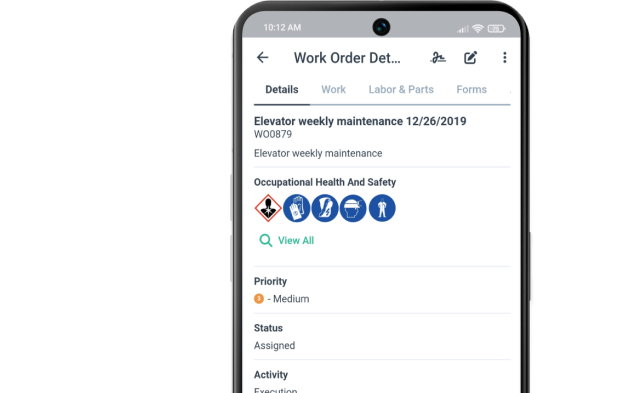
- CMMS platforms like WorkTrek make it easy to store criticality scores, automate preventive maintenance, and track critical assets.
Not all equipment is created equal. Some assets can fail without slowing production. Others can bring an entire facility to a halt in seconds.
The problem is that most maintenance teams treat every asset the same way. They schedule the same intervals, apply the same resources, and hope for the best. That approach wastes time, drains budgets, and leaves the most critical equipment exposed.
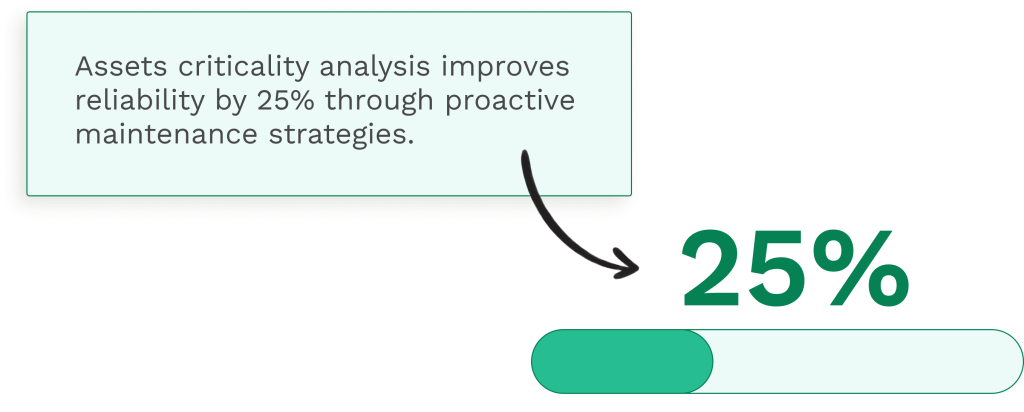
The equipment criticality assessment matrix fixes that.
It is designed to help maintenance managers rank every asset by its failure risk and business impact. That ranking drives smarter decisions about where to focus maintenance efforts, how to allocate resources, and which maintenance strategies to apply.
This article explains what the matrix is, why criticality analysis matters, how to build one, and how a CMMS like WorkTrek makes the entire process more effective.
📊 $1.4 Trillion lost annually to unplanned downtime by Fortune 500 companies
— Siemens True Cost of Downtime 2024
What is Equipment Criticality?
Equipment criticality refers to the level of impact a piece of equipment has on safety, production, and business operations when it fails. A high-criticality asset is one in which an equipment failure causes serious and immediate consequences. A low-criticality asset can fail without a significant operational impact.
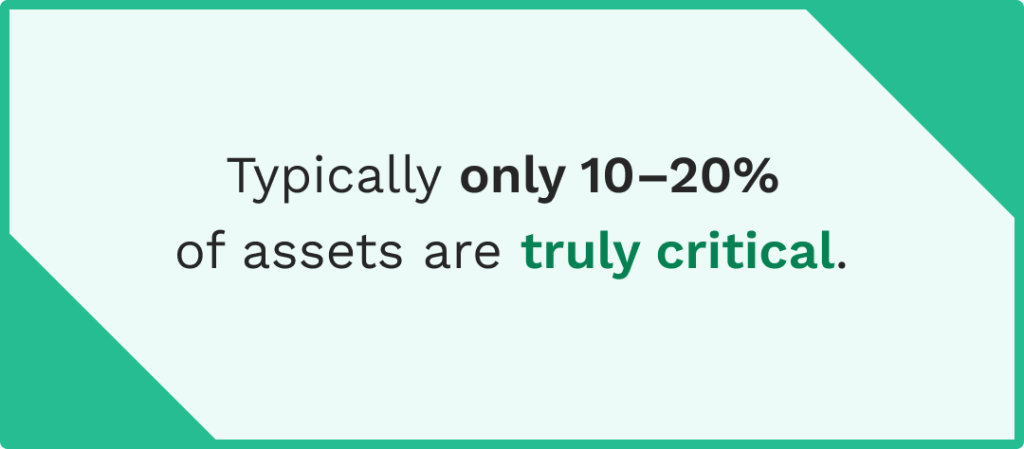
Asset criticality is not a fixed label. It is a calculated score based on several factors that your team evaluates together. Those factors typically include:
- Safety risks to personnel and the environment if the equipment fails
- Production impact and the extent of unplanned downtime caused by failure
- Repair costs and replacement costs associated with the asset
- Spare parts inventory availability and lead times for critical components
- Regulatory compliance requirements tied to the equipment
- Age and condition based on historical maintenance data and failure records
- Failure frequency using maintenance history and mean time between failures
Understanding asset criticality gives maintenance teams a foundation for every decision they make.
It gives them a map as to where to look first when resources are limited and which preventive maintenance tasks cannot be deferred.
What is the Equipment Criticality Assessment Matrix?
The equipment criticality assessment matrix is a structured grid that maps every asset in your facility according to two dimensions: the severity of failure consequences and the probability of failure.
When you plot these two values against each other, you get a criticality score for every asset. That score determines the criticality level and tells your maintenance team exactly how to prioritize maintenance tasks and allocate resources.
The matrix is not just a spreadsheet exercise.
It is the underlying foundation of a data-driven maintenance program.
It connects asset-criticality analysis to your maintenance strategies, preventive maintenance schedules, spare parts inventory decisions, and overall resource allocation.
The Risk Matrix: How It Works
The criticality matrix uses a simple scoring system. Each asset gets a severity rating and a probability rating. Multiplying the two produces a risk priority number. That number places the asset in a criticality tier.
Here is a standard 4×4 equipment criticality assessment matrix:
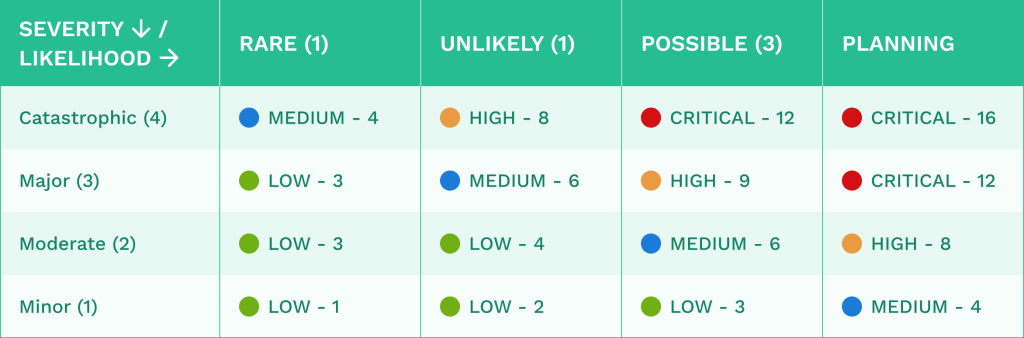
Illustration: WorkTrek | Equipment Criticality Assessment Matrix (Severity × Probability)
Assets in the red zone need immediate attention.
They carry high criticality and require proactive maintenance strategies such as predictive maintenance or reliability-centered maintenance. Assets in the green zone can be managed with basic scheduled maintenance or a run-to-failure approach.
Why Criticality Analysis Matters
Maintenance teams are under constant pressure to do more with less.
A 2024 MaintainX report found that 45% of maintenance leaders cite a lack of resources as their biggest challenge. At the same time, 69% of plants experience unplanned downtime at least once a month.
Criticality analysis helps solve both problems. It tells maintenance teams where to focus their efforts so resources go to the assets that matter most. It also reduces the risk of critical failures by ensuring that high-criticality equipment receives the right level of attention.
Without a criticality assessment, maintenance is reactive by default. Teams respond to whatever breaks first rather than protecting what is most important. That approach costs far more in the long run.
Industry Data: According to Siemens’ True Cost of Downtime 2024, the average large manufacturing plant loses $253 million per year to unplanned downtime. The average hourly cost per incident now exceeds $25,000 for most facilities and can reach $2.3 million per hour in automotive manufacturing.
A structured criticality analysis process prevents that cost by directing preventive maintenance tasks to the equipment that actually needs them. Less critical equipment gets appropriate maintenance strategies. Most critical equipment gets the protection it deserves.
Criticality analysis also supports reliability-centered maintenance (RCM) and overall asset management programs. It gives maintenance teams a common language for prioritizing work orders, allocating budget, and making capital investment decisions.
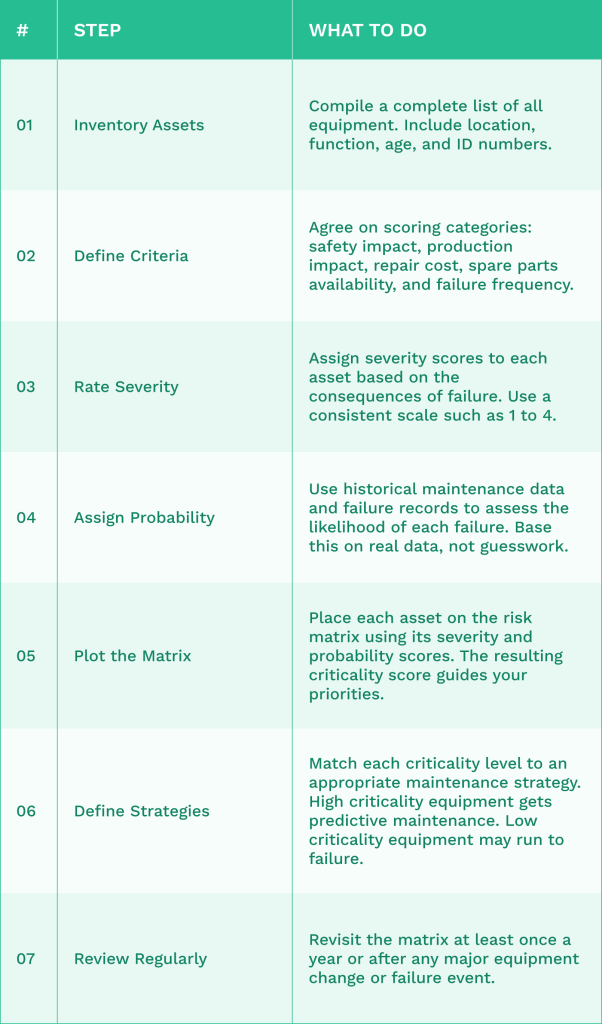
How to Conduct a Criticality Analysis: Step by Step
Performing criticality analysis does not require advanced software or months of data collection. It requires a structured approach, a cross-functional team, and honest input from the people who know the equipment best.
Who Should Be on the Cross-Functional Team?
The best criticality assessments include input from multiple departments. Maintenance personnel bring knowledge of failure modes and repair history. Operations managers understand production impact. Safety officers flag safety risks. Engineers provide technical insight into failure probability.
Assessing equipment criticality as a team reduces subjectivity and ensures that criticality scores reflect real operational priorities rather than individual assumptions.
What Data Do You Need?
The most reliable criticality scores come from real data.
Pull maintenance records and work order history from your CMMS. Review failure events and patterns. Check repair costs and replacement costs. Look at spare parts lead times.
If historical maintenance data is limited, use expert judgment as a starting point. Then refine the scores as you collect more information over time.
Factors That Affect Criticality Scores
Every organization defines its own criteria. But most criticality assessments evaluate the same core categories. Here is how each factor shapes the final criticality ranking:
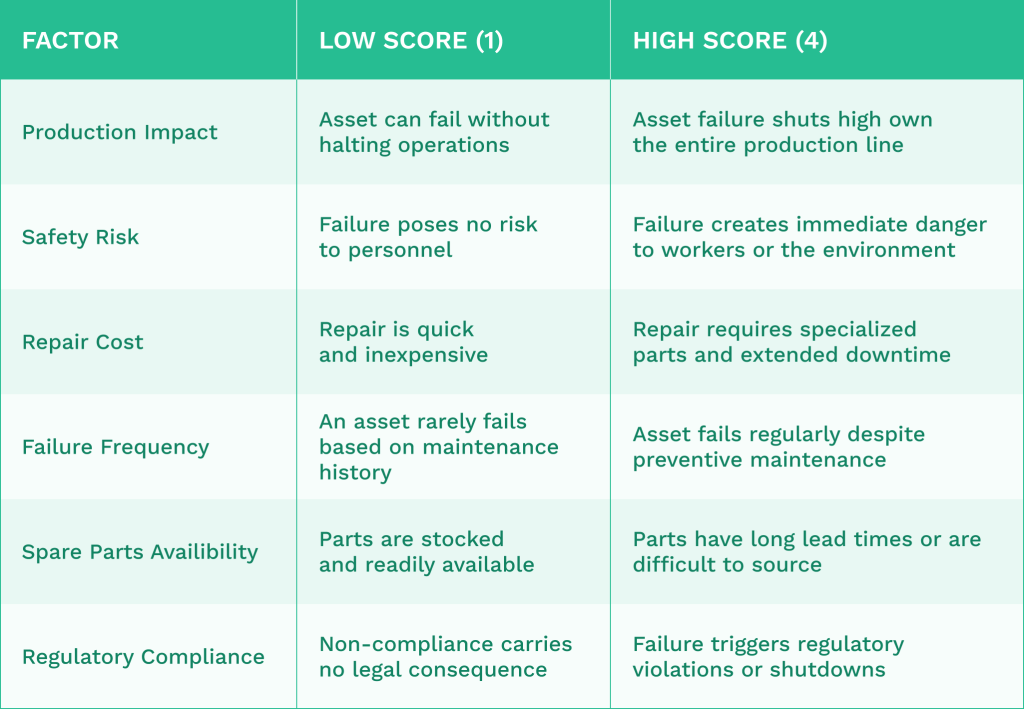
Once you assign scores across all categories, you add or multiply them to produce a composite criticality score for each asset. Many teams use a weighted system to emphasize the factors most relevant to their operations.
Matching Criticality Levels to Maintenance Strategies
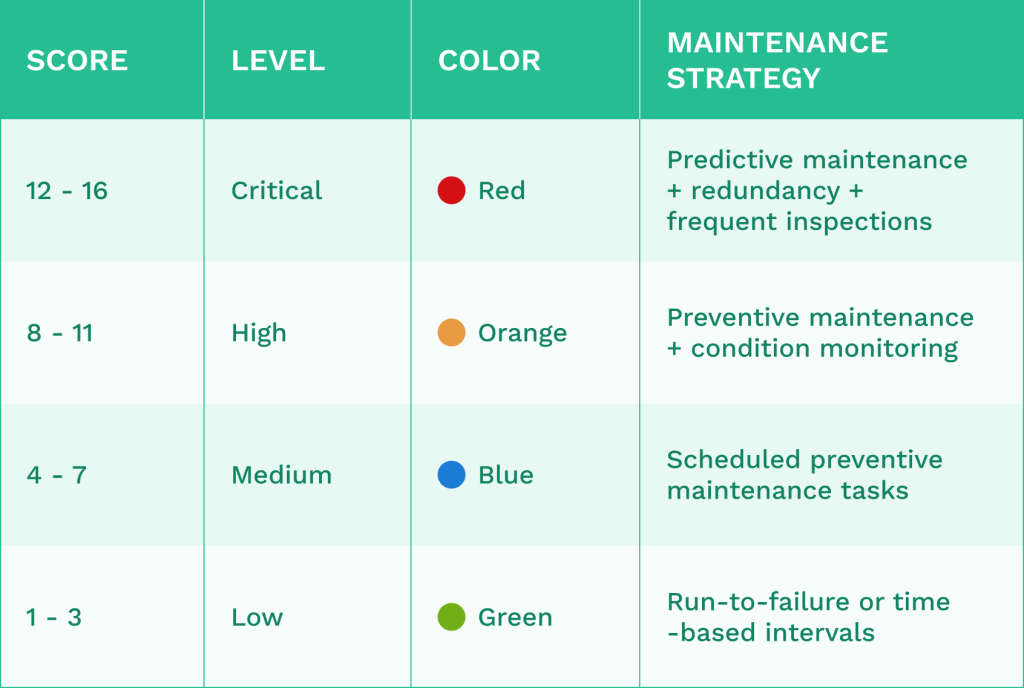
The criticality analysis process is only valuable if it changes how you maintain equipment. Different criticality levels demand different maintenance strategies. Here is how to match them:
Critical Equipment (Score 12 to 16)
High-criticality equipment receives the most intensive attention. Apply predictive maintenance using real-time condition monitoring. Add redundancy where possible. Schedule frequent inspections and ensure critical spare parts are always in stock. Never defer maintenance on these assets.
High Criticality Equipment (Score 8 to 11)
These assets need strong preventive maintenance programs with clearly defined intervals. Use condition monitoring to catch early signs of degradation. Build your maintenance schedule around these assets and do not let work orders slip.
Medium Criticality Equipment (Score 4 to 7)
Schedule regular preventive maintenance tasks based on manufacturer recommendations and usage data. Monitor performance trends, but do not over-invest in redundancy or advanced monitoring tools.
Less Critical Equipment (Score 1 to 3)
Run-to-failure or time-based maintenance intervals are acceptable. Revisit these assets periodically to confirm that their low criticality rating remains accurate. Operational conditions change over time.
Common Mistakes When Assessing Equipment Criticality
Many maintenance teams run into the same problems when they first conduct a criticality analysis. Knowing these pitfalls in advance helps you avoid them.
- Scoring based on opinion rather than data. Pull maintenance records and failure history before assigning criticality scores. Gut feel leads to inconsistent rankings.
- Including only maintenance personnel. A cross-functional team produces more accurate scores. Operations, safety, and engineering all have relevant perspectives.
- Treating the matrix as a one-time exercise. Equipment conditions change. New assets get added. Failure modes evolve. Review and update criticality scores at least annually.
- Ignoring failure modes entirely. Identifying failure modes for each asset makes the probability scoring more accurate and the maintenance strategy more targeted.
- Skipping the connection to maintenance planning. A criticality matrix that does not change maintenance schedules or resource allocation provides no value. The output must drive real decisions.
How a CMMS Supports Criticality Analysis
Running a criticality analysis manually is possible, but it is slow and prone to error. A CMMS makes the entire process faster, more accurate, and more actionable. Here is how it helps at each stage.
| CMMS Capability | How It Supports Criticality Analysis |
|---|---|
| Asset Register | Store criticality scores, failure history, and condition data for every asset in a central location. |
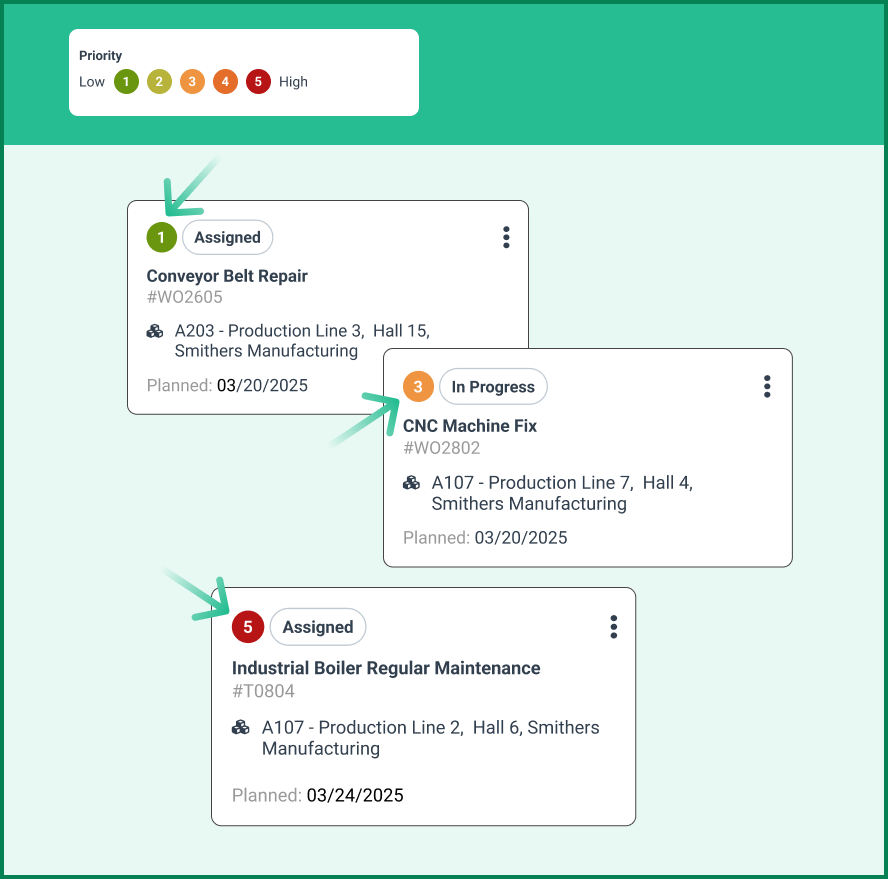
| Work Order Management | Automatically prioritize work orders based on asset criticality. High criticality equipment generates urgent orders. |
| Preventive Maintenance Scheduling | Build maintenance schedules tied to each criticality level. Critical assets get frequent, automated PM triggers. |
| Maintenance Records | Historical maintenance data feeds directly into probability scoring for future criticality reviews. |
| Spare Parts Inventory | Track critical spare parts by asset. Ensure high criticality equipment always has the parts it needs available. |
| Reporting and Analytics | Monitor equipment performance trends and KPIs like MTTR and MTBF to refine criticality scores over time. |
A 2024 UpKeep survey found that 65% of companies now use a CMMS to manage maintenance activities. Teams using CMMS platforms report fewer unplanned downtime events, better visibility into completed work, and stronger communication across maintenance teams.
Conclusion
The equipment criticality assessment matrix is one of the most practical tools in maintenance management.
It brings structure to a process that often relies on instinct. It tells maintenance teams exactly where to focus, which assets need the most protection, and which maintenance strategies will deliver the best results.
The data is clear. Unplanned downtime is expensive, disruptive, and largely preventable. A structured criticality analysis process helps maintenance managers stay ahead of critical failures rather than reacting to them after the damage is done.
The next step is to put it into practice. Start with your most critical assets. Assemble a cross-functional team. Use your CMMS to gather the historical maintenance data you need. Build your matrix. Then let the scores drive your maintenance plan.
If you need a CMMS that supports every step of that process, WorkTrek is ready to help.