

Blog

Operations & Maintenance
Everything You Need to Know About Maintenance Automation
You’ll learn what maintenance automation is, what tools are involved, and how it can streamline your workflows.
Key Takeaways:
Maintenance automation uses technology to streamline tasks, reduce downtime, and improve safety.
High implementation costs are the top barrier to technology adoption for 34% of organizations, but starting with a CMMS offers a low-risk entry point.
One oil & gas company saved an estimated $10 million by using predictive alerts to avoid just one failure.
Maintenance automation is becoming a strategic priority for organizations that depend on the reliability and performance of their assets.
As technology evolves and the pressure to improve efficiency grows, maintenance professionals are turning to automation to reduce manual tasks, limit downtime, and gain better control over operations.
If you are wondering why you should automate maintenance, read on as we reveal what maintenance automation involves, why it matters, and how to get started.
What is Maintenance Automation?
Maintenance automation refers to the use of technology to streamline, manage, and in some cases perform maintenance tasks with minimal human intervention.
It ranges from basic tools that automate work orders to advanced systems powered by sensors, artificial intelligence, and robotics.
Source: WorkTrek
A foundational technology in this space is a Computerized Maintenance Management System (CMMS), which centralizes all asset data, digitizes work orders, and schedules preventive maintenance.
Source: WorkTrek
Next, the Internet of Things (IoT) plays a key role in automation when combined with a CMMS or other analytics platforms.
Sensors attached to equipment can monitor conditions in real time, such as temperature, vibration, or fluid levels, and trigger alerts when values fall outside acceptable ranges.
This enables condition-based maintenance, where servicing is performed only when needed, rather than on a fixed schedule.
However, advanced CMMS platforms support both time-based and condition-based preventive maintenance, as shown in the example below:
Source: WorkTrek
As data volumes grow, artificial intelligence (AI) and machine learning are increasingly used to analyze historical and real-time equipment data.
These technologies support predictive maintenance, which forecasts equipment failures in advance.
In some industries, automation extends even further.
For example, robotics is being deployed to perform tasks in environments that are hazardous or difficult for humans to reach.
One example is the ExR-1 robot, designed to carry out safety inspections in unmanned or remote installations in the oil, gas, and chemical sectors.
Maintenance automation supported by these technologies reflects a broader shift toward data-driven, efficient, and safe operations.
This transformation is followed by strong market growth.
The global market for maintenance, repair, and operations (MRO) automation solutions is projected to grow by USD 60.91 billion between 2024 and 2029, at a compound annual growth rate of 9.8%.
Source: Technavio
Industries such as energy, manufacturing, construction, and e-commerce are leading this shift, driven by the need for greater equipment reliability and cost control.
Given the range of benefits maintenance automation offers, such strong market growth is hardly surprising.
Why You Should Automate Maintenance
Organizations that embrace maintenance automation are seeing measurable improvements in productivity, uptime, cost control, and workplace safety.
Let’s take a closer look at these benefits.
Increased Operational Efficiency
Manual maintenance processes tend to slow teams down.
Technicians spend time retrieving paperwork, traveling back and forth between job sites and offices, or updating records at the end of the day.
These routine delays add up, and Danielle Rivers, Director of Business Services at Camden Property Trust, has seen it firsthand:
“Back when we were using paper service request forms, our techs were losing 15 minutes just going to the office to get what they needed to get jobs started.
They had to print the request forms and collect the keys necessary to get into those units. (...)
Then it was back to the office again to print more request forms and gather more keys.”
Maintenance automation streamlines these steps with mobile-first digital tools.
Work order management platforms, mobile CMMS, and digital checklists provide technicians with real-time access to everything they need, directly from their phone or tablet.
Tasks, locations, asset histories, and instructions are delivered instantly, so work can start and finish faster.
Rivers sums it up:
Illustration: WorkTrek / Quote: RealPage
Through this automation, Camden Property Trust doubled the work that’s getting completed.
Efficiency also improves at the planning level.
Predictive maintenance, a key part of automation, uses real-time data to anticipate issues, which simplifies scheduling and planning.
According to Deloitte, predictive systems can reduce maintenance planning time by up to 50%.
Illustration: WorkTrek / Data: Deloitte
Instead of reacting to failures, teams can plan work earlier, avoid conflicts, and keep operations efficient.
Importantly, this approach also improves uptime by as much as 20%, according to the same report, which leads directly to the next major benefit.
Reduced Equipment Downtime
When equipment goes down unexpectedly, work slows down or stops entirely.
Downtime drains productivity, disrupts schedules, and can cause ripple effects across production lines.
Maintenance automation prevents many of these disruptions before they happen.
Predictive systems continuously monitor equipment health and send alerts at the early signs of failure.
At Yaskawa America, a robotics manufacturer, this kind of monitoring is a core part of their strategy, says Tom Stocker, Director of North American Sales:
Illustration: WorkTrek / Quote: ARMO Tool
But the impact goes beyond the machines themselves.
Downtime affects people, too.
Adam Coulston, former Automation Department Manager at ARMO Tool, a precision tooling and automation provider, noted the internal strain it causes:
“When employees are constantly being pulled from elsewhere to ‘fight fires,’ that erodes the innovation mindset and motivation.”
There’s also the risk of “line starvation.”
When one part of the production line is down, later stages can still operate, but only for a while.
Once backup inventory runs out, the entire process stalls.
Restarting everything takes time, even after the issue is fixed, especially if documentation, parts, or approvals are missing—another gap that automation can close.
Digital systems centralize manuals, parts inventories, and service histories, helping teams resolve issues faster and avoid unnecessary delays.
Additionally, the financial impact of downtime is often massive.
According to Siemens’ True Cost of Downtime report, one hour of downtime at a large automotive plant can cost up to $2.3 million.
Source: Siemens
Avoiding these disruptions is one of the most immediate ways maintenance automation delivers value—by helping teams detect problems early, respond quickly, and keep critical equipment running.
Cost Savings
Maintenance automation reduces costs in several key ways.
First, it reduces asset downtime and helps avoid expensive emergency repairs.
When equipment issues are detected early, teams can intervene before the problem escalates, reducing the need for urgent service calls, overtime labor, or last-minute part replacements.
Consider the case of one oil and gas supermajor that used SparkCognition’s Industrial AI Suite to evaluate maintenance automation across its offshore platforms.
The solution analyzed historical data from a separator system prone to failure and built AI models that predicted 75% of historical failures, on average, nine days before they would have occurred.
Following these results, the system was scaled across multiple platforms.
Predictive alerts, combined with 10-minute diagnostics and remote monitoring, helped prevent costly disruptions.
One of them was a faulty temperature sensor on a critical export compressor.
Thanks to early detection, they scheduled maintenance in time, avoiding up to two days of asset staging and an estimated $10 million in deferred production losses.
According to the company’s internal projections, full deployment of this solution could save up to $800 million annually across their fleet.
Illustration: WorkTrek / Data: Plant Services
These kinds of results show how maintenance automation helps avoid costly breakdowns, but savings don’t end there.
Automation also promotes energy efficiency.
Well-maintained machines run more smoothly and use less power, which lowers utility costs and reduces environmental impact. Over time, these small efficiency gains add up.
Additionally, automation systems improve inventory management.
Instead of stockpiling parts “just in case,” organizations can track usage trends and condition data to order only what’s needed, when it’s needed.
A CMMS like WorkTrek, allows you to assign spare parts to work orders. Once tasks are completed, the system automatically deducts the used parts from the inventory.
You can set thresholds, and when inventory levels fall below those limits, the system sends a notification so parts can be reordered in time.
Source: WorkTrek
This reduces carrying costs while ensuring that critical components are readily available when needed.
All in all, by preventing breakdowns, optimizing maintenance schedules, and eliminating wasteful spending, maintenance automation offers a direct path to substantial long-term savings.
Improved Safety
Maintenance automation improves workplace safety.
Predictive systems detect warning signs before equipment fails, reducing the risk of sudden breakdowns that could endanger personnel.
When issues are identified early, maintenance can be scheduled and performed under safer, controlled conditions.
Moreover, robotics and remote monitoring technologies allow inspections in hazardous or hard-to-reach areas to be carried out without exposing workers to risk.
For example, the previously mentioned ExR-1 robot can perform inspections in explosive environments (either autonomously or via remote control over a 4G/5G connection), thereby reducing the need for human presence in hazardous zones.
Source: Petro Online
IoT-based monitoring also enhances site safety.
Combined with prediction systems and machine learning, this technology can predict ground vibration levels during surface mine blasting operations, enabling crews to work at a safer distance and reducing the risk of accidents.
Even standard automation tools like a CMMS contribute.
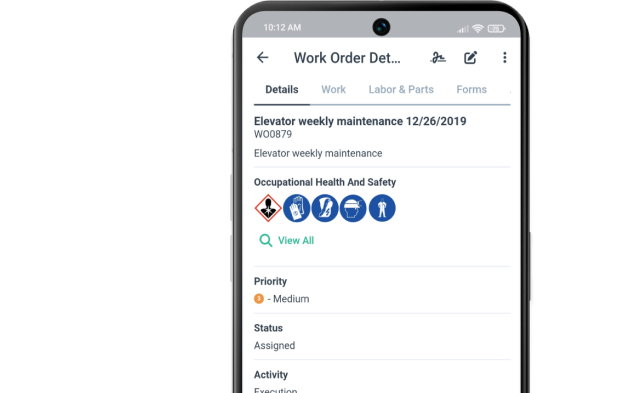
Technicians can instantly access safety protocols, handling instructions and hazard information at the point of need, eliminating guesswork, and helping them work more safely and efficiently.
Source: WorkTrek
Taken together, these technologies reduce risk exposure, prevent accidents, and support a safer working environment.
Maintenance Automation Challenges
While maintenance automation delivers clear benefits, implementing it is not without obstacles.
Like any technological shift, it requires investment, planning, and cultural alignment.
The following challenges are among the most common that organizations face when moving toward automated maintenance.
Implementation Cost
Automating maintenance can be expensive, particularly at the outset.
It often requires a combination of hardware, software, connectivity upgrades, and workforce training.
Key costs may include:
Hardware, such as IoT sensors, gateways, and edge devices, is used to collect and transmit machine data.
Software platforms for condition monitoring, predictive analytics, or asset performance management.
Integration with existing systems, especially if legacy equipment is involved.
Training for maintenance teams, IT staff, and system users.
However, getting started doesn’t always require a massive budget.
For many organizations, a CMMS offers a cost-effective entry point.
These platforms offer flexible pricing models, such as subscription-based plans, per-user licensing, or feature-based tiers, which allow companies to scale according to their needs and resources.
A modern CMMS can deliver immediate value by digitizing work orders, centralizing asset data, and creating the foundation for more advanced automation later.
Still, cost remains a concern for many.
According to the State of Facilities Management Report 2025 by SFG20, 34% of organizations identify high implementation costs as the top barrier to adopting new technologies.
Illustration: WorkTrek / Data: SFG20
Without a clear ROI or phased strategy, many companies hesitate to make the initial investment, even when the long-term savings are evident.
Data Security Risk
The introduction of networked sensors and cloud-based systems increases an organization’s digital footprint, and with it, vulnerability to cyber threats.
As systems become more interconnected, attackers gain more entry points.
Zscaler’s 2023 ThreatLabz report found a 400% increase in malware targeting IoT devices over the year before, with the manufacturing sector accounting for 54.4% of those attacks.
But IoT isn’t the only area at risk.
In April 2023, software provider Brightly confirmed that attackers had breached its widely used SchoolDude platform, stealing data from nearly three million accounts.
Source: TechCrunch
This cloud-based maintenance system was popular among schools and universities for submitting and tracking work orders.
The breach exposed usernames, email addresses, and unencrypted passwords, underscoring how even widely adopted maintenance software can become a cybersecurity liability when not properly secured.
Source: Reddit
These risks underline the importance of secure system architecture, regular software updates, strong authentication practices, and staff awareness training.
Automation can enhance performance, but without adequate cybersecurity measures, it may also introduce new operational risks.
Integration with Legacy Systems
Many industrial facilities still rely on older machines and systems that were never designed with automation or connectivity in mind.
These legacy assets often lack built-in sensors or digital interfaces, making integration with modern tools complex and, in some cases, prohibitively expensive.
Retrofitting such equipment can require:
Custom hardware adaptations, such as sensor installations or PLC upgrades
Middleware or software bridges to enable communication between old and new systems
Specialist expertise to ensure safe and effective implementation
Even with these solutions, some machines may remain incompatible.
As a result, organizations must decide whether to partially digitize their operations, replace outdated assets, or delay automation altogether—each option comes with its own set of costs and complexities.
The report by SFG20 also revealed that 19% of organizations identify integration with existing systems as their primary challenge to adopting new technologies.
Illustration: WorkTrek / Data: SFG20
Additionally, 31% of respondents still manage their asset registers in spreadsheets, highlighting a continued reliance on manual or outdated tools that don’t support automation.
Disconnected systems reduce the effectiveness of automation.
If machines and platforms can’t communicate, organizations can’t obtain a comprehensive view of asset health, maintenance needs, or performance trends.
Employee Resistance
Even when the right systems are in place, automation efforts can stall due to human resistance.
For many employees, automation raises concerns about job security, unfamiliar workflows, or added complexity.
These perceptions—whether accurate or not—can slow adoption or lead to disengagement.
The SFG20 report found that 17% of companies encounter employee resistance as a barrier to implementing new technologies.
Illustration: WorkTrek / Data: SFG20
Concerns are particularly pronounced in hands-on roles where workers may feel technology is replacing, rather than supporting, their expertise.
According to polling data from WillRobotsTakeMyJob.com, 37% of maintenance technicians believe that maintenance machinery roles could be fully automated within the next two decades.
Source: WillRobotsTakeMyJob.com
While full automation is unlikely in the near term, this kind of projection feeds anxiety and highlights the need for clear communication and inclusive change management.
Successful organizations counter this resistance by:
Involving frontline staff early in the process
Demonstrating how automation enhances their work
Investing in upskilling and training to give employees new capabilities
Ultimately, maintenance automation is most effective when it empowers teams, not when it’s perceived as a replacement.
How to Automate Your Maintenance
Automating maintenance does not require a complete system overhaul from the outset.
A practical and sustainable approach is to begin with digitization, focusing first on areas where manual processes are most time-consuming and prone to error.
For example, you might start by automating:
Preventive maintenance scheduling
Routine work order creation
Task management
Inventory tracking
These are often the areas where inefficiencies are most visible, and where even small improvements can deliver immediate results.
All of these tasks can be automated using a CMMS like WorkTrek.
Whether you choose a cloud-based or on-premise deployment, WorkTrek provides a solid digital foundation to centralize asset data, schedule preventive maintenance, manage work orders, and track spare parts.
All in one platform.
Source: WorkTrek
This eliminates paper-based workflows and improves visibility without causing major disruption.
According to a 2024 report from the Institution of Mechanical Engineers, 62% of organizations now use a CMMS to manage their maintenance operations.
Illustration: WorkTrek / Data: Institution of Mechanical Engineers
Once this foundation is in place, you can gradually expand automation by adding IoT sensors or condition monitoring tools.
These enable real-time data collection, allowing maintenance to be triggered based on actual asset conditions rather than fixed schedules.
As your system matures, predictive analytics and AI models help detect early signs of failure and support more effective intervention planning.
Employee involvement remains critical throughout implementation.
Providing hands-on training, gathering feedback, and clearly communicating automation’s benefits help ease adoption and reduce resistance.
Maintenance teams are far more likely to embrace new tools when they understand that automation supports—not replaces—their expertise.
With the right platform and a phased approach, you can automate maintenance efficiently and realistically, no matter where you start.
Conclusion
Maintenance is no exception to the growing wave of digitization and automation across industries.
Organizations that embrace it gain a clear advantage, from streamlining routine tasks to predicting failures and improving safety.
As with any digital transformation, the key is to start smart, build momentum, and bring your people along for the journey.
Whether you're digitizing work orders or deploying AI-driven diagnostics, every step toward automation strengthens your operations and your bottom line.
The tools are ready, and their benefits have been proven.
Now is the time to take the first step.
Facility Management
Top Tech Tools for Commercial Property Maintenance
Managing commercial properties these days is a juggling act. Thankfully, technology is finally catching up to make it a whole lot less stressful.
Illustration: WorkTrek / Data: 99firms
The best new tools enable property managers to track repairs, schedule maintenance, communicate with tenants, and sometimes even predict issues before they arise.
That means less wasted time, lower costs, and fewer headaches for everyone.
Maintenance technicians now cover everything from simple request apps to complex systems that monitor equipment and analyze performance data in real-time.
With mobile access, managers and techs can jump on issues as soon as they hear about them—no more running back and forth to the office.
Top platforms help you stay organized and compliant, dodging expensive mistakes that nobody wants to deal with.
Key Takeaways
Tech tools streamline maintenance management and tracking, saving money.
Mobile and smart solutions improve response time and communication.
Data and automation lead to better efficiency and fewer breakdowns.
Essential Maintenance Management Software
Property maintenance teams are under pressure to be faster, more accurate, and more efficient than ever.
Many building managers now utilize maintenance management software to manage work orders, schedule preventive maintenance, and track repairs and costs.
Overview of Maintenance Management Solutions
Commercial properties rely on a bunch of different software options to make life easier.
Computerized maintenance management systems (CMMS) help organize and automate repair requests, track schedules, and store records in one centralized location.
With a robust CMMS system, owners and managers have complete visibility into all tasks and updates.
This can help teams respond more quickly to tenant needs and minimize the likelihood of missing important fixes.
Key Features of Leading Platforms
So, what makes maintenance software useful? Here’s what usually matters most:
Work Order Tracking: Staff can create, assign, and update requests instantly.
Preventive Maintenance Scheduling: Routine checks and servicing keep equipment from breaking down.
Asset Management: You receive a comprehensive history of all your major equipment.
User-Friendly Interfaces: Clean dashboards and simple menus mean less training for everyone.
Mobile Access: Update the status from anywhere—no need to run back to the office.
Many platforms also offer built-in messaging, document storage, and budgeting tools. When considering a platform, evaluate customer support, since that can be a lifesaver for setup and troubleshooting.
Beyond CMMS
CMMS is an invaluable tool for managing work orders, scheduling tasks, and performing preventive maintenance.
However, if you are looking for a dedicated facility management tool that also handles leasing, online rent payments, financial reporting, and payments, consider products such as Buildium or Yardi.
Illustration: WorkTrek / Data: doorloop
This category of commercial property management software can also integrate with your ERP system and handle some of these tasks. Some of these products can also manage financial tasks such as depreciation and offer accounting tools.
The downside to this software category is cost. They are primarily designed for very large property management operations.
If you are a small to medium-sized property management company, consider using CMMS software to manage costs and enhance operational efficiency.
Selecting the Right Software for Your Needs
Choosing the right software largely depends on your property size, team experience, and the specific features you need.
Consider whether you manage a single property or multiple properties. There are also distinct differences between managing commercial properties vs residential ones.
Begin by creating a list of must-haves to identify which platforms meet those requirements.
If your team isn’t super techy, look for something with a simple interface. You don’t want people fighting with the software more than with the actual maintenance work.
Responsive customer support is a big deal. Quick answers and solid assistance during setup can save you a significant amount of frustration.
Don’t forget to consider pricing, scalability, and whether the software integrates seamlessly with your other tools, such as accounting programs.
You want something that’ll grow with you as your property needs change with new business growth opportunities.
Work Order and Request Management Tools
Modern maintenance tools have significantly transformed the way requests are organized, work orders are created, and real-time communication is enhanced between managers, tenants, and vendors.
Illustration: WorkTrek / Data: Accurent
These systems make it much easier to control costs, schedule repairs, and cut downtime.
Automated Work Order Systems
Automated work order systems enable managers to create, assign, and track jobs efficiently, eliminating the need for extensive paperwork.
These platforms support custom rules and workflows, allowing tasks such as scheduling, approvals, and reminders to occur almost automatically.
Platforms like WorkTrek, Limble, and Upkeep help you track assets, monitor tech performance, and log spare part usage.
WorkTrek can even auto-assign work based on urgency or skill set, which keeps things moving and avoids delays.
Automated tracking makes audits less painful for commercial property owners and managers.
Managers can see open and closed work orders at a glance, so requests don’t get lost in the shuffle. Reports highlight trends, enabling you to tackle recurring issues and allocate your budget more effectively.
Streamlining Maintenance Requests
Work order tools make it dead simple for tenants and staff to submit service requests. Most have online portals or mobile apps that allow users to report problems, upload photos, and check the status at any time.
When considering a CMMS platform for your property, consider solutions like WorkTrek that do not charge license fees to users who report tickets.
These systems categorize and prioritize requests based on urgency. No more lost emails or phone tag—everything’s tracked in one spot, which means faster responses.
Real-Time Updates and Communication
Property management software solutions with alerts and real-time updates keep everyone informed and up-to-date.
Managers, technicians, and tenants receive instant alerts when jobs are assigned, started, delayed, or completed. That helps set expectations and avoid confusion for commercial property owners.
Built-in messaging and automatic notifications are also part of the property management tools available in a CMMS platform.
Some platforms allow file sharing and time-stamped comments, enabling you to follow the entire story of each request.
Preventive and Predictive Maintenance Solutions
Property managers utilize maintenance software to manage equipment care, reduce repair costs, and keep buildings running smoothly. These tools help plan maintenance, catch issues early, and stay organized with reminders and real-time alerts.
That means less stress, lower expenses, and longer equipment life—pretty much a win for everyone.
Scheduling Preventive Maintenance Tasks
Preventive maintenance ensures that equipment and building systems remain in good working order before issues arise.
Source: WorkTrek
Most top programs, especially modern CMMS products like WorkTrek, let you schedule tasks by calendar or trigger them based on usage.
Key features for preventive maintenance:
Custom task lists
Automatic work order creation
Assignment tracking
Digital checklists
These features help teams plan and keep a solid maintenance history. Most programs show upcoming and past tasks in easy-to-read tables. Detailed logs enable staff to see what has been fixed, how often, and what is next on the list.
Predictive Maintenance Technologies
The future of property management technology lies in predictive maintenance. This comprehensive technology utilizes data from repair histories and smart IoT devices to help predict equipment issues.
Benefits?
Spotting performance before equipment failure
Less downtime
Lower long-term costs
Improved efficiency
Valuable insights
Automated Reminders and Notifications
Most modern maintenance programs have automated reminders and notifications to help track maintenance tasks.
These appear as emails, texts, or push notifications on your phone. They help teams remember inspections or repairs and alert them to urgent problems.
Source: WorkTrek
How people use them:
Reminding staff about scheduled maintenance
Notifying managers about overdue work
Alerting crews when sensors spot an issue
Mobile Access and Apps for Property Maintenance
Maintenance staff these days are leaning on mobile access to get stuff done faster.
Mobile apps, along with customization and branding, are now among the top reasons property managers choose modern tools, particularly in the commercial sector.
Mobile Apps
Mobile apps designed for property maintenance enable field teams to work efficiently while they're out in the field.
Workers can quickly get job notifications, check off task lists, upload repair photos, and chat with tenants or supervisors.
Real-time messaging inside these apps keeps everyone on the same page. Task statuses update immediately, so nobody wastes time double-checking or missing jobs.
Push notifications mean staff won't miss urgent news.
Teams can create checklists for routine tasks, mark them as complete, and review their work history later if needed.
User Experience and Customization
When evaluating solutions for your property management portfolio, consider the overall ease of use and user experience of the software.
The best mobile apps have clean layouts and simple navigation, so users don't have to hunt for buttons or information.
Illustration: WorkTrek / Data: Enozom
Fast load times and clear menus help users complete tasks with fewer errors. Another feature to look for is offline access, allowing users to complete work orders even without an internet connection.
Managers can adjust workflows, create custom forms, and select which notifications appear. Look for software solutions that allow you to create custom maintenance checklists easily.
Analytics and Performance Insights
Analytics tools are a game-changer for commercial property teams seeking to make more informed decisions.
They track building operations, monitor costs, and identify areas where improvements can be made.
Advanced Analytics and Reporting
Advanced analytics sift through data from across the board to identify trends in property maintenance.
By examining equipment performance, work order completion, and tenant feedback, managers can identify and address problems before they escalate.
Source: WorkTrek
Key benefits of advanced analytics:
Automates data collection
Highlights the root causes of problems
Supports proactive maintenance strategies
Offers clear, easy-to-understand visuals and graphs
Integration of IoT and Smart Technologies
IoT and smart technology are increasingly being utilized in commercial property maintenance. These tools help track building operations, automate responses, and reduce wasted time and costs.
IoT Applications in Property Maintenance
IoT devices provide property managers with real-time information about building systems. Smart sensors monitor HVAC, lighting, and water usage.
With IoT, building owners can respond quickly to equipment issues, leaks, or unusual temperature fluctuations.
Illustration: WorkTrek / Data: facilio
Many commercial real estate properties utilize smart thermostats and automated lighting controls to conserve energy.
Sensors also monitor humidity, occupancy, and air quality, helping keep spaces safe and comfortable.
Real-Time Monitoring and Automation
Real-time monitoring provides maintenance teams with instant alerts when an issue arises. Instead of waiting for complaints or conducting routine checks, smart sensors report problems, such as failing HVAC units or leaks, as soon as they occur.
This speeds up repairs and prevents small issues from escalating into major headaches.
Automation allows simple tasks—such as adjusting the temperature or turning off lights—to occur on a schedule or when sensors detect changes.
Management can establish rules to ensure systems only use energy when necessary. Automated alerts mean teams get to problems quicker and handle work more efficiently.
Utilizing real-time updates and automation can reduce costs, minimize downtime, and enhance tenant satisfaction.
Compliance Management
Modern commercial property maintenance relies heavily on compliance management and solid health and safety routines.
The right tech tools help everyone stay up to date with changing regulations and keep both teams and tenants safe.
Meeting Regulatory Compliance
Facilities have to stick to fire codes, OSHA standards, and environmental laws.
Source: WorkTrek
Digital compliance management tools enable managers to stay organized and manage reporting more effectively.
With these tools, managers can set up automatic inspection schedules and retrieve records for audits quickly.
Software keeps track of deadlines and sends alerts, ensuring that inspections and updates are not missed.
Most systems store digital records, so all the necessary paperwork is readily available when needed. Some even spit out automated compliance reports for auditors, which cuts down on busywork.
Ensuring Health and Safety Standards
Technology now helps make workplaces safer by flagging potential problems. Maintenance teams can deploy digital checklists and mobile apps as part of their CMMS solution to identify hazards such as leaks, electrical issues, or malfunctioning equipment.
These tools track how quickly repairs are completed, so risks don't linger.
Sensors for air quality, temperature, and water leaks can alert staff if something is off.
Work order systems can ensure that individuals confirm they've followed safety steps, ensuring every job meets the required standards.
Popular Software Solutions in the Market
Commercial property maintenance is way easier with software that works. The CMMS tools below have features for work order management, preventative maintenance, and communication that actually feels smooth.
WorkTrek
WorkTrek positions is a user-friendly and modern CMMS platform that emphasizes streamlined workflows and operational transparency. The product focuses on transforming complex maintenance tasks into efficient processes that reduce resolution times and eliminate bottlenecks.
WorkTrek offers integrated invoicing capabilities that generate bills directly from work orders, eliminating the need for separate Word and Excel documents.
A key differentiator is the use of digital compliance and safety forms that replace paper checklists, helping to prevent incidents and reduce compliance risks.
The platform offers comprehensive asset tracking, providing instant visibility of tool and equipment locations, whether in warehouses or with field technicians.
WorkTrek has extensive experience working with facility management, plant operations, and field service organizations seeking straightforward maintenance management with strong mobile capabilities and built-in invoicing functionality.
eMaint
eMaint is a cloud-based CMMS, EAM, and IIoT platform that focuses on connecting hardware and software to maximize uptime and boost reliability. T
he platform serves over 150,000 users across 116 countries and integrates with 1000+ applications. Key strengths include enterprise-level asset lifecycle management, multi-site operations support across different languages and currencies, and seamless integration with Fluke sensors and SCADA systems.
eMaint excels in predictive maintenance capabilities and offers robust reporting for audit compliance. The platform is particularly well-suited for large enterprises that require comprehensive asset management with IoT connectivity and standardized maintenance strategies across multiple locations.
Limble CMMS
Limble positions itself as a user-friendly CMMS that emphasizes team adoption and customer success, with response times under 60 seconds. The platform places a strong emphasis on preventive maintenance automation and provides dedicated success managers for implementation guidance.
Limble offers SOC 2 Type II compliance and robust security features, making it an ideal solution for enterprises that require strict data protection. Their strength lies in multi-site operations management, ERP and IoT integrations, and streamlined workflows.
The platform is designed to reduce operational costs while maintaining peak production efficiency, particularly for manufacturing, hospitality, and multi-location facilities requiring standardized maintenance processes.
UpKeep
UpKeep has been around for a while, emphasizing mobile-first maintenance management and real-time insights for smarter operations. The platform offers a unique "Pledge" program providing dedicated implementation support and 24/7 assistance via phone, SMS, or chat.
UpKeep's Asset Operations Management solution includes their Data Hub for advanced analytics and Edge IoT sensors for remote monitoring.
The platform excels in combining ease of use with modern technology, offering strong mobile capabilities and comprehensive analytics dashboards for maintenance KPIs and compliance reporting.
Fiix (Rockwell Automation)
Fiix offers robust offline capabilities, enabling work order management even without internet connectivity.
Fiix provides predictive maintenance setup in as little as two weeks, featuring AI-powered reporting with automated alerts for asset performance issues. Their parts forecaster analyzes historical data to predict inventory needs, helping avoid stockouts.
The platform excels in data visualization, offering hundreds of filtering options and seamless integrations across systems, making it particularly suitable for manufacturing and industrial facilities focused on reducing unscheduled maintenance.
Conclusion
The bottom line? Technology has completely transformed how we handle commercial property maintenance, and honestly, it's about time.
Gone are the days of sticky notes, endless phone calls, and scrambling to find that one repair receipt from six months ago.
Whether you're managing a single building or juggling multiple properties, the right tech stack can save you serious time and money while keeping tenants happy.
From simple work order apps to sophisticated IoT sensors that detect problems before they occur, there's something available for every budget and skill level.
The key is starting somewhere—even a basic CMMS can make a huge difference in how smoothly things run.
Illustration: WorkTrek / Data: Market Research Future
As your operation grows, you can always add more bells and whistles. Just remember to pick tools that your team will use, because the fanciest software in the world won't help if it's sitting there collecting digital dust.

CMMS
How CMMS Helps in Managing Maintenance Costs
Key Takeaways:
2 out of 3 organizations already use a CMMS, while others rely on pen and paper, spreadsheets, or no system at all.
CMMS adopters achieve a 20% reduction in downtime and material costs.
CMMS-enabled inventory tracking helps avoid costly delays caused by stockouts.
Maintenance teams are under constant pressure to achieve more with limited resources.
A Computerized Maintenance Management System (CMMS) is designed to support this objective.
It provides the data and tools necessary for informed decision-making, enabling everything from expense tracking to failure prevention.
Below are six ways a CMMS helps control maintenance costs.
Enables Maintenance Cost Tracking
Maintenance costs can escalate rapidly when teams lack visibility into how time, labor, and materials are allocated.
A CMMS addresses this challenge by acting as a centralized hub for tracking maintenance activities, work orders, asset condition, downtime, and related expenses.
Most modern CMMS platforms are web- and mobile-based, allowing users to input data and attach documentation from any device with internet access.
This supports real-time updates and mobile access for the entire team.
It’s no surprise that two-thirds of companies already use a CMMS to monitor maintenance operations, as UpKeep’s 2024 survey found:
Illustration: WorkTrek / Data: UpKeep
Among CMMS adopters, 35% cited increased visibility into completed work as one of the top three benefits.
This visibility comes from the system’s ability to capture detailed records of all maintenance activities in one place, enabling accurate and up-to-date cost tracking.
Technicians can log tasks, labor hours, and expenses directly from the field, ensuring that all activities are accurately recorded.
Mobile features such as the clock-in/clock-out function help track task duration and labor costs down to the minute.
Source: WorkTrek
Work log entries recorded by technicians, along with photo attachments and document uploads, provide additional context and insight into labor and parts usage.
Moreover, when creating a work order, you can add details about the expected materials, the time required for completion, and their associated costs.
Once that work order is closed, you can compare planned versus actual expenses.
Source: WorkTrek
Beyond these functionalities, a CMMS enables cost tracking through powerful analytics and reporting features.
It can aggregate all recorded data, including labor hours, parts used, and other expenses, into dashboards and customizable reports.
This enables managers to track cost trends, pinpoint inefficiencies, and make more informed budgeting decisions.
Source: WorkTrek
With all data in a single system, maintenance teams can examine specific cost drivers or assess broader spending patterns, ensuring complete visibility into how the maintenance budget is being used.
As the following sections will show, expense tracking and reporting are only one part of how a CMMS helps reduce costs.
Optimizes Preventive Maintenance
A CMMS makes preventive maintenance manageable and scalable.
It eliminates the need to rely on memory, manual logs, or scattered calendars.
This helps maintenance teams address issues before they escalate into costly emergency repairs or unexpected downtime.
Let’s have a look at how CMMS does it.
For starters, you can set up and schedule preventive maintenance (PM) tasks on any recurring basis—daily, weekly, monthly, or yearly—ensuring nothing slips through the cracks.
You can also create work orders in advance and attach SOPs, checklists, photos, and instructions for more consistent and cost-effective task execution.
Source: WorkTrek
Beyond dynamic scheduling, checklists, and time-triggered work orders, a CMMS supports meter-based preventive maintenance.
You can set specific thresholds, such as mileage, operating hours, or oil levels, and the system will generate a work order when those limits are reached.
Meter readings can be entered manually or captured in real time when integrated with IoT sensors.
Source: WorkTrek
Meter-based PM work orders enhance accuracy by basing maintenance on the actual condition of assets.
This helps prevent over-maintenance and unexpected failures, ultimately reducing repair costs and extending asset life.
Inspections also play a key role in any cost-effective PM program.
With a CMMS, field technicians can log work directly from their mobile devices using pre-filled templates, required fields, time tracking, and electronic signatures.
Source: WorkTrek
If an inspection fails, the system can automatically generate a follow-up work order, ensuring timely repairs and ongoing regulatory compliance.
Source: WorkTrek
Of course, all these PM features are made even more powerful with comprehensive reporting.
A CMMS gives you dashboards that track key metrics, including PM compliance, overdue work orders, and response times.
These insights help you identify inefficiencies, fine-tune scheduling, and ensure that PM tasks are completed on time, leading to fewer unexpected failures and improved asset performance.
Source: WorkTrek
Ultimately, the right CMMS gives you full control over your preventive maintenance program by combining automation, time- and meter-based scheduling, actionable reporting, and more.
When it comes to managing maintenance costs, these features help you extend asset life, prevent costly breakdowns, and make more informed, data-driven decisions.
Reduces Downtime Costs
By now, it’s clear that a CMMS helps prevent unexpected failures, thereby reducing costly downtime and emergency repair expenses.
It achieves this through a mix of direct and indirect capabilities, including preventive maintenance and automated work order management.
Some features, like automated alerts based on time or meter readings, directly reduce downtime by ensuring critical maintenance tasks are performed before breakdowns occur.
This is vital to avoid unplanned outages, which can be extremely costly.
Estimates range from over $2 million per hour in the automotive industry to approximately $40,000 in fast-moving consumer goods (FMCG), according to Siemens.
Illustration: WorkTrek / Data: Siemens
The downtime- and cost-reducing capabilities of a CMMS go beyond preventive maintenance.
When unexpected failures do occur, a CMMS enables users to report the issue from their mobile device quickly, complete with photos, notes, and other key details.
Meanwhile, managers can instantly review the request, generate a work order, assign it to the appropriate technician, and mark it as high priority to ensure it gets immediate attention.
Source: WorkTrek
This functionality substantially reduces response times during emergencies.
In addition to these direct downtime minimizers, a CMMS also contributes indirectly by improving maintenance planning, decision-making, and root cause analysis.
For example, users can analyze historical data and asset service logs to spot recurring patterns, such as:
Machines that fail most frequently
Typical repair durations
Parts requiring frequent replacement
With these insights, maintenance teams can fine-tune preventive maintenance schedules, stock high-risk spare parts, or even retire underperforming assets before they trigger repeated failures.
When all these CMMS-enabled strategies are combined, the result is a measurable reduction in downtime.
This is confirmed by a BusinessWire survey of over 550 company-level CMMS users that reported an average 20% decrease in equipment downtime and material costs.
Illustration: WorkTrek / Data: BusinessWire
As these findings show, managing spare parts and materials is essential to controlling costs.
Overall, a CMMS offers a comprehensive suite of features that work together to reduce downtime costs significantly.
Optimizes Inventory Spending
Maintaining the right balance between availability and overstocking of tools, parts, and materials has always been a challenge.
A CMMS simplifies this by linking inventory directly to asset records and maintenance tasks.
This integration enables accurate tracking, automated low-stock alerts, and analysis of historical usage, helping organizations manage inventory more efficiently and reduce unnecessary spending.
One immediate advantage is that both technicians and managers can view real-time stock levels at any time.
Source: WorkTrek
This easy access to real-time stock levels is invaluable for procurement planning and for improving response times and maintenance efficiency, as it directly contributes to lower downtime and reduced maintenance costs.
The importance of having the right parts on hand can’t be overstated.
Jeff Shiver, CEO of People and Processes Inc., explains why:
“Studies have shown as much as 32% of downtime was related to not having the right parts and materials in the storeroom.”
In other words, poor inventory management is the primary cause of nearly one in three repair delays.
A CMMS addresses this with automated inventory tracking and low-stock notifications.
As shown below, in a CMMS like WorkTrek, you can set minimum stock levels for any inventory item.
Source: WorkTrek
Then, technicians are instructed to log usage directly in the app, allowing the system to maintain accurate, real-time inventory counts.
When supplies fall below the set threshold, the CMMS automatically alerts the manager.
Altogether, these features help control inventory spending by streamlining restocking, improving procurement timing, and ensuring critical tools, parts, and materials are available when needed.
Provides Cost Insights for Smarter Decisions
Understanding the true cost of maintenance and how those costs are distributed is essential for effective budget control and informed decision-making.
A CMMS provides this visibility by tracking every expense tied to an asset or task, including labor hours, parts used, and any additional charges.
Source: WorkTrek
Over time, this information forms a detailed record of asset performance and maintenance spending.
With these insights, maintenance teams can perform repair vs. replace analysis based on actual historical costs rather than estimates.
For example, if an older machine frequently breaks down, the CMMS can show how its cumulative maintenance costs compare with the cost of replacing it with a newer, more efficient model.
Lifecycle costing also becomes more manageable when all historical data is consolidated in one system.
Teams can review total ownership costs and develop more accurate budget forecasts.
Source: WorkTrek
This cost transparency also supports regular asset performance assessments.
Managers can compare equipment across locations or against industry standards to identify underperforming assets, frequently replaced components, and potential areas for cost savings.
On a broader level, CMMS-generated data informs long-term maintenance budgeting.
By reviewing spending patterns, such as increases in repair costs, recurring issues with specific assets, or seasonal fluctuations, teams can adjust maintenance strategies, justify investment requests, and minimize the risk of budget overruns.
This level of insight is particularly important when considering how much maintenance contributes to overall plant operating budgets:
Illustration: WorkTrek / Data: MaintainX
These figures illustrate the variance in how organizations allocate their maintenance budgets, often influenced by their understanding of actual expenses.
A CMMS brings clarity by delivering accurate, data-driven insights that support smarter planning and resource allocation.
Ultimately, improved cost visibility leads to enhanced financial oversight and more efficient maintenance operations overall.
Improves Overall Efficiency
Every CMMS capability we’ve covered so far contributes to greater efficiency and better cost control.
However, there are also day-to-day features that are explicitly designed to streamline maintenance workflows and optimize resource utilization, which we haven’t touched on yet.
For example, a CMMS allows for smarter workforce allocation by assigning tasks based on technician availability, location, or skill set.
Some platforms, like our WorkTrek, also let guest users submit unlimited maintenance requests using simple mobile and web forms.
As shown below, users can quickly submit a request from any device, improving response times and eliminating communication bottlenecks.
Source: WorkTrek
Teams further benefit from shared calendars, in-app messaging, and mobile access to instructions and checklists—all of which support faster coordination and task execution.
Offline access is another practical feature offered by most CMMS providers.
Technicians working in remote or low-connectivity areas can still access asset data and log activities. The system automatically syncs once an internet connection is available.
One more feature that directly supports efficiency is the map view of asset locations.
Source: WorkTrek
This is particularly valuable when assets are distributed across multiple sites.
A visual overview of asset locations, combined with access to maintenance histories and technical documentation, enables better planning and reduces unnecessary travel.
This results in lower transportation costs, more efficient labor utilization, and faster issue resolution.
To summarize, a CMMS improves maintenance efficiency by streamlining communication, optimizing task scheduling, supporting field work, and enhancing visibility across distributed operations.
All these capabilities work together to reduce operational waste and maintain tight control over maintenance costs.
Conclusion
A CMMS offers more than just a digital alternative to paper-based maintenance processes.
It fundamentally improves how organizations manage assets, inventory, time, and costs, delivering clear, measurable benefits across all areas of maintenance operations.
Its impact is both significant and wide-ranging, from reducing downtime to improving budget control.
For organizations seeking greater efficiency and cost visibility, exploring CMMS solutions is a practical next step.
The right platform can align with your operational needs and support long-term maintenance goals.

Operations & Maintenance
Complete Guide to Maintenance Cost Management
Key Takeaways:
65% of companies use a CMMS to monitor and optimize maintenance operations.
Nearly 20% of plants dedicate over 20% of their budget to maintenance.
Deferred maintenance cost the city of San Diego $1 billion in 2024.
Many view maintenance costs as a cost center with little return, rather than a potential source of added value.
This is a mistake.
With effective maintenance cost management, companies can maximize their budgets, weather rising costs, and achieve significant operational efficiency.
In this article, we’ll explore what maintenance cost management entails and share best practices to help you master it.
If you’re curious to learn more, keep reading.
Maintenance Cost Factors
Before we start exploring the intricacies of maintenance cost management, let's first define what maintenance costs encompass.
Understanding this will help you monitor and control expenses more effectively.
Maintenance costs refer to any expense incurred by an individual or organization to keep assets in proper operating condition.
These costs are generally classified into three categories:
Direct costsExpenses are directly tied to maintenance activities, including labor wages, spare parts, materials, and contractor fees.Indirect costsCosts are caused by the downtime or inefficiency that happens because something wasn't maintained properly.Induced costsSystem-wide consequences that stem from poor maintenance planning or failure. They often hit beyond the maintenance department.
When viewed holistically, it becomes clear that maintenance costs are far more complex and impactful than they initially appear.
They can consume a substantial portion of an organization’s operating budget.
A recent report found that 64.4% of plants allocate between 5% and 20% of their annual operating budget to maintenance.
Additionally, nearly 20% of facilities dedicate over 20% of their budget to these activities.
Illustration: WorkTrek / Data: MaintainX
These figures illustrate the significant investment required for maintenance.
That’s why it’s so important to carefully plan, monitor, and allocate upkeep budgets, which is exactly what maintenance cost management aims to achieve.
The Objectives of Maintenance Cost Management
Now, let’s explore what you can achieve with efficient cost management.
Minimizing Total Maintenance Costs
One of the most obvious cost management goals is to reduce unnecessary expenses related to labor, parts, downtime, and energy.
This objective is particularly important today, as maintenance costs rise by the month, creating greater pressure to save money wherever possible.
The 2025 BCIS Facilities Management Forecast predicts that maintenance costs, as measured by the BCIS All-in Maintenance Cost Indices, will rise by 17% by Q4 2029.
Illustration: WorkTrek / Data: BCIS
This increase is driven by various factors, including:
Labor shortages
Rising labor costs
Stricter safety requirements
Growing economic uncertainty
The impact of these issues can be minimized only through strategic cost control.
However, truly effective cost management never tries to slash costs indiscriminately. Instead, it focuses on the big picture.
For instance, an inexperienced maintenance manager might postpone costly maintenance to save money in the short term.
But a seasoned professional understands that deferred maintenance often leads to even greater expenses down the road.
The city of San Diego had to learn this lesson the hard way.
The city delayed hundreds of maintenance projects, including roof patches and basic repairs to HVAC systems, to save money.
Source: Facilities Net
According to an audit reported by the San Diego Union-Tribune, long-term costs are expected to rise, as the city may need to replace entire buildings earlier than necessary.
This is exactly why strategic cost management matters.
Companies need to realize that it’s not just about spending less, but about spending wisely.
It’s about making the right investments at the right time to avoid far greater losses in the future.
Reducing Downtime
Reducing downtime is one of the biggest priorities of maintenance cost management.
After all, downtime can be extremely costly, and it's only getting more expensive.
According to a 2024 Siemens study, the annual cost of an idle production line at a large automotive plant has reached $695 million.
That’s 1.5 times higher than just five years earlier.
In the heavy industry sector, that figure stands at $59 million, a 1.6-fold increase since 2019.
Illustration: WorkTrek / Data: Siemens
Such enormous losses stem from the many different costs associated with downtime.
These include lost revenue, wages paid to idle staff, salaries for those resolving the issue, the cost of emergency replacement parts, and other related expenses.
There are also significant hidden costs involved.
Virve Viitanen, Global Head of Customer Care and Support at ABB Motion Services, explains:
“On top of the obvious direct financial costs, downtime also presents businesses with several indirect costs, like reputational damage, health and safety risks, loss of team morale, and insurance premium rises.”
Downtime poses a significant risk to companies across all industries.
To mitigate this, it’s important to balance resources carefully, ensuring there is just enough material and skilled labor to maintain asset reliability without wasting money on unnecessary expenses.
Improving Budget Accuracy
Cost management in maintenance focuses on creating realistic, data-driven budgets that accurately reflect actual spending.
The goal is to forecast costs with minimal variance between projected and real expenses, using historical data, asset conditions, and anticipated future needs.
This is essential if you want to avoid overspending, underfunding, or inefficient allocation of financial resources.
However, a 2025 report by SFG20 shows how thankless of a task cost management can be.
As it turns out, 40% of organizations have reduced their facilities management budgets compared to the previous year.
Illustration: WorkTrek / Data: SFG20
In other words, while maintenance costs are climbing, budgets are shrinking, putting maintenance teams under pressure to do more with less.
This is why accurate budgeting is more important now than ever.
Maynor Carranza Vargas, Maintenance Manager at Griffith Foods, a food ingredients manufacturer, agrees:
Illustration: WorkTrek / Quote: LinkedIn
Vargas adds that an accurate budget also helps you plan ahead and optimize maintenance schedules, boosting efficiency and reducing costs even further.
As a result, experienced maintenance managers consistently prioritize accurate, up-to-date data and consider maintenance costs holistically.
This helps them understand where the money is going and why, ultimately enabling them to tailor budgets according to company needs and priorities.
Best Practices for Effective Cost Management
Finally, let’s see how you can improve maintenance cost management within your organization.
Monitor Relevant KPIs
KPIs provide measurable insights into the performance, cost efficiency, and asset reliability within your company.
By tracking them consistently, you gain a clearer view of the effectiveness of your maintenance strategies.
Ultimately, this will help you identify trends and cost-saving opportunities.
Some helpful maintenance KPIs, along with brief explanations, can be found in the table below:
Maintenance Cost per Unit of ProductionMaintenance spending per unit produced. Helps evaluate overall cost-efficiency.Planned vs. Unplanned Maintenance RatioA higher ratio of planned work indicates better cost control and fewer emergencies.Maintenance Cost as % of Replacement Asset Value (RAV)Measures maintenance spending against the asset's value. Helps flag over- or under-investment.Mean Time Between Failures (MTBF)Calculates the average time between equipment failures. A higher MTBF indicates more reliable assets.Mean Time to Repair (MTTR)Shows how long it typically takes to repair failed equipment. Lower MTTR means reduced downtime and improved productivity.Work Order Completion RateReflects the percentage of maintenance tasks completed on schedule. Indicates team efficiency and workflow management.Overtime Hours as % of Total Maintenance HoursHighlights the amount of maintenance being handled during overtime. High levels may suggest poor scheduling or understaffing.Inventory Turnover for Spare PartsMeasures how often spare parts are used relative to what’s stocked. Helps optimize inventory and reduce holding costs.
There’s no denying that tracking all this data can become overwhelming, especially if you still rely on outdated, manual methods, such as spreadsheets.
Dedicated maintenance software solutions, like a CMMS, are much better suited for this task.
They automate data collection and reporting, offering real-time insights in an easy-to-digest format.
Pamela Paddock, Managing Director for Life Sciences at JLL, a firm that specializes in real estate and investment management, offers an example:
Illustration: WorkTrek / Quote: Facilities Net
From there, it’s easier to make informed decisions.
If the asset is aging, it might be time to retire it.
If it’s newer, further investigation may be necessary to identify the root cause.
The bottom line is that when KPIs are tracked diligently, inefficiencies become visible and more easily fixable.
After all, you can’t improve what you don’t measure.
Prioritize Proactive Maintenance
Proactive maintenance lowers the risk of equipment failures, emergency repairs, and unexpected downtime.
This makes it a more cost-effective option compared to reactive upkeep.
Zach Williams, Engineering Manager at Kito Crosby Australia, an industrial equipment supplier specializing in custom hoists and lifting solutions, elaborates:
Illustration: WorkTrek / Quote: Manufacturers’ Monthly
There are several approaches to proactive maintenance, depending on your budget and operational needs.
Let’s break them down.
Firstly, there is preventive maintenance, performed at regular intervals regardless of the equipment's condition.
It prioritizes regular inspections and minor repairs that ultimately help prevent major failures and operational disruptions.
To maximize efficiency, many organizations use a CMMS to automate task scheduling based on specific parameters, as shown in the example below.
Source: WorkTrek
Secondly, condition-based maintenance is triggered by signs of asset wear or performance decline, identified through sensors that monitor parameters such as:
Temperature
Vibration
Oil quality
Maintenance is carried out only when indicators suggest it's necessary, which can make it more cost-effective than preventive maintenance.
However, condition-based maintenance requires an upfront investment in monitoring technology.
Lastly, predictive maintenance is another strategy that’s gaining increasing traction.
It’s an advanced version of CBM that leverages IoT sensors and artificial intelligence to analyze asset data and predict failures before they happen.
According to research by Deloitte, it can increase equipment uptime by 10–20% and reduce overall upkeep costs by 5–10%.
Illustration: WorkTrek / Data: Deloitte
While highly effective, it demands a significant initial investment, which may not be feasible for all organizations.
Outsource Maintenance When Necessary
Outsourcing reduces overhead, provides access to specialized expertise, and frees up internal teams to focus on core business activities.
This is a great way to save money, especially when dealing with complex or seldom-used equipment that would be inefficient to maintain in-house.
Eric Woltz, Garage Management System Liaison at Holman, a fleet management and productivity solutions provider, is a big believer in this approach.
According to him, running an effective in-house maintenance operation requires a substantial investment:
Illustration: WorkTrek / Quote: Fleet Owner
However, by outsourcing, you can eliminate most of these variables and redirect your attention to your core business.
That said, outsourcing isn’t always a perfect solution.
It can come with trade-offs, including reduced control and potential security concerns.
That’s why it’s worth taking a step back and evaluating whether this strategy aligns with your organization’s long-term needs.
Generally, outsourcing makes sense when:
You don’t have the resources—or the need—to build your maintenance team
You’re working on a specialized project that requires niche expertise
You’re testing a short-term investment or pilot program
Your business has a seasonal production load
If you decide outsourcing is the right choice for you, ensure you research the market thoroughly and tailor the outsourcing model to your specific needs.
Choose the right partner, outline a clear agreement, and define the scope of work precisely.
Without these fundamentals in place, outsourcing can ultimately do more harm than good.
Invest in the Right Technology
Technology reduces manual effort, increases data visibility, and automates cost-intensive processes, ultimately providing you with greater visibility and control over expenses.
It's no wonder that so many companies are increasingly relying on it.
A recent study has shown that 65% of companies already use a CMMS to monitor and optimize maintenance operations.
Illustration: WorkTrek / Data: UpKeep
The popularity of these solutions stems from their ability to streamline all key aspects of maintenance without sacrificing user-friendliness and cost-effectiveness.
Take our own CMMS solution, WorkTrek, for example.
It automates tasks and monitors data throughout all maintenance activities, including:
Work order management
Inventory management
Invoicing
Preventive maintenance scheduling
WorkTrek unifies all these activities in one centralized platform, eliminating the need to rely on fragmented spreadsheets or handwritten logs.
This significantly improves data accuracy.
Additionally, with over 50 pre-built reports and more than 20 pre-built KPIs, WorkTrek transforms this raw data into actionable insights, allowing you to identify areas for improvement easily.
For example, by analyzing planned versus actual expenses, you can identify where budget assumptions deviate from reality.
Source: WorkTrek
This would enable you to adjust future budgets, revise maintenance strategies, and justify corrective actions based on actual performance instead of assumptions.
That’s the beauty of maintenance technology.
It gives you clear insight into where your money goes, how effectively it’s being used, and how to maximize the value of every resource.
In an era of rising costs and shrinking budgets, CMMS solutions are essential allies for those aiming to optimize their spending.
Conclusion
When you stop treating maintenance as an afterthought and start viewing it as a strategic investment, everything changes.
Costs become more predictable, downtime decreases, asset lifespans increase, and your staff can do more with less.
Today, looking beyond quick fixes and focusing on long-term value is what separates those who struggle from those who thrive.
Yes, it might take a shift in mindset, but once you make it, you’ll realize it was worth the effort.

Operations & Maintenance
Commercial Property Maintenance: Best Practices
Every day, commercial property owners watch their investments deteriorate while hemorrhaging money on emergency repairs that could have been prevented. Leaking roofs can destroy expensive equipment, HVAC failures can drive away frustrated tenants, and neglected maintenance can turn profitable properties into costly liabilities.
The statistics are sobering—properties without proper maintenance lose up to 20% of their value within just five years.
Emergency repairs cost three to five times more than preventive maintenance, and every day of downtime due to system failures means lost rental income and damaged tenant relationships.
Illustration: WorkTrek / Data: CIM
Meanwhile, competitors with well-maintained properties are commanding higher rents and enjoying nearly 100% occupancy rates.
The difference between thriving and struggling commercial properties isn't luck—it's strategic maintenance management. This comprehensive guide reveals the proven systems successful property owners use to slash emergency repair costs by up to 70%, extend equipment lifespans by decades, and transform their buildings into tenant magnets that generate consistent profits year after year.
Key Takeaways
Regular inspections and preventive maintenance significantly reduce the need for emergency repairs
Balancing maintenance budgets with sustainable practices creates both environmental and financial benefits for property owners.
Implementing technology tools like a Computerized Maintenance Management System (CMMS) can streamline maintenance operations
Understanding Commercial Property Maintenance
Commercial property maintenance is all the tasks required to keep a building functional, safe, and appealing. These activities protect your investment, ensure tenant satisfaction, and comply with regulations that govern commercial spaces.
Defining Commercial Property Maintenance
Commercial property maintenance involves regular upkeep and repairs to ensure buildings remain in optimal condition.
It includes routine inspections, cleaning, and emergency repairs that preserve property value and functionality.
This maintenance can be categorized into three main types:
Preventive maintenance: Scheduled upkeep to prevent issues
Corrective maintenance: Addressing problems after they occur
Predictive maintenance: Using data to anticipate future needs
Illustration: WorkTrek / Data: IndustryWeek
Property owners often develop maintenance schedules that outline daily, weekly, monthly, and annual tasks. These schedules help ensure nothing is overlooked and systems operate efficiently.
Professional maintenance teams typically handle specialized tasks, such as HVAC servicing, while property managers oversee the overall maintenance strategy.
Benefits of Proper Maintenance
Consistent maintenance delivers significant financial advantages to property owners.
Key benefits include:
Increased property value: Well-maintained buildings command higher rents and sale prices
Enhanced tenant satisfaction: Functional facilities lead to higher retention rates
Improved safety: Regular inspections identify and eliminate hazards
Lower operating costs: Efficient systems consume less energy and water
Regulatory compliance: Meeting legal requirements avoids penalties
Proactive maintenance also creates positive first impressions for visitors and potential tenants. The appearance of a property has a significant impact on its marketability and perceived value in competitive commercial real estate markets.
Common Types of Commercial Properties
Different commercial properties have unique maintenance requirements based on their purpose and usage patterns. Commercial property maintenance covers various building types, including offices, retail spaces, and industrial facilities.
Illustration: WorkTrek / Data: National Mortgages News
Office buildings require particular attention to HVAC systems, elevators, and common areas. These spaces must maintain comfortable temperatures and professional appearances year-round.
Retail properties need regular exterior maintenance, including parking lot upkeep, landscaping, and storefront cleaning. The customer experience heavily depends on these visual elements.
Industrial facilities prioritize equipment maintenance, loading dock functionality, and specialized systems essential to their operations. Safety considerations are critical in these environments.
Multi-tenant buildings present unique challenges, as maintenance must accommodate diverse tenant needs while efficiently maintaining building-wide systems.
Developing a Comprehensive Maintenance Plan
A well-structured maintenance plan is the cornerstone of effective maintenance. The right approach strikes a balance between immediate needs and long-term preservation, while maximizing resource efficiency.
Establishing Maintenance Schedules
Creating a maintenance schedule begins with itemizing all internal and external systems of the property. Property managers should categorize maintenance tasks by frequency: daily, weekly, monthly, quarterly, and annual.
Daily tasks might include inspecting common areas and addressing immediate safety concerns. Weekly tasks often cover basic landscaping and checking mechanical systems.
Monthly schedules typically include more thorough inspections of HVAC systems, plumbing, and electrical components. Quarterly and annual maintenance involve more comprehensive evaluations, such as roof inspections and full system testing.
Illustration: WorkTrek / Data: Camcode
CMMS platforms can help track these schedules efficiently. These tools send automatic reminders and maintain detailed maintenance histories, which proves valuable for both operations and compliance purposes.
Routine vs. Preventive Maintenance
Routine maintenance addresses regular upkeep needs, including cleaning, landscaping, and basic repairs. These tasks maintain the day-to-day functionality and appearance of the property.
Preventive maintenance focuses on preventing future problems through scheduled interventions, thereby reducing costly repairs and improving operational efficiency.
This proactive maintenance approach preserves the structure and extends the equipment's lifespan, ultimately reducing long-term costs.
Key Differences:
Source: WorkTrek
An effective maintenance plan for commercial buildings allocates 70-80% of resources to preventive measures rather than reactive repairs to reduce costly repairs.
Documenting Procedures and Protocols
Documentation creates consistency and ensures critical maintenance tasks aren't overlooked. Property managers should develop standardized maintenance checklists for each maintenance activity.
These checklists should outline step-by-step procedures, specify required tools, include safety precautions, and describe expected outcomes. They serve as training tools for new staff and reference materials for vendors.
Inspection procedures should be documented, including assessment criteria for different property components. This documentation helps identify potential issues before they become major problems.
Maintenance checklists and protocols should also include emergency response procedures. These outline steps for handling urgent situations, such as water leaks, power outages, or structural damage.
Digital document management systems can centralize these protocols, making them easily accessible to all relevant personnel while maintaining version control and compliance records.
Routine Maintenance Tasks
Regular maintenance tasks form the backbone of effective commercial property management.
These essential activities preserve property value, ensure tenant satisfaction, and prevent costly emergency repairs when performed consistently.
Cleaning and Janitorial Services
Daily cleaning operations should include trash removal, restroom sanitation, and floor care in high-traffic areas. These routine maintenance tasks help maintain a professional appearance and a healthy environment.
Source: WorkTrek
Weekly duties typically include deeper floor cleaning, window washing in common areas, and sanitizing shared spaces such as break rooms and conference facilities. Maintaining cleanliness standards requires clear checklists for janitorial staff.
Quarterly deep cleaning should target carpets, upholstery, and hard-to-reach areas. This includes duct cleaning, light fixture maintenance, and thorough disinfection of all surfaces.
Professional cleaning services should follow a documented schedule with specific quality standards.
Landscaping and Grounds Care
Seasonal landscaping needs vary significantly throughout the year. Spring requires mulching, planting, and irrigation system checks, while summer demands regular mowing and watering schedules.
Fall maintenance focuses on leaf removal and preparing plants for winter. Winter tasks include snow removal, de-icing walkways, and protecting sensitive landscaping elements from freeze damage.
Effective commercial property maintenance for landscaping should prioritize:
Weekly lawn care (mowing, edging, weeding)
Monthly tree and shrub maintenance
Seasonal flower rotations
Irrigation system monitoring and adjustment
Parking lot and walkway clearing
Professional landscaping not only enhances curb appeal but also prevents safety hazards, such as overgrown vegetation blocking sightlines or creating trip hazards.
Interior Upkeep
HVAC system maintenance stands as perhaps the most critical interior maintenance task. Regular inspections should check filters, belts, and electrical components according to the manufacturer's recommendations.
Lighting systems require ongoing attention with bulb replacement, fixture cleaning, and occasional electrical checks.
Plumbing systems need regular inspection for leaks, water pressure issues, and drain blockages. This includes checking:
Bathroom fixtures
Water heaters
Sump pumps
Backflow preventers
Source: WorkTrek
Interior paint and finishes should be refreshed every 3-5 years in most commercial properties. Touch-ups in high-traffic areas may be needed more frequently to maintain a professional appearance.
Preventive Maintenance Strategies
A commercial property maintenance checklist helps property managers avoid costly emergency repairs and extends the lifespan of building systems.
Implementing scheduled inspections and maintenance routines for critical building infrastructure can significantly reduce operational disruptions.
HVAC System Maintenance
HVAC systems require consistent attention to function efficiently. Proper HVAC maintenance is crucial for maintaining energy efficiency and ensuring tenant comfort.
Property managers should schedule quarterly filter replacements to maintain air quality and system efficiency.
Dirty filters restrict airflow, forcing systems to work harder and consume more energy.
Annual professional inspections should check:
Refrigerant levels and pressure
Electrical connections
Thermostat calibration
Ductwork for leaks or damage
Blower components and motors
Coil cleaning should be performed twice a year to prevent buildup that reduces heat transfer efficiency.
Plumbing and Water Systems Care
Regular plumbing maintenance prevents water damage and ensures the reliable operation of your plumbing system.
Property managers should conduct monthly visual inspections of accessible pipes, looking for signs of corrosion, leaks, or unusual moisture.
Water pressure testing helps identify potential issues before they cause pipe failures. Readings consistently above 80 PSI indicate a need for pressure-reducing valves to prevent strain on the system.
Critical maintenance tasks include:
Quarterly drain cleaning to prevent blockages
Annual backflow prevention device testing
Semi-annual water heater flushing
Regular inspection of irrigation systems
Preventative measures should include installing leak detection systems in critical areas. These systems can automatically shut off water flow when leaks are detected, preventing extensive water damage.
Electrical System Inspections
Electrical system failures pose significant safety and fire risks and can result in business interruptions. Annual comprehensive inspections by licensed electricians help identify potential hazards before they become a problem.
Illustration: WorkTrek / Data: System Inner West Electrician
Monthly visual inspections should check for:
Damaged outlets or switches
Exposed wiring
Flickering lights
Warm panels or unusual odors
Circuit breaker panels require special attention to ensure they remain clean, properly labeled, and free from moisture. Thermographic imaging can detect hotspots in electrical systems that indicate potential failure points.
Seasonal Maintenance Considerations
Each season presents unique challenges for property managers and should be incorporated into your commercial property maintenance plan.
Implementing preventive measures and regular upkeep throughout the year helps maintain property value and prevents costly emergency repairs.
Winterizing the Property
Winter preparation should begin in late fall with a thorough inspection of heating systems. HVAC filters need to be replaced, and ducts require cleaning to ensure efficient operation during the cold months.
Critical winter checklist items:
Inspect and insulate pipes to prevent freezing
Clear gutters and downspouts of debris
Check the roof for damaged shingles or potential leak points
Test snow removal equipment before the first snowfall
Stock ice melt products and sand for walkways
Weather stripping around doors and windows should be checked and replaced if worn. This simple step can reduce heating costs significantly during the winter months.
Spring and Summer Care Procedures
As temperatures rise, transitioning building systems from heating to cooling becomes a priority. Spring is the ideal time to address any damage caused by winter weather.
Spring maintenance priorities:
Deep cleaning of interior spaces
Checking for water damage from winter ice and snow
Preparing irrigation systems for the growing season
Inspecting and cleaning air conditioning systems
Testing parking lot lighting and restriping faded lines
Addressing Safety and Compliance
As a property manager, you understand the importance of adhering to safety regulations. Property owners must regularly monitor and update their buildings to meet legal requirements while protecting occupants and visitors.
Source: WorkTrek
Ensuring Fire Safety Measures
Fire safety remains a central aspect of commercial property maintenance. Property managers should implement these essential measures:
Regular inspection of fire extinguishers, sprinkler systems, and smoke detectors
Marked emergency exits with functioning emergency lighting
Unobstructed fire escape routes and assembly points
Updated fire evacuation plans are visible throughout the building
ADA Compliance Checks
The Americans with Disabilities Act (ADA) establishes accessibility requirements that commercial properties must follow. Regular ADA compliance checks should include:
Exterior Accessibility:
Accessible parking spaces with proper signage
Ramps with appropriate slopes and handrails
Obstacle-free pathways to building entrances
Interior Accessibility:
Doorways wide enough for wheelchair access (minimum 32 inches)
Accessible restrooms with grab bars and proper clearance
Elevator controls at accessible heights
Property managers should conduct quarterly accessibility audits using standardized checklists. These audits help identify and address potential violations before they become legal issues.
Health and Environmental Regulations
Commercial building maintenance should address various health and environmental standards to ensure occupant well-being and regulatory compliance.
Indoor Air Quality Management:
Regular HVAC system cleaning and filter replacement
Mold and asbestos inspections and remediation when necessary
Proper ventilation in all occupied spaces
Air quality testing, especially in older buildings
Water systems require regular monitoring for contaminants and proper temperature maintenance to prevent the growth of Legionella. Drinking water should be tested annually for safety.
Waste management practices must follow local environmental regulations.
This includes proper disposal of hazardous materials and implementation of recycling programs.
Pest control should utilize integrated pest management (IPM) approaches that minimize chemical usage while effectively preventing infestations. Documentation of all pest control activities must be maintained.
Budgeting for Maintenance and Repairs
As a maintenance manager, you must keep a close track of your budgets. Smart budget planning enables timely maintenance while maximizing return on investment.
Estimating Maintenance Costs
There are several industry benchmarks can guide your maintenance budget planning.
The widely used 1% Rule suggests allocating approximately 1% of your property's total value annually toward maintenance expenses. For example, a $2 million property would have a yearly maintenance budget of $20,000.
Different property types have varying maintenance requirements.
Retail properties typically cost $1.50 to $2.00 per square foot annually for maintenance, while office buildings or industrial spaces may have different cost structures.
Consider these factors when estimating costs:
Building age and condition
Square footage
System complexity (HVAC, electrical, plumbing)
Local climate conditions
Previous maintenance history
Tracking historical maintenance data from your property provides the most accurate baseline for budgeting and future planning. This can be simplified by using a CMMS platform, such as WorkTrek.
Allocating Reserve Funds
Smart property owners maintain separate reserve funds for both routine maintenance and unexpected repairs. This financial cushion prevents deferred maintenance, which often leads to more costly problems.
Industry experts recommend setting aside approximately 10% of your yearly maintenance budget specifically for emergency repairs. This preparation ensures funds are available when unexpected situations arise.
Consider these reserve fund categories:
Preventative maintenance: Regular inspections and upkeep
Corrective maintenance: Addressing identified issues
Emergency repairs: Unexpected critical failures
Capital improvements: Major system replacements
Reserve funds should account for predictable long-term expenses, such as roof replacements, HVAC system upgrades, and parking lot resurfacing, which occur on 5- to 20-year cycles.
Tracking and Managing Expenses
Implementing robust tracking systems helps property owners allocate necessary funds for both planned and unexpected repairs. Detailed expense tracking also identifies maintenance patterns that may indicate underlying issues.
Modern CMMS facility management modules can:
Track maintenance requests and completions
Document repair history by building system
Analyze cost trends over time
Generate maintenance forecasts
Compare actual spending against budgeted amounts
Compare your maintenance spending to industry benchmarks to identify potential areas for improvement.
Leveraging Technology in Maintenance Management
Modern technology offers powerful tools that streamline maintenance processes and improve overall efficiency in commercial property management.
These digital solutions help reduce costs, offer valuable insights, improve maintenance services, and enhance response times and preventive maintenance capabilities.
Using Computerized Maintenance Management Systems (CMMS)
CMMS platforms like WorkTrek serve as the central nerve center for all maintenance activities across commercial properties.
These systems digitize work orders, schedule preventive maintenance, and track inventory of parts and supplies.
Key benefits of implementing CMMS include:
Reduced downtime through scheduled preventive maintenance
Better resource allocation by tracking maintenance history and costs
Extended asset life through timely interventions
Improved compliance with automated documentation
Many CMMS platforms now integrate with IoT sensors that monitor equipment performance in real-time, alerting staff to potential problems before they escalate.
Mobile Inspections and Reporting Tools
Mobile technology has transformed how maintenance teams perform inspections and report issues.
Staff can now document problems, submit work orders, and access maintenance records directly from their smartphones or tablets.
These tools enable:
Real-time documentation with photos and videos
Immediate submission of maintenance requests
Quick access to equipment manuals and repair histories
GPS tracking of maintenance activities
Green and Sustainable Practices
Adopting eco-friendly practices not only benefits the environment but also reduces operational costs and improves tenant satisfaction.
Illustration: WorkTrek / Data: Ecologi
Modern sustainable practices prioritize resource conservation and minimize environmental impact.
Integrating Green Cleaning Products
Green cleaning products reduce exposure to harmful chemicals and environmental pollution while maintaining high cleanliness standards. Property managers should select cleaning solutions certified by recognized organizations, such as Green Seal or EcoLogo.
These eco-friendly alternatives contain fewer volatile organic compounds (VOCs) and are biodegradable, making them safer for maintenance staff and occupants. They help improve indoor air quality and reduce respiratory irritants.
Creating a transition plan is essential.
Start by:
Replacing harsh chemicals with plant-based alternatives
Training maintenance staff on proper green product usage
Implementing microfiber cleaning tools that require fewer chemicals
Establishing regular assessments of cleaning effectiveness
Many properties report that green cleaning programs lead to fewer occupant complaints about chemical sensitivities and odors.
Conclusion
By adopting a comprehensive maintenance schedule that incorporates routine inspections, preventive maintenance activities, and seasonal tasks, property owners can protect their commercial real estate investments.
The use of technology, such as a CMMS system for tracking maintenance tasks, further improves operational efficiency.
Commercial property management remains challenging. However, by implementing a regular maintenance schedule along with a balance of preventive and reactive maintenance, you can lower the overall maintenance cost.

Operations & Maintenance
How to Reduce Maintenance Costs
Key Takeaways:
Using the right lubricants can slash maintenance costs by up to 30% a year.
Most companies see increased business growth as a result of process automation.
Using durable, manufacturer-approved replacement parts can reduce maintenance costs.
No matter what industry you're in, maintenance always comes at a cost—and often a steep one.
While that’s unlikely to change anytime soon, there are still many ways to reduce inefficiencies and uncover significant savings opportunities.
In this article, we’ll walk you through eight practical strategies to do just that.
By the time you’re done reading, you’ll be well-equipped to make smarter maintenance decisions and help your company save more.
Train Your Staff
It all starts with your team.
Your maintenance personnel should receive ongoing training in equipment handling, safety protocols, diagnostics, and emerging technologies.
The reasoning behind this is simple: well-trained staff can identify and resolve issues more quickly and accurately, reducing downtime and minimizing costly errors.
They are also less likely to damage assets due to improper use.
Training is particularly important today, as organizations struggle to find and retain skilled workers.
In fact, a 2024 survey by the Institution of Mechanical Engineers shows that 50% of companies find attracting and retaining talent the biggest challenge in improving upkeep processes.
Illustration: WorkTrek / Data: Institution of Mechanical Engineers
This means now is the time to invest in your people, and it is especially true when it comes to new technologies.
Without proper training, workers may misuse or underutilize new machinery or software, resulting in inefficiencies or equipment damage and incurring unnecessary costs in the process.
Steven Lumley, Technical Manager at condition monitoring specialist WearCheck, agrees:
“The rate at which technology is advancing [...] dictates that regular technical training is necessary, to ensure that staff members stay abreast of the latest techniques, and that they understand and implement the most efficient processes.”
Essentially, ongoing training helps teams adapt and stay current with changes, thereby reducing the costs associated with outsourcing or hiring.
It also ensures that your technicians make full and proper use of the tools available to them, boosting maintenance efficiency and maximizing ROI.
Prioritize Tasks Strategically
In asset-heavy environments, you can’t give equal attention to everything, nor should you.
That’s why it’s vital to have a system that ranks maintenance tasks based on factors like:
Impact on operations
Safety risks
Asset age
Urgency
This kind of prioritization helps focus your valuable resources on the most critical assets or issues, instead of wasting time and money on low-priority or non-essential work.
Not to mention that without it, you also risk creating a backlog of crucial tasks that should have been addressed earlier.
This is an expensive problem in itself.
Take California’s public universities as an example.
They offer a glimpse into what happens when key assets and facilities aren’t properly maintained.
Across the state, students, faculty, and staff are working and learning in aging buildings where HVAC systems, plumbing, electrical, and roofs are deteriorating or non-functional.
These issues often go unaddressed—not because they're unimportant, but because they’re simply not prioritized by the state.
Source: CalMatters
As a result, the deferred maintenance backlog has ballooned: $9.1 billion for the University of California and $8.3 billion for the California State University system as of the 2023–24 school year.
The longer those critical repairs are delayed, the more expensive and complex they become.
Inflation exacerbates the situation, driving up the prices of parts and the cost of skilled labor.
As Matt Gudorf, Assistant Vice Chancellor of Facilities Management at UC Irvine, explains:
Illustration: WorkTrek / Quote: CalMatters
This is what happens when priorities aren’t clear.
Without a focused strategy, you risk misallocating resources, allowing critical assets to degrade, and spending more in the long run.
However, keep in mind that prioritization is just one aspect of efficient, cost-effective maintenance planning.
It’s about what gets attention first, ranking tasks based on various factors to allocate resources more strategically.
But when maintenance happens is just as important.
Optimize the Maintenance Schedule
If you want to save money on maintenance, timing is crucial.
If you schedule maintenance too frequently, you waste resources.
However, if inspections and maintenance are not performed frequently enough, you're at risk of costly breakdowns.
Therefore, the best approach is to create and regularly update a preventive maintenance schedule that factors in equipment usage, age, and failure history.
Some maintenance can also be done on a simple time-based schedule (i.e., daily, weekly, monthly, etc.).
You can see an example of both usage-based and time-based tasks below:
Source: WorkTrek
Usage-based maintenance is generally more efficient than time-based, as the latter often leads to unnecessary servicing.
That said, each maintenance strategy has its use.
Here’s a quick breakdown:
Reactivefor non-critical assets or equipment that’s cheap and easy to fixTime-basedfor seasonal equipment or those with fixed service intervals (as outlined in manufacturer guidelines)Usage-basedfor critical assets or machinery that wears according to use
Be sure to consider each of these approaches and leverage them strategically.
Ultimately, by rethinking and optimizing your maintenance schedule, you ensure you do just the right amount of upkeep for each asset.
This is the most effective way to prevent failures without overspending on unnecessary maintenance.
Monitor Your Assets
To effectively schedule maintenance, you need to understand and monitor the condition of your assets.
This can be achieved through:
IoT sensors
Manual inspections
Performance monitoring software
Such tracking helps detect early signs of wear or failure, enabling timely interventions that minimize unplanned downtime, reduce repair costs, and extend the lifespan of assets.
This approach is known as condition-based maintenance.
In 2019, Sapura Brazil, a company specializing in subsea services, adopted condition-based maintenance for its Pipe Laying Support Vessels (PLSVs)—and it proved to be a smart move.
They used sensors to closely monitor the vessels’ propulsion equipment, much of which is located underwater and difficult to inspect manually.
The real-time sensor data was sent to the cloud, where specialists analyzed it to assess equipment health and plan maintenance only when necessary.
Sapura Head of Marine Asset Management, Fábio Gervasio, elaborates on the benefits of this method:
Illustration: WorkTrek / Quote: Brazil Energy Insight
The key takeaway is this: If you want to cut maintenance costs, don’t rely on guesswork.
You need accurate, real-time insights into your assets to intervene at just the right time, every single time.
Analyze Data to Identify Opportunities
In addition to real-time asset condition data, it's important to analyze historical information from upkeep activities, asset performance, and failures.
This helps uncover trends, identify root causes, and reveal cost-saving opportunities.
In other words, data-driven insights:
Focus efforts on improvements that deliver the greatest return on investment
Enable more effective long-term maintenance strategies
Eliminate recurring issues
For example, analyzing planned versus unplanned maintenance costs over time highlights how much is being spent on scheduled upkeep versus emergency repairs:
Source: WorkTrek
This can expose areas of excessive reactive spending and help justify investments in preventive maintenance programs.
It can also reveal that despite scheduling efforts, unexpected breakdowns still occur, signaling inefficiencies in current processes.
Robert Peffen, Director of Asset Performance Excellence at Implementation Engineers, points out that such inefficiencies are among the most common sources of maintenance overspending.
Illustration: WorkTrek / Quote: FieldCircle
To do that, you need data.
Track what’s being done, when, why, and what went wrong.
Then, you’ll be able to identify your “bad actors”—the areas causing the most disruption.
That’s where your biggest cost savings are hiding.
Use High-Quality Replacement Parts
The parts and materials used for maintenance can significantly impact your budget.
Rather than opting for cheaper, lower-quality alternatives, try to source durable, manufacturer-approved, or OEM parts.
While these may have a higher upfront cost, they tend to last longer and are less likely to fail, ultimately reducing the frequency and expense of future repairs.
Farouk Abrahams, Sales Director at Weba Chute Systems, a provider of customized bulk material chute transfer solutions, agrees:
Illustration: WorkTrek / Quote: African Mining Market
After all, OEMs possess specialized knowledge.
Their deep understanding of how the equipment is designed to work means their components are built to meet high-performance and reliability standards.
Go with a cheaper alternative, on the other hand, and you’re inviting trouble.
Michael Longbottom, Global LubeExpert Coach at Shell Lubricant Solutions, points to a typical pin or bush on an excavator as an example:
“If you are using a cheaper grease with poor mechanical stability, you need to apply it more often. For the sake of argument, it is $1 cheaper than a higher-quality grease. You might be saving on the initial costs, but that pin or bush will probably cost you $20-30,000 more a year.”
His perspective is supported by research.
A Shell Lubricant Solutions survey of 561 mining decision-makers found that using the right lubricants—and managing them effectively—can reduce maintenance spend by up to 30% annually.
Illustration: WorkTrek / Data: Shell
So next time you're weighing your options, ask yourself: is that small saving today worth the massive cost tomorrow?
Because when it comes to maintenance, cutting corners rarely leads to cutting costs.
Track Your Inventory
Procuring the spare parts, tools, and materials needed for maintenance is only the beginning.
It’s equally important to maintain an accurate, real-time inventory of those items, like the one you see below.
Source: WorkTrek
That way, you get a clear overview of your stock levels, item locations, reorder points, supplier information, prices, and more.
Essentially, everything you need to know about your supplies is in one place.
Cianna Kennedy, Director of Sales at the heavy truck repair software provider, Pluss Software, explains that kind of visibility can be a game-changer:
Illustration: WorkTrek / Quote: Fleet Equipment
With this level of insight, you know exactly what you need, when you need it, and can take timely action.
This helps prevent both overstocking, which ties up capital, and understocking, which causes delays.
As a result, the right parts are always available when needed, minimizing costly downtime.
No waste, no shortages. Just substantial cost savings.
Still not convinced?
Consider this: one industry report found that 59% of facilities that improved their parts inventory management reduced unplanned downtime costs in 2024.
Illustration: WorkTrek / Data: MaintainX
Simply put, inventory tracking works.
It empowers you to stop stockpiling excess inventory that drains your resources or deteriorates into useless stock, and start stocking more strategically and cost-effectively.
Automate the Maintenance Processes
By now, you might be thinking: “These strategies sound great, but they also seem like a lot of work.”
And you’re right—they can be, if you don’t have the right tools in place.
That’s where automation comes in. It’s the key to making these strategies not just manageable, but truly effective.
Automation reduces human error, enhances data consistency, and boosts efficiency across nearly every upkeep task.
In fact, a 2022 Camunda survey found that 89% of companies report increased business growth due to automation, while 92% say it frees up teams to focus on more complex, strategic work.
Illustration: WorkTrek / Data: MaintainX
In other words, automation does the heavy lifting, taking care of time-consuming and repetitive tasks.
Meanwhile, you can focus on the bigger picture and saving money.
Take WorkTrek, for example.
It’s a powerful yet user-friendly CMMS that automates various aspects of maintenance, turning complex tasks into seamless workflows.
Here’s what it offers:
Asset ManagementGain access to detailed asset metadata, monitor asset conditions with meter readings, and track downtime in depth.Inventory ManagementStandardize parts tracking across unlimited warehouses, receive low-stock alerts to prevent stockouts, and sync inventory seamlessly with ERP systems and other applications.Work Order ManagementCreate, assess, prioritize, track, and record all work from a centralized platform.ReportingChoose from over 50 customizable, pre-built reports tailored to your needs. You can also schedule reports to be automatically delivered via email.
WorkTrek also offers automated preventive maintenance scheduling.
This enables you to schedule recurring tasks based on either time intervals or various usage criteria, such as mileage, temperature, pressure, and more.
Additionally, automated responses to failed inspections and checks ensure issues are addressed proactively, before they escalate:
Source: WorkTrek
In short, with WorkTrek, all the cost-saving strategies we've discussed become easy to implement.
No need for manual data entry and no more preventable errors—just smooth, efficient, and cost-effective maintenance operations running on autopilot.
Conclusion
Maintenance may always come at a price, but paying more than necessary is optional.
Remember: what separates the top-performing organizations from the rest isn’t just bigger budgets or advanced tools.
It’s how strategically they use what they have.
So the next time someone tells you maintenance is just a cost center, feel free to disagree—because when done right, it’s one of your biggest opportunities for value creation.
Operations & Maintenance
HVAC Maintenance Statistics: What the Numbers Reveal
Key Takeaways
Preventive maintenance on HVACs shows a 545% ROI for facility managers
Dramatic equipment lifespan extension and increase in MTBF
Reduction in the downtime of equipment
The $50 Billion Problem Every Facility Manager Faces
Unplanned downtime costs U.S. companies approximately $50 billion annually, consuming up to 20% of productive capacity.
For facility managers, HVAC system failures are among the most disruptive and costly operational challenges. Not only is it costly, but it can lead to tenant dissatisfaction and complaints.
But what if there was a way to reduce these failures by up to 95% while achieving a 545% return on investment?
The answer lies in the science of preventive maintenance, and the data is overwhelmingly clear. Multiple peer-reviewed studies, government research, and large-scale industry analyses have quantified the exact benefits of preventive HVAC maintenance, including extending equipment life, reducing costs, and improving operational reliability.
Source: Jones Lang LaSalle Preventive Maintenance Study
The Research Foundation: What the Studies Show
The most comprehensive research on HVAC preventive maintenance comes from three authoritative sources: academic peer-reviewed journals, government research institutions, and large-scale industry studies. Each provides quantifiable evidence that preventive maintenance significantly extends the lifespan of HVAC equipment.
Academic Research: The Gold Standard
Kwak et al.'s 2004 study, published in Building and Environment, analyzed HVAC systems in high-rise office buildings and found that condition-based maintenance increased Mean Time Between Failures (MTBF) by 90-175 hours. More significantly, their economic analysis showed expected profit increases of 210.5-265.1% compared to reactive maintenance approaches.
More recent research by Es-Sakali et al. (2022) in Energy Reports documented 70-75% reduction in system breakdowns and 35-45% decrease in breakdown duration through predictive maintenance algorithms applied to HVAC systems.
Source: WorkTrek.com
Government Validation: DOE and NIST Findings
The Department of Energy estimates that organizations achieve 5-20% annual energy savings through proper operations and maintenance practices. Their research shows that comprehensive planned maintenance programs result in 50% reduction in total maintenance costs compared to reactive approaches.
NIST Technical Note 1848 provides additional quantification, showing that improper installation and maintenance increase household HVAC energy use by 30% or more. This establishes the baseline against which the benefits of preventive maintenance are measured.
Equipment Lifespan Extension: The Numbers That Matter
The most critical question for facility managers is: "How much longer will my HVAC equipment last with preventive maintenance?" The research provides clear answers.
Mean Time Between Failures (MTBF) Improvements
Properly maintained industrial HVAC components achieve significantly extended operational life:
Source: MTBF Comparison Study
Operational Availability: Near-Perfect Uptime
Myrefelt's 2004 study in Energy and Buildings found that proper maintenance programs achieve almost 100% operational availability. This research analyzed log-normal distributions for Mean Time to Repair (MTTR) and MTBF data from seven large real estate operators.
The Financial Impact: Beyond Equipment Costs
While equipment lifespan extension is crucial, the financial benefits of preventive maintenance extend far beyond avoiding replacement costs.
Energy Efficiency and Operating Costs
Post-cleaning HVAC systems deliver 10-46% more airflow compared to uncleaned counterparts, with 41-60% reductions in energy consumption for conveyance (fan/blower) following HVAC cleaning. Well-maintained systems achieve 5-15% reduction in monthly utility bills through regular filter changes alone.
Emergency Repair Cost Avoidance
The Pacific Partners Consulting Group study found that every $1 of deferred maintenance becomes $4 in capital renewal costs. Emergency HVAC repairs cost 50-100% more than standard service calls, while running equipment to failure costs 3-10 times more than proper maintenance programs.
Cost Comparison of Preventive vs Reactive Maintenance
Preventive maintenance has a proven track record of extending equipment life vs reactive maintenance. However, given the additional cost, it is sometimes ignored.
Implementation Strategies: What Works Best
The research reveals clear hierarchies in maintenance effectiveness:
Reliability-Centered Maintenance: 30-40% total savings compared to reactive strategies
Predictive Maintenance: 8-12% additional savings over preventive maintenance
Preventive Maintenance: 8-12% average cost savings over reactive approaches
Reactive Maintenance: Highest-cost approach with unpredictable expenses
Industry Adoption Patterns
Current implementation statistics reveal significant opportunities:
88% of manufacturing companies use preventive maintenance programs
80% of manufacturing plants employ preventive strategies
52% still use run-to-failure approaches in industrial settings
Only 40% apply analytics-based preventive maintenance using data-driven approaches
Source: Infraspeak
Real-World Case Studies: Putting Data into Practice
National Rental Home Council Study
Analysis of four major rental operators found 31-50% reduction in HVAC service requests through preventive maintenance programs. This study tracked over 100,000 rental units across multiple climate zones.
Hospital HVAC Analysis
Kitwe Central Hospital demonstrated that implementing preventive maintenance significantly increased Mean Time Between Failures (MTBF) over run-to-failure strategies, achieving a double-fold benefit of increased reliability and reduced costs.
Manufacturing Facility Results
According to a wide-ranging study by Smartdev, manufacturing facilities that utilize predictive maintenance on robotic assembly lines have achieved a 30% reduction in downtime. In comparison, 91% of businesses reported a decrease in repair time after implementing predictive maintenance systems. This is according to a study
Actionable Recommendations for Facility Managers
Based on the comprehensive research analysis, facility managers should implement the following evidence-based strategies:
Immediate Actions (0-3 months)
Establish baseline MTBF measurements for all major HVAC components
Implement monthly filter replacement schedules (5-15% utility bill reduction)
Begin tracking system availability and downtime incidents
Schedule quarterly professional maintenance inspections
Medium-term Implementation (3-12 months)
Develop condition-based maintenance protocols for critical components
Install monitoring systems for predictive maintenance capabilities
Train maintenance staff on systematic inspection procedures
Establish vendor partnerships for emergency repair cost reduction
Long-term Strategy (1-3 years)
Transition to reliability-centered maintenance for 30-40% cost savings
Implement data analytics for predictive maintenance optimization
Develop comprehensive lifecycle replacement planning
Establish benchmarking against industry MTBF standards
Start Your Data-Driven Maintenance Journey Today
The research is clear: preventive HVAC maintenance extends equipment life by several years while delivering an exceptional return on investment (ROI).
Don't wait for a major breakdown to prove these statistics in your facility.
Take action and begin tracking your baseline metrics today, and implement the immediate actions outlined above. Your equipment—and your budget—will thank you.

Facility Management
Commercial Property Maintenance: All you need to know
Your commercial property is silently bleeding money. Every day you delay proper maintenance, small issues transform into expensive emergencies that disrupt business operations, drive away tenants, and erode your property's value.
Imagine arriving at your property to find flooded offices from a burst pipe that could have been prevented with routine inspections.
Picture losing a major tenant because outdated HVAC systems create uncomfortable working conditions.
Consider the liability exposure when neglected walkways cause slip-and-fall accidents, or when emergency repairs necessitate shutting down operations during peak business hours.
Illustration: WorkTrek / Data: CIM
Strategic commercial property maintenance transforms these risks into opportunities. With the right maintenance plan, you can prevent costly emergencies, create a positive first impression that attracts quality tenants, and protect your investment while reducing long-term expenses.
This blog post outlines common steps to follow for maintaining your building.
Key Takeaways
Regular commercial property maintenance protects business investments and keeps tenants happy
Focus on both interior and exterior maintenance
Developing a structured maintenance schedule helps prevent emergencies and manage costs
What Is Commercial Property Maintenance?
Commercial property maintenance refers to all the activities necessary to keep your property in good condition.
These maintenance efforts protect property value and ensure safe, efficient operations for tenants and visitors.
Scope of Services Covered
A comprehensive maintenance plan includes a wide range of regular services and occasional repairs. Daily maintenance typically includes janitorial services, trash removal, and basic cleaning of common areas.
Illustration: WorkTrek / Data: Sunrise Landscape
Part of a successful commercial property maintenance plan also includes regular inspections. Some of these inspections include:
HVAC system maintenance (quarterly or bi-annually)
Landscaping and grounds upkeep
Snow removal (in applicable climates)
Exterior cleaning and power washing
Elevators
Security Systems
Fire Safety Equipment
Don't forget the exterior, as it requires periodic painting, roof inspections, and facade maintenance to maintain both structural integrity and appearance.
Differences from Residential Maintenance
There are some distinct differences between commercial and residential general maintenance.
Commercial buildings are typically more sophisticated and will likely have commercial-grade HVAC systems, industrial plumbing, and specialized electrical installations.
The other issue with commercial property is that safety compliance is more rigorous. Some of these safety protocols include fire codes, accessibility standards (ADA), and occupational safety regulations.
Inspections occur more frequently and are subject to greater scrutiny.
The financial stakes are higher with commercial properties. Maintenance issues can significantly impact business operations and potentially result in revenue loss for both tenants and property owners.
Response times for issues are also typically faster than in residential settings, due to concerns about the potential business impact.
Commercial Property Maintenance Approaches
A well-maintained commercial property requires a systematic approach to address all essential building systems.
Routine Building Inspections
Inspections are the cornerstone of an effective property maintenance program. These inspections should occur at least quarterly, with more frequent checks during seasonal transitions.
Some of these inspections include building exteriors, water damage, and materials that are deteriorating.
Roofing systems require special attention to prevent leaks that could damage expensive interior components.
Some things to look for include damaged flashing, pooling water, or worn membranes.
Interior inspections should focus on:
Common areas and lobbies
Stairwells and emergency exits
Structural elements
Fire safety systems
Document all findings with photos and detailed notes.
This creates a historical record that helps track building conditions over time and guides maintenance planning.
Implementing a Computerized Maintenance Management System (CMMS) like WorkTrek can streamline the process.
HVAC System Maintenance
HVAC systems represent one of the most critical maintenance needs for commercial properties.
Professional HVAC servicing should occur at a minimum of twice yearly:
Spring maintenance prepares cooling systems for summer demands
Fall servicing ensures heating systems function properly for winter
Key maintenance tasks include:
Filter replacement (monthly or quarterly)
Duct inspection and cleaning
Coil cleaning and inspection
Checking refrigerant levels
Thermostat calibration
Belt inspection and replacement
Industry Statistics for Preventive Maintenance for HVAC
The Jones Lang LaSalle preventive maintenance study provides the most compelling quantitative evidence, analyzing 14 million square feet of mixed commercial properties and 15 different types of HVAC equipment.
Their conservative financial model, which assumed zero downtime costs, still demonstrated a return on investment of over 500% from preventive maintenance programs.
Illustration: WorkTrek / Data: Williams Comfort Air
Another study, published in an academic peer-reviewed journal, offers the most rigorous quantitative data. Kwak et al.'s 2004 study in Building and Environment (DOI: 10.1016/j.buildenv.2004.01.029) found condition-based maintenance increased Mean Time Between Failures by 90-175 hours in high-rise office buildings, with expected profit increases of 210.5-265.1% compared to reactive maintenance.
Electrical and Lighting Upkeep
Inspect your electrical systems regularly. Begin with quarterly inspections of electrical panels, checking for hot spots that might indicate loose connections or overloaded circuits.
Lighting maintenance is more than changing out burned-out light bulbs. A good approach includes:
Monthly tasks:
Check emergency lighting systems
Replace failed lamps
Clean fixtures to maintain light output
Quarterly tasks:
Inspect and test backup generators
Check all exterior lighting
Verify that the parking area illumination meets safety standards
Upgrading to energy-efficient lighting can reduce electricity costs by 50-70% while decreasing maintenance needs.
A popular property maintenance strategy is to incorporate lighting control systems that adjust based on occupancy and daylight levels.
Plumbing and Water Systems Care
Facility managers should inspect for water leaks and poorly maintained plumbing systems, as these can cause significant damage if not addressed promptly.
Repair any damage immediately if there is any indication of a water leak.
Source: WorkTrek
Any regular plumbing routine upkeep should focus on preventing leaks and maintaining water quality.
Quarterly inspections should examine:
All visible pipes for leaks or corrosion
Drains for proper flow
Water heaters for efficiency and leaks
Backflow prevention devices
Sump pumps and drainage systems
One way to save money is to implement water conservation measures, such as low-flow fixtures, which not only reduce utility costs but also minimize system wear and tear.
Another approach is to install smart water meters that can detect unusual usage patterns, which may indicate hidden leaks.
Exterior Maintenance Essentials
The outside of a commercial property creates the first impression for visitors and customers.
Landscaping and Groundskeeping
Regular maintenance of your outdoor grounds includes:
Seasonal tasks are equally important:
Spring: Mulching, planting annuals, fertilizing
Summer: Increased watering, pest control
Fall: Leaf removal, winterizing irrigation systems
Winter: Snow and ice management
Source: WorkTrek
Prune trees and shrubs and inspect your irrigation system.
Parking Lot and Pavement Maintenance
Pavement and parking lot maintenance should check for cracks, potholes, and drainage issues that could lead to more expensive repairs if left unaddressed.
Key maintenance tasks include:
Depending on your location and weather, sealcoating asphalt every 2-3 years
Filling cracks promptly before water infiltration causes larger problems
Repainting parking lines and directional markings annually
Checking and maintaining proper drainage
Winter maintenance is critical in colder climates, with snow removal and de-icing being essential services. Property managers should establish a snow removal plan before winter begins.
Roof and Façade Upkeep
Schedule roof and exterior inspections at least twice a year.
Roofing should be checked for damaged shingles, membrane tears, or clogged drainage systems that could lead to costly leaks.
Illustration: WorkTrek / Data: C&C Family Roofing
Façade maintenance includes:
Inspecting windows and doors for proper alignment and weather sealing
Checking for cracked or damaged siding materials
Cleaning exterior walls, windows, and signage
Examining masonry for cracks or deterioration
Check and clean gutters and downspouts to prevent water damage.
One strategy used by facility managers is to schedule annual pressure washing of the building exterior to remove dirt, mold, and stains.
Interior Maintenance Strategies
A well-maintained property features an interior that is clean and leaves a positive impression for both tenants and guests, thereby reducing the need for costly repairs.
Flooring and Carpeting Care
Commercial flooring is heavily used and requires a regular maintenance schedule to keep things in good shape. For example, hard surfaces, such as tile and hardwood, require daily sweeping and weekly mopping to prevent dirt buildup and surface damage.
Illustration: WorkTrek / Data: Rejuvenation Floor & Design
Carpeted areas should be vacuumed daily in high-traffic zones and receive deep cleaning quarterly to remove embedded dirt and allergens.
Consider implementing walk-off mats at entrances to reduce dirt tracked inside.
Restroom Sanitation
Restroom cleanliness has a significant impact on the overall perception of the property by tenants and visitors.
Create a detailed checklist for cleaning staff that includes:
Sanitizing all fixtures
Checking/replacing light bulbs
Reporting any maintenance issues
Cleaning mirrors and partitions
Restocking paper products and soap
Preventative Maintenance Planning
Establish a commercial property maintenance checklist as part of the broader preventive maintenance planning. This process is further simplified if you implement a Computerized Maintenance Management System (CMMS) like WorkTrek.
Commercial Property Maintenance Checklist
A regular maintenance schedule is the foundation of an effective preventive maintenance schedule. Property managers should identify all building systems and components that require regular attention.
The system requires a specific maintenance frequency, as recommended by the manufacturer.
Source: WorkTrek
For example, HVAC systems typically require quarterly inspections, while elevators need monthly checks.
A well-organized schedule should include:
Task descriptions - Clear explanations of what needs to be done
Responsible parties - Who performs each task
Time frames - When tasks should be completed
Verification methods - How completion is documented
CMMS systems help track these schedules automatically and send reminders when tasks are due.
Tracking Equipment Lifespan
Understanding the expected lifespan of building components allows property managers to plan for replacements before failures occur. Most commercial equipment has predictable life expectancies.
Property managers should maintain detailed records of. This can easily be managed within a CMMS system.
Installation dates
Manufacturer warranty information
Repair history
Performance metrics
Old, faulty wiring and outdated systems should be identified and replaced by local building codes before they become hazards.
Sometimes, equipment that is showing signs of decreased efficiency or an increasing frequency of repairs often signals the approaching end of its life. This data helps create accurate capital expenditure budgets for equipment replacement.
This could be part of a larger set of sustainable maintenance practices.
Anticipating Seasonal Needs
Managing commercial property remains challenging.
Different seasons bring unique maintenance requirements for commercial properties. Planning for these predictable changes prevents weather-related problems.
Fall maintenance should focus on:
Heating system inspections
Roof and gutter cleaning
Weather sealing windows and doors
Spring preparation typically includes:
HVAC efficiency checks
Inspection of cooling systems
Exterior drainage assessment
Winter and summer require specialized maintenance for extreme temperatures. Property managers should schedule these seasonal tasks several weeks in advance to ensure completion before weather changes occur.
Regulatory Compliance and Safety Standards
If you manage a commercial property, you know the importance of regular compliance.
These requirements vary by location but share common principles focused on safety, accessibility, and sustainability.
Following Local Codes and Laws
Commercial property managers must stay current with local building codes, zoning regulations, and industry-specific requirements. These codes typically cover structural integrity, electrical systems, plumbing, and accessibility features.
Commercial properties must adhere to stringent safety regulations that protect occupants and visitors. Regular documentation of compliance efforts helps avoid penalties and liability issues.
Building permits are required for most renovations and structural changes. Property managers should maintain a compliance calendar that tracks:
Code update implementation deadlines
License renewal dates
Required certification timelines
Mandatory reporting schedules
Working with qualified contractors familiar with local regulations ensures work meets all requirements. This prevents costly corrections and reduces the risk of business interruptions due to compliance violations.
Health and Safety Inspections
Regular inspections form a major part of commercial real estate compliance. These assessments help identify potential hazards before they cause accidents or violations.
Key inspection areas include:
Source: WorkTrek
Keep emergency response plans up-to-date and readily accessible to all building occupants.
These plans should include evacuation procedures, emergency contact information, and designated assembly areas.
Training staff on safety protocols ensures everyone understands their responsibilities during emergencies.
Environmental Considerations
Sustainable practices have become the cornerstone of modern commercial property management.
Energy efficiency standards continue to evolve, requiring ongoing building improvements.
Waste management regulations dictate the proper disposal of various materials. Property managers must establish:
Recycling programs for paper, plastic, and metal
Proper disposal methods for hazardous materials
Systems to prevent contamination of water supplies
Protocols for handling construction debris
Many jurisdictions now require commercial properties to meet specific environmental standards related to water usage, energy consumption, and carbon emissions. These requirements may include regular reporting and audits.
Selecting Commercial Property Maintenance Providers
Finding the right maintenance partner for your commercial property can significantly impact both the condition of your building and your bottom line.
In-House vs. Outsourced Services
Managing commercial property maintenance requires choosing between in-house teams or outsourced services. Each option offers distinct advantages tailored to your property's specific needs.
In-house maintenance teams provide immediate response to issues and consistent familiarity with your property. They can develop specialized knowledge about your building's unique systems and requirements.
Outsourced maintenance companies often deliver specialized expertise across multiple areas and can be more cost-effective for many properties.
Qualities to Look for in Providers
When evaluating maintenance companies, credentials and experience should be your top priority. Look for providers with proper licensing, insurance, and certifications relevant to your property type.
Responsiveness is also important, along with good communication channels.
Consider their technological capabilities, including maintenance tracking systems and reporting tools. Modern providers utilize software that enables property owners to monitor maintenance activities remotely.
Key evaluation factors:
Proven track record with similar properties
Comprehensive service offerings
Transparent pricing structure
Quality of equipment and materials used
Strong references from current clients
Leveraging Technology in Property Maintenance
Modern technology has transformed the way commercial properties are maintained. Digital tools now enable more efficient operations, reduced costs, and improved tenant satisfaction in property management.
Facility Management Software
Facility management software, which is typically part of a CMMS, centralizes maintenance operations into a unified platform.
Source: WorkTrek
These platforms allow property managers to track work orders, schedule preventative maintenance, and manage vendor relationships all in one place.
Most systems offer mobile accessibility, enabling maintenance teams to receive and update tasks in real time while on the property.
Key benefits include:
Faster response times to maintenance requests
Improved record-keeping for compliance and planning
Data analytics to identify recurring issues and optimize maintenance schedules
Cost tracking to manage maintenance budgets effectively
Many property managers report significant reductions in maintenance backlogs after implementing these systems.
Smart Building Systems
Smart building technology uses sensors and automation to monitor building conditions.
These systems collect real-time data on everything from HVAC performance to water usage.
Commercial real estate firms increasingly use AI and machine learning to analyze this data and predict maintenance needs before equipment fails.
This shift from reactive to predictive maintenance can reduce downtime and extend the lifespan of assets.
Popular smart building features include:
Temperature and humidity sensors
Automated lighting controls
Occupancy monitoring
Water leak detection
Energy usage tracking
These technologies not only enhance maintenance efficiency but also support sustainability goals by optimizing resource usage.
Property managers who leverage these smart technologies report annual maintenance cost savings of 10-30%.
Conclusion
By following routine maintenance processes, property managers can minimize costly downtime and prolong the lifespan of building systems.
Property owners should develop a comprehensive maintenance schedule that covers seasonal tasks. This includes HVAC servicing, roof inspections, grounds maintenance, and structural reviews.
Watching for early warning signs that something needs repair or updating can prevent small issues from becoming major problems. Regular inspections by qualified professionals help identify these issues before they escalate.
Implementing a CMMS will provide you with the tools necessary to manage your property efficiently.

Operations & Maintenance
Complete Guide to Maintenance Efficiency
Key Takeaways:
Almost 70% of plants or facilities experience unexpected downtime at least once a month.
Efficient maintenance involves continuous monitoring of asset health and targeted interventions.
Predictive maintenance can boost asset uptime by 10-20%.
Keeping machines running smoothly is the ultimate goal for maintenance teams across industries.
But there are more and less efficient ways to get there.
When maintenance efficiency is high, downtime drops, costs stay under control, and teams work more safely and productively.
In this guide, we’ll explore why maintenance efficiency matters, how to measure it, and proven strategies to help your team run like a well-oiled machine.
Why Maintenance Efficiency Matters
Maintenance isn’t just about fixing what’s broken. It’s also about doing the work in the smartest, most resource-effective way possible.
That’s where maintenance efficiency comes in.
It’s a measure of how well your maintenance team uses time and resources to keep equipment performing at its best.
When operations run efficiently, assets last longer, downtime is reduced, and the entire organization benefits, from technicians on the floor to decision-makers in the boardroom.
Here are three key reasons maintenance efficiency deserves your attention.
Reduced Downtime
Unplanned downtime is one of the most visible consequences of inefficient maintenance.
It halts production, delays orders, and incurs significant costs.
A recent global survey by ABB Motion Services highlights the frequency of these disruptions and their associated costs.
Illustration: WorkTrek / Data: ABB
What’s often overlooked is how much of that unplanned downtime could be avoided with more efficient maintenance.
Seemingly minor tasks, like inspections or lubrication, play a critical role in preventing major equipment failures.
When machines are neglected or maintained inefficiently, small issues can snowball into critical breakdowns.
That’s when costs spike—not just for repairs, but also due to lost productivity, rush shipping, and emergency contractor fees.
Here’s how Terri Ghio, President of FactoryEye North America, puts it:
Illustration: WorkTrek / Quote: Pet Food Processing
This example shows exactly why improving maintenance efficiency directly reduces downtime.
It’s not just about keeping operations smooth today, but also about safeguarding the bottom line for the future.
By adopting the strategies outlined later in this guide, your maintenance team can avoid costly surprises, conserve resources, and extend the lifespan of your equipment.
Prolonged Asset Lifespan
One of the most valuable outcomes of efficient maintenance is longer-lasting, more reliable equipment.
When tasks such as inspections, lubrication, and part replacements are performed on schedule, wear and tear are reduced, and assets remain in peak condition.
Digital tools like CMMS support this by automating maintenance routines and flagging early warning signs.
In fact, research by OxMaint indicates that asset lifespan can be extended by 20 to 40% by leveraging CMMS for continuous health monitoring and targeted interventions.
Illustration: WorkTrek / Data: OxMaint
It starts with preventive maintenance scheduling to ensure tasks such as lubrication and inspections happen on time, every time.
Next is access to asset history.
Tracking recurring issues makes it easier to identify and address small problems before they escalate into larger ones.
Then come condition-monitoring tools such as sensors and IoT devices, which detect early signs of wear and trigger service alerts.
Together, these practices reduce stress on equipment components, leading to fewer breakdowns, longer service life, and better ROI on every asset.
Improved Safety
Alongside its other benefits, maintenance efficiency directly contributes to improved workplace safety.
When maintenance is rushed, reactive, or poorly planned, it increases the likelihood of accidents, particularly in high-risk environments such as manufacturing.
Consider these concerning findings from EU-OSHA’s research into workplace safety across Europe:
Illustration: WorkTrek / Data: OSHA.eu
Beyond technician safety, efficient maintenance also reduces risks for operators and nearby staff by preventing unexpected breakdowns that can create hazardous situations.
It also means fewer emergency repairs, which often push workers into unsafe conditions, whether that’s working under pressure, at odd hours, or without proper tools or preparation.
CMMS software plays a key role here, too.
It provides both operators and technicians access to digital checklists and safety protocols, helping ensure all tasks are carried out in line with regulatory and site-specific standards.
For instance, they can quickly review what personal protective equipment (PPE) is required for the task and environment at hand.
Source: WorkTrek
By reducing the likelihood of accidents and ensuring that everyone works within safe parameters, efficient maintenance directly supports a safer and more compliant workplace.
Now that we’ve covered how efficiency reduces downtime, extends asset life, and improves safety, let’s look at how to measure it.
Key Metrics for Measuring Maintenance Efficiency
What gets measured gets managed. That’s why tracking maintenance efficiency is the first step toward improving it.
Without reliable data, you can’t spot inefficiencies, justify new investments, or plan meaningful improvements.
Therefore, maintenance teams must closely monitor a select few key metrics that accurately reflect the current state of their operations.
The right KPIs can reveal bottlenecks, highlight what’s working, and support smarter, data-driven decisions.
The five metrics below are widely used across industries and form a solid foundation for measuring maintenance efficiency.
Source: WorkTrek
Let’s take a closer look at what each metric measures and why it matters.
Mean Time to Repair (MTTR) measures the average time required to complete a maintenance task or repair following an equipment failure.
A lower MTTR reflects a well-organized team that responds quickly, a strong indicator of maintenance efficiency.
Maintenance Schedule Compliance calculates the percentage of scheduled tasks completed within their designated timeframes.
Source: WorkTrek
High schedule compliance rates show your team is staying on track, avoiding delays, and helping prevent unexpected failures.
Planned Maintenance Percentage (PMP) indicates the percentage of all maintenance activities that are planned.
The higher this number, the more proactive your strategy.
This typically translates to fewer breakdowns, more efficient use of labor, and better control of maintenance costs.
On the other hand, the Maintenance Backlog metric measures the total estimated hours of overdue or pending maintenance work.
A growing backlog can indicate resource shortages, poor prioritization, or planning inefficiencies.
Lastly, Equipment Downtime and Associated Costs examines how long assets remain offline and the associated costs to your organization.
Many experts consider this metric essential.
As Caleb Otto, director at NorthWind Technical Services, puts it:
Illustration: WorkTrek / Quote: Pet Food Processing
He goes on to emphasize that, once downtime costs are measured, businesses can make more informed decisions to reduce downtime and boost overall performance.
Together, these and other maintenance efficiency metrics provide a clear picture of your team’s efforts, highlighting both successes and areas for improvement.
Best tracked through a CMMS, these metrics also serve as benchmarks to monitor progress over time and justify future investments in tools, training, or staffing.
Once you’ve identified inefficiencies, the next step is to implement targeted strategies to improve performance where it matters most.
Strategies to Improve Maintenance Efficiency
There are best practices that can help improve maintenance processes, in turn streamlining operations, reducing unexpected failures, and maximizing asset longevity.
In this section, we’ll explore five key strategies that can significantly enhance your maintenance efforts and drive long-term success.
Focus on Preventive Maintenance
Preventive maintenance (PM) is one of the most effective ways to boost efficiency.
It involves performing routine checks and servicing equipment at regular intervals, based on manufacturer recommendations, asset condition, and internal best practices.
Preventive maintenance helps teams:
Reduce downtime
Extend asset lifespan
Avoid costly breakdowns
Improve safety and compliance
Ensure smoother day-to-day operations
It’s no surprise, then, that nearly 80% of maintenance managers surveyed in 2024 reported using preventive maintenance specifically to reduce unplanned downtime.
Illustration: WorkTrek / Data: Facilities Dive
The key to effective preventive maintenance lies in consistency and planning.
With a CMMS, teams can automate schedules based on manufacturer guidelines or equipment usage, set up preventive maintenance (PM) checklists, and track work order completion in real-time.
These features help ensure that nothing slips through the cracks.
When preventive tasks are done on time, equipment runs more reliably, and your team spends less time scrambling to fix unexpected failures.
Implement Predictive Maintenance
Predictive maintenance (PdM) takes efficiency a step further by using sensors, real-time data, and condition monitoring to anticipate equipment failures before they happen.
Rather than relying only on fixed schedules, PdM monitors actual operating conditions—such as temperature, vibration, or oil quality—to determine when maintenance is truly necessary.
This targeted, tech-based approach holds great potential for avoiding unnecessary servicing, minimizing unplanned downtime, and extending asset life.
To illustrate that potential, Deloitte’s internal studies show that PdM can boost uptime by 10 to 20%.
Illustration: WorkTrek / Data: Deloitte
For example, a vibration sensor on a pump might detect early signs of imbalance or wear.
When integrated with a CMMS, the sensor triggers an alert on the dashboard, allowing the manager to schedule maintenance before a breakdown occurs.
While PdM requires more advanced tools and setup, the long-term efficiency gains—greater uptime, optimized labor, and lower repair costs—often justify the investment.
Over time, real-time condition monitoring helps shift maintenance from reactive firefighting to proactive problem-solving.
Streamline Spare Parts and Inventory Management
Poor management of spare parts, materials, and other maintenance inventory often leads to avoidable delays, sometimes prolonging downtime by more than 30%.
That’s why keeping an accurate, up-to-date record of available tools, parts, and supplies is key to reducing both planned and unplanned downtime.
The simplest way to streamline inventory management is through a CMMS.
For instance, our CMMS—WorkTrek—allows technicians to instantly check the availability of essential tools and materials, ensuring they have what they need before starting a job.
Source: WorkTrek
Additionally, WorkTrek supports low-inventory alerts that notify managers when stock levels fall below set thresholds.
As technicians inspect items, they record what they take, either manually or by scanning barcodes, keeping inventory levels up to date.
When the system detects that a preset threshold is reached, it automatically sends a low-inventory alert to the manager.
They can also use dashboard options to obtain a list of inventory items with quantities less than the minimum.
Source: WorkTrek
When combined, real-time insights into stock levels and low-inventory alerts enable your organization to:
Ensure inventory items are available when needed
Prevent stocks and over-ordering
Avoid last-minute purchases
Overall, streamlining inventory management through a CMMS boosts maintenance efficiency by ensuring smoother operations, minimizing downtime, and enabling smarter decision-making.
Leverage Data to Optimize Decision-Making
Modern maintenance tools generate a wealth of data—from CMMS logs, service requests, and completed work orders to, optionally, IoT sensor inputs.
When analyzed effectively, this data enables your maintenance team to spot trends and make smarter, evidence-based decisions.
CMMS reporting features make this type of analysis easy and accessible.
For instance, managers can monitor the ratio of active to completed work orders and quickly compare planned versus actual maintenance costs, all in one report.
Source: WorkTrek
Depending on the data available in your CMMS, you can, for example:
Monitor technician workloads
Identify underperforming assets
Adjust schedules based on real-time data
Leveraging data transforms maintenance decision-making from an often complex guessing game into a strategic, data-driven process.
Standardize Maintenance Workflows
Standardizing maintenance workflows is one of the simplest and most effective ways to boost efficiency.
By establishing clear procedures (SOPs) and utilizing CMMS features such as checklists and digital forms, you ensure that technicians follow the same steps every time, regardless of who is assigned the task.
This consistency reduces errors, streamlines operations, and supports high performance across teams.
For example, you can create standardized inspection checklists tailored to different asset types under your team’s care.
Source: WorkTrek
Each checklist outlines inspection steps, helping technicians know exactly what to do, what to look for, and in what order.
Here’s a look at part of the electrical panel inspection checklist above:
Source: WorkTrek
Since all records and documentation are stored and accessible in a CMMS, workflows tied to audits and compliance also benefit from this standardization.
Digital forms and templates can be reused, updated, and automatically assigned with work orders, making the entire process faster and more reliable.
In short, standardized workflows drive consistency, and consistency drives efficiency.
Conclusion
Given all we’ve covered, it’s clear that improving maintenance efficiency doesn’t require a complete overhaul—just the right strategies and tools.
From preventive and predictive maintenance to standardized workflows, each step helps reduce downtime, cut waste, and boost productivity.
With a modern CMMS at the core, your team can shift toward proactive, data-driven maintenance that keeps operations running smoothly.
Make your work easier.
Try for free.
Book a demo