

Blog

Operations & Maintenance
5 Key Steps of a Good Maintenance Audit Program
Have you ever wondered how solid your maintenance practices really are? Is your equipment properly maintained, and are your technicians consistently following safety procedures? These are the types of crucial questions a good maintenance audit can answer. While some industries require mandatory audits by regulatory bodies, each company can benefit from an internal, voluntary audit. […]
Have you ever wondered how solid your maintenance practices really are?
Is your equipment properly maintained, and are your technicians consistently following safety procedures?
These are the types of crucial questions a good maintenance audit can answer.
While some industries require mandatory audits by regulatory bodies, each company can benefit from an internal, voluntary audit.
If you’d like to start conducting these audits more regularly, this article is for you.
We’ll walk you through the key steps of effective maintenance audits to ensure you’re truly getting value from the process.
1. Defining Audit Scope and Objectives
Before starting the audit, the first step is to clearly define its scope and objectives.
This might seem obvious, but without it, you’re just looking for a haystack without knowing which needle to look for.
So, plan what you’ll audit first. If you manage three different facilities or two different production lines, you might audit the maintenance on just one.
Prioritize what’s most impactful. For example, assets that are the largest contributors to product output pose the greatest safety risks or are the most costly to maintain.
By focusing on these, you’ll get the most value from your audit.
Also, think about what aspects of your maintenance program you want to focus on.
This could include everything from maintenance planning and scheduling, work order management, safety practices, and predictive maintenance.
Source: WorkTrek
Your maintenance audit might cover all these aspects, or it could narrow down to just one.
Once you’ve determined what you’re auditing, decide why you’re auditing it.
Maybe you’ve noticed that maintenance is taking longer than planned and want to dig into why that’s happening to reduce it.
Or perhaps you want to reduce unplanned downtime.
Whichever objectives you choose, make them specific, measurable, achievable, relevant, and time-bound (SMART).
This ensures they’re not just vague goals but targets you can hit.
So, think about a specific objective like:
Cut asset downtime by 10% over the next three months by improving preventive maintenance scheduling and inventory management.
Next, define the metrics and KPIs to benchmark your audit against.
This could include:
Source: WorkTrek
Of course, metrics should align with your objectives.
With so many moving parts, it’s easy to oversee something. But if you compile everything into a maintenance audit checklist, you will ensure this doesn’t happen.
Below is a simple maintenance audit checklist:
Source: WorkTrek
Finally, think about the right people for the job.
Does the audit scope call for a team of people, or is it just you?
Do you need to include maintenance technicians, engineers, and other managers to help you out?
If multiple people are involved, a designated audit manager should be appointed to oversee the process and ensure everything runs smoothly.
Doing all this will lay the groundwork for a thorough and effective audit.
2. Reviewing Documentation on Past Maintenance
After you’ve set your audit’s scope and objectives, review your past maintenance documentation.
Go over previous work orders and parts replacement history to see what you can learn.
That’s a lot of information to gather, but if you’re already using a computerized maintenance management system (CMMS) like WorkTrek, this step becomes much easier.
With solutions like WorkTrek, you can track who completed a task, when it was done, how long it took, and which parts were used.
Source: WorkTrek
You can also store all your documents in one place, and generate reports in just a few clicks.
Below is just a small part of the reports that WorkTrek generates for you:
Source: WorkTrek
Thanks to historical data, you can see if certain pieces of equipment break down more often.
This might mean it’s time to replace them, or it could indicate they are not correctly maintained.
You might also discover that problems arise more often after certain technicians perform maintenance.
This could suggest a need for better training or clearer maintenance procedures.
Another thing you can do is compare the costs of similar work orders over time.
Source: WorkTrek
If the same maintenance job costs way more now than it did a few months ago, there are some inefficiencies to fix.
You can also check if the maintenance steps in your logs match the procedures you’ve set for each piece of equipment.
This is a good way to see if your team is following the standard operating procedures.
At this point, you should also categorize your findings into two main groups:
unplanned or breakdown maintenance,
and planned or preventive maintenance.
This helps you evaluate how well your maintenance planning is working.
For example, a high number of unplanned maintenance tasks might signal that your planning process needs improvement.
Finally, use past maintenance documentation to check if you’re meeting all the necessary regulations and standards—safety, environmental, or regulations specific to your industry.
The data shows if maintenance tasks are performed at industry-standard intervals and if all necessary checklists have been completed and signed off.
Going through all these records might feel daunting, but it’s a crucial step to understand how well your maintenance program is working and where it needs improvement.
And if you’ve got a good CMMS, it’s not nearly as tough as it sounds.
3. Examining the Equipment in Use
Don't limit your audit to reviewing documents and records in an office.
It's as important to visit the facility or shop floor and inspect the actual machines and their conditions.
This way, you gather firsthand information and verify the accuracy of the documentation.
Paul Hardiman, director of Quality Partner Limited and an expert in IATF auditor training, agrees:
Illustration: WorkTrek / Quote: IATF 16949 Auditing on YouTube
So, at this point, you physically check the equipment.
You’re looking for any signs of wear and tear, damage, or malfunction.
This means closely examining components like bearings, belts, electrical connections, and the overall structural integrity of the machines.
Specialized tools can help you measure factors like temperature, pressure, and vibration levels to clearly understand how well the equipment is performing.
As you inspect the equipment, you’ll want to compare what you see to your maintenance records.
Is the equipment in the condition it should be, based on what’s been reported?
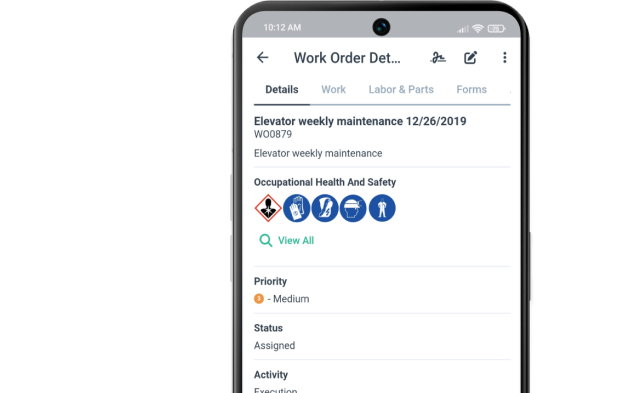
For instance, you might print out a list of current work requests (which is very easy to do with WorkTrek) and then head out to see if the maintenance was carried out as reported.
Below is one such report.
Source: WorkTrek
Now, check the code R0003.
It shows a high-priority maintenance task: fixing a failing elevator button.
The system says the job’s done, so you go to the elevator and test the button yourself.
Simple checks like this one confirm whether your team is doing the work recorded in the system.
In summary, get out into the field, see the equipment firsthand, and ensure everything aligns with the maintenance records.
4. Checking the Backup Inventory
Once you’ve inspected the equipment, check your spare parts inventory.
By now, you have a better idea of which backup items are most needed, so you should check if those parts are available in the inventory.
Having replacement parts on hand is critical for both unexpected breakdowns and preventive maintenance.
If a machine breaks down and you don’t have the parts to fix it immediately, production grinds to a halt, leading to delays and extra costs.
Take a look at one audit by Paul Hardiman that describes such a case:
https://www.youtube.com/watch?v=2Phfb5oVQxg
Source: IATF 16949 Auditing on YouTube
If you watched the video, you saw what happened when a robotic arm didn’t arrive as planned.
The machine was down for 16 hours, which disrupted the entire production line.
All because the backup inventory wasn’t handled properly.
Or, learn from the experience of Jan Barraclough, a maintenance manager who found himself in a tough spot when working at a plant with two process trains.
The plant had multiple pump failures, and when he checked the stock levels, he discovered they were running dangerously low:
Checking stock levels, I discovered we had six belts left on site. I also made a few calls and discovered that we had no spare pulleys (either pump or motor) or taper locks and nothing on order.
This led to him trying to get parts delivered quickly to solve this mess. Of course, this urgency cost a lot more than it would have if the parts had been ordered on time.
Some parts even took up to six months to arrive, dangerously increasing the chances of another breakdown the facility wouldn't be ready for.
Again, having a good CMMS can make a huge difference here.
With WorkTrek, for example, you can keep an accurate list of all your spare parts, and it’s easy to compare that list with your actual inventory.
Source: WorkTrek
This way, you can quickly spot if something’s missing or if there’s a problem with how parts are being managed.
The key takeaway from this step?
Never miss it.
If there are inefficiencies in your backup inventory, it’s an area you should improve to avoid costly downtime in the future.
5. Creating a Report With Findings
The audit is only useful if it results in actionable steps. Without a clear report, all that effort won’t lead to any changes.
So, create a report that summarizes your findings, highlights areas for improvement, and suggests actionable steps which could include:
replacing outdated equipment
reporting issues to upper management
providing additional training for technicians
One of the key parts of creating your report is deciding what to tackle first.
You can do this by attributing a risk rating to each finding:
High-priority recommendations for urgent issues that could threaten safety, reliability, or compliance.
Medium-priority recommendations for problems that affect efficiency or cost but aren’t immediate threats.
Low-priority recommendations for minor issues or improvements that can wait until later.
For example, look at the audit conducted by the Office of the Auditor General (OAG) on the Facilities Maintenance program for Fairfax County Public Schools.
Below is the risk rating summary for their findings:
Source: Fairfax County School Board
They identified five moderate-risk findings and provided detailed recommendations for each.
One big risk was insufficient funding for maintenance priorities and a deferred maintenance backlog.
To fix it, they recommended developing a backlog reduction spending plan and elevating concerns to the leadership team to secure additional funding.
Source: Fairfax County School Board
These recommendations were then shared with the management.
Let’s conclude with an excellent example of what happens when you actually accept audit recommendations.
Wärtsilä Power Plants, a supplier of flexible baseload power plants from Finland, audited the Limbe power plant in Cameroon.
They discovered major corrosion and maintenance issues that had cut the plant’s output to just 40%.
Wärtsilä recommended a total power plant rehabilitation, including repairs to engines, alternators, and radiators, and technical training for the staff.
The Limbe power plant implemented them.
In just seven months, the plant got back to its full capacity of 80 MW and saved money through reduced fuel and lube oil consumption.
Illustration: WorkTrek / Data: Wärtsilä
This is a perfect example of what happens when you turn what you’ve learned from a good audit into action.
Conclusion
With these five steps, you’ll get your maintenance audit right.
It might seem like a lot of work, but these steps can really make a big difference in how well your facility runs.
By defining what to audit, reviewing past maintenance records, inspecting equipment, checking your spare parts, and putting together a detailed report, you’re setting yourself up for better maintenance practices.
The key is to keep doing these audits regularly—whether that’s every year, every six months, or even more often.
This way, you can track your progress, see improvements, and stay on top of your maintenance, which is why maintenance audits were invented.

Operations & Maintenance
Maintenance Audit: Everything You Need to Know
Keeping your company's financial health demands strict controls, detailed records, and regular audits.
The same goes for your physical assets.
You likely know the frustration of unexpected equipment breakdowns, plant shutdowns, and rising maintenance costs.
A thorough maintenance audit is the solution to prevent these issues.
With a comprehensive audit, you'll gain a clear picture of your assets' health, how well you plan and schedule maintenance, whether your technicians follow maintenance procedures, and much more.
Curious to learn more?
Keep reading to discover everything you need to know about maintenance audits and how the right tools can make them easier.
Maintenance Audit Basics
A maintenance audit is a thorough examination of your maintenance practices and procedures.
Think of it as a health check for your equipment and maintenance operations.
It identifies what’s working well and what needs improvement.
The primary purpose of a maintenance audit is to ensure you're doing the right things that make your equipment run efficiently and reliably, minimizing downtime and repair costs.
As per the latest statistics, unplanned downtime costs manufacturers more than $120,000 per hour.
Illustration: WorkTrek / Data: ABB
That’s a significant hit to the budget—and productivity.
A maintenance audit helps prevent these costly disruptions by identifying potential issues before they become real problems.
It ensures your maintenance teams follow best practices, keep detailed records, and adhere to safety standards.
This saves you money, prolongs your equipment’s lifespan, and improves overall efficiency.
Beyond cost savings and efficiency, maintenance audits also ensure regulatory compliance.
In different industries, various regulatory bodies conduct audits to make sure companies follow quality, health, and safety regulations.
Maintenance audits are an important part of these larger checks.
If you fail to comply with them, you face legal issues, damage to your company’s reputation, and hefty fines.
For instance, penalties from the US Occupational Safety and Health Administration (OSHA) currently range from $16,000 to over $160,000 per violation.
Source: OSHA
A maintenance audit helps you stay ahead of the industry requirements, ensuring you meet all necessary standards and avoid potential penalties.
How often these audits occur depends on who conducts them.
If the quality team within your organization does it, they have the authority to schedule them based on internal needs and goals.
And if we’re talking about external audits by regulatory bodies, their frequency may increase in response to past issues or compliance failures.
Extreme circumstances, like workplace injuries or product failures, might trigger immediate audits as part of an investigation.
The table below sums up maintenance audit basics:
Source: WorkTrek
All in all, getting a grasp of these basics is the first step towards conducting maintenance audits correctly.
Let’s now explore different types of maintenance audits.
Different Types of Maintenance Audits
Since maintenance audits come in several flavors, each serving a distinct purpose, let’s take a closer look at the main types of maintenance audits and how they can impact your operations.
Mandatory
These audits are non-negotiable and are conducted by government agencies to ensure you’re complying with industry regulations.
They are essential for maintaining operational standards and avoiding legal trouble.
For example, OSHA might show up for a safety audit.
Part of their examination could include how your maintenance team handles equipment repairs.
They could also check if there is a departmental safety program, including courses on topics like forklift safety, lockout/tagout, electrical hazards, and compressed gasses.
Similarly, the US Food and Drug Administration (FDA) audits the pharmaceutical industry to ensure adherence to Current Good Manufacturing Practices (CGMP).
Marie Getsug, an experienced maintenance and reliability subject matter expert, explains what exactly the FDA checks during these audits:
Well-documented asset logs of failures—with appropriate strategies implemented to prevent the failure in the future, a robust record of technician training—adding confidence that the implemented changes were executed appropriately, and lists of equipment specification, detailing the safety and efficacy of using such equipment, are areas of focus within this regulated industry that are fundamental to a successful maintenance program.
Overall, these mandatory audits often encompass a broad review of your company’s policies and procedures, including maintenance practices, as seen in the example below.
Source: AOL
To stay ahead of these audits, you should keep your maintenance records detailed and up-to-date.
This will prepare you for any inspection and avoid potential fines or compliance issues.
You can do this most easily with a good computerized maintenance management system, which we will discuss later on.
Voluntary
Voluntary audits usually happen when a company wants to evaluate the efficiency and compliance of its facilities and equipment.
They are your chance to showcase excellence and earn certifications for committing to high industry standards.
While these certifications (and, therefore, audits) aren’t required by law, they can boost your company’s credibility and competitiveness.
For instance, if you aim for ISO 55001 certification, which standardizes effective asset management practices, or LEED certification for sustainable building practices, you’ll undergo a series of self-audits to prove you meet these high standards.
Take a quick look at what obtaining an ISO 55001 certification looks like at the Bureau Veritas certification company.
Source: Bureau Veritas
The certification process usually starts with a pre-audit or gap analysis to assess your current practices against the standards.
This is followed by a two-stage certification audit:
Stage 1 assesses your readiness,
Stage 2 evaluates the effectiveness of your implementation.
Once you receive certification, you’ll undergo regular surveillance audits to ensure ongoing compliance.
Yes, these certifications can enhance your reputation.
However, maintaining them requires a consistent commitment to best practices.
So, regularly reviewing and refining your maintenance processes to stay compliant and keep the certification is all the more important.
And for that, you need the third type of maintenance audit: an internal one.
Internal
Internal audits are, essentially, your facility’s self-checkup.
They should be conducted by your team to ensure that maintenance processes align with your company’s standards and policies.
These audits help you identify and address issues before they escalate.
Paul Michalicka, former sales manager for maintenance products at SKF USA, advises conducting internal audits as soon as you notice any of the following signs:
Rising energy consumption
Frequent equipment failures
Rapid growth in your maintenance staff
Breakdowns in your work order system
A series of maintenance-related failures
An increase in overtime (10%+ of total maintenance hours)
Any of these issues can be a sign that you either don’t plan maintenance or your maintenance planning is not as it should be.
This can cost you a lot of money in the long run, as Gabriel Fagade, a maintenance advisor at ExxonMobil, rightly points out:
Illustration: WorkTrek / Quote: Linkedin
Conversely, internal audits can show whether your technicians follow procedures or have all the necessary tools.
Regular internal audits will pinpoint inefficiencies and help ensure that your maintenance planning, scheduling, and execution are as effective as possible.
This will ultimately prevent costly equipment breakdowns and downtime.
So, take it from the experts and make internal audits a regular part of your maintenance strategy.
What Does a Maintenance Audit Examine
Depending on your industry, the specifics of what’s examined can vary.
However, the core elements typically include safety practices, maintenance planning and scheduling, and adherence to documented procedures.
Here’s a quick overview of what maintenance audits commonly examine:
Policies and Procedures
Are technicians adhering to your maintenance policies and procedures?
Planning and Scheduling
Are your maintenance activities well planned and scheduled to avoid downtime?
Work Order Management
Is your work order system efficient? Do work orders include all necessary information?
Preventive Maintenance Programs
Review preventive maintenance schedules. Are maintenance intervals based on equipment specifications?
Shutdown Maintenance
Review procedures for planned shutdowns and overhauls.
Condition Monitoring
Check the use of predictive maintenance technologies.
Training and Skills
Is training provided to maintenance staff good? Are their skill levels adequate?
Safety Practices
Are safety protocols followed? Is equipment maintained to prevent accidents?
Documentation
Are maintenance records accurate? Do they match the equipment’s condition?
But these are not the only elements that audits examine.
Audits also check how you communicate with your maintenance team, how you budget and allocate resources for maintenance, and if you have emergency response plans for maintenance-related incidents.
To gather all this information, auditors observe maintenance processes, interview maintenance staff, and review all your documents or, ideally, go through your CMMS.
What’s The Role of CMMS In Maintenance Audits
A CMMS provides auditors with easy access to historical records for all maintenance activities.
This allows them to quickly verify maintenance tasks, check compliance with regulations, and review historical data without sifting through different spreadsheets.
For example, a key aspect of maintenance auditing involves reviewing past work orders.
It is a procedure done in almost every maintenance audit, and below is an example from the City of Denton’s facilities maintenance audit:
Source: The City of Denton
But if your work orders are scattered across several spreadsheets or printed out and put into various folders, the process becomes chaotic and inefficient.
Don’t you agree?
This Reddit user certainly does.
They describe struggling with siloed maintenance programs across multiple spreadsheets, making it hard and time-consuming to monitor and cross-reference tasks manually:
Source: Reddit
A CMMS, such as our WorkTrek, solves this problem by centralizing all asset and maintenance data in one place.
It features a robust work order management system that lets you assign tasks to technicians with step-by-step instructions.
Maintenance checklists are saved and linked to work orders, making it easy to see who completed each checklist and when.
Source: Reddit
Moreover, technicians can update task status and add details such as time spent and parts used. This creates a history showing what work was completed, by whom, and when.
WorkTrek also allows users to directly link OSHA rules and maintenance manuals to equipment records, ensuring that maintenance activities follow the required standards.
You can even specify which personal protective equipment (PPE) technicians should use, adding an extra layer of safety and compliance.
Source: WorkTrek
Also, WorkTrek replaces paper documentation with electronic signatures to track sign-offs, ensuring clear accountability for each task.
Source: WorkTrek
You can even enforce approval requirements before closing work orders.
Also, generating maintenance activity reports is quick and easy, so you’ll be well-prepared when auditors come knocking.
In summary, a robust CMMS like our WorkTrek simplifies maintenance audits by consolidating all your data and providing a clear, organized record of maintenance activities.
It’s a more efficient solution than managing various spreadsheets or keeping paper records, making your audit process much smoother.
Conclusion
Hopefully, we’ve clarified that maintenance audits are essential for keeping your plant or facility running smoothly and efficiently.
They help you identify areas for improvement, ensure compliance, and avoid costly downtime.
So, make sure your internal audits are regular and thorough—you have control over that.
For mandatory and external audits from regulatory bodies, you don’t need to worry if you follow the rules and use a reliable CMMS.
With all your data centralized, this tool will make your audits a breeze.
Operations & Maintenance
Preventive vs Breakdown Maintenance
Maintenance is crucial for keeping equipment and facilities running smoothly. Two main types of maintenance strategies are preventive and breakdown maintenance. These approaches differ in their timing and goals.
Preventive and predictive maintenance aims to prevent breakdowns before they happen, while breakdown maintenance addresses issues after they occur. Preventive maintenance involves regular checks and upkeep to keep things working well. It helps avoid sudden problems and keeps operations efficient.
Breakdown maintenance, on the other hand, is a reactive approach. It kicks in when something stops working. This method can lead to more downtime and higher costs. Both strategies have their place in a maintenance plan, depending on a business or facility’s needs.
[ez-toc]
Source: WorkTrek
Understanding Maintenance
Maintenance is vital for keeping equipment running smoothly and efficiently. It involves different approaches to caring for machinery and assets in a business.
https://youtu.be/21aY8-ifoo8
Definition of Maintenance
Maintenance refers to the actions taken to keep equipment and facilities in good working order. It includes fixing, replacing, and caring for machinery to prevent breakdowns. The goal is to extend equipment life and ensure it runs at peak performance.
Proper maintenance helps avoid costly repairs and unexpected downtime. It also improves workplace safety. Regular upkeep can spot potential issues before they become big problems.
Types of Maintenance
There are several types of maintenance strategies businesses can use:
Preventive or Preventative maintenance: Regular, planned care to prevent breakdowns
Breakdown maintenance: Fixing equipment after it fails
Corrective maintenance: Addressing issues as they arise
Predictive maintenance: Using data to predict when maintenance is needed
Planned maintenance: Scheduled upkeep based on time or usage
Run to failure maintenance: Allowing equipment to operate until it breaks down
Each type has its own benefits and best uses. The right mix depends on the business and its equipment needs.
Importance of Maintenance for Business Operation
Good maintenance practices are key to smooth business operations. They help:
Reduced unexpected downtime for critical equipment
Lower repair costs
Extend equipment life
Improve product quality
Boost productivity
Reduced emergency maintenance
Reduced Safety Risks
Reduced equipment failure
Reduce Maintenance Costs
Proper maintenance can lead to big savings over time. It cuts the risk of major breakdowns that can halt production. Well-maintained equipment also uses less energy, which saves money.
Maintenance is crucial for safety. It helps prevent accidents caused by faulty machinery, protects workers, and avoids legal issues.
What Is Preventive Maintenance?
https://youtu.be/TsDsE9fePLk
Preventive maintenance is a proactive approach to equipment upkeep. It aims to prevent breakdowns before they occur through planned inspections and repairs.
Core Principles of Preventive Maintenance
Preventive maintenance focuses on regular upkeep to avoid unexpected failures by employing preventive maintenance strategies. It involves scheduled inspections and maintenance activities to keep equipment running smoothly.
Key principles include:
Routine checks and cleaning
Timely replacement of worn parts
Regular lubrication of moving components
Adjustments to maintain optimal performance
A well-designed maintenance schedule is crucial. It ensures all equipment receives proper care at the right intervals.
Benefits of Preventive Maintenance Strategy
Implementing preventive maintenance offers several advantages:
Reduced downtime: Regular care helps avoid unexpected breakdowns.
Extended equipment life: Proper maintenance keeps machines running longer.
Improved safety: Well-maintained equipment is less likely to malfunction dangerously.
Cost savings: Preventing major repairs is often cheaper than fixing breakdowns.
Preventive maintenance can maintain efficiency and save time in the long run. It allows businesses to plan for maintenance costs rather than face surprise expenses.
Illustration: WorkTrek / Data: Plant Engineering
Challenges in Implementing Preventive Maintenance
Despite its benefits, preventive maintenance can face hurdles:
Initial investment: Setting up a program may require upfront costs.
Time commitment: Regular maintenance takes time away from production.
Overcoming resistance: Staff may resist changes to established routines.
Balancing maintenance needs with operational demands can be tricky. It requires careful planning and communication across teams.
Preventive Maintenance Techniques
Effective preventive maintenance strategy uses various techniques:
Visual inspections: Regular checks to spot early signs of wear or damage.
Vibration analysis: Detecting unusual vibrations that may indicate problems.
Oil analysis: Testing lubricants to assess equipment condition.
Thermography: Using infrared imaging to identify hot spots or thermal issues.
Preventive maintenance software can help manage these tasks. It tracks maintenance schedules, stores equipment data, and generates work orders.
Proper training ensures maintenance staff can effectively perform these techniques. This helps create a robust preventive maintenance system that keeps equipment running smoothly.
Illustration: WorkTrek / Data: FinancesOnline
What Is Breakdown Maintenance?
Breakdown maintenance strategy is a reactive approach to equipment upkeep. It involves fixing or replacing assets only after they fail or stop working properly. This strategy is used for certain types of equipment and situations.
Nature of Breakdown Maintenance
Unplanned breakdown maintenance is reactive and unplanned. It happens when equipment suddenly stops working, and teams rush to fix the problem quickly.
This type of maintenance often leads to unexpected downtime. It can disrupt normal operations and cause delays. Breakdown maintenance is also called emergency maintenance.
The main goal is to get equipment running again fast. This might mean quick fixes or total replacements.
When Breakdown Maintenance Is Applicable
Breakdown maintenance is best for non-critical equipment, which doesn't affect key operations if it fails. It's also suitable for short-life assets that are cheap to replace and generally not part of a scheduled maintenance strategy. This approach can reduce unnecessary maintenance.
Examples include:
Light bulbs
Fuses
Some office equipment
It's often cheaper to replace these items when they break than to check them regularly.
Ideal Scenarios for Breakdown Maintenance
Breakdown maintenance can work well when:
Failures won't cause safety issues
Downtime won't hurt production much
Repair costs are low
Downsides of Breakdown Maintenance
Relying too heavily on breakdown maintenance can cause problems. It often leads to more unplanned downtime, which hurts productivity and increases costs.
Other downsides include:
Higher repair costs due to sudden failures
Longer repair times
Shorter equipment life
Health and safety risks from unexpected breakdowns
Stress on maintenance teams
Unexpected failures can also damage other parts of a system. This can make repairs more complex and expensive.
Illustration: WorkTrek / Data: Unlocking Performance
Breakdown Maintenance Scenarios
Common breakdown scenarios include:
Flat tires on vehicles
Burnt-out light bulbs
Broken office printers
Failed computer hard drives
A non-critical machine might stop working in a factory. If this doesn't affect the main production line, breakdown maintenance could be used.
A retail store might use breakdown maintenance for its air conditioning. They'd fix it only when it stops working, not before.
Some examples of breakdown maintenance for home appliances like toasters or microwaves. They replace these items when they stop working.
Comparing Maintenance Strategies
Maintenance strategies are crucial in keeping equipment running smoothly. The right approach can save money and boost productivity. Let's compare preventive and breakdown maintenance.
Source: WorkTrek
Key Differences Between Preventive and Breakdown Maintenance
Preventive maintenance is planned and regular. It aims to stop problems before they start. Breakdown maintenance happens after equipment fails.
Schedules differ greatly. Preventive work follows a set plan. Breakdown fixes occur as needed.
Downtime varies too. Preventive tasks cause short, planned stops. Breakdowns lead to longer, unexpected halts.
The costs show a stark contrast. Preventive work spreads expenses over time, while breakdown repairs often cost more due to emergency repairs.
Equipment lifespan is affected. Regular care extends machine life. Waiting for failures can shorten it.
Source: WorkTrek
Evaluating Maintenance Approaches
Productivity impacts differ. Preventive maintenance keeps machines running well. Breakdowns disrupt workflow.
Quality of output varies. Well-maintained equipment produces better results. Failing machines may create defects.
Health and safety is a key factor. Regular checks catch hazards early. Breakdowns can pose sudden risks.
Costs over time show different patterns. Preventive care has steady, predictable expenses, while breakdown fixes have unpredictable, often higher costs.
Preventive: Planned, lower long-term costs
Breakdown: Reactive, higher emergency expenses
Choosing the Right Maintenance Strategy
The best strategy depends on several factors:
Equipment type and age
Production demands
Budget constraints
Available staff
Manufacturer Recommendations
Manufacturer recommendations guide preventive schedules. Critical machines need more care.
A mix of strategies often works best. Some items get regular checks. Others run until they fail.
Maintenance teams need proper training for each approach. They must know how to plan and respond.
The correct program balances costs and benefits. It keeps equipment running without excessive downtime or expense.
Advanced Maintenance Practices
Modern maintenance goes beyond simple prevention or repair. New methods use data and technology to predict issues and optimize maintenance tasks.
Predictive Maintenance and Its Advantages
Predictive maintenance uses data to forecast when equipment might fail. It relies on sensors and Internet of Things (IoT) devices to monitor machine health in real-time. This approach can spot problems before they cause breakdowns.
The main benefit is less downtime. Repairs happen only when needed, not on a fixed schedule. This cuts costs and extends equipment life.
Analytics play a big role in predictive maintenance. The software analyzes data from machines to find patterns. These patterns help predict future issues.
Illustration: WorkTrek / Data: McKinsey & Company
Implementing Computerized Maintenance Management Software
New tech tools make maintenance more efficient. Computerized Maintenance Management Systems (CMMS) help plan and track all maintenance tasks. They store equipment info, schedule work, and track parts.
Cloud-based systems let teams access data from anywhere. This improves communication and speeds up decision-making.
Benefits of CMMS
There are several benefits to implementing a CMMS solution. CMMS solutions offer several benefits:
Automate Work Orders
Get Real-time status updates
Spare parts management
Key Performance Indicators (KPIs)
Compliance & Control
Health and Safety Guidelines
Detailed Reporting
Maintenance Planning and Implementation
Planning and implementing maintenance strategies are key to keeping equipment running smoothly. Both preventive and breakdown maintenance require careful preparation and execution.
Developing a Maintenance Plan
A good maintenance plan starts with setting clear goals. These goals should focus on reducing downtime and costs while improving equipment life.
Next, create a maintenance schedule. This schedule lists when to check and fix equipment, helping prevent unexpected breakdowns.
The plan should also include a system for work orders. Work orders track tasks and who does them, ensuring nothing is missed.
Lastly, assign team roles. Each person should know their job in the maintenance process. Clear roles help avoid confusion and improve efficiency.
Implementing Maintenance Strategies
Train maintenance teams to put the plan into action. They need to know how to perform both preventive and breakdown maintenance.
Use tools to track maintenance tasks. The software can help schedule work and keep records, making it easier to see what's been done and what needs to be done.
Regular checks are important. They help catch minor issues before they become big problems. This is a key part of preventive maintenance.
Set up a system for quick responses to breakdowns. This might include having spare parts on hand or on-call technicians.
Keep good records of all maintenance work. These records help spot patterns, improve future planning, and minimize downtime.
Legal, Safety, and Economic Considerations
Maintenance strategies have big impacts on workplace safety and company finances. Rules and costs shape choices between preventive and breakdown approaches.
Compliance and Safety Standards
Preventive maintenance helps companies meet safety rules and regulatory compliance. It finds issues before they cause harm, and regular checks keep equipment safe for the maintenance team.
Safety groups often require preventive care, which reduces accident risks and lowers legal troubles from broken rules.
Breakdown fixes can be risky. Rush jobs may skip safety steps, and workers might use unsafe tools to get things running fast.
Some laws demand proof of upkeep. Preventive logs show a company takes care of its gear. This can help if there's an accident or inspection.
Source: secure frame
Cost Implications and Savings
Preventive care costs money upfront, but it saves cash over time. It prevents big, costly breakdowns and makes machines last longer, too.
Breakdown fixes cost more than prevention. Emergency parts and overtime pay add up fast, and stopped work loses income.
A mix of both types works best for many firms. They often do basic checks but let some less crucial items run until they break.
Smart maintenance planning stretches the maintenance budget, putting money where it helps most and boosting profits in the long run.
Replacing old gear on time saves money. New machines work better and use less power. The trick is knowing when to upgrade.
Operations & Maintenance
Run-To-Failure vs Breakdown Maintenance: What’s the Difference?
Maintenance strategies play a key role in keeping equipment running smoothly. Two common approaches are run-to-failure and breakdown maintenance. While they may seem similar, these methods have important differences.
This article will also compare run-to-failure and breakdown maintenance with other maintenance strategies, such as corrective maintenance.
Run-to-failure maintenance lets equipment operate until it stops working, while breakdown maintenance responds to unexpected failures as they happen. Run-to-failure is planned for non-critical assets that are cheap to replace.
Breakdown maintenance applies to both critical and non-critical equipment.
Understanding these strategies helps companies choose the best way to maintain their equipment. The right approach can save money and prevent unplanned downtime. Picking between run-to-failure and breakdown maintenance depends on each piece of equipment’s specific needs.
[ez-toc]
Understanding Maintenance Strategies
https://youtu.be/X3qkPJjfNwE
Maintenance strategies are key to keeping any piece of equipment running smoothly. Different approaches suit various situations and assets. Let's explore two common strategies and compare their uses.
Defining Run-to-Failure Maintenance
Run-to-failure maintenance is a strategy in which machines operate until there is an equipment break. This approach works best for non-critical assets with low repair costs.
For example, a non-critical stapling machine can be used in a cardboard box production factory under the run-to-failure approach. This method allows for continuous use without regular maintenance, addressing issues only after the machine fails, which is cost-effective and time-saving.
Companies use this method when:
Replacement parts are cheap and easy to get
Downtime won’t cause major issues
Regular checks cost more than letting it fail
Run-to-failure needs minimal planning. Managers wait for equipment to stop working before fixing it.
This strategy can save money on some items. But it’s risky for necessary machinery. Unexpected breakdowns may lead to longer downtimes and higher costs.
Defining Breakdown Maintenance
Breakdown maintenance is a reactive approach. It kicks in when equipment suddenly fails and needs urgent repair, with maintenance performed to address the unexpected malfunction.
Key points about breakdown maintenance:
It’s often unplanned and disruptive
Technicians respond quickly to fix issues
It applies to both critical and non-critical assets
This method is also called emergency or reactive maintenance. It aims to get broken equipment back up and running fast.
Breakdown maintenance can be costly. It may lead to:
Longer downtimes
Higher repair expenses
Lost production time
Unplanned failures
Yet, it remains common in many industries for certain types of equipment.
Source: WorkTrek
Comparing Maintenance Approaches
Run-to-failure and breakdown maintenance are both forms of corrective maintenance. They differ in key ways from preventive and predictive strategies.
Both run-to-failure and breakdown maintenance involve dealing with faulty equipment, but run-to-failure is a planned approach, while breakdown maintenance is reactive.
Differences between the two:
Run-to-failure is planned; breakdown maintenance is not
Run-to-failure suits low-priority items; breakdown applies to all equipment
Both strategies contrast with proactive methods like:
Preventive maintenance: Regular, scheduled upkeep
Predictive maintenance: Using data to forecast failures
Choosing the right approach depends on:
Equipment criticality
Failure consequences
Repair costs
Available resourcesSource: WorkTrek
Smart maintenance management often combines multiple strategies. This helps balance costs with equipment reliability and performance.
The Role of Maintenance in Operations
https://youtu.be/aiNDt3TLk4k
Maintenance choices shape how businesses run. They affect costs, productivity, and equipment life. In some scenarios, allowing equipment to break down is considered acceptable, mainly when safety risks are minimal. Smart maintenance helps companies succeed.
Operational Impact of Maintenance Choices
Run-to-failure maintenance can work for some equipment. It's used when replacing parts is cheaper than fixing them, and it saves money on routine checks.
But it has risks. Sudden breakdowns can halt work. This hurts productivity and profits.
Breakdown maintenance fixes things only when they stop working. It can lead to more downtime, and repairs may take longer and cost more.
Planned maintenance prevents many problems. It keeps machines running smoothly. This boosts efficiency and cuts long-term costs.
Businesses must balance these options. The right mix depends on equipment type and importance.
Downtime and Its Effects on Productivity
Equipment failure causes unplanned downtime. This stops work and wastes time. Workers sit idle while machines are fixed.
Even short delays add up. They can mean missed deadlines and unhappy customers.
Breakdown maintenance often leads to more downtime. Repairs take time to start, and parts may not be on hand.
Planned maintenance reduces surprises. It finds problems early. This means shorter, scheduled breaks instead of long, unexpected ones.
Less downtime means more output. Workers can focus on their jobs instead of waiting for repairs, boosting overall productivity and helping meet business goals.
Cost Considerations in Maintenance
Maintenance costs play a big role in asset management. Companies need to weigh repair expenses against equipment value. Smart planning can help reduce costs over time. It is also crucial to compare breakdown maintenance to other maintenance strategies, considering factors such as equipment criticality and cost implications.
Analyzing Maintenance Costs
Run-to-failure maintenance can seem cheaper at first, as it requires no ongoing upkeep. But sudden breakdowns may cost more in the long run.
Breakdown maintenance often leads to higher repair bills. Emergency fixes are pricey. They can also cause costly downtime.
To cut costs, companies should track repair history. This helps spot problem areas. It also shows which fixes work best.
A cost-benefit analysis compares different approaches. It looks at:
Parts costs
Labor fees
Downtime expenses
Equipment lifespan
This data helps pick the best maintenance plan for each asset.
Budgeting for Asset Maintenance
Good maintenance planning is key to controlling costs. It helps avoid surprise expenses.
Managers should set aside funds for regular upkeep. This includes money for:
Routine inspections
Minor repairs
Parts replacement
For critical equipment, extra budget may be needed. This covers potential breakdowns.
Companies can use past data to predict future costs. This helps create more accurate budgets.
Some firms use special software to track expenses. It can spot trends and suggest ways to save money.
Smart budgeting also includes staff training. Well-trained workers can spot issues early, preventing big problems later.
Safety and Risk Management
Safety is a key factor when choosing between run-to-failure and breakdown maintenance. Both strategies have different impacts on workplace safety and risk management.
Run-to-failure maintenance can pose higher safety risks. Equipment may fail unexpectedly, potentially causing accidents or injuries. This approach requires strong safety protocols to protect workers.
Breakdown maintenance also carries risks. Emergency repairs can be rushed, increasing the chance of mistakes. Workers may need to intervene in dangerous situations to fix critical equipment.
Source: ABB
What is the difference?
Risk management differs between the two approaches:
• Run-to-failure: Focuses on containing risks of sudden failures
• Breakdown maintenance: Emphasizes quick, safe responses to breakdowns
Both strategies need clear safety procedures. This includes:
Personal protective equipment requirements
Emergency shutdown protocols
Proper training for maintenance staff
Safety Audits
Regular safety audits help identify and address potential hazards. This is crucial for both maintenance approaches to minimize risks to workers and equipment.
Ultimately, the choice between run-to-failure and breakdown maintenance must prioritize safety. Companies must assess the risks associated with each strategy for their specific equipment and workplace.
Maintenance Execution and Tracking
Proper execution and tracking are key to successful maintenance programs. They help organizations manage repairs and keep equipment running smoothly.
Work Order Management and Execution
Work orders are essential for managing maintenance tasks. They outline what needs to be done, who should do it, and when. A good work order system helps prioritize tasks and allocate resources efficiently.
Many companies use CMMS software to manage work orders. This software makes creating, assigning, and tracking maintenance jobs easy and helps schedule preventive maintenance tasks.
CMMS tools often include mobile apps. These let technicians access work orders in the field. They can update job status and log completion in real time
Source: Keystone Industries
Importance of Maintenance Documentation
Good documentation is crucial for effective maintenance. It creates a record of all work done on equipment. This helps spot trends and plan future maintenance.
Maintenance reports should include details like:
Date and time of work
Equipment serviced
Problems found
Actions taken
Parts used
Time spent on the job
Well-kept records help with troubleshooting. They show what's been tried before when similar issues occur. This can speed up repairs and reduce downtime.
Documentation also aids in compliance. It provides proof of regular maintenance for safety inspections or audits.
Technological Integration in Maintenance
Modern maintenance strategies use advanced technologies to improve efficiency and reduce costs. These digital tools help predict failures, manage assets, and optimize operations.
Implementing CMMS Solutions
Computerized Maintenance Management Systems (CMMS) are key to effective asset management. CMMS software tracks equipment history, schedules maintenance, and manages inventory.
CMMS solutions offer several benefits:
Automated work order generation
Real-time asset status updates
Improved inventory control
Enhanced reporting capabilities
Key Performance Indicators (KPIs)
Compliance & Control
Health and Safety Guidelines
CMMS helps organizations make informed decisions about their equipment by centralizing maintenance data. It allows teams to shift from reactive to proactive maintenance strategies.
CMMS also supports continuous improvement efforts. Teams can analyze past maintenance activities to identify trends and optimize future work.
Data Analysis and Predictive Maintenance
Data analysis transforms maintenance practices. By examining equipment performance data, teams can predict failures before they occur.
Key aspects of data-driven maintenance include:
Collecting real-time equipment data
Using artificial intelligence to identify patterns
Developing predictive models for asset health
Predictive maintenance reduces downtime and extends equipment life. It allows teams to schedule repairs at optimal times, minimizing disruptions to operations.
This approach also helps with inventory management. Organizations can stock the right items at the right time by predicting part failures.
Illustration: WorkTrek / Data: Global Education Board
The Role of IoT in Maintenance Strategies
The Internet of Things (IoT) connects equipment to the digital world. Sensors on machines collect and transmit data in real time.
IoT devices in maintenance:
Monitor equipment performance constantly
Alert teams to potential issues quickly
Provide data for predictive analysis
Source: Q Services
Integrating IoT
IoT integration enhances both run-to-failure and preventive maintenance strategies. For run-to-failure, IoT sensors detect imminent failures, allowing for timely replacements.
In preventive maintenance, IoT data helps refine maintenance schedules. This ensures tasks are performed only when needed, saving time and resources.
Source: Softweb Solutions
Maintenance Strategy Optimization
Optimizing maintenance strategies is key for businesses to improve efficiency and cut costs. The goal is to find the right balance between different approaches.
A good maintenance strategy combines multiple methods. It may use run-to-failure for some equipment and preventive care for others.
Choosing the best strategy depends on several factors:
Equipment criticality
Failure patterns
Maintenance costs
Downtime impact
Preventive maintenance programs involving regular inspections and servicing can help extend equipment life and reduce unexpected breakdowns.
Data analysis plays a big role in optimization. Tracking repair history and failure rates helps identify trends. This information guides decision-making on when to repair or replace assets.
Continuous improvement is essential for maintenance strategy optimization. Regular reviews allow companies to adjust their approach as needs change. They can phase out ineffective practices and adopt new technologies.
Training staff is another important aspect. Well-trained technicians can spot issues early and perform maintenance more effectively.
Ultimately, the best maintenance strategy balances cost, reliability, and performance. It evolves to meet changing business needs and technological advances.
Advantages and Disadvantages
Both run-to-failure and breakdown maintenance have pros and cons. Each approach impacts asset conditions and repair costs differently.
Benefits of Run-to-Failure Maintenance
Run-to-failure maintenance can be cost-effective for certain assets. It requires minimal planning and upfront costs. This method works well for non-critical equipment with low replacement costs.
Companies save money on routine inspections and repairs. They can fully use an asset's lifespan. This strategy is simple to implement and manage.
Run-to-failure fits assets where:
Failure doesn't cause safety issues
Downtime has little impact
Replacement is cheaper than maintenance
Drawbacks of Breakdown Maintenance
Breakdown maintenance has significant downsides. It often leads to higher repair costs and longer downtime, and unexpected failures disrupt operations and production schedules.
This approach can shorten equipment lifespan. It may cause secondary damage to connected systems. Emergency repairs are usually more expensive than planned maintenance.
Disadvantages include:
Unpredictable failures and costs
Increased safety risks
Lower equipment reliability
Potential for more severe breakdowns
Breakdown maintenance makes it hard to budget for repairs. It can lead to rushed fixes and subpar work quality. This method is risky for critical assets or those with high replacement costs.
Communication and Training
Communication plays a key role in both run-to-failure and breakdown maintenance strategies. Clear channels help teams respond quickly when issues arise.
For run-to-failure, staff need to know which assets follow this approach. They should understand when to report problems and how to request replacements.
Breakdown maintenance relies on fast communication. Teams must quickly relay equipment failures to maintenance staff, allowing for rapid response and repair.
Training is vital for both methods. Employees should learn to spot signs of wear and impending failure. This helps even with run-to-failure, allowing time to order replacement parts.
Illustration: WorkTrek / Data: Pumble
Necessary skills
Maintenance teams require specific skills for each approach:
Run-to-failure: Focus on efficient replacement procedures
Breakdown maintenance: Emphasis on diagnostics and repair techniques
Regular refresher courses keep staff up-to-date on best practices. This ensures they can handle various maintenance scenarios effectively.
Communication
Proper communication and training lead to the following:
• Faster problem resolution
• Reduced downtime
• Improved safety
• Better resource management
By investing in these areas, companies can maximize the effectiveness of their chosen maintenance strategy.
Frequently Asked Questions
Run-to-failure and breakdown maintenance are complex topics with many nuances. These questions explore key aspects, strategies, and applications in industrial settings.
What are the examples of run-to-failure maintenance in industry?
Run-to-failure maintenance is used for non-critical equipment. Light bulbs in office buildings are a common example. They're left on until they burn out, then replaced.
Another example is disposable air filters in HVAC systems. These are used until they become clogged, then swapped out for new ones.
What are the potential advantages and disadvantages of run-to-failure maintenance?
Run-to-failure maintenance can save money on unnecessary preventive maintenance. It's simple to implement and requires minimal planning.
A big disadvantage is the risk of unexpected breakdowns. If critical equipment fails suddenly, this can lead to production delays, higher repair costs, and safety hazards.
How does run-to-failure maintenance compare to condition-based maintenance?
Run-to-failure maintenance allows equipment to operate until it breaks down. Condition-based maintenance uses sensors and data to predict when failures might occur.
Condition-based maintenance can prevent unexpected breakdowns. It's more complex and expensive to set up than run-to-failure, but it can save money long-term for critical assets.
What are the four primary types of maintenance strategies?
The four main maintenance strategies are:
Reactive maintenance
Preventive maintenance
Predictive maintenance
Reliability-centered maintenance
Each strategy has its benefits and drawbacks, depending on the equipment and industry.
Could you explain the concept of run-to-failure maintenance?
Run-to-failure maintenance involves using equipment until it stops working. Then, it's either repaired or replaced.
This approach is best for non-critical assets with low repair costs. It's also used when failure patterns are unpredictable or when equipment is near the end of its life cycle.
How is breakdown maintenance defined and when is it typically employed?
Breakdown maintenance is fixing equipment after it has already failed. It's often unplanned and requires immediate action.
This type of maintenance is used for both critical and non-critical equipment. It's common in industries where unexpected failures can occur despite preventive measures.
Operations & Maintenance
Importance of Maintenance Audits
Facility and plant managers often dread audits, especially when conducted by external auditors.
But why, when maintenance audits offer so many benefits?
Audits aren’t about pointing fingers, assigning blame, or highlighting mistakes.
They are valuable tools for reducing costs, improving maintenance procedures, and, most importantly, ensuring the safety of your team.
In this article, we’ll go deeper into these benefits.
We’ll also touch on what can happen when you don’t give them the attention they deserve.
Cuts Down Your Costs
You might be wondering how this works, so let’s break it down.
First, regular audits give you a chance to review everything about your maintenance practices.
This includes how you plan and schedule maintenance, the types of maintenance you use, and how much that costs you.
By doing this, you can pinpoint areas where better practices could save you money without compromising the quality of your work.
For example, imagine you discover that you’re frequently replacing a certain motor component. This part is expensive, and the cost of replacements across multiple facilities is adding up.
The audit reveals you’re replacing it every 4 months, although the wear and tear analysis shows it could last up to 9 months. There’s your savings opportunity.
Moreover, when you are on top of your maintenance regime, you keep equipment in good shape.
This means fewer breakdowns and, consequently, less need for expensive emergency repairs and costly downtime.
For example, in the oil and gas industry, downtime can cost as much as $500,000 per hour.
Illustration: WorkTrek / Data: Siemens
Imagine avoiding that kind of money loss.
Well, regular maintenance audits can help make that possible.
Good maintenance also means you won’t need to buy new equipment as frequently, which lowers your purchase costs.
Take, for example, a company that had issues with its limestone transport belt conveyor gearbox.
Initially, the problem seemed serious, but a detailed inspection revealed that the issue was a faulty drive drum bearing, not the gearbox itself.
By replacing the bearing for just $4,000, they avoided a costly $27,000 gearbox replacement and significant downtime.
Source: Reliable Plant
Another way to save money is to lower your energy bills. Well-kept equipment runs more efficiently and uses less power.
All these things reflect on labor costs. When your machinery runs smoothly, your workers can be more productive, and you spend less on maintenance technicians.
In short, maintenance audits, especially internal ones, are smart investments.
They help save money in the long run in more ways than one.
Helps Your Company Perform Better
Efficiency is where maintenance audits can make a significant difference.
Operational efficiency refers to how effectively your company uses its resources—like time, money, and equipment—to achieve results.
It’s about getting the best possible outcomes and doing more with less.
So, how do maintenance audits fit into this picture?
It’s simple.
By conducting a maintenance audit, you can detect areas where you waste too many resources.
This happened to Kaiser Aluminum’s extrusion plant in Sherman, Texas, a few years ago.
A maintenance audit conducted by the U.S. Department of Energy (DOE) revealed that simple fixes—like adjusting burner controls and repairing furnace door seals—could save them substantial energy.
So they fixed them.
The outcome?
They reduced their energy use by about 45,000 MMBtu annually and improved furnace efficiency by 11.1%.
This also resulted in big financial gains.
The company invested $28,000 in these improvements and saved $360,000 on energy costs, paying the investment off in less than a month.
Illustration: WorkTrek / Data: Reliable Plant
This success led Kaiser Aluminum to apply these findings across its other plants, showing that an effective audit can result in impressive savings and boost performance.
However, you don’t always need to wait for an external audit to find areas for improvement.
Sometimes, an in-house tool can do the job.
One such tool is a computerized maintenance management system (CMMS), like our WorkTrek.
Here’s how it helps.
First, with a CMMS like our WorkTrek, you can easily plan and schedule maintenance tasks in one place and assign work orders to your technicians.
Source: WorkTrek
You can also monitor your equipment conditions and identify patterns that point to maintenance inefficiencies.
Second, WorkTrek logs all maintenance activities, including work orders and changes.
This acts as an audit trail, showing exactly what was done, by whom, and when.
At the end of the day, this audit trail is crucial for passing audits and keeping everything transparent.
So it’s best when maintenance audits and a good CMMS work together. Their synergy can lead to improved performance and best use of resources.
Ensures You Comply with Regulations
Maintenance audits are crucial for keeping your business on the right side of the law and avoiding serious consequences.
Often, these audits are part of larger inspections, like health and safety audits, which are designed to ensure that your company is following all the necessary regulations.
Failing to comply with these regulations can have devastating consequences, both financially and operationally.
In the U.S., for instance, the Occupational Safety and Health Administration (OSHA) is the federal agency responsible for ensuring workplace safety.
Under the OSH Act of 1970, private companies are required to provide a safe and healthy work environment for their employees.
OSHA’s audits often focus on maintenance practices to determine whether safety regulations are being followed.
If your company is found lacking, the fines can be hefty.
Currently, penalties stand at $16,131 per violation, with willful or repeated violations costing up to $161,323 each.
Source: OSHA
Across the Atlantic in the U.K., the Health and Safety Executive (HSE) plays a similar role.
They also perform audits to check whether companies provide a safe and healthy environment for workers.
When accidents occur, the fines can reach millions.
A tragic example of what can happen when maintenance is neglected occurred in January 2019, involving Synergy Housing Limited and Orona Limited, a company responsible for lift maintenance.
A five-year-old girl lost her life after she put her head through a broken vision panel in her home’s lift, which was ascending.
Source: Google
The HSE investigation revealed critical failures by both companies, including a lack of inspections, failure to repair the broken panel, no risk assessments, missing safety mechanisms, and insufficient safety information for tenants.
As a result, Synergy Housing was fined £1 million plus £40,000 in costs, while Orona was fined £533,000 plus £40,000 in costs.
Another example is the 2009 fire at Lakanal House in Southwark, a borough in Greater London, which tragically claimed the lives of six people.
Poor maintenance, combined with inherent structural deficiencies, led to this disaster.
Southwark Council was fined £570,000 for safety failings, which included the absence of a proper fire risk assessment, breaches in fire-resistant structures, lack of compartmentation in ceilings, and missing fire door seals.
These issues could have been identified and addressed through regular maintenance audits.
As Dan Daly, London Fire Brigade’s assistant commissioner for fire safety, pointed out:
If buildings are built and maintained correctly, walls, floors and doors in flats and maisonettes give you protection from fire – a minimum of 30 to 60 minutes.
The lesson here is clear: preventive maintenance and regular audits are not just about staying compliant with regulations—they’re about saving lives.
Regular maintenance audits help you identify potential risks before they escalate, ensuring that your company stays within legal requirements, avoids hefty fines, and most importantly, keeps people safe.
Reduces Risky Situations
Even more, regular maintenance audits can prevent catastrophic incidents that lead to environmental harm.
This is especially crucial in high-risk industries like oil and gas, where even a small failure can have devastating consequences.
Take the Deepwater Horizon oil spill as a sobering example.
On April 20, 2010, this oil rig, operated by BP, a British multinational oil and gas company, suffered a blowout, causing one of the largest environmental disasters in history.
Source: Britannica
What went wrong?
A series of maintenance failures and safety oversights.
BP’s former Chief Executive, Tony Hayward, sums it up:
To put it simply, there was a bad cement job and a failure of the shoe track barrier at the bottom of the well, which let hydrocarbons from the reservoir into the production casing. The negative pressure test was accepted when it should not have been, there were failures in well control procedures and in the blowout preventer; and the rig’s fire and gas system did not prevent ignition.
The blowout resulted in the deaths of 11 workers and released millions of barrels of oil into the Gulf of Mexico, causing extensive environmental and economic damage.
The fallout from this disaster was immense, leading to major regulatory changes and significant fines for BP.
But more importantly, it is a powerful reminder of why regular maintenance audits are vital.
They help detect anomalies early, prevent escalation, and ensure that safety protocols are in place, thereby protecting lives, equipment, and the environment.
So, just as regular audits could have prevented the Lakanal House fire, they could have also prevented the Deepwater Horizon spill.
Enables You to Make Good Decisions
Maintenance audits don’t just keep your operations running smoothly but help you make smart, strategic decisions that benefit your company in the long run.
Take this real-world example: a tissue producer was dealing with repeated issues on their press suction roll cover, which was disrupting production.
Seeking a solution, they turned to an external auditor—Valmet.
The audit revealed several critical issues.
They discovered that the groove design on the roll was flawed, and the roll cover showed edge damage because of high temperature and nip pressure.
Based on this, Valmet recommended changes to the groove design and improvements in the chamfer design at the roll’s ends.
When these recommendations were implemented during the next scheduled maintenance, the results were clear: better performance without any extra costs.
Source: Valmet
This example shows how maintenance audits can guide you in making better decisions for your operations.
So, whether it’s upgrading outdated equipment, maintaining equipment more frequently, or investing in new technologies, the insights you gain from these audits help you steer your company in the right direction.
And if you’re using a CMMS, this process becomes even easier.
The software keeps all your maintenance data organized, making it simpler to analyze and turn into actionable plans.
In the end, maintenance audits, especially when paired with a CMMS, give you the knowledge and foresight to make decisions that truly benefit your business.
Conclusion
Maintenance audits are really nothing to fear.
In fact, they're incredibly valuable tools that can benefit your facility or plant in numerous ways.
They help improve efficiency, cut costs, prevent risks, and provide a safe working environment for your whole team.
So, make maintenance audits a regular part of your routine, and you'll quickly start seeing these benefits for yourself.

Operations & Maintenance
Breakdown Maintenance Planning Tips
If you are running a maintenance organization, you are likely dealing with breakdown maintenance.
Preventive maintenance can be resource-intensive but is ideally suited for critical equipment.
Based on our experience working with customers, most organizations prefer a breakdown maintenance approach to non-critical equipment.
Source: WorkTrek
This article provides several practical tips for improving your approach to breakdown maintenance.
If you are looking for a more detailed guide on breakdown maintenance, refer to our comprehensive guide on the topic.
Defining Breakdown Maintenance
Breakdown maintenance is a type of corrective maintenance. It happens when machines fail.
This also means that teams only take action after equipment stops working.
This method, also called reactive maintenance, is used for parts that are easy to replace or cannot be fixed. Some companies choose it for non-critical gear.
Breakdown maintenance can be quick and doesn’t require much planning. However, it can lead to extended downtimes and higher costs if not managed well.
Having defined maintenance procedures can help mitigate unexpected equipment failures.
Tips for Breakdown Maintenance
Below are a few practical tips for improving breakdown maintenance. We've learned these tips working with clients across a variety of industries.
Identify Critical Equipment and Areas
The first step in the process is to identify critical equipment. This involves assessing which machines or systems are vital to operations.
Illustration: WorkTrek / Data: PlanetEngineering
List all equipment and rank them based on importance. Use factors like production impact, repair costs, and safety risks to determine criticality.iiIt’s helpful to make a map of critical areas in the facility. This allows quick response when breakdowns occur. Teams should also gather technical information for each piece of equipment, including manuals and repair histories.
Safety Protocols and Risk Management
Regardless of the type of maintenance you are performing, safety is paramount. Teams must develop clear safety protocols for different types of equipment and situations.
Perform risk assessments for each critical piece of machinery. This helps identify potential hazards and necessary precautions.
Safety gear requirements should be clearly defined for each maintenance task. If you use Lock Out Tag Out (LOTO) products, ensure your staff is fully trained.
Training
Illustration: WorkTrek / Data: Infraspeak Blog
Proper safety procedure training is critical. This improves efficiency, improves safety, and saves the company resources.
Illustration: WorkTrek / Data: Linkedin Learning
An effective training strategy can also help with employee retention. According to a LinkedIn study,94% of workers will stay long with an employer if offered learning opportunities.
Parts Inventory
Good inventory management and low-quantity alerts are key to effective breakdown maintenance. It ensures teams have the right parts and tools when needed.
Maintenance departments should keep a detailed spare parts inventory in their maintenance report. This list should be updated regularly and include part numbers, quantities, and storage locations.
It's wise to keep essential spare parts on hand for critical equipment. This reduces downtime during breakdowns. Teams should set up a system to track part usage and reorder when stocks are low.
Tools and supplies needed for common repairs should also be readily available. This includes safety equipment, cleaning materials, and diagnostic tools. Regular inventory checks help ensure everything is in good condition and ready for use.
Communication and Reporting Procedures
Better communication can benefit all teams. This can include setting up daily standups, using chat software, or using group chat capabilities.
Illustration: WorkTrek / Data: Simon&Simone
Keep it simple. This could be an app or a phone hotline. Make it easy for workers to flag issues quickly.
Create detailed breakdown reports. Include what broke, why, and how it was fixed. Share these with all teams. This helps everyone learn from each event.
Hold brief meetings after major repairs to discuss what went well and what didn't. Use these talks to improve your handling of breakdowns.
Implementing Continuous Improvement
Always look for ways to improve. Review each breakdown afterward. Ask what went wrong and how to prevent it next time.
Track key stats like repair times and costs. Set goals to improve these numbers over time.
Get feedback from machine operators. They often notice small changes that can signal future problems.
Stay up to date on new maintenance tech. Tools like vibration sensors can catch issues early.
Share success stories and lessons learned across teams. This spreads good practices and builds a culture of improvement.
Implement CMMS Software
CMMS software is a vital tool for managing breakdown maintenance. It helps track equipment, schedule repairs, and manage work orders.
Illustration: WorkTrek / Data: GoodFirms
CMMS systems store each asset's information, including repair history and part details, and will reduce manual paper records.
This makes diagnosing issues easier and ordering parts quickly when breakdowns happen.
Illustration: WorkTrek / Data: Pumps&Systems
Teams can use CMMS to set up alerts for routine checks. This helps prevent minor problems from turning into big breakdowns. The software also tracks costs, assisting managers in seeing where money is spent on repairs.
The Role of Maintenance Data and Analytics
Data is crucial for smart breakdown maintenance planning. Good data helps teams spot trends and make better choices.
Maintenance software collects repair times, part usage, and equipment downtime. This data shows which machines break down most often and why.f
Analytics tools and SMART maintenance can predict when gear might fail. This lets teams fix things before they break. Managers can use data to decide if it's cheaper to keep fixing old equipment or buy new.
Charts and reports make it easy to see how well the maintenance team is doing. This helps improve processes over time.
Documentation and Knowledge Transfer
Good documentation is vital for sharing know-how. Teams should write down all repair steps and note any tricks they learn.
Creating a database of maintenance history is smart. This helps spot trends and prevent future issues. The database should include:
Problem details
Fix steps
Parts used
Time taken
Illustration: WorkTrek / Data: The Growth Blueprint
Older workers should teach newer ones. This passes on years of wisdom. Setting up mentor programs can help with this.
Regular team meetings help spread best practices. Workers can share what they've learned from recent jobs.
Condition Monitoring and Diagnostic Tools
Condition monitoring tools watch equipment while it runs. They can spot signs of wear before a breakdown happens.
Sensors check things like temperature, vibration, and oil quality. When something's wrong, they send alerts, giving teams time to plan repairs before a complete breakdown.
Illustration: WorkTrek / Data: icon
Diagnostic tools help find the exact cause of a problem. They can test electrical systems, check fluid levels, and analyze error codes.
Some tools use AI to learn what "normal" looks like for each machine. This makes it easier to spot when something's off. Mobile apps let workers check equipment status from anywhere.
Effective Utilization of Tools and Equipment
Proper tool use is vital in breakdown maintenance. Keep tools clean and ready for use. Store them in a set spot so workers can find them fast. Check tools often to make sure they work well.
Illustration: WorkTrek / Data: dynaway
Train staff on how to use tools correctly. This helps avoid equipment damage and keeps workers safe. Have a system to track who has which tools. This prevents tools from getting lost.
Keep spare parts for tools on hand. If a tool breaks, you can fix it fast. For non-critical gear, have backup options ready.
Materials and Replacement Parts Planning
Good parts planning helps fix breakdowns fast. Keep a stock of common parts like light bulbs, batteries, and fuses. Know which parts break most often and have extras.
Make a list of key suppliers for quick orders. Set up deals with them for fast delivery. The track part used to know when to order more.
For rare or costly parts, think about sharing with other sites. This can save money. Use software to track part levels and order history.
Plan for disposal of old parts. Some may need special handling. Set up a system to recycle when possible.
Performance Metrics and KPIs
Breakdown Maintenance planning relies on solid data. Teams should track:
Mean Time Between Failures (MTBF)
Mean Time To Repair (MTTR)
Overall Equipment Effectiveness (OEE)
Maintenance Costs vs. Equipment Value
Source: WorkTrek
These numbers show how well the maintenance plan works. Low MTBF or high MTTR may mean equipment needs more care.
Tracking these KPIs can help you better predict future breakdowns and help the team set clear goals for improvement.
Maintenance and Spare Parts Correlation
Match spare parts to your maintenance plan. Know which parts each machine needs. Keep those on hand.
Study equipment failure modes. Stock parts that often break or wear out. This helps prevent long downtimes.
Use maintenance data to spot trends. If a part fails often, keep more in stock. If it rarely breaks, stock less.
Link spare parts to work orders. This shows which parts are used most, helping plan future orders and stock levels.
Conclusion
Breakdown maintenance is an effective way to maintain non-critical equipment. Establish protocols for maintenance procedures, well-organized inventory, clear safety protocols, and effective communication.
These can help significantly improve your approach to breakdown maintenance.

Operations & Maintenance
When to Use Breakdown Maintenance
What situations are ideal for breakdown maintenance? Breakdown maintenance involves fixing equipment only after it fails. This approach can work well for non-critical systems where downtime isn’t a major issue.
A breakdown maintenance strategy is best used for low-priority assets that don’t significantly impact business operations if they stop working.
Companies often use this method for simple items like light bulbs or backup systems. It can save money on regular check-ups and repairs. But it’s not ideal for critical assets that keep a business running.
This article covers scenarios for when to use breakdown maintenance. Those scenarios depend on the importance of the equipment and the risk of failure. Waiting until they break is acceptable for some assets.
For others, it can lead to costly delays and safety issues.
Understanding Breakdown Maintenance
https://youtu.be/21aY8-ifoo8
Breakdown maintenance is a repair approach used when equipment fails unexpectedly. It involves fixing or replacing components after they stop working. This strategy has both pros and cons for businesses. Companies often need to perform breakdown maintenance due to budget constraints, which can impact other maintenance strategies like preventive maintenance.
Definition and Key Concepts
Breakdown maintenance occurs when equipment breaks and needs urgent repairs. Unlike planned upkeep, it's reactive. Teams fix issues as they arise, not before.
Key features of breakdown maintenance:
Repairs occur after failure
No planned schedules
It can be costly and disruptive
Sometimes called “run-to-failure” maintenance
Reduces unnecessary preventive maintenance
A breakdown maintenance workflow is a structured, step-by-step action plan for effectively managing equipment failures. This approach works for some less critical items, such as letting office light bulbs burn out before changing them.
Source: WorkTrek
Comparison with Other Maintenance Types
Breakdown maintenance differs from other upkeep methods in several ways.
Preventive maintenance involves regular, scheduled checks and repairs. It aims to stop breakdowns before they happen. This can save money in the long term but needs more upfront planning.
Predictive maintenance uses data to guess when parts might fail. It can be very effective but needs special tools and skills.
Corrective maintenance fixes minor issues before they become big problems. It’s less urgent than breakdown repairs but still reactive.
A strategic combination of preventive and breakdown maintenance is essential for efficiently managing high-value assets while saving costs on less critical components. This approach can also reduce downtime costs.
When to Apply Breakdown Maintenance
https://youtu.be/anTecYyb1a0
Breakdown maintenance is best used in specific situations that can be cost-effective and safe. It works well for non-critical equipment and items with short lifespans.
The key is knowing when this approach makes sense. A breakdown maintenance plan is essential to effectively manage equipment failures and differentiate between breakdown and preventive maintenance strategies to optimize maintenance costs.
Run-to-Failure Maintenance Scenarios
Run-to-failure maintenance is suitable for equipment that can fail without major consequences. This approach works for items that are cheap and easy to replace. Examples include:
• Light bulbs
• Fuses
• Batteries
These items often have predictable lifespans. Replacing them only when they fail can save time and resources. It’s more efficient than checking and replacing them regularly.
Spare Parts
Organizations can plan for eventual failures and keep spare parts on hand, minimizing downtime when replacements are needed.
Examples of breakdown maintenance show that while this strategy is cost-effective for noncritical parts, it is unsuitable for industries where safety is paramount, such as aviation and automotive.
Dealing with Non-Critical Equipment
Non-critical equipment is ideal for breakdown maintenance. These items don’t affect safety or core operations if they fail. Examples might include:
• Office printers
• Vending machines
• Backup systems
For these items, the cost of constant monitoring may outweigh the benefits. It’s often cheaper to fix them only when they break.
Companies should assess each piece of equipment. They need to determine its importance to operations.
This helps decide if breakdown maintenance is appropriate. Unplanned breakdown maintenance can occur with non-critical equipment, making it essential to have resources ready to address unexpected failures.
Considering Cost-Effectiveness and Safety
Cost and safety are critical factors in choosing a maintenance strategy. Breakdown maintenance can be cost-effective for certain items. It eliminates the expense of regular inspections and preventive work.
But safety must come first. Breakdown maintenance is not suitable for:
• Critical safety equipment
• Machinery that could cause injury if it fails
• Systems that would lead to costly downtime
Companies must weigh the risks and benefits. They should consider the potential costs of equipment failure. This includes repair expenses, lost productivity, and safety impacts.
In some cases, a mix of strategies works best. Critical systems receive preventive care, while less important items use the breakdown approach.
Source: IVC
Planning for Breakdown Maintenance
https://youtu.be/VvvnhlVv4-0
Planning for breakdown maintenance involves using systems, managing inventory, and optimizing workflows. These steps help companies respond quickly when equipment fails unexpectedly.
Effective asset management is crucial to minimize the occurrence of breakdowns and ensure efficient maintenance planning.
CMMS Software
Maintenance management systems, like CMMS software, are key for planning breakdown maintenance. These tools track equipment history, schedule repairs, and store important data about each machine.
CMMS software sends alerts when parts need replacing, helping prevent some breakdowns before they happen. The system can also track repair costs and downtime for each piece of equipment.
Good CMMS software is easy to use. It should work on mobile devices so technicians can access info anywhere. Look for systems that generate clear reports to help with planning.
Source: FinancesOnline
Inventory Management for Spare Parts
Keeping the right spare parts on hand is crucial for quick repairs. A good inventory system, generally part of most mature CMMS systems, tracks what parts are in stock.
It also shows where each part is stored. Implementing efficient inventory management procedures is essential for a successful breakdown maintenance program.
Set up automatic reordering for critical parts. This ensures you never run out when you need them most. Consider keeping extra stock of parts that are hard to get or have extended lead times.
Group similar parts together in storage. Label everything clearly. Use barcodes or RFID tags to track parts easily. Regular inventory checks help catch errors and prevent shortages.
Source: intelliarts
Workflow Optimization
Creating clear workflows helps teams respond faster to breakdowns. Start by listing all steps in the repair process. Then look for ways to streamline each step.
Make sure everyone knows their role when a breakdown occurs. Create checklists for common repairs. This helps even new team members work efficiently.
Use mobile apps to report issues quickly. Set up a system to prioritize urgent repairs. Train staff regularly on breakdown procedures. Practice scenarios to find weak spots in your process.
Track how long each repair takes. Use this data to find bottlenecks and improve your workflow over time.p
Identifying Critical Equipment
Knowing which machines are vital helps decide when to use breakdown maintenance.
Critical equipment:
Directly impacts production or safety
Has no backup or spare
It causes major issues if it fails
Non-critical equipment:
It doesn't stop primary operations if it breaks
Has backups available
It causes only minor problems when down
Other maintenance types often work better for critical machines, helping avoid costly shutdowns. However, breakdown maintenance might be okay for non-critical items if it's cheaper overall.
Executing Breakdown Maintenance
Breakdown maintenance requires quick action and a clear plan. The process involves immediate repairs, proper documentation, and thorough testing to get equipment back up and running.
Steps in Immediate Repair Procedures
When a breakdown occurs, the first step is to assess the situation. Safety comes first. Make sure the area is secure and workers are not at risk.
Next, identify the problem. This may involve visual checks or using diagnostic tools. Once the issue is clear, gather the needed tools and parts.
The next decision is whether to repair or replace. For simple fixes, on-site repair may work. Complex issues might need a full replacement.
Work quickly but carefully. Rushing can lead to mistakes. Follow proper repair procedures to avoid further damage.
Work Orders and Emergency Maintenance
Emergency maintenance needs a system. Start by creating a detailed work order. This document should explain the problem, list the required parts, and outline the repair plan.
Assign the job to the right team. Choose technicians with the skills for the specific breakdown. Make sure they have all the necessary information.
Prioritize the work order based on how critical the equipment is. Some breakdowns can wait, while others need immediate attention. Use a clear system to rank urgency.
Track the repair process. Update the work order as steps are completed. This helps manage the job and provides a record for future reference.
Many of these steps can be automated using a CMMS system like WorkTrek.
Source: WorkTrek
Performance and Functional Tests
Testing is crucial after repairs. Basic operational checks ensure the equipment runs without unusual noises or vibrations.
Next, more detailed functional tests should be performed to ensure all parts of the machine work properly. Check speeds, temperatures, and other key metrics.
Compare current performance to usual standards. Look for any signs that the repair might not be complete or effective.
Document all test results. This information helps verify the repair's success and can guide future maintenance decisions. It also provides a baseline for monitoring the equipment's ongoing performance.
Monitoring and Improving Maintenance Operations
Tracking maintenance data helps companies make smart choices about equipment upkeep. It can lead to big cost savings and better ways to prevent breakdowns.
Using Maintenance Data for Better Decisions
Maintenance reports are key tools for making good choices. They show when machines break down and how often, which helps plan future events. Companies can use failure data to spot trends. For example, they might see that certain parts wear out faster than others.
By looking at these reports, managers can:
Find weak spots in their equipment
Schedule repairs at the best times
Order parts before they're needed
This data also shows if planned breakdown maintenance is working well. If not, the team can switch to other methods.
Source: WorkTrek
Cost Savings through Maintenance Analysis
Looking at maintenance costs can save money. Teams can cut equipment downtime by fixing problems early and avoid buying new machines too soon.
Here's how analysis helps:
It shows which repairs cost the most
It finds ways to make fixes cheaper
It proves when it's time to replace old equipment
Smart companies use this information to create better budgets. They spend less on rush repairs and more on planned work, which leads to fewer surprises and lower overall costs.
Integrating Preventive and Predictive Approaches
Mixing preventive and predictive maintenance can prevent many breakdowns. Preventive maintenance means fixing things on a schedule, while predictive maintenance uses data to guess when something might break.
For certain assets, preventive maintenance costs can be higher than the costs of addressing failures as they occur, particularly for inexpensive or less critical machinery.
These methods work well together:
Preventive tasks keep machines running smoothly
Predictive tools catch problems early
Teams can use both to make a strong plan. They might do monthly basic checks but also watch for signs of wear. This combo helps catch issues before they become big problems.
By using both, companies can reduce equipment downtime and save money. They fix only what needs fixing when it needs it. This smart approach keeps machines running longer and better.
Source: Oden Technologies
Maintenance Technologies and Trends
New tech is changing how companies handle equipment upkeep. Smart tools and software make maintenance faster and more precise. They help catch problems early and keep machines running smoothly.
AI in Maintenance Management
AI is transforming maintenance practices. It can predict when equipment might fail before it happens, helping prevent costly breakdowns and unplanned downtime.
AI analyzes data from sensors on machines. It spots patterns that humans might miss. It alerts maintenance teams when it sees signs of trouble, allowing for quick fixes before big problems occur.
Some AI systems can even suggest the best repair methods. They learn from past maintenance records and improve over time, making repairs faster and more effective.
Benefits of Maintenance Management Software
Maintenance management software boosts productivity. It helps teams track all their equipment and schedule upkeep tasks.
The software stores detailed maintenance records, making it easy to see each machine's history. Teams can quickly find information on past repairs and part replacements.
Good maintenance software also helps plan work orders. It can set up regular check-ups for equipment. This keeps machines in top shape and reduces surprise breakdowns.
Many programs offer mobile access. Workers can update records and check tasks from anywhere, speeding up work and improving communication.
Source: WorkTrek
Customization and Maintenance Apps
Custom maintenance apps can be created to meet a company's exact needs and work with specific equipment or processes.
These apps often have user-friendly interfaces. Workers can easily log issues or request repairs. This helps catch small problems before they grow.
Some apps use QR codes or barcodes. Workers can scan equipment to see its maintenance history, which puts important information at their fingertips.
Mobile maintenance apps also work offline, which is helpful in areas with poor internet. Workers can still access and update information, which syncs later.
Operations & Maintenance
Breakdown Maintenance Guide
Breakdown maintenance is a strategy for managing equipment and machinery in various industries. It involves fixing or replacing parts when they unexpectedly fail or stop working.
Breakdown maintenance works specifically on nonoperational equipment, emphasizing its effectiveness when it is new and within its lifespan. Breakdown maintenance is also known as reactive maintenance, as it responds to issues after they occur rather than preventing them in advance.
[ez-toc]
Advantages and Drawbacks of Breakdown Maintenance
This maintenance strategy has both advantages and drawbacks. It can be cost-effective for non-critical equipment or when preventive maintenance is not feasible. Breakdown maintenance is often used for easily replaceable parts or when equipment failures don’t significantly impact operations.
Understanding the ins and outs of breakdown maintenance can help businesses make informed decisions about their maintenance strategies. This guide will explore the types of breakdown maintenance, its benefits, and when it’s most appropriate.
It will also discuss how modern software tools can improve the management of breakdown maintenance processes.
Source: WorkTrek
Understanding Breakdown Maintenance
Breakdown maintenance is a type of corrective maintenance done when machines fail unexpectedly. It involves repairing or replacing parts to get operations running again. This method is used for disposable items, parts that can't be fixed, or readily available components.
This is a reactive approach to equipment repairs. Emergency maintenance can increase maintenance costs due to the increased cost of expedited shipping, outsourced assistance, and labor.
This approach focuses on fixing issues after a breakdown, making it unsuitable for critical assets. It can also lead to costly downtime and sudden equipment failure.
Source: Rasmussen Mechanical Services
Definition and Scope
Breakdown maintenance is a type of corrective maintenance done when machines fail unexpectedly. It involves repairing or replacing parts to get operations running again. This method is used for disposable items, parts that can't be fixed, or readily available components.
Two main types of breakdown maintenance are:
Run-to-Failure: Equipment runs until it stops working, then gets fixed.
As-Needed: Repairs happen when failures occur, or problems arise.
Companies often use breakdown maintenance for non-critical equipment. It can save money on regular upkeep for less important machines.
Source: WorkTrek
Importance in Industry
Breakdown maintenance plays a key role in many industries. It helps businesses deal with sudden equipment failures quickly. This approach can be useful when:
Regular inspections are too costly
Failures are hard to predict
Equipment is not critical to operations
Source: ifm
Some benefits of unplanned breakdown maintenance include:
Lower upfront maintenance costs
Less time spent on routine checks
Focus on running equipment until it fails
Unplanned Breakdown Maintenance
However, unplanned breakdown maintenance involving unexpected equipment failure can lead to significant drawbacks and operational disruptions.
But it also has risks. Unexpected breakdowns can lead to:
Production delays
Higher repair costs
Safety risks
Equipment breakdown
Potentially increased maintenance cost
Increased number of emergency repairs
Comparison with Preventive Maintenance
Breakdown maintenance differs significantly from preventive maintenance. Here's how they compare:
Source: WorkTrek
Preventive maintenance aims to prevent problems before they happen. It involves regular checks and upkeep, which can lead to less downtime and longer-lasting equipment.
Breakdown maintenance is more reactive. It waits for issues to occur before taking action. This can save time on routine tasks but may result in more significant problems later.
Choosing between these methods depends on the equipment's importance and potential failure impacts.
Planning for Breakdown Maintenance
Getting ready for equipment failures is key. Planned breakdown maintenance is a systematic approach to managing equipment failures.
It allows non-critical equipment to run until a failure occurs while minimizing negative impacts on operations. This approach also reduces unnecessary preventive maintenance.
A solid plan helps fix issues fast and keep work going. Good planning covers quick responses, staff training, and having the right parts on hand.
Developing a Response Plan
A response plan clearly outlines the steps to take when machines break down and the type of maintenance needed. It should list who to call and what to do first.
The plan also needs to cover different failures and how to handle each.
Key parts of a good plan include:
• Contact info for repair teams
• Steps to assess the problem
• Rules for when to fix vs. when to replace
• Ways to keep other work going during repairs
Make sure the plan is easy to find and use. Keep copies in key spots around the work area.
Illustration: WorkTrek / Quote: Comparesoft
Training and Preparedness
Staff need to know how to spot issues early and what to do when things break. Regular training sessions help workers stay ready.
Training topics should cover:
• Basic troubleshooting steps
• Safety rules for broken equipment
• How to report problems quickly
• Using backup systems
Practice drills can test how well staff know the plans. These drills help find gaps in knowledge and improve response times.
Inventory Management
Having the right parts on hand can cut repair times. A good inventory system tracks what parts are needed most often.
A Computerized Maintenance Management System (CMMS) system can also be important in managing parts inventory and providing low-quantity alerts.
Source: WorkTrek
Tips to Help Manage Inventory
• Keep a list of critical parts
• Set up auto-orders for items that run low
• Store parts where they’re easy to find
• Check stock levels often
For hard-to-get parts, have backup suppliers ready. This helps avoid long waits when rare parts are needed.
Execution of Breakdown Maintenance
https://youtu.be/hJkHAw7pNSY
Breakdown maintenance requires quick action and careful planning. The process involves assessing the problem, choosing repair methods, and keeping detailed records.
Initial Assessment
When equipment fails, technicians must act fast. They start by checking the machine to determine what's wrong, which is key to fixing the issue quickly.
Techs use special tools to test different parts. They look for signs of wear, damage, or faulty components. Sometimes, they talk to machine operators for more information about what happened.
Safety is paramount during this check. Techs wear protective gear and follow strict rules to avoid accidents.
Repair Strategies
After finding the problem, techs decide how to fix it. They might replace broken parts or repair what's there. The choice depends on time, cost, and the extent of the damage.
Breakdown maintenance often means working fast. Techs may use quick fixes to get machines running again. But they also plan for longer-term solutions.
Some standard repair methods include:
Replacing worn-out parts
Fixing electrical issues
Adjusting mechanical components
Cleaning and lubricating moving parts
Checking and changing fluids
Documentation and Reporting
Keeping good records is crucial in breakdown maintenance. Techs write down what they did and why, which helps prevent future problems.
Reports include:
What broke and why
How long the repair took
Parts and tools used
Costs involved
Good records help managers make smart choices about equipment care. They can spot patterns and decide if machines need more regular upkeep.
Proper documentation also helps teams learn from each breakdown. A CMMS system like WorkTrek can centralize all of your documentation in a single, easy-to-access application.
This can lead to better maintenance plans in the future.
Source: WorkTrek
Tools and Equipment
Proper tools and equipment are crucial for effective breakdown maintenance. Having the right items on hand allows technicians to diagnose issues quickly and repair them efficiently.
Essential Tools for Repairs
A well-stocked toolkit is vital for breakdown maintenance. Basic hand tools like screwdrivers, wrenches, and pliers are must-haves. Specialized tools may be needed for specific equipment.
Power tools such as drills and impact drivers speed up repairs, and measuring instruments like multimeters help diagnose electrical problems.
Safety gear is also essential. This includes:
Safety glasses
Work gloves
Steel-toed boots
Hard hats (when needed)
Maintenance technicians should have easy access to spare parts for common repairs. Keeping an inventory of frequently used components reduces downtime.
Technological Aids
Modern technology enhances breakdown maintenance efforts. Handheld diagnostic devices can quickly identify issues in complex machinery.
Thermal cameras detect overheating components before they fail. Vibration analyzers spot potential problems in rotating equipment.
Computerized maintenance management system
Computerized maintenance management systems (CMMS) help track repair histories and schedule work. Mobile devices allow technicians to access manuals and documentation on-site.
Source: FinancesOnline
Augmented Reality and Artificial Intelligence (AI)
Augmented reality (AR) tools are emerging in maintenance. These can overlay repair instructions onto equipment, guiding technicians through complex procedures.
Data analysis and AI software help identify patterns in breakdowns. This information can be used to prevent future failures and improve maintenance strategies.
Safety Considerations
Safety is crucial when performing breakdown maintenance. Considering safety risks is essential when implementing different maintenance strategies, as equipment failure can lead to severe safety concerns. Proper precautions protect workers and equipment from harm. Careful planning and procedures minimize risks.
Risk Assessment
Identifying potential hazards is the first step in breakdown maintenance safety. Evaluate equipment conditions and work areas for risks. Look for electrical dangers, moving parts, and chemical exposure.
Create a checklist of common hazards for each machine. Update it regularly as new risks emerge.
Train staff to spot and report dangers quickly. Use a risk matrix to prioritize threats. Focus on high-risk items first. Set up controls to reduce danger levels where possible.
Safety Protocols
Clear safety rules keep workers protected during repairs. Lockout/tagout procedures prevent accidental starts. Proper personal protective equipment (PPE) is required for all tasks.
Set up barriers around work areas. Use signs to warn others of ongoing maintenance. Follow confined space entry rules when needed.
Create step-by-step guides for everyday repair tasks. Include safety checks at each stage. Train staff regularly on these protocols.
Test safety equipment often. Replace damaged items right away. Keep first aid kits stocked and easily accessible.
Source: WorkTrek
Emergency Procedures
Fast action in emergencies can save lives. Post clear evacuation routes near all work areas and hold regular drills to practice these plans.
Train staff in basic first aid and CPR. Keep contact info for local emergency services handy. Install emergency stop buttons on all machines.
Set up a communication system for quick alerts. Use radios or alarms to spread warnings fast. Have a plan to account for all workers after evacuations.
Create an incident reporting system. Learn from close calls to prevent future accidents. Review and update emergency plans yearly.
Measuring Maintenance Effectiveness
Tracking the right metrics helps organizations assess and improve their maintenance practices. Key performance indicators provide insights into efficiency and reliability, and continuous improvement efforts use these metrics to drive ongoing enhancements.
Key Performance Indicators
Maintenance effectiveness is often measured as a ratio of planned, corrective, and breakdown activities. Preventive maintenance strategies are essential to avoid costly failures and unplanned downtime, especially for critical or high-value equipment. Planned maintenance should make up the most significant portion.
Common KPIs include:
Overall Equipment Effectiveness (OEE)
Mean Time Between Failures (MTBF)
Mean Time To Repair (MTTR)
Preventive Maintenance Compliance (PMC)
Tracking these metrics helps identify problem areas. For example, low MTBF may indicate equipment reliability issues, while high MTTR could point to inefficient repair processes.
Regular KPI reviews allow teams to spot trends. This data guides decisions on resource allocation and maintenance strategies. It’s important to choose KPIs that align with organizational goals.
Illustration: WorkTrek / Quote: Forbes
Continuous Improvement
Using KPI data, maintenance teams can drive ongoing enhancements. They should:
Set clear improvement targets
Analyze root causes of issues
Implement changes
Monitor results
Robust inspection standards help prevent breakdowns. Teams can develop these by studying past failures, and training programs keep staff up-to-date on best practices.
Regular audits ensure processes stay effective. Teams should adjust strategies based on changing equipment needs. New technologies like predictive maintenance can further boost efficiency.
Engaging frontline staff in improvement efforts is crucial. Their hands-on experience often reveals valuable insights, and celebrating successes helps maintain motivation for ongoing progress.
Future Trends in Maintenance
Maintenance is changing fast. New technology and smart systems are making it easier to fix things before they break, which saves companies time and money.
Predictive Maintenance Technologies
Predictive maintenance uses data to spot problems early. Machine sensors collect information about how they work, and computer programs analyze this data to guess when parts might fail.
Smart sensors can check things like:
Vibration
Temperature
Noise levels
These tools help fix issues before they cause major problems. This reduces surprise breakdowns, reduces unnecessary maintenance, and is cost-effective.
AI and machine learning make predictions better over time. They learn from past data to make smarter guesses about future breakdowns.
Integration with Industry 4.0
Industry 4.0 brings the internet and smart tech to factories, and maintenance systems are a big part of this change.
Smart factories use connected devices to share information. This helps maintenance teams work better, as they can see how machines perform in real-time.
Some cool Industry 4.0 tools for maintenance:
Digital twins (virtual copies of machines)
Augmented reality for training and repairs
Robots that can do simple maintenance tasks
Internet of Things (IoT)
Cloud Computing
AI and Machine Learning
Edge Computing
These tools make maintenance faster and more accurate. They also help workers learn new skills.
Source: WorkTrek
Operations & Maintenance
How to Digitalize Your Maintenance
Are you wondering how to digitalize your maintenance for improved efficiency? This article will guide you through practical steps to transition to digital maintenance. You’ll find tips on choosing tools, using real-time data, and enhancing team skills.
We will discuss using a CMMS system to reduce human error and allow for live data access. Additionally, this article will discuss the benefits of implementing Preventive Maintenance Checklists, which can improve the organization's efficiency.
[ez-toc]
Transition to Digital Maintenance Procedures
Traditional maintenance methods are inefficient and generally paper-based. Manual data collection and poor history tracking can lead to delays, errors, and missed maintenance tasks.
This hampers productivity, increasing the risk of equipment failure and unplanned downtime. The need for digitization has never been more pressing.
Maintenance organizations face significant challenges related to equipment availability, emphasizing the importance of preventive maintenance strategies.
Digitization of maintenance procedures can enhance operational efficiency and productivity, allowing companies to avoid reliance on outdated paper-based systems and instead utilize real-time data for informed decision-making.
Benefits of Digital Maintenance
Digitization of maintenance procedures can enhance operational efficiency and productivity, allowing companies to avoid reliance on outdated paper-based systems and instead utilize real-time data for informed decision-making.
Improve Efficiency by Ditching Paper-Based Processes
Digital maintenance management offers a solution that improves efficiency and reduces that improves efficiency and reduces human error. Automating maintenance procedures and delivering real-time data access enables technicians to make swift, informed decisions, enhancing maintenance operations.
Transitioning from paper-based processes to digital systems guarantees accurate tracking and timely completion of all maintenance tasks.
Source: WorkTrek
Real-Time Data
One key benefit of digital maintenance is the ability to provide frontline workers with real-time data. This access to up-to-date information allows them to perform maintenance tasks more effectively, reducing the likelihood of errors and improving overall safety.
A well-prepared transition strategy is essential. Implementing the right digital tools and specialized technical teams ensures successful adaptation to digital maintenance.
Selecting the Right Tools for Digital Maintenance
It all starts with selecting the right tools. This process is essential to using Computerized Maintenance Management Systems (CMMS), which significantly streamline maintenance tasks, diminish equipment downtime, and boost scheduling efficacy.
CMMS offers a centralized management platform that helps keep all maintenance activities accounted for without oversights.
Illustration: WorkTrek / Quote: Forbes
Customized Maintenance Procedures
It all starts with selecting the right tools. The first step is choosing a suitable Computerized Maintenance Management System (CMMS) that significantly streamlines maintenance tasks, diminishes equipment downtime, and boosts scheduling efficacy.
CMMS offers a centralized management platform that helps keep all maintenance activities accounted for without oversights.
Fine Tune Maintenance Procedures
Individual machines have unique maintenance-related requirements that must be addressed through digitized preventive maintenance procedures. This includes the need for real-time data access and digital checklists to ensure efficient operational management.
Integrating IoT devices into operations is invaluable in monitoring equipment conditions live. These devices gather continuous data streams that support preventive maintenance measures and reduce the chances of unexpected equipment failure.
Augmented Reality and Smart Glasses
Employing smart glasses can reshape how technical teams accomplish their work. They provide augmented reality guidance by superimposing critical digital information onto real-world scenarios within technicians’ field of view.
The combination of CMMS, IoT gadgets, and smart eyewear proves indispensable in propelling productivity levels and quality outcomes when effectively maintaining operational assets.
By integrating these innovative tools, your maintenance team will be well-equipped for current efficiency and future adaptability.
Source: EDAG
Implement Customized PM Checklists
The introduction of PM checklists has transformed maintenance operations. Maintenance managers can use a CMMS system, like WorkTrek, to create customized preventive maintenance checklists with detailed instructions.
These checklists assist operators in navigating through legal mandates and procedural steps, reducing mistakes while elevating safety standards.
Preventive maintenance checklists are vital for maintaining consistency in maintenance tasks. They offer detailed, step-by-step instructions, health and safety guidelines, control measure checkpoints, and visual aids to help technicians execute procedures precisely.
Source: WorkTrek
Live Tracking
Moreover, integrating case status tracking within these tools guarantees that tasks are monitored.
Maintenance checklists are designed with safety considerations in mind. They are equipped with intelligent offline modes so that technicians can carry out their duties even when network connectivity is compromised or absent altogether, thereby ensuring continuous operation of maintenance activities without any interruptions.
Integrating digital checklists into routine practices significantly enhances the accuracy and efficiency of executing maintenance tasks and overall operational security.
This technological strategy ensures compliance with all critical checkpoints, substantially diminishing the likelihood of equipment failures leading to unexpected halts in production or service delivery (unplanned downtime).
Enhancing Preventive Maintenance with Real-Time Data
Data acquisition in real-time is essential for executing effective preventive maintenance operations. IoT sensors facilitate monitoring equipment conditions, giving maintenance managers a detailed view of all equipment.
Such measures contribute considerably to prolonging the service life span of the machinery.
Access to archived production data plays can help maintenance technicians perform preventive maintenance. This type of analysis of historical information can help organizations identify and discern patterns, enabling maintenance teams to improve overall maintenance procedures.
Source: Estuary
Preventive Maintenance
Preventive maintenance can help organizations reduce student and expensive interruptions.
By anticipating potential equipment failures early enough, businesses can organize their resources and schedule maintenance to reduce production disruptions.
By anticipating potential equipment failures early enough, businesses can organize their schedule around necessary maintenance, minimizing disturbances in ongoing production processes.
Incorporating real-time data into routine preventive maintenance practices enables swift responses to emerging issues, reducing unplanned downtime and significantly enhancing system performance.
This proactive approach strengthens safety measures and increases productivity while lowering maintenance-related costs.
Source: WorkTrek
Training Your Maintenance Team on New Technologies
Training your team in emerging technologies can improve the success of any digital transformation initiative.
An additional approach is promoting cross-training. By doing so, you empower your maintenance teams with the capability to handle intricate software systems and cooperate effectively across different departments.
Customized training modules catering to individual career ambitions should be part of structured educational plans, providing each member with the skills necessary for professional advancement.
Knowledge Sharing
Establishing knowledge-sharing practices like mentoring encourages informal learning within a supportive environment and increases overall efficiency among team members.
A cross-training matrix can reveal areas where expertise is lacking within the group, guiding developmental efforts appropriately.
Employing varied instructional techniques such as simulations or role-play exercises reinforces abilities by allowing workers to hone their skills without real-world consequences.
Source: Helpjuice
Feedback
Ongoing reviews and updates based on strategic insights from employee feedback are fundamental in continuously enhancing operational performance through education programs.
Investing in thorough training regimens equips your maintenance staff to use innovative technologies adeptly, ensuring they meaningfully contribute to refining digital strategies related to upkeep activities.
Integrating CMMS
As you undertake digital transformation, you must link maintenance systems with established infrastructures.
Ensuring that Computerized Maintenance Management Systems (CMMS) can seamlessly interact with existing data systems is key to maintaining a consistent flow of digital information. This integration enhances collaboration between departments and boosts overall operational efficiency.
Connect with ERP and MES Systems
Integrating CMMS with other systems, such as Enterprise Resource Planning (ERP), accounting software, and Manufacturing Execution Systems (MES), enhances operational productivity through task automation and simplification.
Leveraging a cloud-based approach for incorporating CMMS may streamline this process while ensuring these management solutions stay updated.
Setting distinct goals when merging CMMS into business operations helps align efforts with overarching organizational objectives. This can lead to a more strategic allocation of resources.
Source: L2L
Continuous Assessment
Regular assessments of data accuracy uphold the quality of information within integrated systems while preventing redundancies during this fusion stage.
Implementing advanced dashboards within Enterprise Asset Management or CMMS provides robust visualization tools that support informed decision-making based upon real-time maintenance insights.
Real-Time Monitoring
Finally, integrating digitized checklists into automated systems allows for real-time monitoring of ongoing maintenance tasks and their outcomes.
This approach streamlines processes, encourages continuous communication among components, and enhances overall efficiency in maintaining system health.
Source: WorkTrek
Monitoring and Analyzing Maintenance Performance
Monitoring and analyzing maintenance performance can optimize equipment operation and boost efficiency. Integrating CMMS with other systems can enhance reporting capabilities, making tracking Key Performance Indicators (KPIs) easier.
These reports offer valuable insights into maintenance activities, helping pinpoint areas needing improvement.
A Connected Worker platform aids in tracking job completion by digitally storing completed job information for management insights. Monitoring work order cycle time, which measures the duration from initiation to completion, provides valuable insights into maintenance efficiency.
Key Performance Indicators (KPIs)
Key performance metrics such as operating hours, equipment availability, and task completion rates are essential for making data-driven decisions to enhance maintenance performance. Analyzing these metrics helps organizations identify trends and patterns, optimize maintenance operations, and improve overall quality.
Regular monitoring and analysis ensure efficient equipment operation and improve maintenance operations' overall safety and reliability. This data-driven approach supports continuous improvement and helps organizations achieve their maintenance goals.
Free Demo and Trial
A free demo of digital maintenance solutions lets users experience the software’s features and understand how it can enhance their maintenance operations. Experiencing the software through a demo provides insights into its practical application and benefits.
A demo allows users to ask questions and address any concerns regarding implementing digital maintenance solutions. This hands-on experience can help users understand how to integrate digital solutions effectively into their maintenance practices.
By experiencing the software firsthand, potential customers can make informed decisions about adopting these technologies.
Source: WorkTrek
Summary
Implementing digital maintenance procedures offers numerous benefits, including enhanced effectiveness, reduced human error, and improved safety protocols. By adopting these digital solutions, organizations can overcome the constraints of traditional maintenance methods, resulting in more efficient and effective execution of maintenance tasks.
Choosing the appropriate tools—including CMMS (Computerized Maintenance Management Systems), IoT devices, and smart glasses—is essential for organizations as they are key to improving productivity and quality in maintenance operations.
Using digitized checklists and comprehensive step-by-step instructions increases precision and ensures that every maintenance task is performed methodically and according to safety standards.
For preventive maintenance strategies to succeed, they must integrate real-time data capture capabilities, enabling continuous monitoring and analysis of system performance.
Offering comprehensive training programs to equip your team with the necessary skills, alongside smoothly integrating new technological advancements into existing infrastructures, ensures your organization is ready for a successful digital transformation journey.
Make your work easier.
Try for free.
Book a demo