Siemens collected data from 181 online interviews with maintenance, engineering, and IT professionals at large industrial organizations around the world.
The researchers wanted to examine how often production stops unexpectedly.
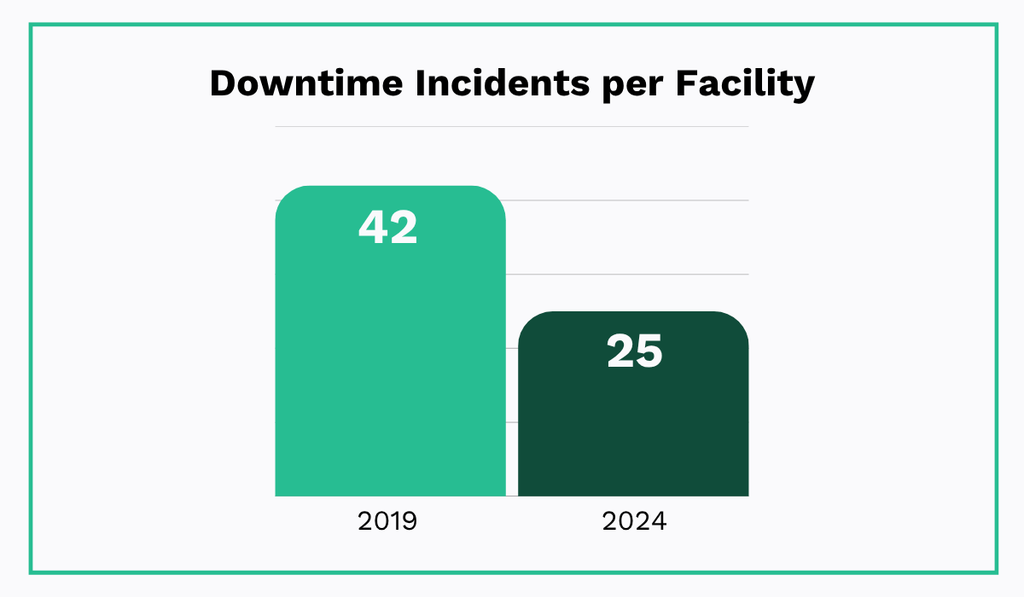
They found that, on average, each facility experiences 25 downtime incidents a month, as shown in the chart below.
As we can see, this is a 41% drop from 2019, when the average was 42 incidents.
The report explains that the number has dropped due to the rise of predictive maintenance (PdM), which uses equipment data to detect early signs of failure.
Manufacturers can now predict many mechanical failures because these technologies have become common.
So, while the report shows that the cost of each hour of downtime rose in most sectors, fewer incidents mean total losses grow more slowly.
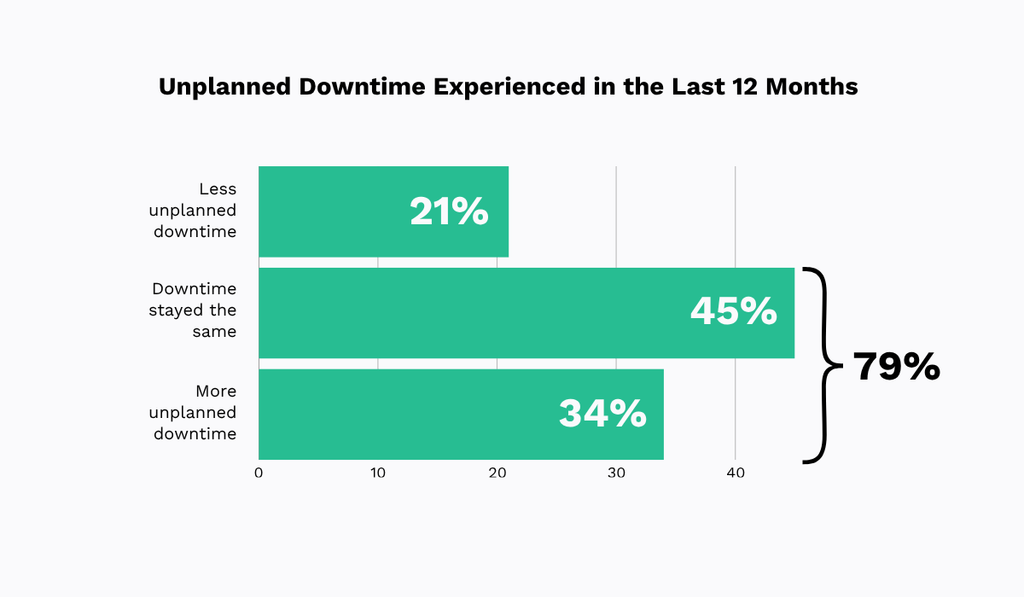
For 79% of Maintenance Teams, Unplanned Downtime Held Steady or Increased Over the Past Year
Two years later, we can see a slightly different trend.
The report also found that facilities lose an average of 30 hours of production to downtime each month, and 17 of those hours are unplanned.
This means most of this downtime is not caused by scheduled repairs or planned inspections, but directly affects production that has already been scheduled.
Planned downtime can be arranged around delivery dates, but unplanned stops cannot.
When a line stops without warning, orders are delayed, and customers notice.
Reducing unplanned stops helps you meet production targets and deliver orders on time.
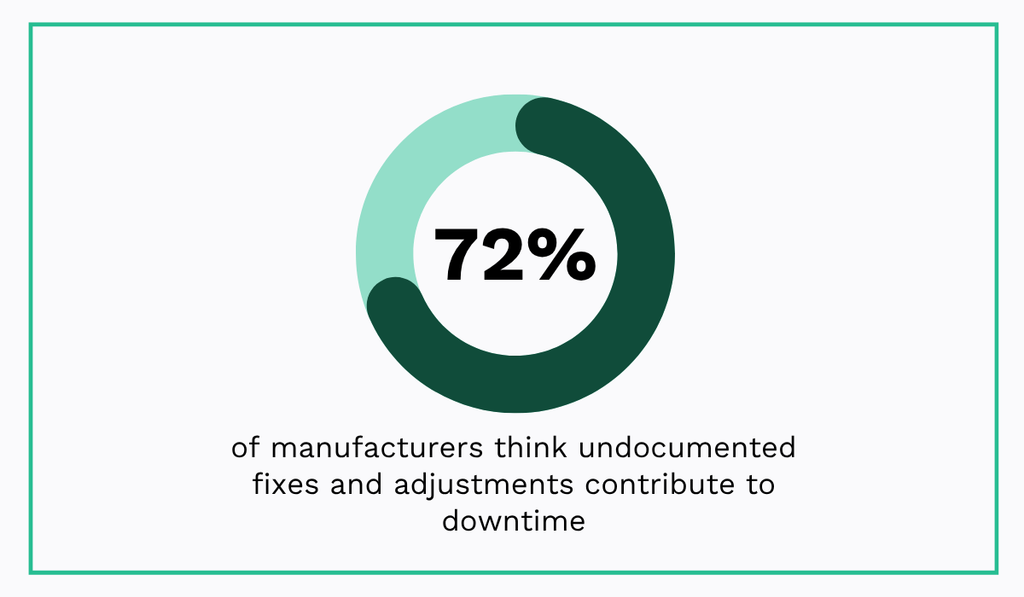
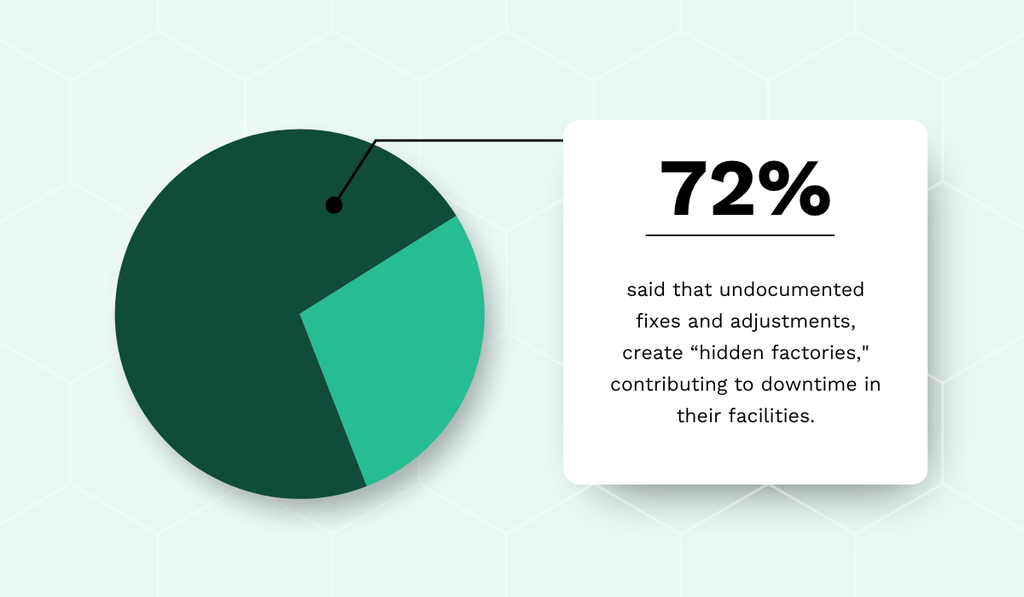
72% of Manufacturing Teams Say Undocumented Fixes Contribute to Downtime
One cause of this widespread problem is described in the same L2L report.
The researchers asked manufacturing leaders what they think contributes to unplanned downtime, and the majority named undocumented work as a major cause.
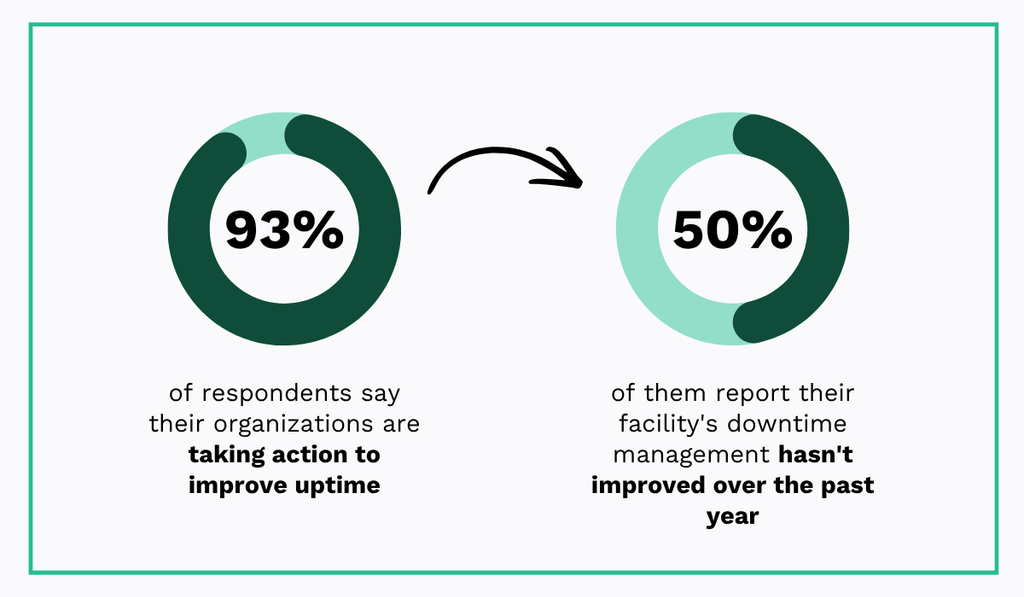
Unfortunately, half of the same respondents also report that their downtime management hasn’t improved in the last 12 months, despite these efforts.
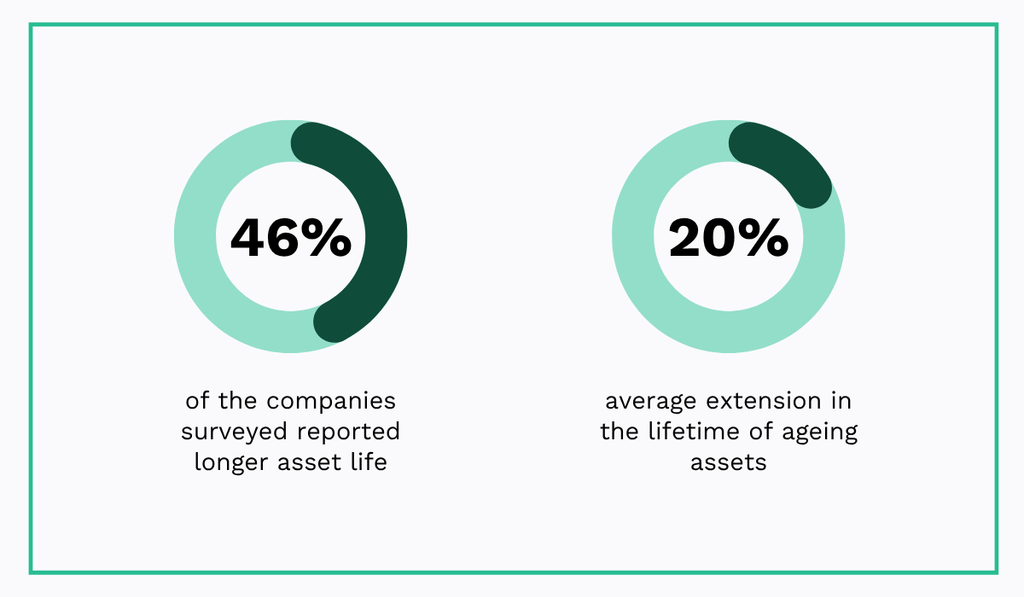
That being said, 46% saw improvements over the same period.
Out of this group, 64% said stronger maintenance protocols, such as clear inspection schedules and repair procedures, were the main reason their downtime decreased.
Improved training, better inventory tracking, and greater visibility into operations also helped reduce their downtime.
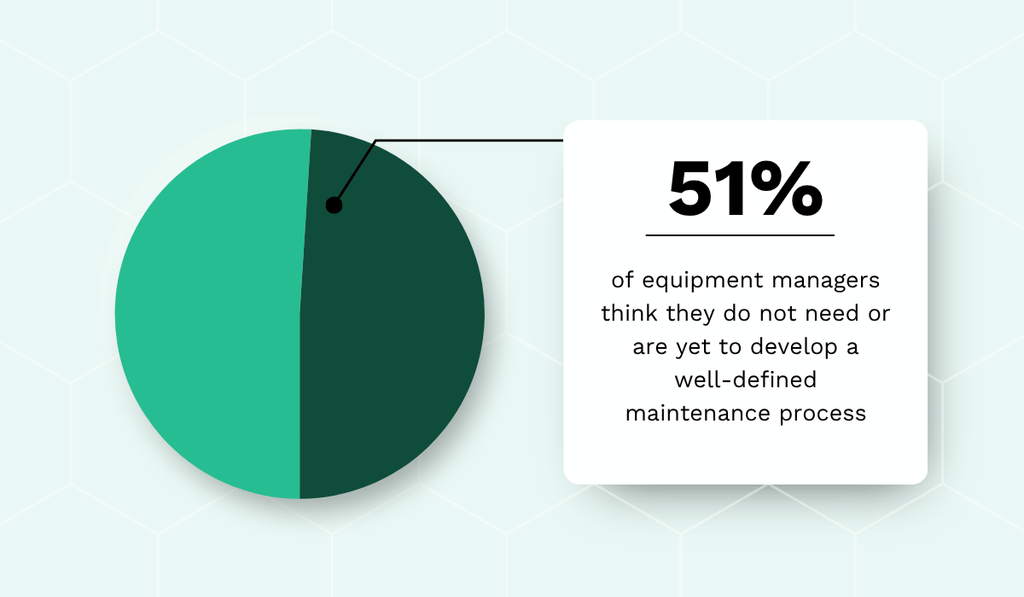
51% of Equipment Managers Don’t Have a Well-Defined Maintenance Process
While a strong maintenance process is key to reducing downtime, not every organization has one.
More specifically, 28% want to develop a better process, while 23% believe they don’t need a formal process.
Having a structured way to maintain equipment is necessary to prevent downtime, but the report states most organizations rely on informal practices nobody has reviewed closely.
Those that had well-defined processes for maintenance and other areas were more likely to rate their overall systems as extremely effective.
This means it’s worth checking processes for gaps, such as equipment without an inspection schedule or repairs with no written procedure.
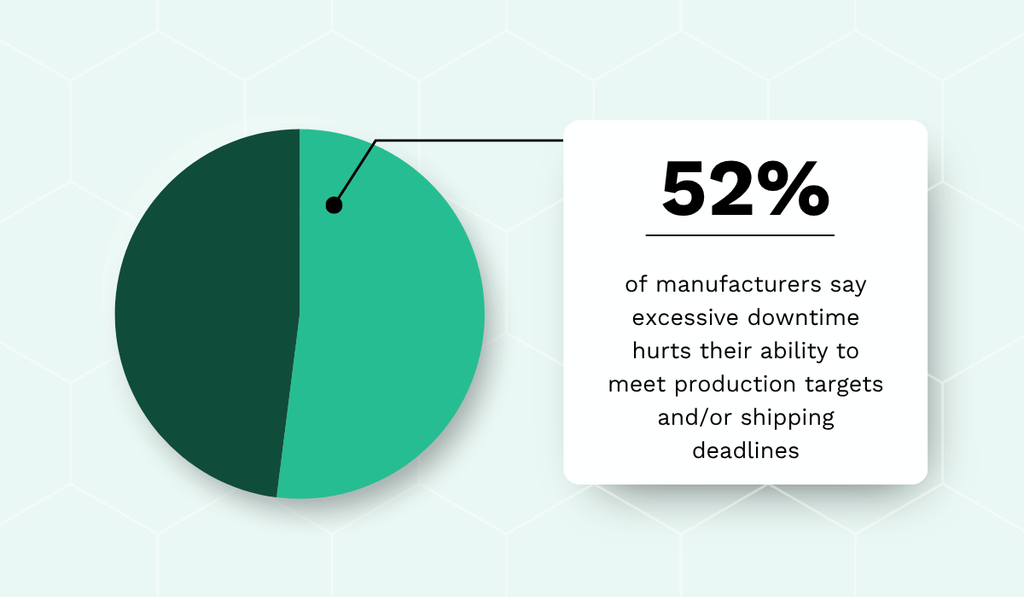
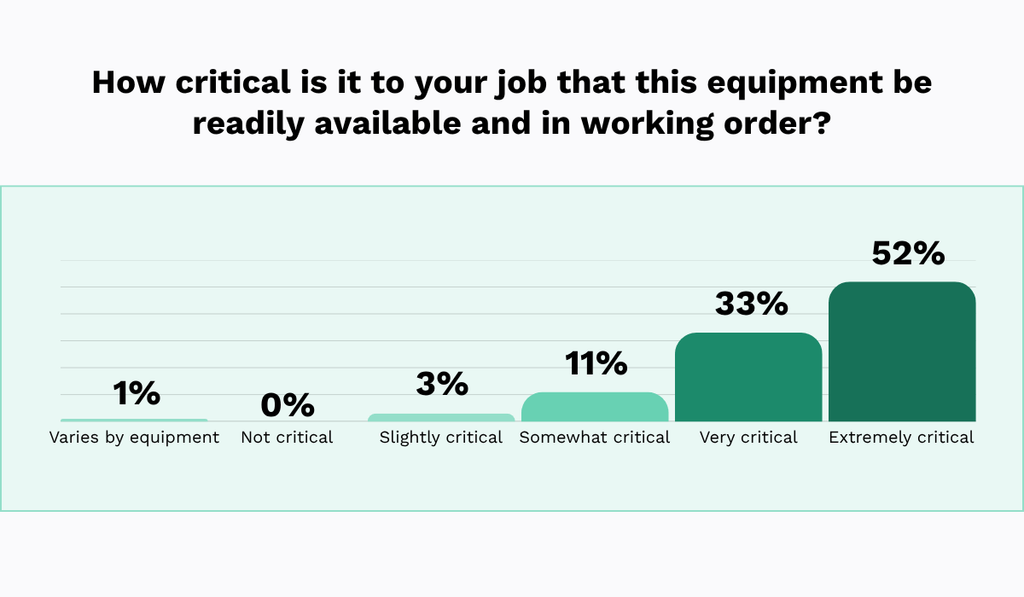
52% of Equipment Managers Say Equipment Availability Is Extremely Critical to Their Job
The same report highlights the importance of equipment being readily available.
When asked how critical it is that this equipment is available and working, respondents answered as shown below.
This data should come as no surprise, since 85% rated availability as very or extremely critical.
Their daily work depends on these assets.
When equipment stops working unexpectedly, the work planned around it is delayed, and other teams have to wait.
As one respondent put it in the Cheqroom report:
Production deadlines get postponed which then dominos down the line affecting everything from production times, to finishing times, and even to the customer receiving it.
This chain of delays the respondent describes is important to consider.
Even a minor part of a production line can stop the whole line when it fails, so maintenance needs to be planned and completed on schedule.
So, it’s a good idea to identify the assets operations depend on most and check that each has a maintenance plan.
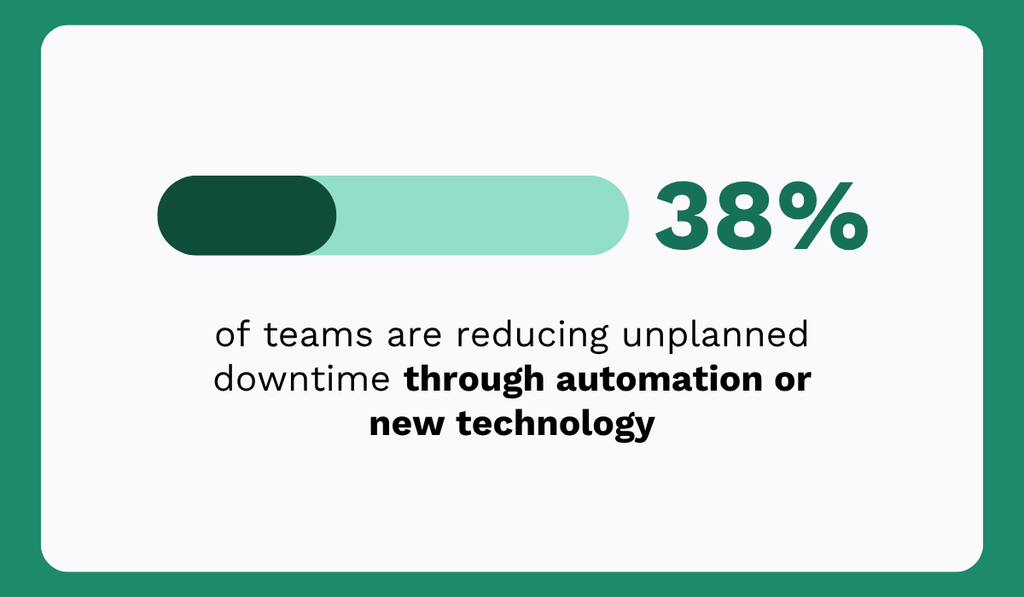
38% of Teams Are Reducing Unplanned Downtime Through Automation or New Technology
Technology is a big part of how maintenance teams reduce downtime.
Sensors, software, and automated systems can detect problems earlier and reduce manual work.
In fact, the MaintainX report found that many leaders plan to invest in new technology or automation over the next year to reduce downtime.
The chart below shows how many teams are using this approach to reduce unplanned downtime.
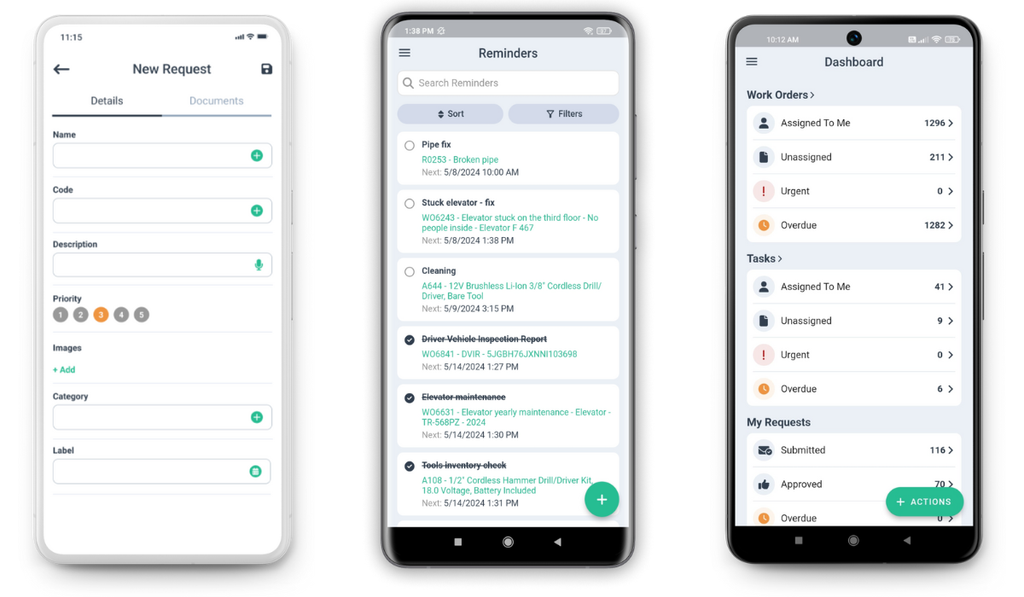
Its preventive maintenance scheduling creates work orders automatically, so inspections happen before equipment fails.
Each work order also records who fixed what and when, so no repair goes undocumented.
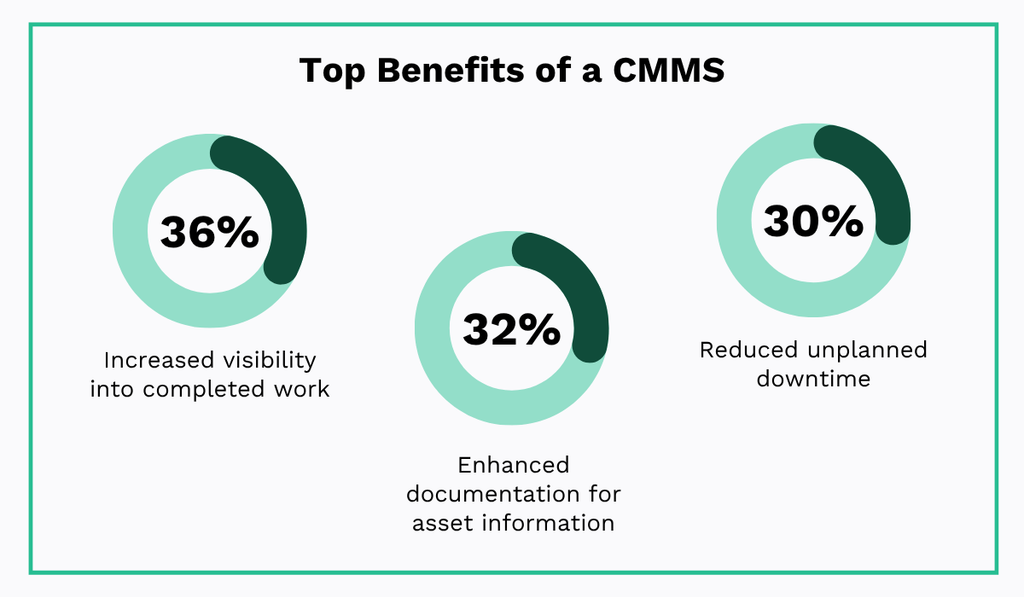
This provides the documentation and visibility that UpKeep’s respondents valued most.
With a CMMS, teams can plan maintenance around the assets that fail most often, instead of reacting to each breakdown.
Conclusion
The data in this article shows that unplanned downtime is frequent, expensive, and not decreasing for most teams.
But it also shows that teams with clear processes and complete records see improvement.
The main takeaway is that reducing downtime starts with knowing where and why it happens.
A good next step is to review your own maintenance records for the gaps described above.
Every improvement you make lowers the chance of the next unplanned stop.
5 Manufacturing Work Order Software Options Worth Considering
Choosing work order software for a manufacturing facility can get confusing pretty quickly.
Mainly because most work order software covers the same basics, such as creating and assigning work orders, scheduling jobs, tracking labor and parts, and keeping a record of completed work.
They all have some sort of work request form and a calendar to schedule work.
However, there are some nuances that distinguish them and make them more or less appropriate for a manufacturing facility’s needs.
With that in mind, here are five work order software options to consider.
WorkTrek
Our own CMMS, WorkTrek, keeps work order management pretty straightforward.
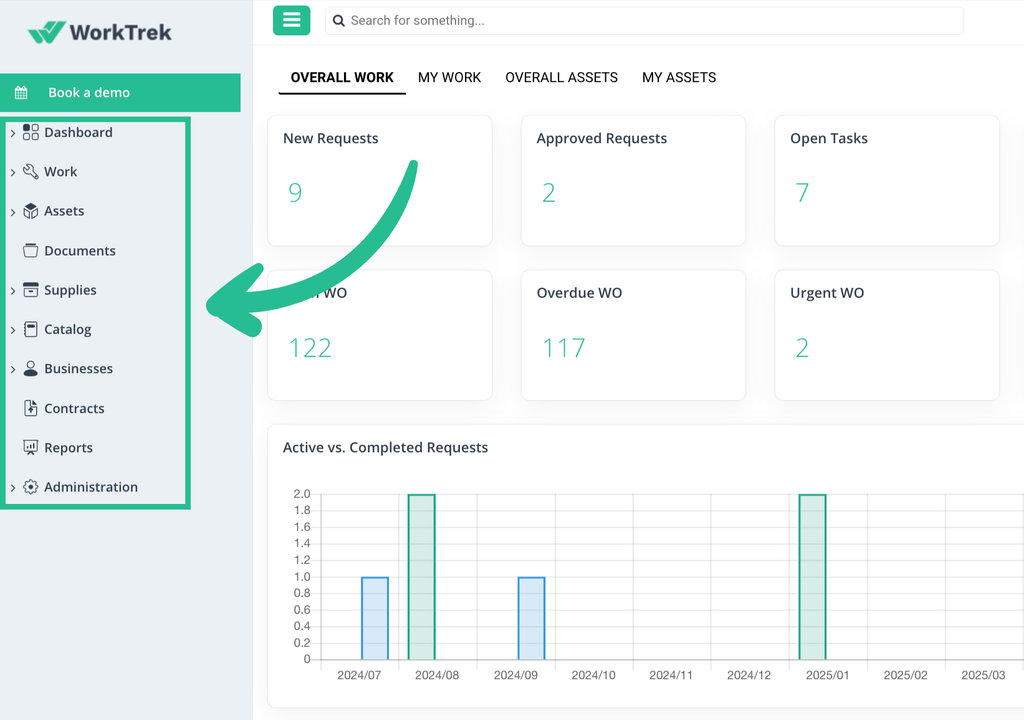
You get all the features you would expect from a work order system, but they are organized in a dashboard that is easy to learn and use.
You can also manage work orders from the mobile app, which is useful when you are on the shop floor rather than sitting at a computer.
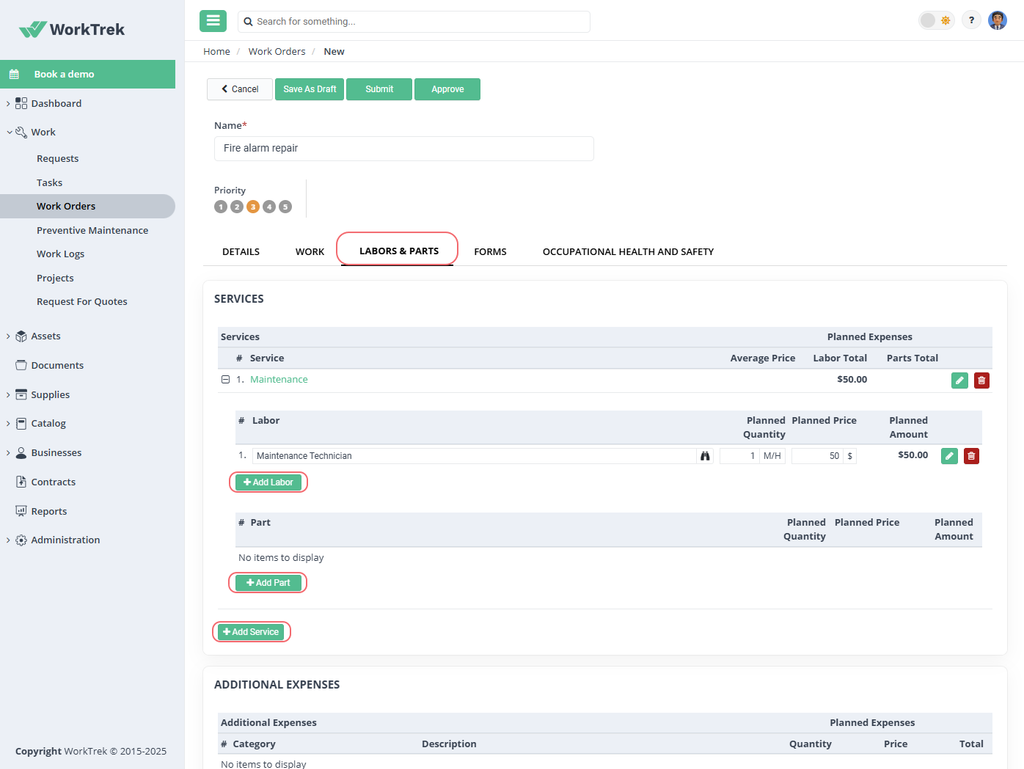
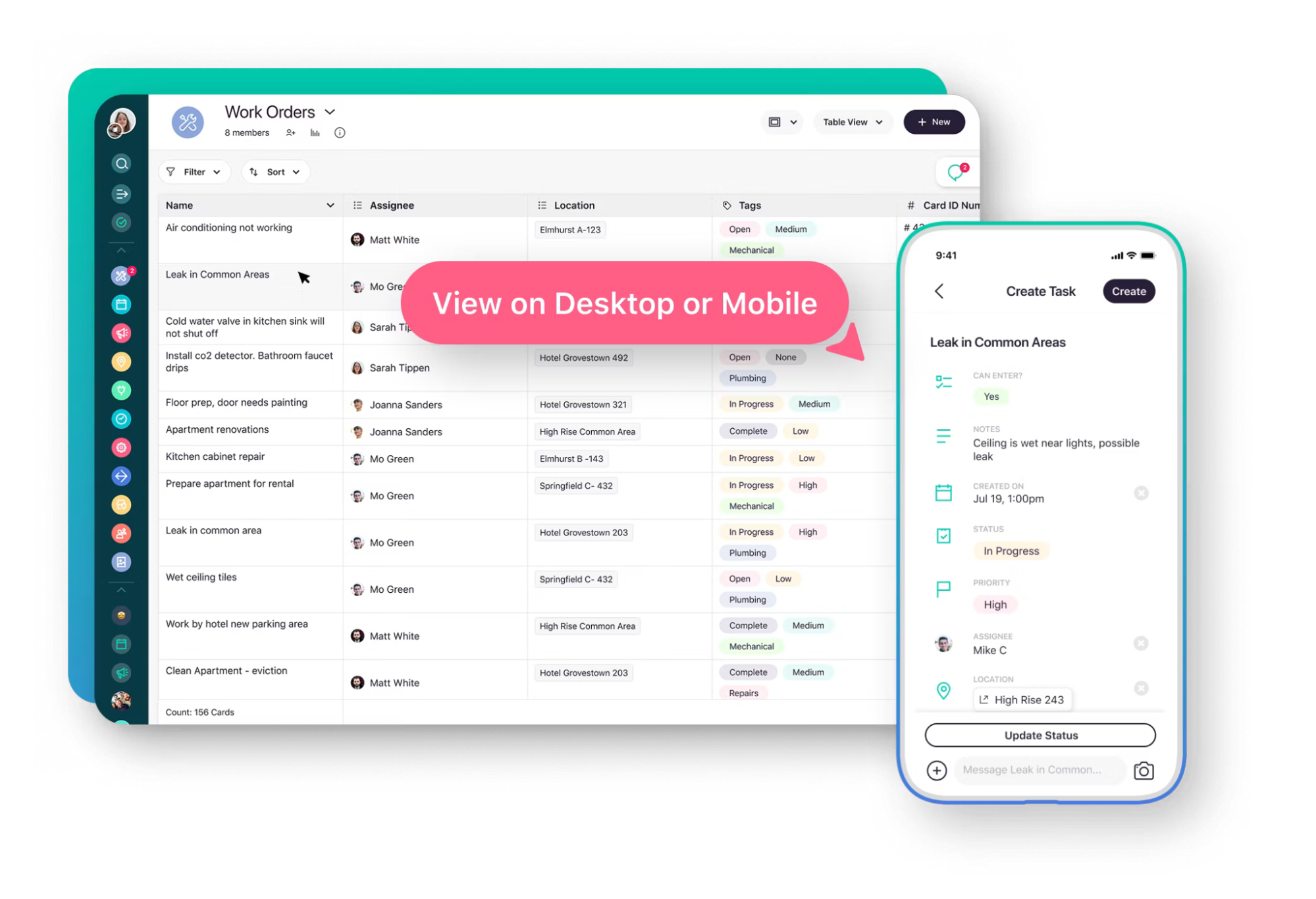
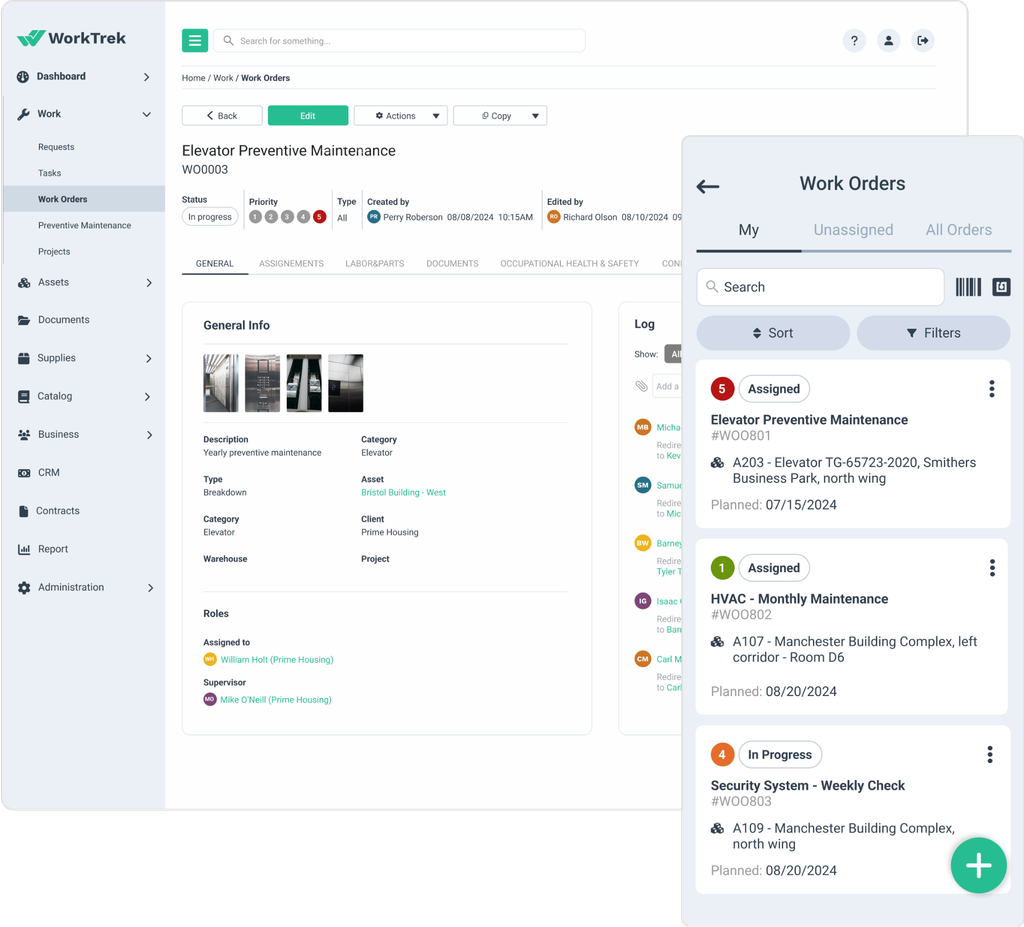
As you can see below, there is quite a lot you can add to a WorkTrek work order.
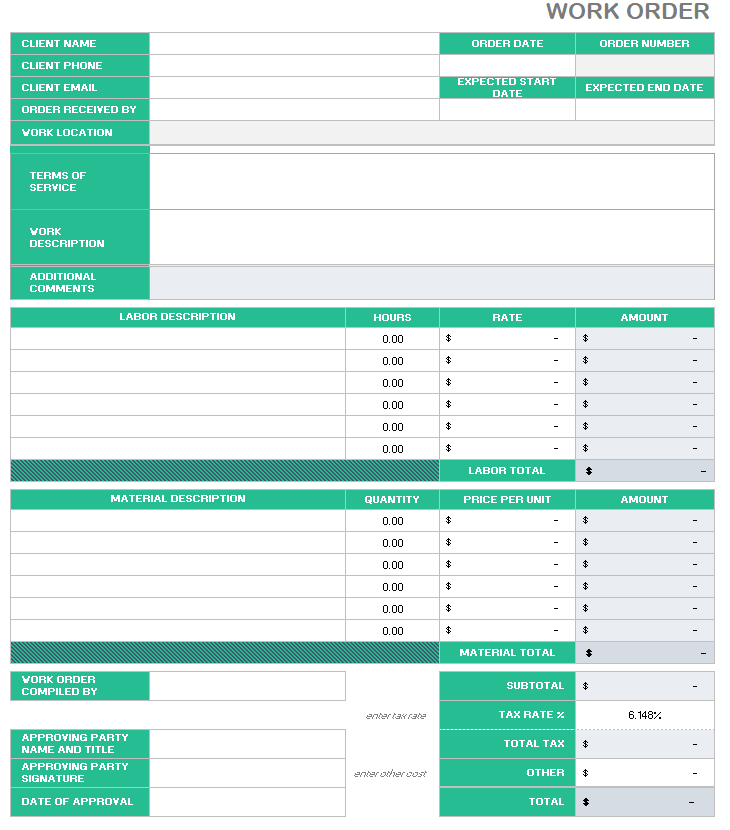
You can link it to an asset, set the priority and assignee, schedule the work, and track labor, parts, materials, expenses, documents, photos, and signatures.
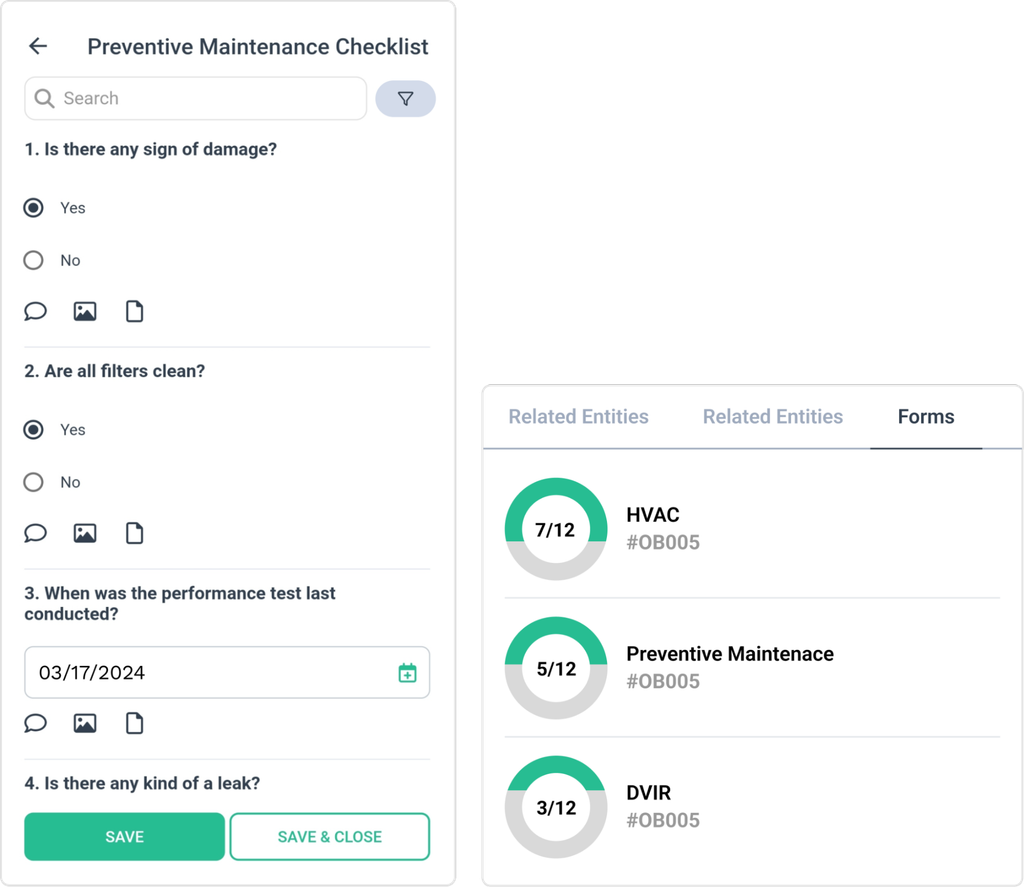
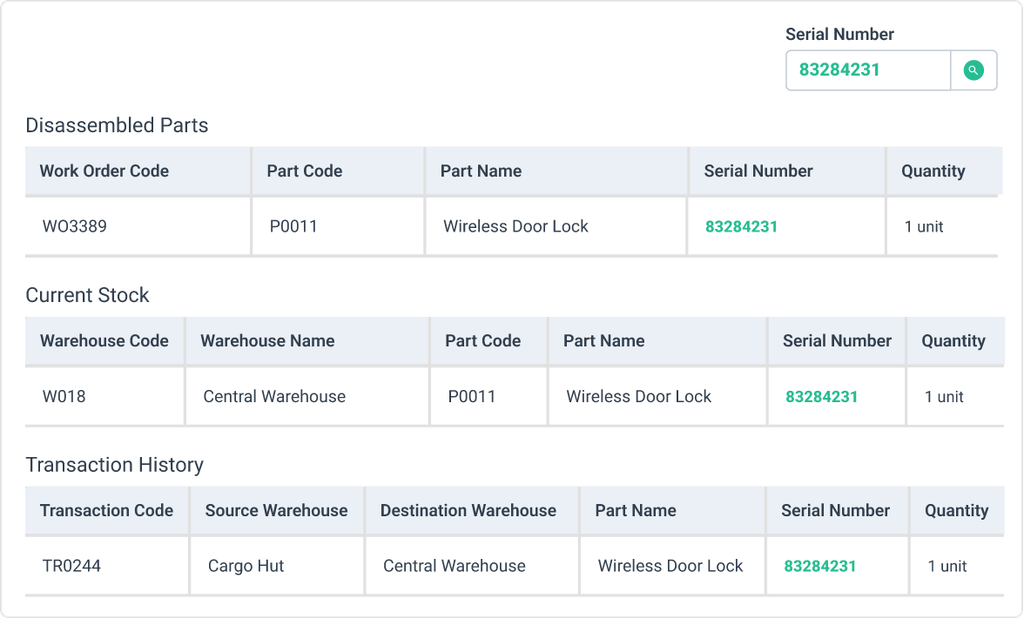
You can also add checklists, safety information, and work history, while serial-numbered and disassembled parts give you more detailed tracking when you need it.
Most work order software lets you record many of the same details. What stands out more is how WorkTrek lets you get to the work order in the first place.
A work order can start as a regular maintenance request, but it can also come from a preventive maintenance schedule or an inspection.
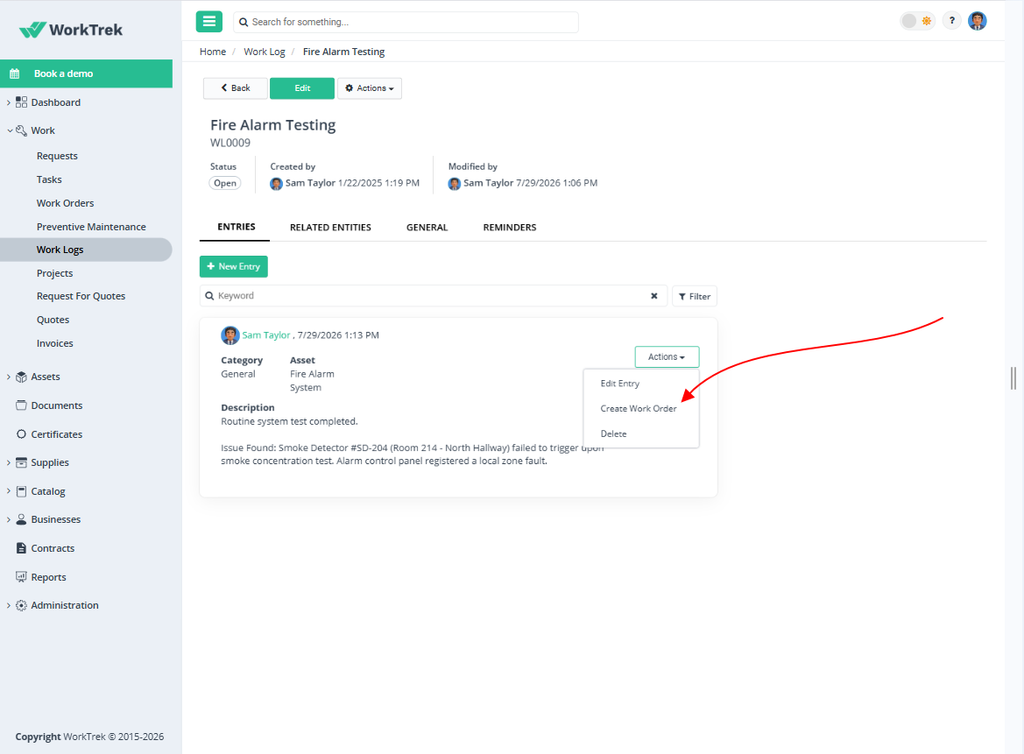
You can even turn a work log entry into a work order.
For example, a technician can record an issue in a work log, and you can use that information to create a work order.
The asset and description carry over automatically, so you don’t have to enter the same information again.
You can then add anything else you need, such as the priority, assigned personnel, labor and parts, due date, or additional instructions.
That can be particularly useful when your technicians record problems as they find them and someone else handles the actual work-order planning.
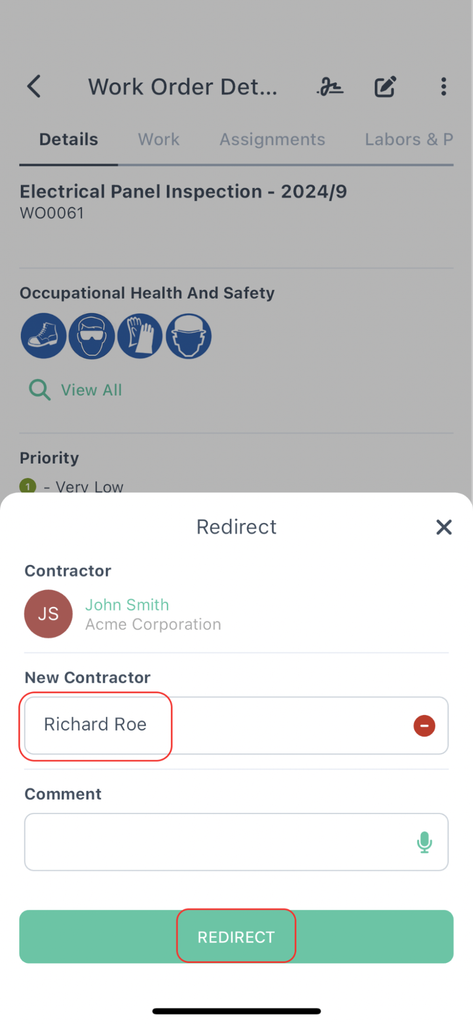
It is also worth mentioning that in WorkTrek, you can easily redirect a work order to another technician if the original technician/contractor is not available, without having to enter all the information again.
Basically, you can customize work orders to your needs, and that is what our clients appreciate most.
Ashley M. Stadelmaier, Production Planning and Procurement Specialist at Cygnus Manufacturing Company, confirms:
“One of the things we love about WorkTrek is that it is fully customizable, so it fits perfectly into our operations and meets all our needs… WorkTrek is intuitive and easy to use.”
When it comes to cost, WorkTrek has three pricing plans, starting at $29 per user per month.
If you are mainly looking for straightforward work order and asset management, Starter covers the basics.
If you need more maintenance and inventory capabilities, Professional adds those tools, while Enterprise gives you more room to adapt the software to your existing processes.
Of course, these are just some of the features WorkTrek offers.
If you want to see how it would fit into your manufacturing facility, you can try it for free and explore our software firsthand.
FMX
FMX is another work order software that covers the usual work order basics and brings requests, scheduling, technician assignment, mobile work, inventory, and reporting into one system.
One of the most useful parts is its calendar.
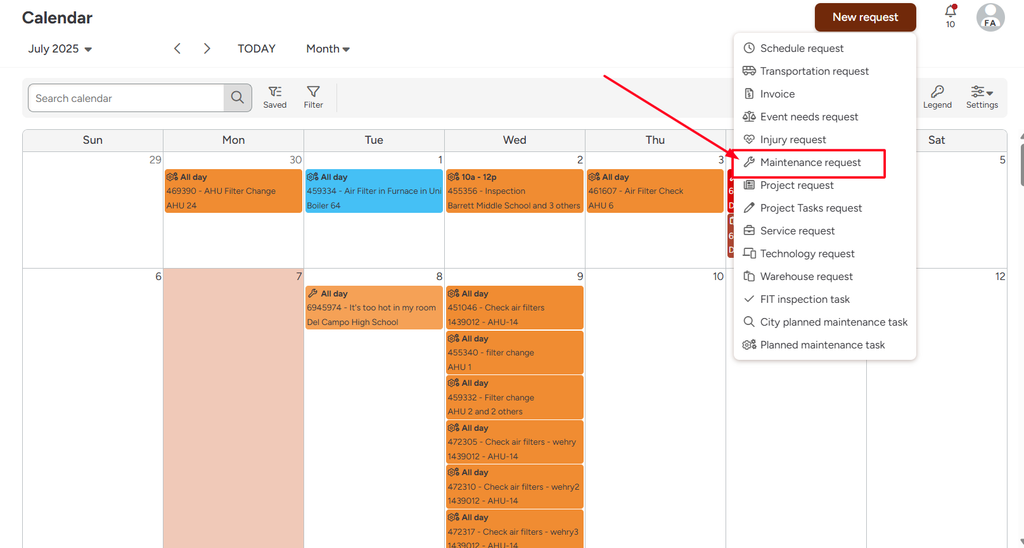
You can create a maintenance request or planned maintenance task directly from the calendar, and supervisors can drag and drop work to adjust assignments and schedules.
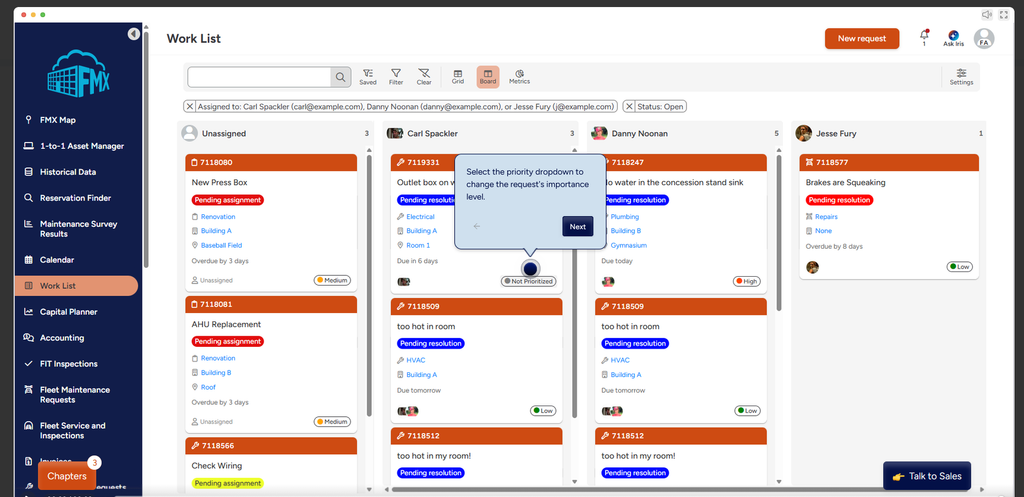
This can be helpful when you manage several technicians and need to see what is coming up, who is handling each job, and where you may need to adjust the workload.
Work orders can also come from several other places.
You can create them manually, or FMX can generate them from inspections, scheduled preventive maintenance, or external integrations. So, like in WorkTrek, you are not limited to creating every work order manually.
Once a technician gets the job, the workflow is also fairly familiar to WorkTrek’s.
They can open the work order from their phone, record labor hours and parts used, add photos, and complete the work from the mobile app.
FMX can also automatically update on-hand inventory when parts are used on a work order.
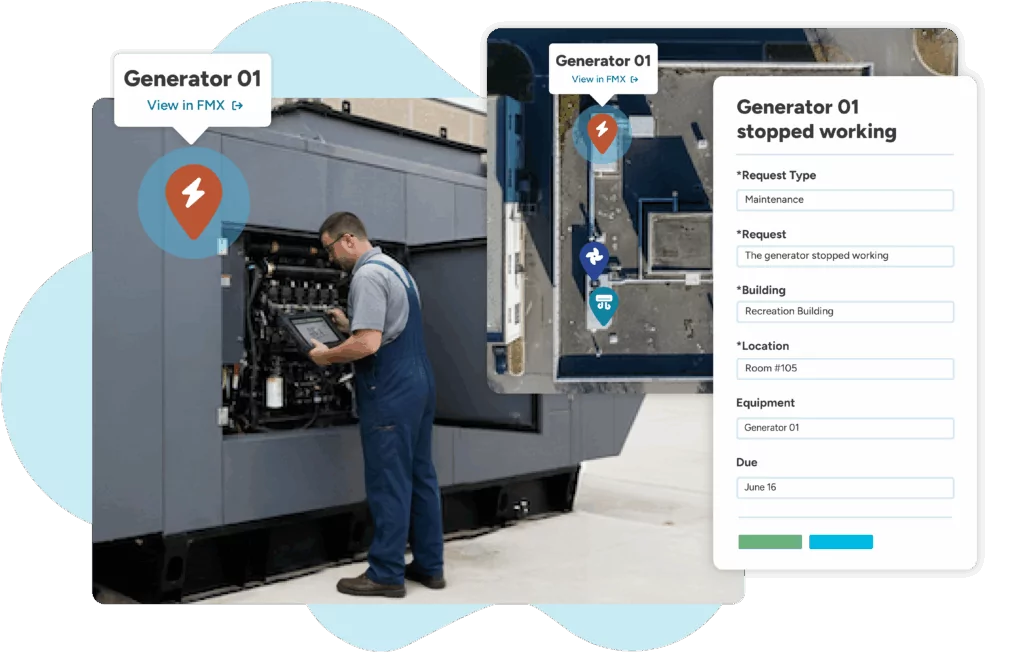
Another practical feature is interactive mapping. You can see open work on a map, which can help when technicians need to handle jobs across a larger facility or multiple locations.
But there are also some specific issues to keep in mind.
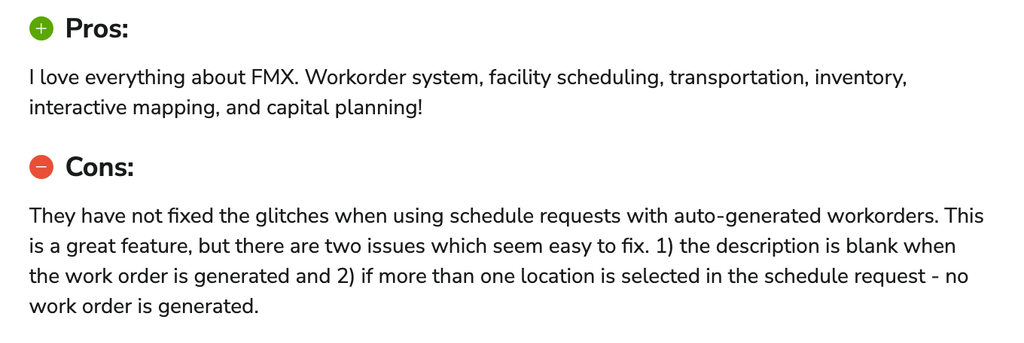
The same reviewer reported glitches when using Schedule Requests with automatically generated work orders.
According to the review, the generated work order can have a blank description, and selecting more than one location in a schedule request may prevent a work order from being generated.
That is worth considering if you plan to rely heavily on automated work order creation from scheduled requests.
FMX does not publish standard pricing for its plans. You need to contact the company for a quote, and there is also a one-time implementation fee.
Additional fees may apply for in-person implementation and other services.
OxMaint
OxMaint takes a fairly structured approach to work orders.
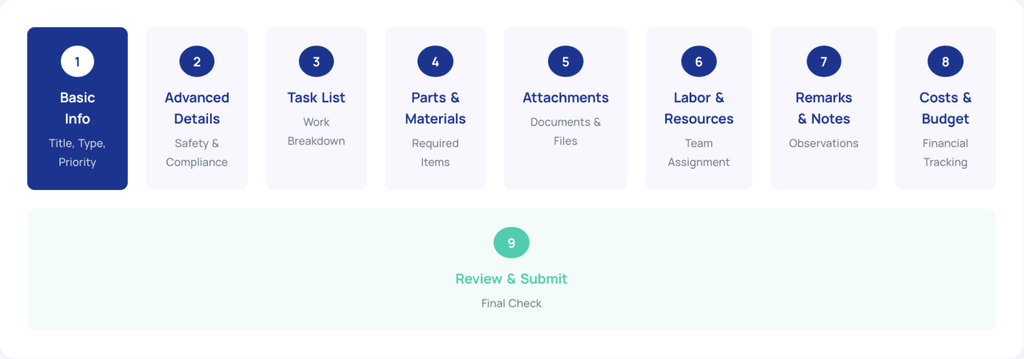
Its 9-step workflow takes you from basic information and safety requirements through tasks, parts, labor, attachments, costs, and notes before you review and submit the work order.
İt also has mobile apps for iOS and Android, so technicians can create, view, and manage work orders from the field.
But the more interesting part is what OxMaint can do to create and trigger work orders.
Its Synapse AI Assistant can generate a work order from a description of the maintenance need and suggest the task breakdown, required parts, safety procedures, labor time, and estimated costs.
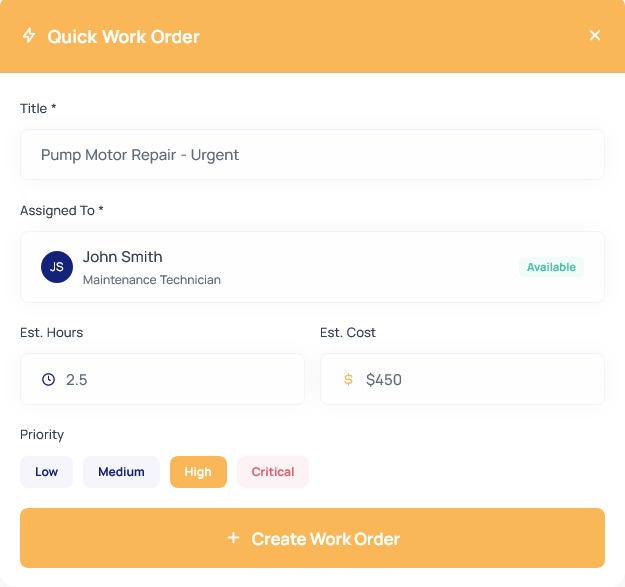
For urgent repairs, Quick WO lets you create and assign a work order with only the essential information and fill in the rest later.
You can also link work orders dırectly to planned shutdown periods.
This is a useful detail for manufacturing because planned downtime can give maintenance teams a window to work on equipment without interrupting production unexpectedly.
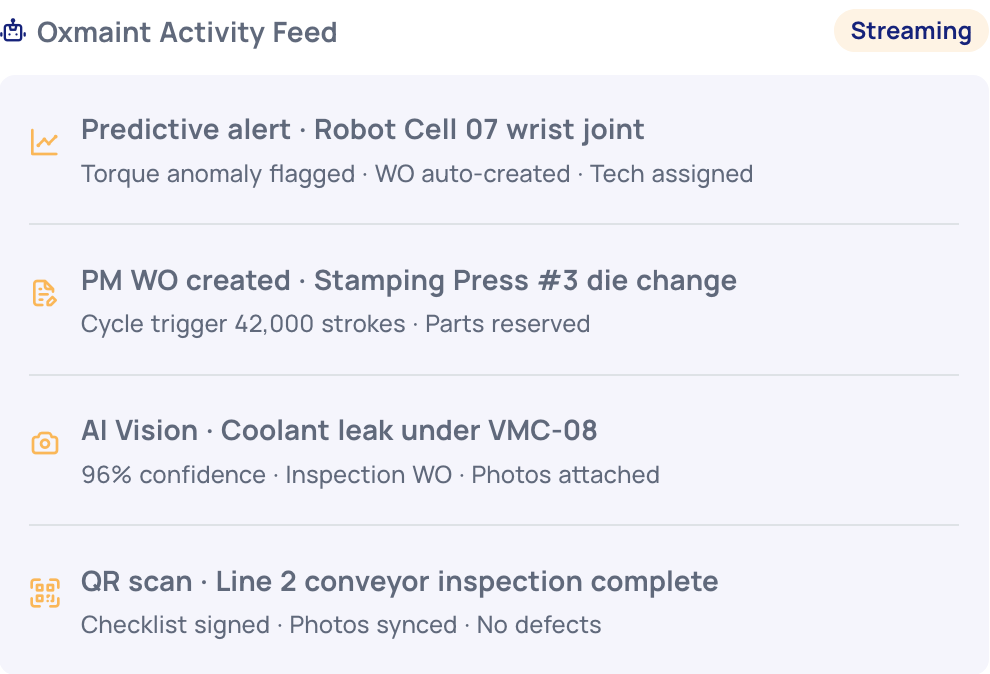
For manufacturing, OxMaint also supports cycle-based preventive maintenance, so you can trigger work based on runtime, parts produced, strokes, or spindle hours.
Its predictive maintenance tools can use sensor data to detect anomalies and automatically create work orders, while work order data can feed into downtime and OEE tracking.
When it comes to user feedback, there is one thing to keep in mind.
This software has ratings in mobile app stores and publishes customer testimonials, but it has limited independent feedback on software-review platforms.
Capterra and Software Advice currently do not have a substantial collection of user reviews, making it harder to get a clear picture of how people use the software in real-world manufacturing environments.
İt has four plans: Lite is free and allows up to three work orders per month, Pro costs $19/user/month, Agentic costs $49/user/month, and Enterprise uses custom pricing.
The main difference between Pro and Agentic is the addition of AI-powered maintenance capabilities in the Agentic plan.
iFactory
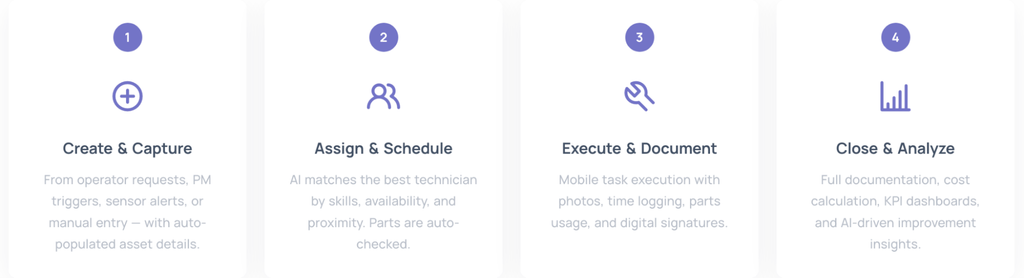
iFactory AI divides the work order management process into four steps:
The first step covers operator requests, preventive maintenance triggers, sensor alerts, or manual entry, with asset information automatically added to the work order.
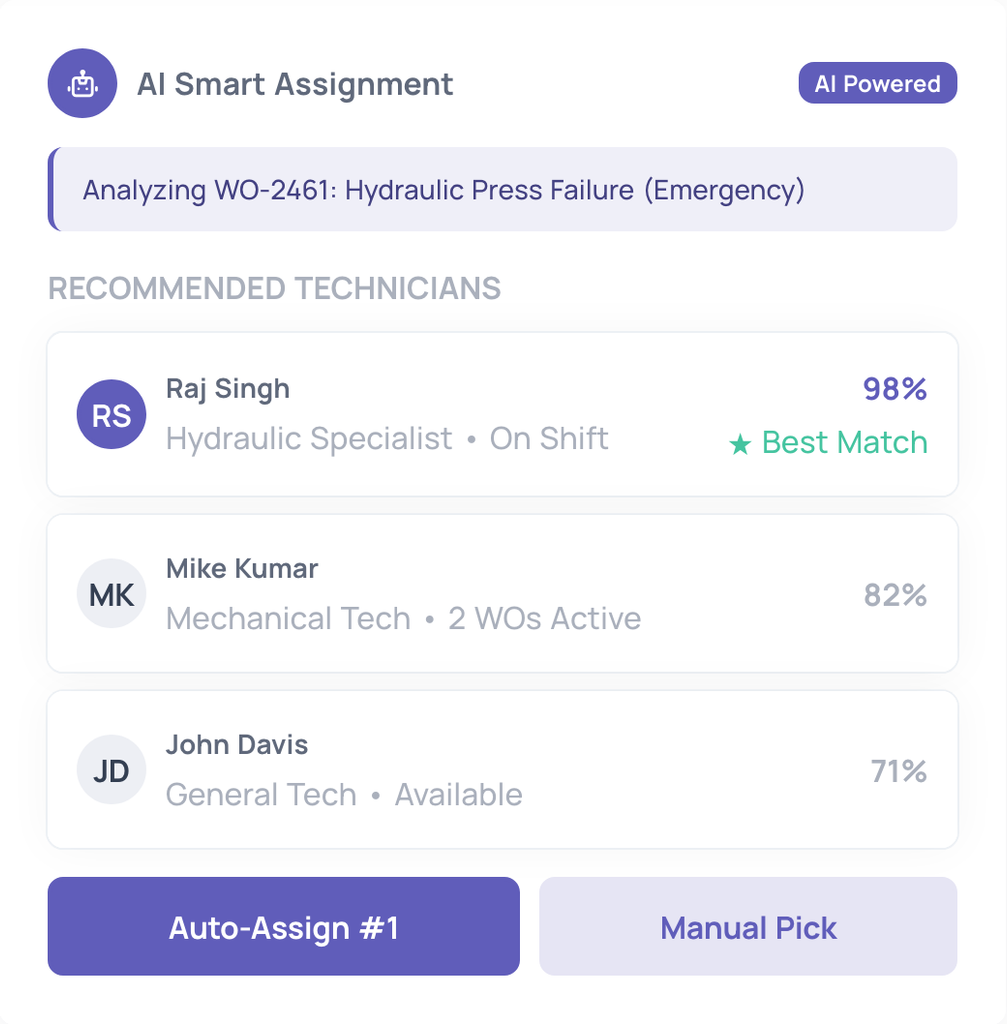
The assignment step is where iFactory puts more emphasis on AI. Its Smart Assignment Engine can match a work order to a technician based on skills, certifications, workload, shift schedule, availability, and proximity.
It can either assign the job automatically or provide ranked recommendations for a supervisor to approve.
Once the work is assigned, technicians can manage it from the mobile app, including task checklists, photos and videos, time and parts tracking, barcode or QR scanning, and digital signatures.
The app also works offline and syncs updates when the connection is restored.
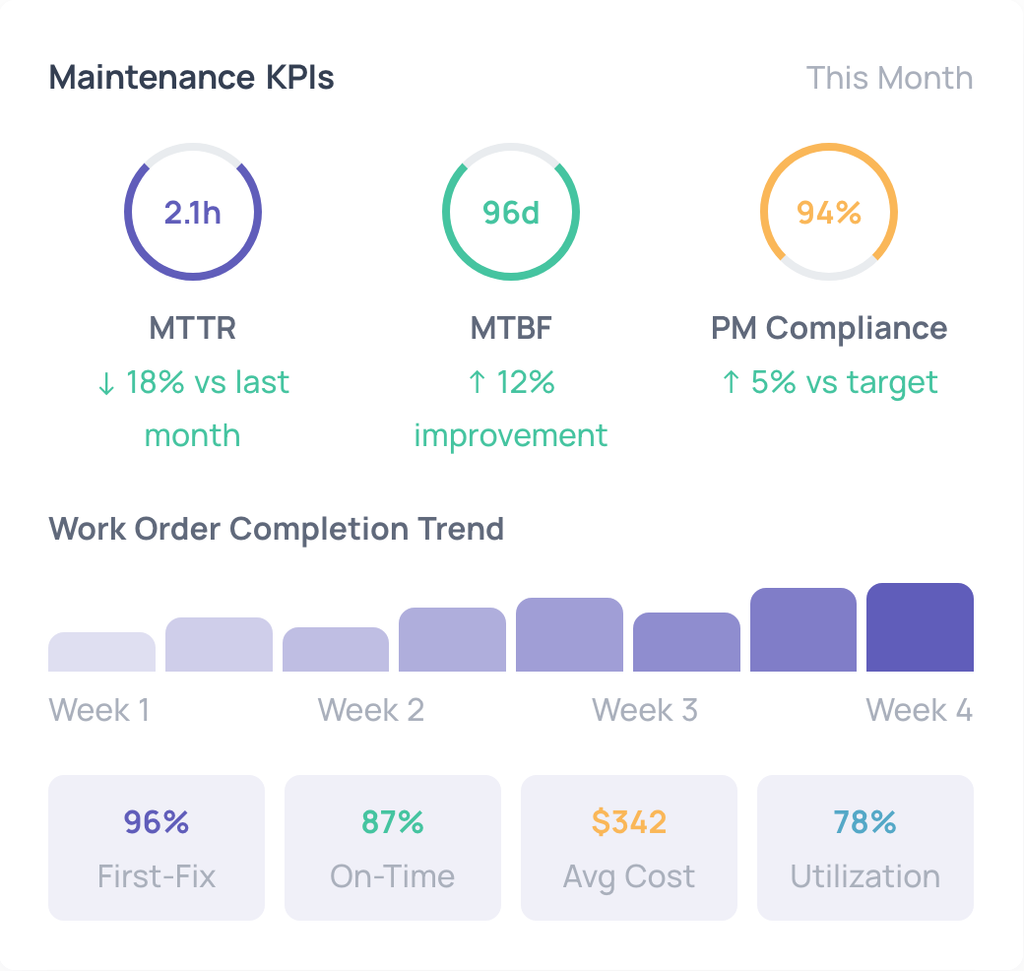
iFactory also puts a lot of information around work orders into dashboards and reports. You can track metrics such as MTTR, MTBF, PM compliance, backlog aging, work order costs, and technician productivity, with options to drill down and export reports.
Another useful part is the maintenance request portal. Operators and other employees can submit a request with an asset, photo, and urgency, and approved requests can be converted into tracked work orders.
For manufacturing teams, iFactory also connects work orders with parts, labor, inventory, safety, and production data.
This makes the system less about simply creating and closing work orders and more about connecting the maintenance job with what is happening around it.
Do keep in mind, though, that there are currently no substantial independent user reviews available on the main software review platforms, so most of the information available about its features comes directly from iFactory.
iFactory AI also doesn’t publish standard pricing. The cost depends on the setup and modules you need, so you need to contact the company for a quote.
Snapfix
Snapfix takes a notably visual approach to work order management.
Instead of asking technicians or other frontline employees to fill out a traditional maintenance request, you can create a task using a photo, video, voice note, or QR code.
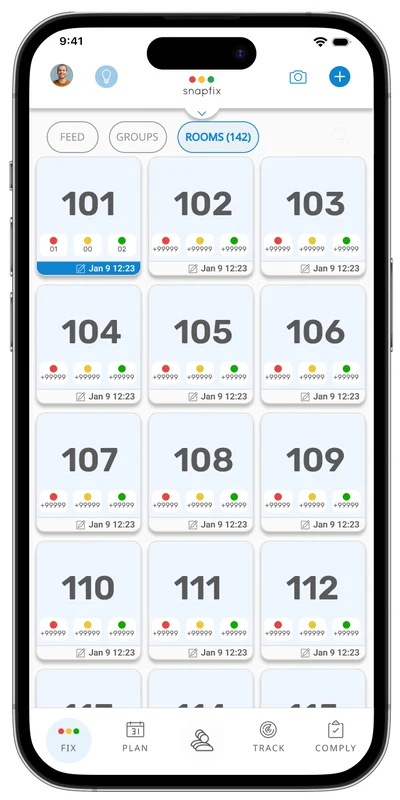
The traffic-light system is probably the easiest feature to recognize.
The three dots that also appear in the Snapfix logo show the status of a task at a glance: red means it still needs attention, yellow means it is in progress, and green means it is done.
That may sound simple, but it is also what makes Snapfix different from a more traditional work order system.
The idea is to make reporting and checking tasks quick and visual, especially for people who do not spend their whole day working in maintenance software.
You can also scan a QR code attached to a room, asset, or piece of equipment to create or view related tasks.
Preventive maintenance schedules, offline access, voice notes, and a multilingual interface add to the same focus on quick, practical use in the field.
Another feature worth mentioning is Snapfix Rooms. It lets teams keep track of all tasks connected to a particular room or unit, including maintenance, inspections, and cleaning.
This feature is especially useful in hotel and property operations, where teams need to keep a history of everything that happens in a room, but the same idea can also be useful for facilities and other multi-site operations.
Snapfix has particularly strong roots in hospitality and property management, but the company has also extended its photo-first workflow to manufacturing and industrial maintenance.
For a manufacturing team, the main appeal is therefore less about having a completely different set of work order features and more about making it easier to report, understand, and track work visually.
What do users say about this approach to maintenance?
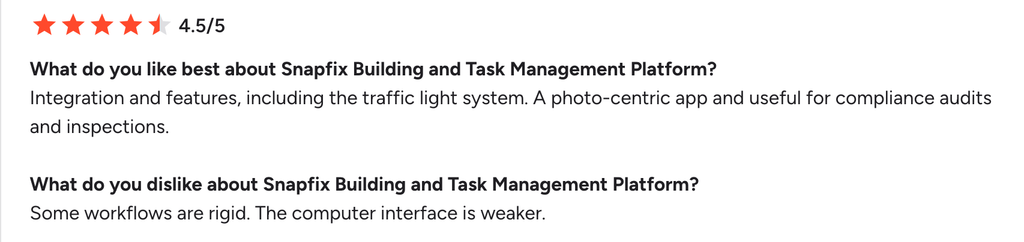
Users on G2 like the photo-centric approach and traffic-light system, with one reviewer also mentioning their usefulness for inspections and compliance audits.
There are some criticisms, too. The same reviewer found certain workflows too rigid and felt that the desktop interface was weaker than the mobile experience.
Snapfix does not use a simple public per-user pricing model. You need to contact the company for pricing based on your requirements.
Conclusion
At the end of the day, most work order software can do the basics. It all comes down to what you actually want your maintenance team to get out of it.
Maybe scheduling is your biggest headache, or you want AI and machine data to take more work off your team’s plate.
Or maybe you just want technicians to be able to report an issue without filling out a dozen fields.
That’s really what to look at when comparing these tools – how they will fit into your team’s day-to-day work.
Maintenance Workforce Statistics: Technician Shortages, Skills Gaps, and the Future of Maintenance Work
Every maintenance program depends on the people who perform it.
That’s why in this article, we examine the latest statistics on maintenance technician demand, retirement, and skills gaps.
We will also look at some of the steps organizations are taking in response to these maintenance workforce changes and what that means for you.
Installation, Maintenance, and Repair Employment Is Projected to Outpace Average Job Growth Through 2035
The maintenance field is growing, and it needs more workers every year.
Its Occupational Outlook Handbook projects how employment in each occupation will change between 2025 and 2035, including installation, maintenance, and repair jobs.
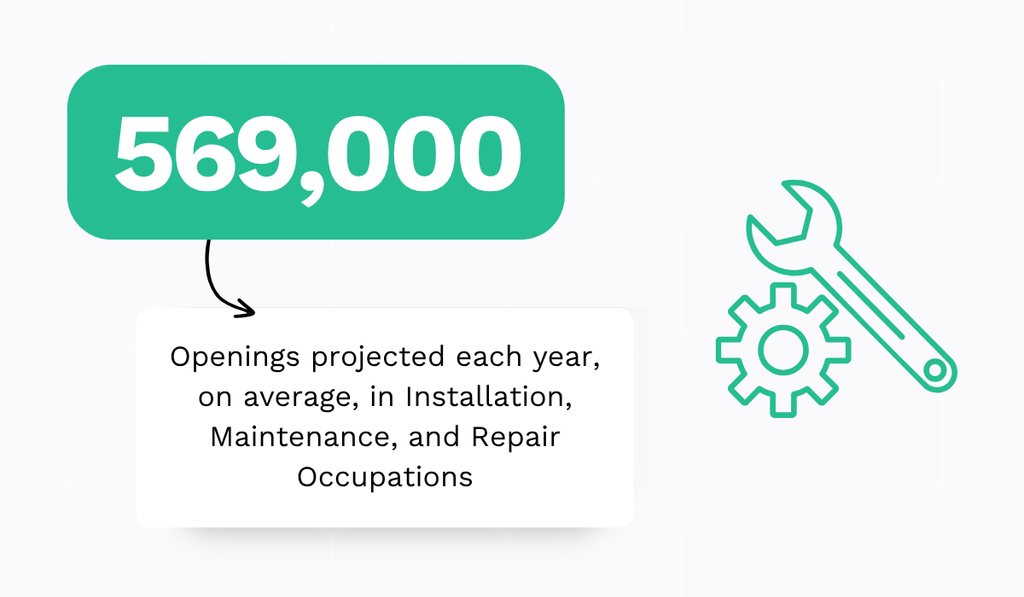
According to these projections, more than half a million positions in this group will open each year, on average.
Part of these openings comes from the growth of the field itself.
Factories are installing more automated machinery, and every new conveyor or production line needs technicians to maintain it.
BLS expects employment in these occupations to grow by around 5% between 2025 and 2035, compared to 3% for all occupations on average.
Some maintenance positions are projected to grow especially fast.
For instance, employment of electrical power-line installers and repairers is projected to grow by 10%, while the outlook is 14% for industrial machinery mechanics, machinery maintenance workers, and millwrights.
For maintenance managers, this means more employers will compete for the same limited number of positions.
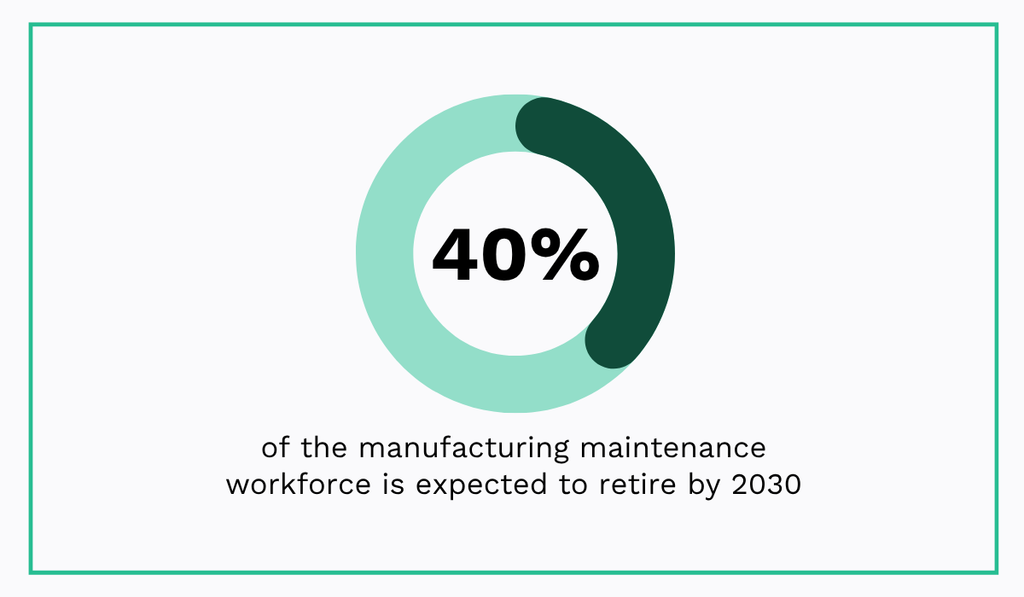
40% of the Manufacturing Maintenance Workforce will Retire by 2030
While some of the job openings we just covered come from industry growth, many come from the need to replace workers who leave.
In fact, retirement is becoming one of the biggest workforce challenges in maintenance.
In other words, two out of every five of these workers could leave their jobs within the next few years.
This is happening because the workforce is aging, and many technicians who started decades ago are now close to retirement.
The same report found that 69% of maintenance professionals are already 50 or older.
For maintenance managers, an increasing priority is to record what these technicians know before they leave.
Much of that knowledge, such as how a specific machine behaves or which repairs worked in the past, exists only in their memory.
But organizations also need to consider who will replace these workers.
After all, written procedures are useful only when there are trained technicians to follow them.
43% of Industrial Businesses Struggle to Recruit Maintenance Staff
Unfortunately, when organizations look for people to replace departing technicians, many find the search difficult.
ABB, a global electrification and automation company, examined this in its 2023 Value of Reliability survey.
The survey, conducted by Sapio Research in July 2023, collected answers from 3,215 plant maintenance decision-makers across 11 sectors, including energy, metals, and rail.
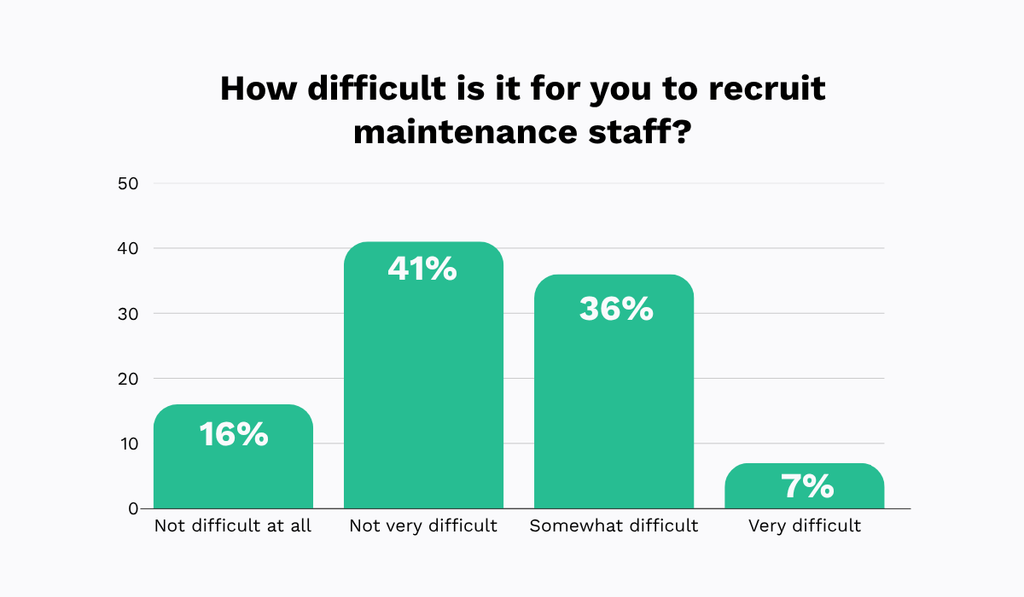
One of the questions asked was how difficult it is for these decision-makers to recruit maintenance staff.
Their answers were split across four levels of difficulty, from not difficult at all to very difficult.
Fortunately, the majority of respondents, 57% in total, do not find recruiting qualified maintenance staff difficult.
That said, a large percentage, or 43%, find recruitment at least somewhat difficult.
For these plants, positions stay open longer while the existing team covers the extra work.
Some industries are affected more than others.
The sectors that find recruitment the most difficult are the following:
Metals (54%)
Water and wastewater (52%)
Rail (49%)
Oil and gas (47%)
Overall, recruitment difficulty is relatively split in half.
For plants that operate in one of the tougher sectors, it’s a good idea to plan ahead and start hiring maintenance roles earlier than what’s typical for other roles.
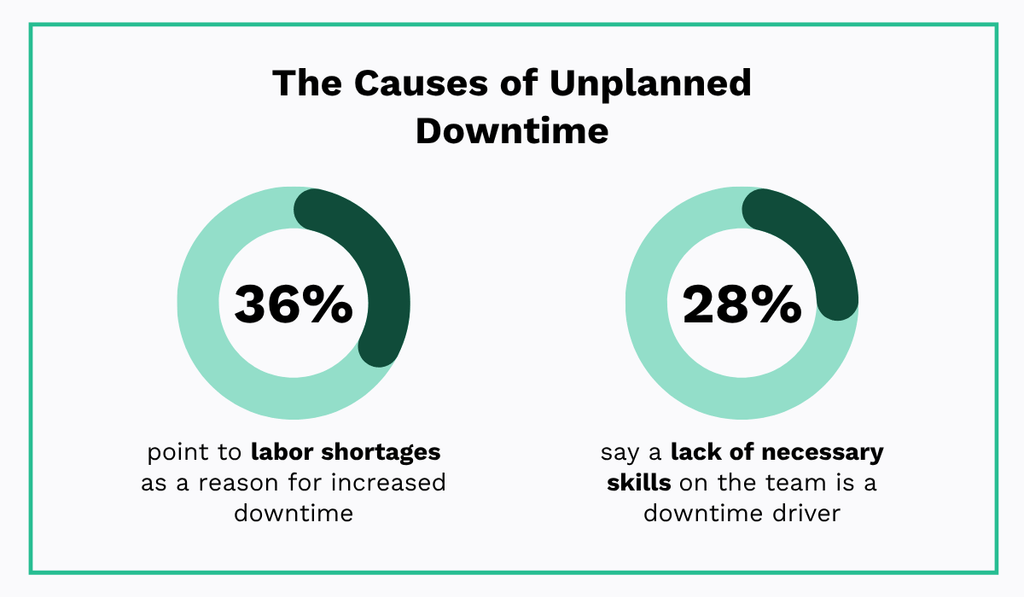
36% of Maintenance Professionals Blame Labor Shortages for Increased Unplanned Downtime
Workforce shortages also have a direct effect on unplanned downtime.
This was one of the topics in the State of Industrial Maintenance 2026 report by MaintainX, a maintenance software company, which surveyed 2,234 maintenance and operations leaders across the United States and Canada.
Among them, 34% said their facility experienced more unplanned downtime in the past 12 months.
When asked about the reasons for this increase, respondents included two workforce issues among the top causes, as illustrated below.
Labor shortages mean fewer technicians are available to respond to failures and complete planned work on time.
When a team is short on technicians, preventive tasks are postponed, and minor faults have more time to develop into breakdowns.
As a result, maintenance backlogs grow, and equipment runs longer between inspections.
The second issue is also worth examining, since it concerns skills rather than the number of workers.
In fact, as experienced specialists retire, newer technicians often take over equipment they have not worked on before and need more time to diagnose problems.
As an industry, this means we need to focus on capability as well as headcount, so that the right knowledge is available when a machine fails.
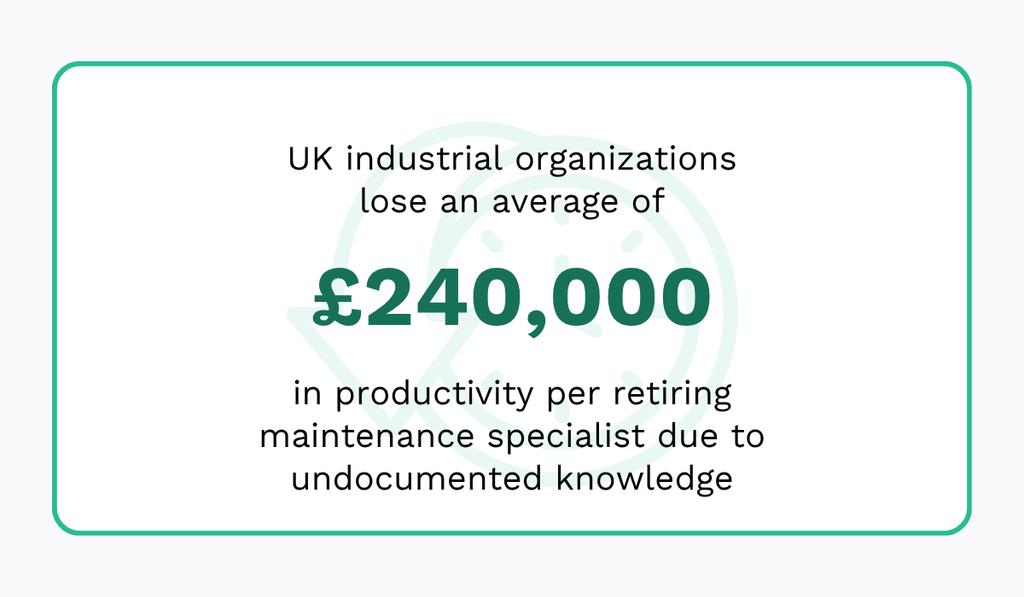
Industrial Organisations Lose About £240,000 in Productivity per Retiring Maintenance Specialist
Another study quantified the effect of some of these workforce changes.
The report combines a survey of 103 UK maintenance and reliability professionals with roundtable discussions and 30 interviews with industry leaders.
According to the report, UK industrial organizations lose almost a quarter of a million pounds in productivity each time a maintenance specialist retires.
The main reason is that much of their knowledge was never documented.
The report divides this issue into three parts:
Limited formal documentation
Past maintenance decisions and their reasons are not stored in systems
Informal knowledge transfer
In other words, when a specialist retires, the organization loses information that cannot be found in its own records.
This makes knowledge loss a financial problem as well as an operational one.
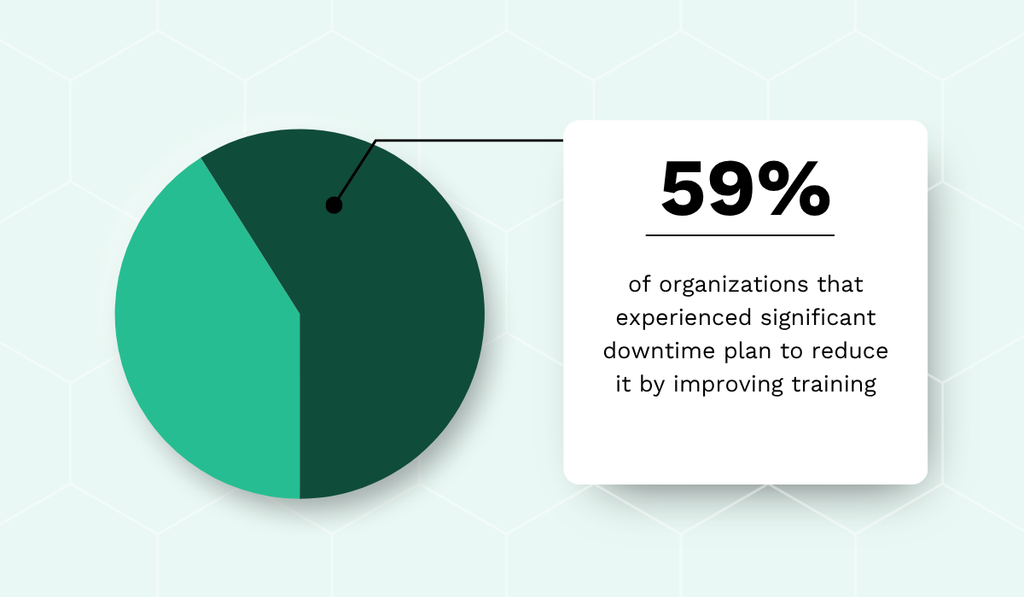
59% of Organizations Facing Significant Downtime Plan to Improve Workforce Training
According to the MaintainX survey we highlighted before, plans for reducing downtime differ depending on how much downtime an organization has experienced.
Among the organizations with the largest increase in downtime, the majority plan to invest in their people through better training.
This kind of maintenance training can cover technical skills for specific equipment, troubleshooting methods, and the use of new maintenance technologies.
It’s worth highlighting that this 59% figure applies only to organizations that experienced significantly more downtime.
These organizations focus most on training, and 44% of them are also trying to hire more technicians.
On the other hand, organizations that had significantly less downtime focus elsewhere, mainly on replacing aging equipment and improving their overall maintenance strategy.
This is an understandable division.
Organizations with rising downtime are likely short of people or skills, so they address the workforce first, while those with stable operations can direct resources to equipment and planning.
So before deciding where to invest, it’s a good idea to examine where your operations stand in terms of the amount of downtime.
68% of Maintenance Professionals Acknowledge the Importance of Internal Experience for Skill Development
Knowledge is one of the most valuable resources a maintenance team has.
Often, only a few experienced technicians have this knowledge, and many of them will retire soon.
UpKeep, a maintenance software company, examined how teams develop skills in its State of Maintenance Report 2025, based on a survey of maintenance and reliability professionals.
A large majority of respondents agree that knowledge shared inside the organization is key to developing skills.
In fact, every completed job can be recorded with the asset involved, the steps taken, and the technician’s notes, creating a searchable history for each machine.
As a result, a CMMS like WorkTrek can serve as the basis for technician training.
Instead of relying only on informal conversations, they can study documented procedures and past work on an asset before starting a job.
This way, each technician’s experience stays with the organization even after a person leaves.
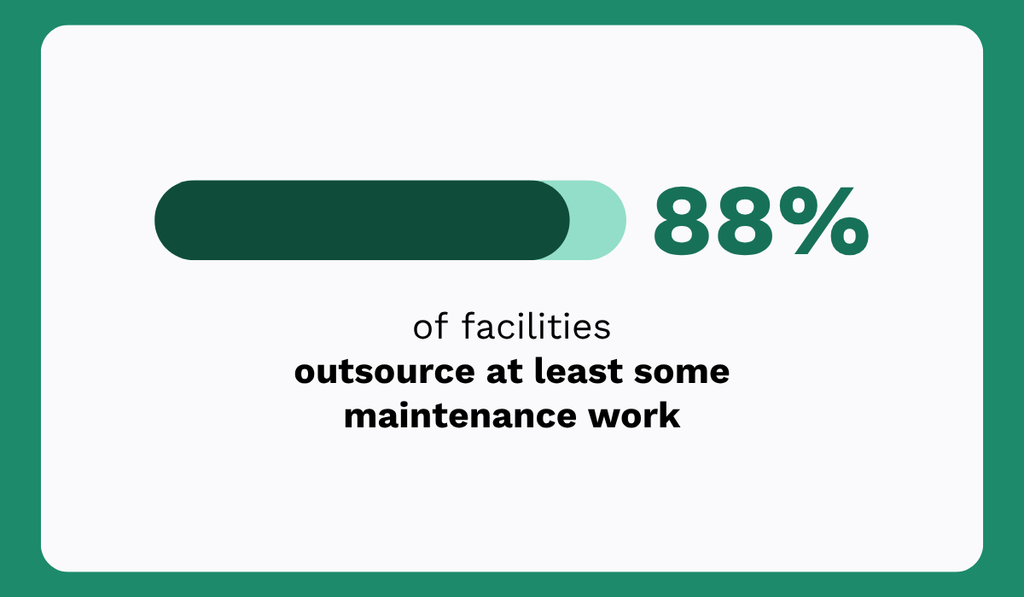
88% of Facilities Outsource at Least Some Maintenance Work
Technician shortages are not a problem organizations can solve quickly, as hiring and training can take months, if not years.
In the meantime, organizations rely on outside help to complete maintenance work.
According to Oxmaint’s report, the overwhelming majority of facilities assign at least part of their maintenance work to external contractors.
On average, these facilities outsourced 23% of their maintenance tasks.
This means contractors perform close to a quarter of the work, while internal teams handle the rest.
Outsourcing is often the only option when the team lacks the skills for a job, such as work on specialized equipment.
It can also cost less than employing a full-time technician for tasks that occur only a few times a year.
At the same time, outsourcing has downsides, since contractors know less about a site’s equipment and often leave no record of what they learned.
38% of Organizations Cite Apprenticeship Programs as Effective in Bridging Generational Gaps
In addition to outsourcing, organizations are starting initiatives to bring younger people into maintenance careers.
A key challenge here is motivation, since many young people do not consider maintenance an attractive career.
The work is often seen as physically demanding and less modern than jobs in technology.
The UpKeep survey we highlighted looked at youth engagement, and the chart below shows the share of respondents who named each of the three initiatives as effective.
As you can see, each of these approaches offers young people practical contact with maintenance work early in their careers.
They also connect newcomers with experienced professionals, which supports the knowledge transfer we discussed earlier.
This is meant to address the labor supply at its source by increasing the number of people who choose maintenance as a career.
As 54% of respondents find it difficult or very difficult to attract talent from younger generations, these efforts are becoming necessary.
Because training a technician takes years, the youth programs of today will determine how well teams handle retirements later in the decade.
Conclusion
The numbers show a field that needs more skilled people, as many experienced technicians are leaving.
The main thing to remember is that your team’s knowledge matters as much as its size.
Start recording that knowledge and investing in new people today, and your team will be ready for the changes ahead.
Keeping Your Air Compressor in Good Shape: Practical Maintenance Tips
Key Takeaways:
Electricity accounts for roughly 76% of what an air compressor costs you over its lifetime.
You need to stay mindful of typical service intervals, which vary by component.
Between 75% and 80% of plant failures trace back to human factors.
Your air compressor’s purchase price is about 12% of what it will cost you during its lifetime. Electricity is 76%.
Poor maintenance practices only increase these operational costs.
A clogged filter or saturated separator element can increase your power bill as it degrades months or years before a full breakdown.
If you want to keep your air compressor costs under control, you need to approach maintenance the right way. Below are six efficient habits that keep plant air safe and your costs predictable.
Generic checklists pulled from the internet don’t account for your machine’s specific lubricant type, duty cycle, or the ambient temperature in your compressor room.
Therefore, treat the manual as your single source of truth.
The most important thing it tells you is that service intervals are based on running hours, not on the calendar.
As FS-Curtis describes in its guidance on oil-flooded units, service is carried out at whichever comes first, hours or months, and you shorten those intervals by 25% to 50% in dusty, hot, or humid conditions (or when you’re running a food-grade lubricant).
Different units have different isolation points, and assuming yours matches the last one you worked on is how people get hurt.
Component
Typical interval
Watch for
Inlet air filter
~2,000 hours
Dusty plants need it sooner
Oil filter
~2,000 hours
Long-life variants differ
Oil sample for analysis
~2,000 hours
Often a warranty condition
Compressor oil
4,000 to 8,000 hours or annually
Mineral shorter; synthetic longer
Air/oil separator element
4,000 to 8,000 hours, or 10 psi pressure drop
Every 2 psi of drop adds about 1% to brake horsepower
Full PM, airend and valves
4,000 hours or annually
Hot or dusty rooms shorten the interval
As Lewis Systems notes in its rotary screw guidance, a separator element left past its pressure-drop threshold costs you horsepower for every hour of operation.
Remember that the manual also often doubles as your warranty contract, meaning ignoring it could further lead to extra expenses.
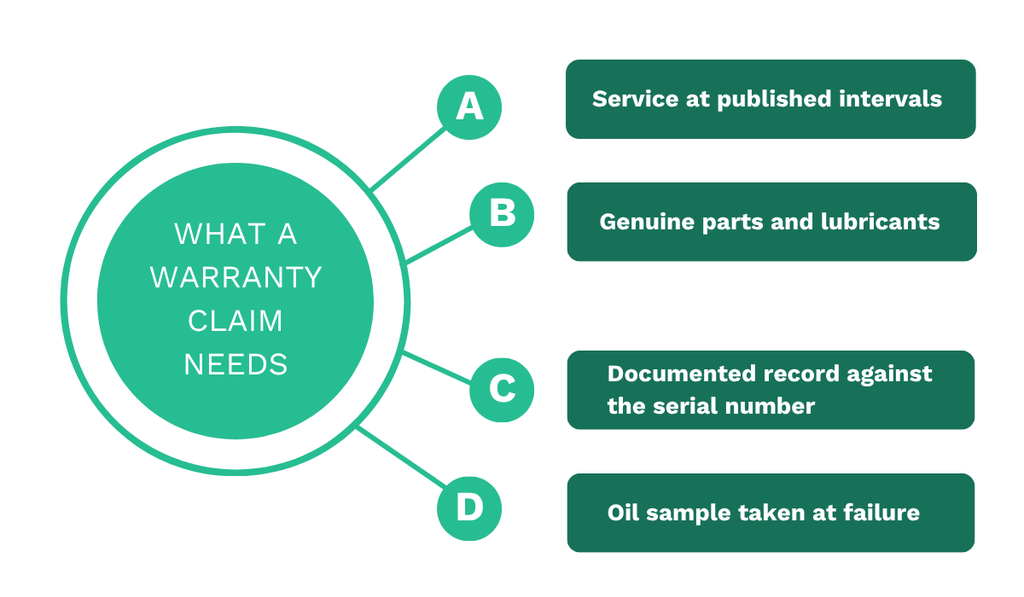
Atlas Copco’s extended warranty terms require that servicing is completed at the published intervals using genuine parts and lubricants, that the record of that work is logged against the specific machine serial number, and that an oil sample is taken at the time of failure for any claim to proceed.
Miss any one of those and a covered failure stops being covered.
So, before you build a schedule, read what the manufacturer already wrote for your machine.
Then plan maintenance around that.
Keep Maintenance on Track with a Checklist
The manual tells you what should happen, but it doesn’t solve issues on its own.
To keep your air compressor safe and secure against malfunctions, you’ll need a robust, readable checklist.
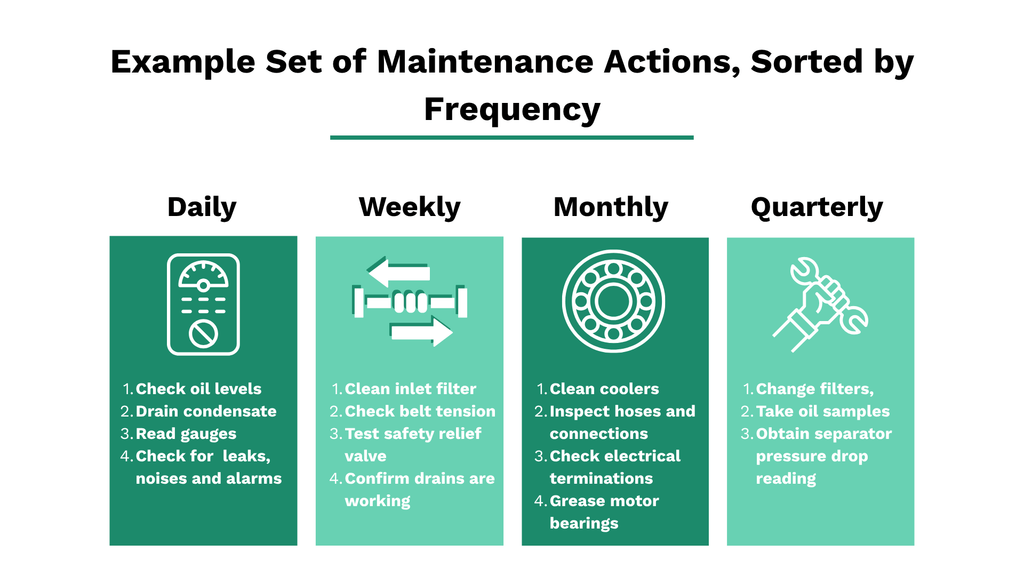
While the specifics of the checklist should depend on your facility, one universal rule worth adopting is the cadence and scope of maintenance actions.
Some technical aspects will require daily inspection; others can be checked on a monthly basis.
You might be surprised that gauge readings and oil level checks are daily items. This should be standard across many industries because of their function as predictors for deeper-set issues.
As Gregory Gilliland, Quality Manager at FS-Curtis, a manufacturer of compressed air and air treatment solutions, put it in an interview with Reliable Plant:
As he asserts, when a compressor’s energy use spikes with no link to something obvious, like increased production demand, “it’s a strong sign that something within the system is degrading or becoming inefficient.”
A structured checklist that can be easily accessed helps catch these issues before they escalate.
A technician cannot be expected to carry every tolerance and every task in their head, and checklists shouldn’t just provide action items without contextual guidance.
Oil life depends heavily on operating temperature, and as FS-Curtis notes, a compressor running hot burns through its interval faster than what the manual says.
Reaching for whatever is on the shelf
Automotive engine oil lacks the anti-foaming and water-separation properties a compressor needs. Always rely only on fit-for-purpose materials
Getting the quantity wrong
Too little shows up as high discharge temperature and rising power draw. Too much creates buildup at the separator, and eventually you’ll find oil pushed downstream into your dryers, filters, and tools
Hence why it’s recommended to take a sample every 2,000 hours.
Remember, however, that none of this will help much if the filter or separator element you use in the first place is the wrong one.
Don’t Cut Corners on Genuine Spare Parts
Atlas Copco warns that replica filters, for example, can produce higher pressure drops than genuine parts, increasing energy consumption and, in the worst case, causing the compressor to fail outright:
“Operating conditions play a crucial role for the lifetime of your air compressor and its components. Compressor oils and filtration parts serve as the first and most important barrier to protect the machine. That is why it is key to safeguard the performance, reliability, and lifetime of your air compressors with genuine parts […].”
Then there is the warranty.
As covered in section one, Atlas Copco’s terms require genuine parts and lubricants, along with documented servicing. Fitting a cheaper equivalent simultaneously risks components and could void your coverage entirely.
The bigger problem is that “aftermarket” and “counterfeit” are not always distinguishable at the loading dock.
A legitimate aftermarket supplier with published specifications is a defensible choice. An unbranded element from a marketplace listing is not.
In practice, it’s worth keeping a minimum backup inventory to avoid rushed substitutions.
Keep part numbers, quantities, and reorder points against each asset in your parts and inventory records to prevent decisions being made under pressure at 2 am.
Make Safety Measures a Priority
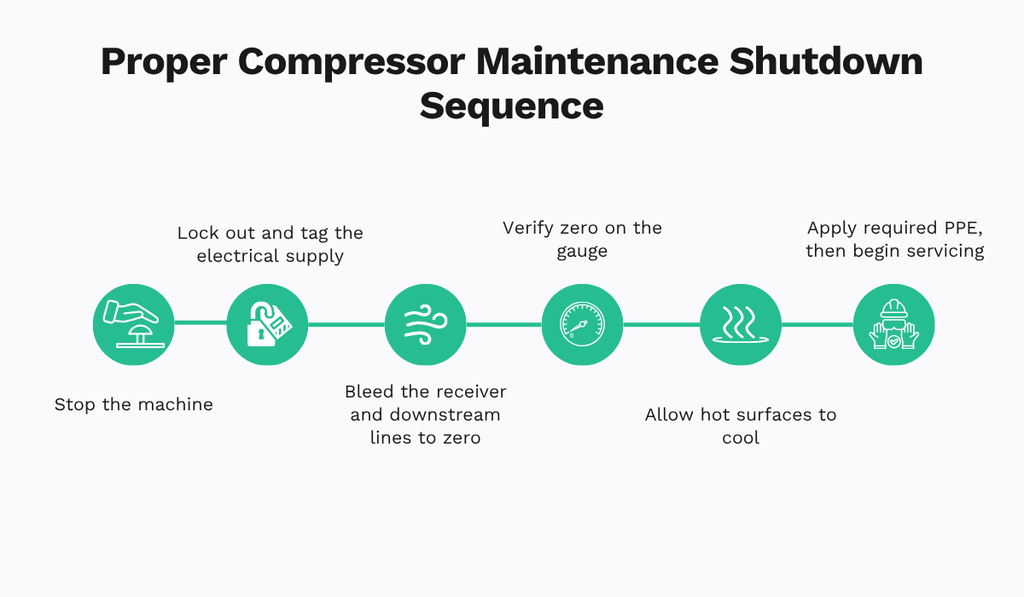
Switching off a compressor doesn’t make it safe to work with, as the receiver tank and the lines downstream of it hold energy long after the motor stops.
And that’s not all. Rotating parts, surfaces that haven’t properly cooled down from continuous operation, a live electrical supply – the list of hazards goes on.
This sequence may look obvious, but if the facility and personnel don’t foster a culture of safety, it’s easy to turn a blind eye to some readings, or skip step three entirely.
Also, it’s just as easy for a contractor who has never seen your installation to miss the second receiver still holding pressure.
A laminated sheet on the compressor room wall won’t catch either of those.
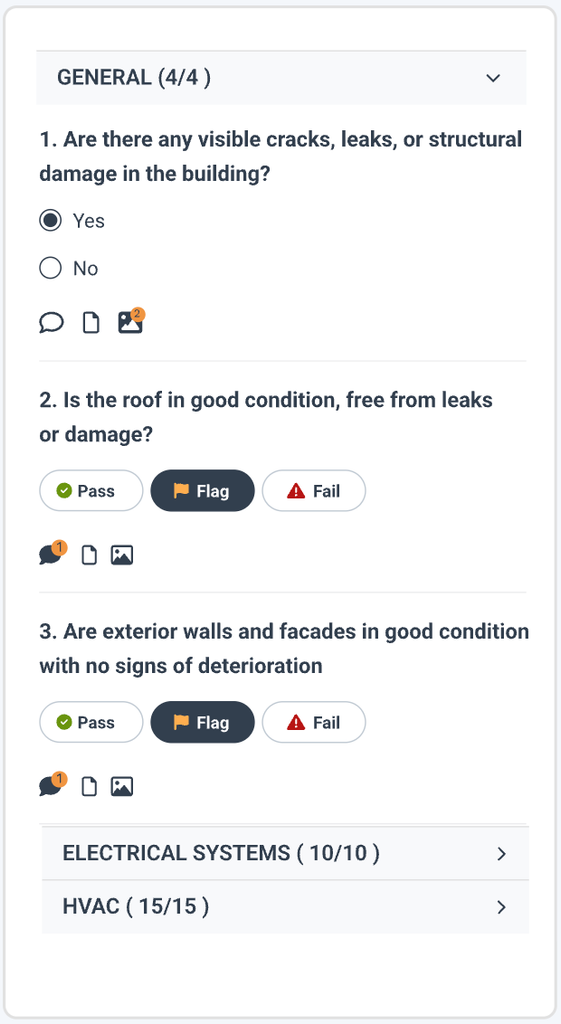
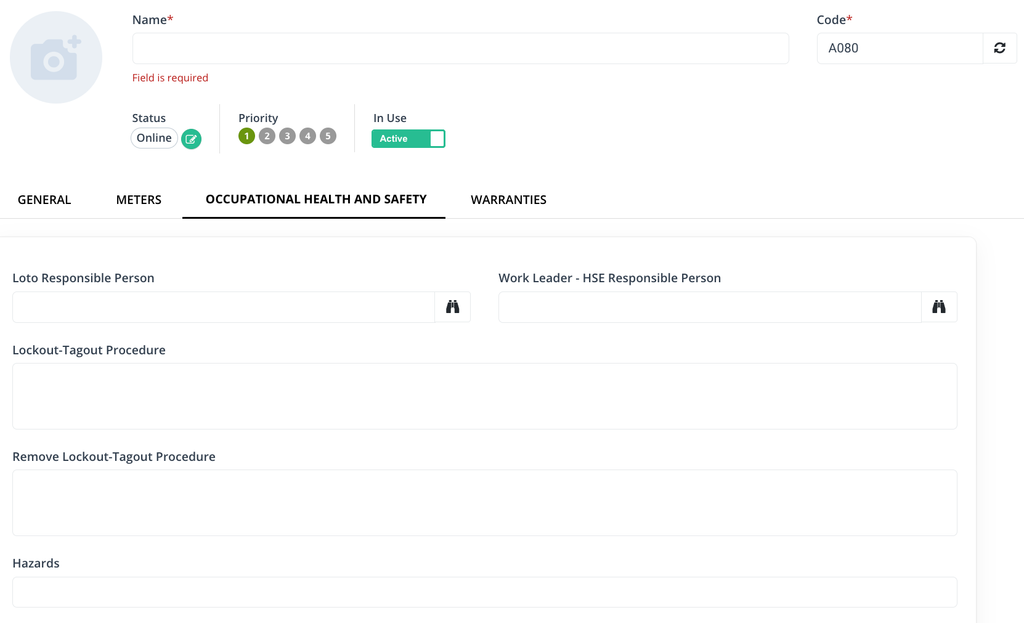
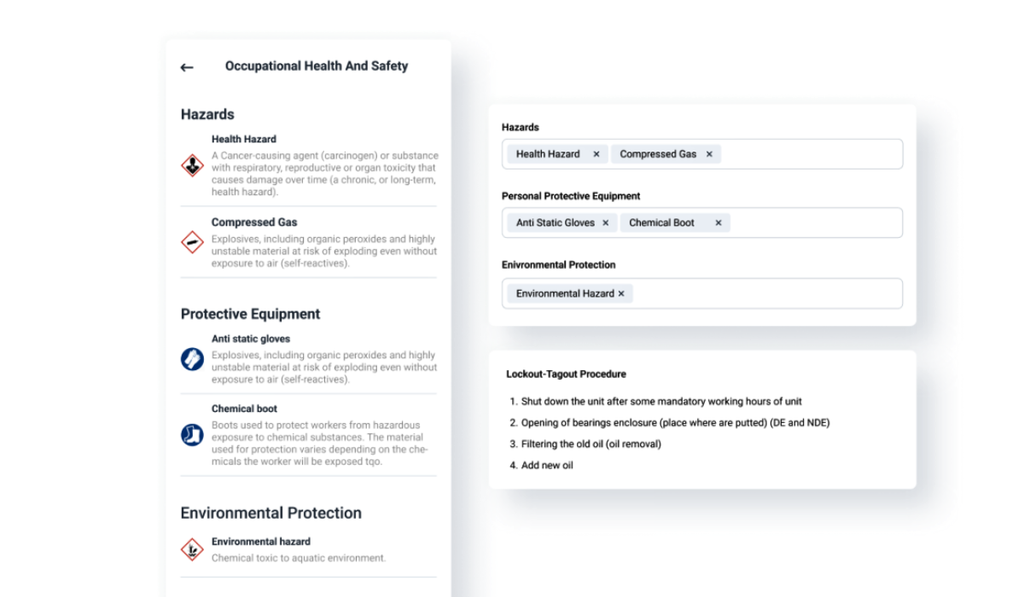
Instead, put the lockout steps and the PPE list inside the work order (as shown below), and the technician reads them on a phone before touching anything, with the closed job recording that they did.
These checks constitute easy, reliable fixes and remove the burden of having to memorize steps for semi-annual maintenance procedures from your employees.
Keep a Detailed Maintenance Log
Every habit in this article produces paperwork. Without somewhere to put it, you end up managing the compressor from memory.
You’ll know it had a bad year, but not how many hours it has run since the separator was changed, which derails your manufacturer interval count.
When nobody logs the hours, all you’re relying on is plain guesswork.
A log records critical data, including:
Service history
Replacement parts and their numbers
Running hours tallied at each intervention
Oil analysis results
Trend readings from daily checks
Two years of that can tell you plenty about a machine, its state, and whether it might be time for another rebuild.
However, if maintenance logs are so valuable, why are so many teams struggling to keep them?
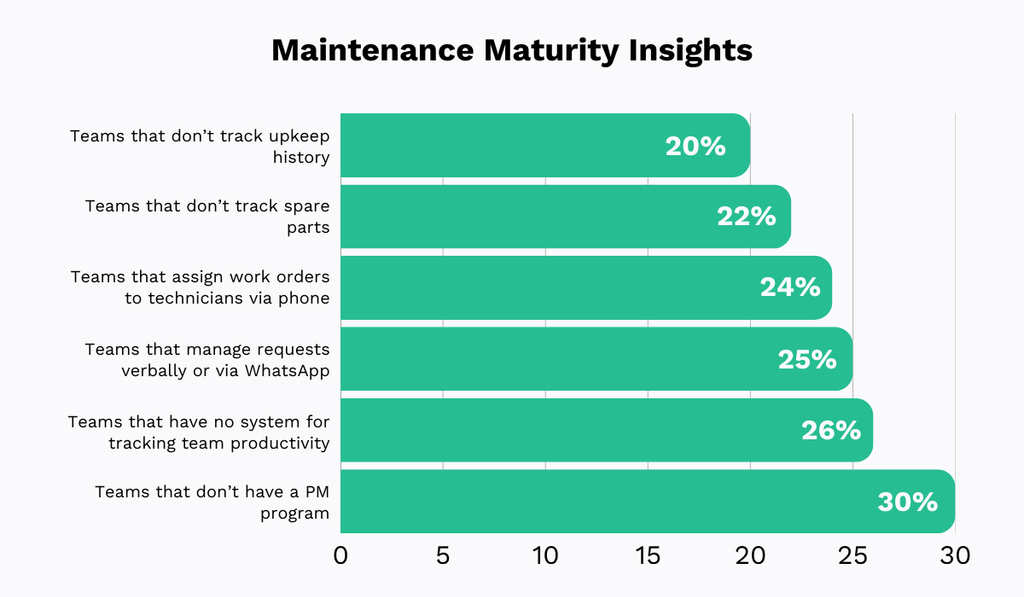
It shows that many maintenance teams still operate at a very low level of maturity, relying on manual processes, with no systematic way to track maintenance or assign tasks.
The obvious solution is to move it all into software and digitize your records.
That’s also where most of these projects die, because the technician who has done the job the same way for fifteen years has no interest in learning a system that makes their day longer.
The key is making data tracking easier, not more complicated.
This is where WorkTrek comes in. With our CMMS, you can simplify your records and boost operational efficiency while minimizing friction.
Technicians follow a simple procedure, from opening the work order to recording data off the panel, filling out the necessary information, including attaching photos/documents, and lastly, confirming purchase orders for replacements.
All of this can be done through their phones.
Over time, maintenance history of each asset is created, so every job, part, reading, and completed safety procedure sits in one timeline.
Beyond making planning and maintenance management easier, this timeline also serves as evidence when someone asks for information about audits, insurance, or your recordkeeping measures.
Conclusion
You won’t always see all the problems with your air compressor at a glance, but they will cause damage nonetheless.
They will drive up electricity costs while dragging down production efficiency, not to mention health risks in your facility.
But the six habits we’ve outlined here can make a difference. They will provide you with a structured and repeatable, yet simple system to keep your maintenance on track.
The cumulative savings and peace of mind are worth the initial effort.
WorkTrek Monthly Updates – September 2026
September brings a redesigned Asset Module and several improvements to the WorkTrek mobile app. This update makes it easier to navigate and manage your assets, while giving mobile users more flexibility when working with parts and regional settings.
1. Redesigned Asset Module
Managing assets in WorkTrek is now simpler and more intuitive with our redesigned Asset Module.
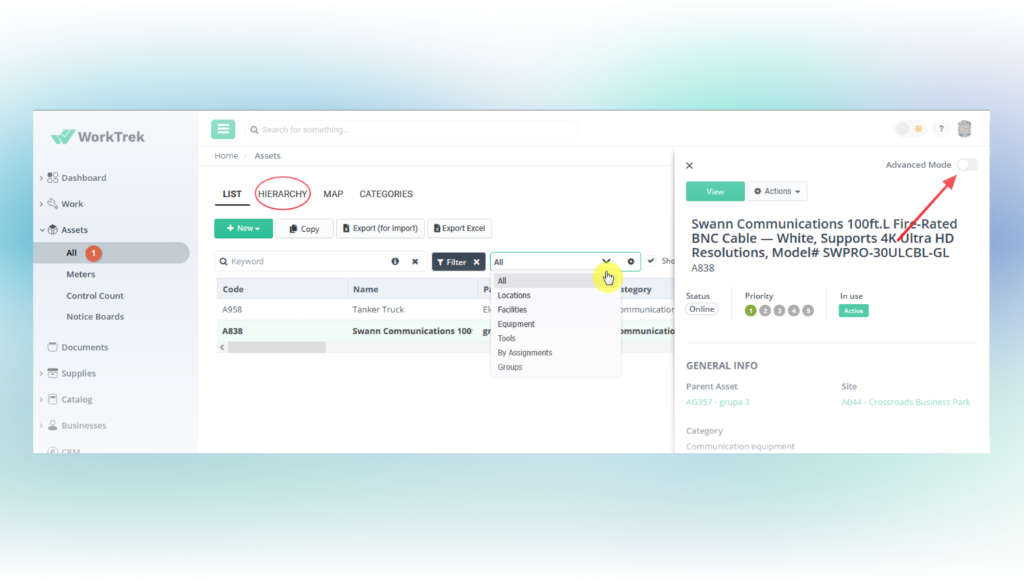
The new interface makes navigation and editing easier, with a more streamlined way to work with your assets. You can now use Advanced Mode to view and edit asset details directly from the list or hierarchy view, without having to open each asset separately.
We’ve also brought all asset types into one place. Using the view selection dropdown, you can easily switch between Locations, Facilities, Equipment, Tools, and Groups, making it faster to find and manage exactly what you need.
The WorkTrek mobile app gets two useful improvements this month.
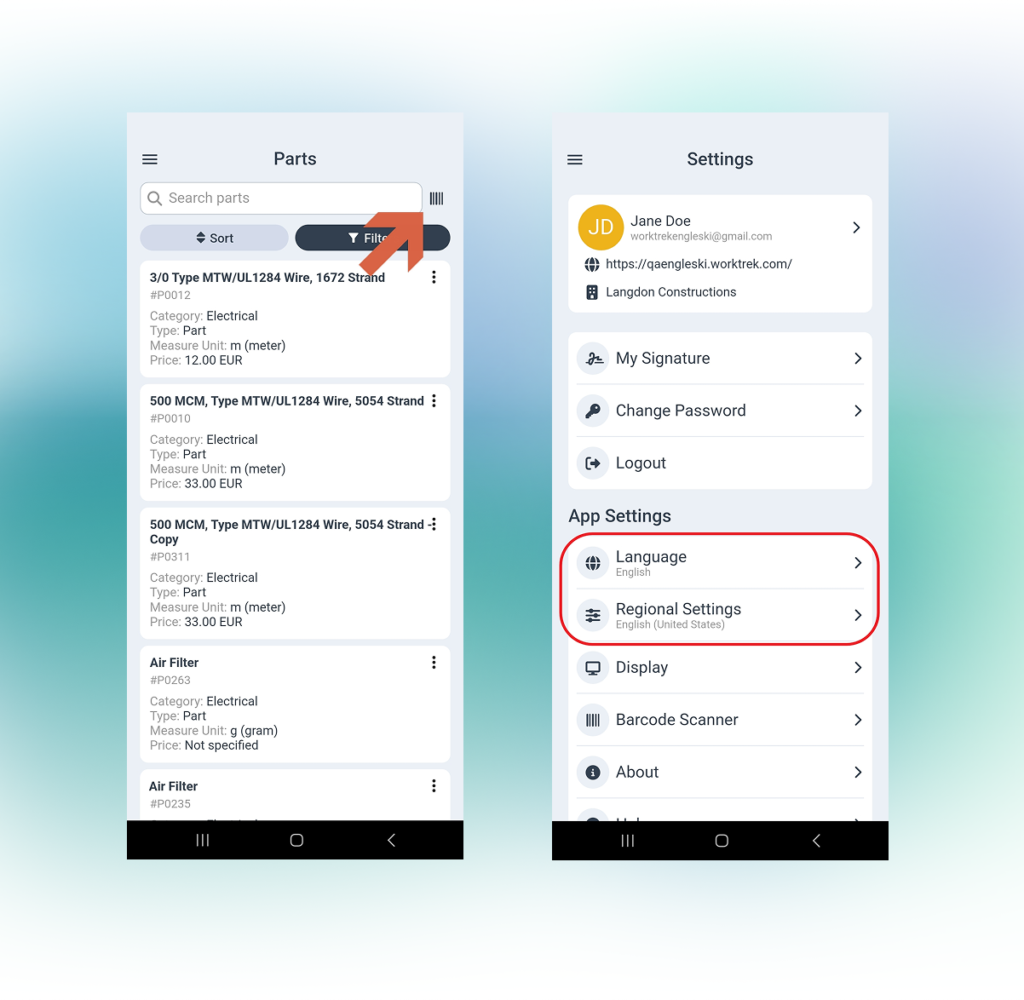
Barcode Support for Parts
You can now use barcodes to identify parts directly in the mobile app. This makes it faster and easier to find and work with spare parts while performing maintenance in the field.
Language & Regional Settings
Users can now configure their language and regional format settings directly from their mobile profile. You can choose your preferred language and control how dates and numbers are displayed, making WorkTrek more convenient for users working across different countries and regions.
We work hard to keep delivering tools that make your maintenance operations smoother and more powerful. November’s updates are all about saving time and boosting productivity — and we can’t wait for you to experience them.Start your free trial or book a demo today and take your maintenance management to the next level!
A Quick Look at the Best Work Order Software for Small Businesses
If your work orders are still managed through spreadsheets, emails, paper notes, or verbal requests, you may already know how easy it is to miss important information or even tasks.
But moving to software can feel like trading one problem for another.
Will your team actually use it? Will it be too complicated? And is it worth the cost?
The good news is that you do not need a complex system. There are simple work order tools built to fit smaller teams, budgets, and busy schedules.
Here are five worth considering.
WorkTrek
Our CMMS WorkTrek can help you replace scattered work requests and manual work order tracking with one place to manage all your maintenance work.
You can start with a work request, turn it into a work order, assign it to the right person, schedule the job, and track its progress until it is completed.
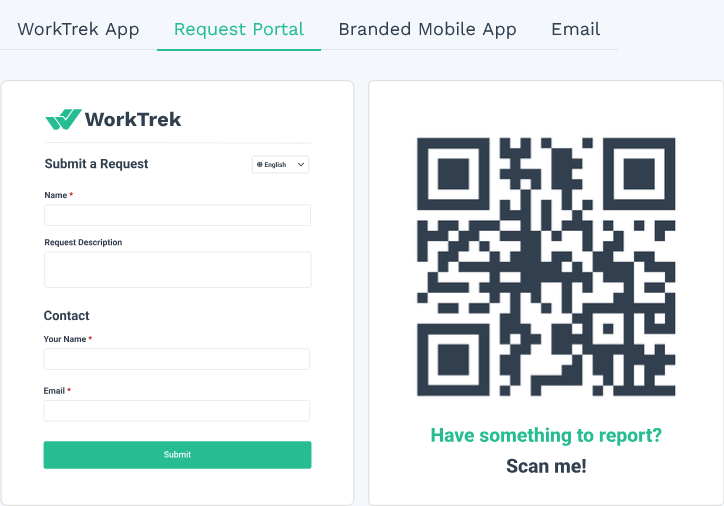
In WorkTrek, your team can submit work requests from the web or mobile app. You can also let employees, tenants, or other users send requests through the portal or email.
Technicians can access work orders on their phones, do their work, and record all the details the office needs, including how much time it took them and which spare parts and materials they used.
When the work is completed, they can also sign it digitally.
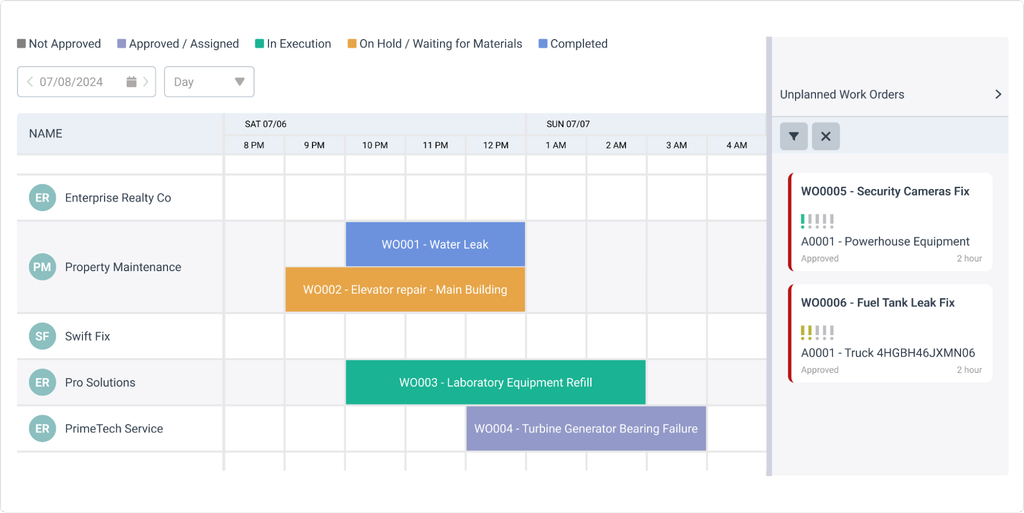
You can organize all these work orders in a list, map, or scheduler view where you can clearly see which orders are approved, assigned, in execution, waiting for material, or completed.
Pricing plans start at $29 per user per month, with work orders, asset management, simple inventory, reports, and dashboards included in the Starter plan.
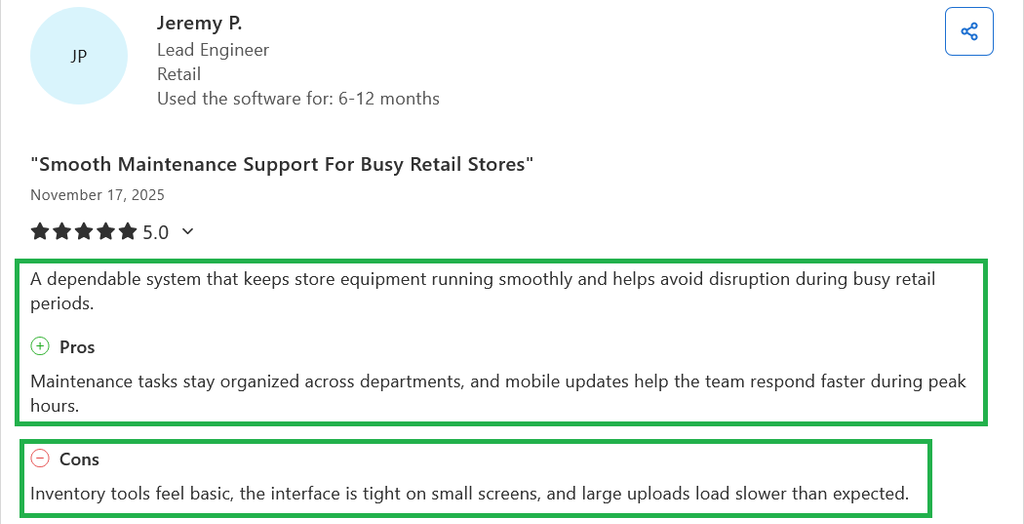
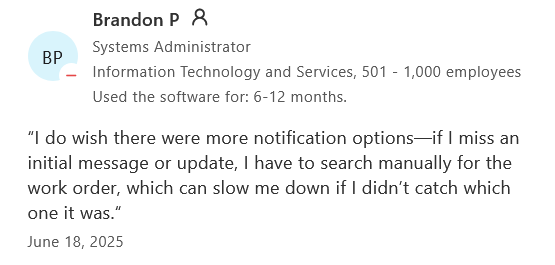
The same reviewer finds the inventory tools basic, while another reviewer wished there were more notification options and found it difficult to locate a work order after missing an initial update.
It includes unlimited work orders, real-time messaging, file uploads, and up to five repeating work orders.
If you need unlimited repeating work orders, time and cost tracking, permissions, or workflow automations, you will need the Starter plan at $25 per user per month at the current promotional rate.
Keep in mind that some really important features, including multiple reminders, reporting, dashboards, signature capture, and external request forms, are available only in higher plans.
eWorkOrders
If you want a more traditional CMMS with plenty of maintenance features, eWorkOrders gives you a solid set of tools for managing work orders, assets, preventive maintenance, materials, and service requests.
When someone submits a service request, eWorkOrders can turn it into a work order and assign the task to a technician based on factors such as their skills, availability, and location.
You can also use the software to manage preventive maintenance, track assets and materials, store documents, and monitor performance through reports and dashboards.
User feedback is generally positive about ease of use and support.
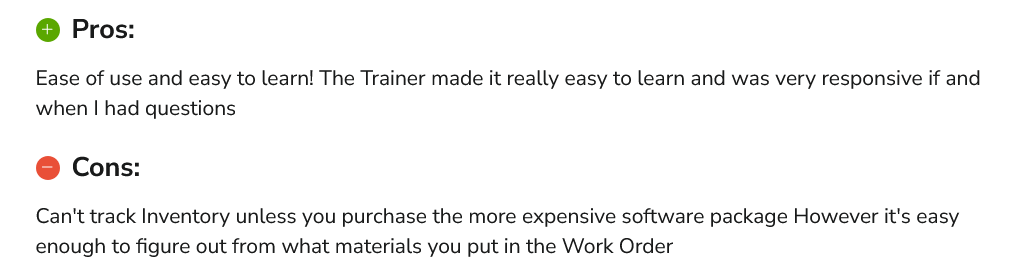
One reviewer described the software as easy to learn and praised the trainer for making onboarding straightforward, but he also noted that inventory tracking required a more expensive package, which is worth considering if parts management is important to you.
For a small business, the biggest question is probably how much functionality you actually need.
The Starter plan costs $380 per month and includes unlimited users, work orders, asset management, preventive maintenance, materials management, reporting, and customer service requests.
However, mobile and tablet access, along with QR and barcode scanning, start with the Advanced plan at $480 per month.
The unlimited-user model can make the pricing more attractive as your team grows. For a very small team, however, the monthly cost may be harder to justify.
You should also check which features you need before deciding, as inventory control, multi-site management, API access, and signature capture are reserved only for Enterprise.
RO App
RO App is built with repair and service businesses in mind, making it particularly relevant if you run a repair shop or a small field service operation.
You can create work orders from leads or client requests and manage the whole job from one place.
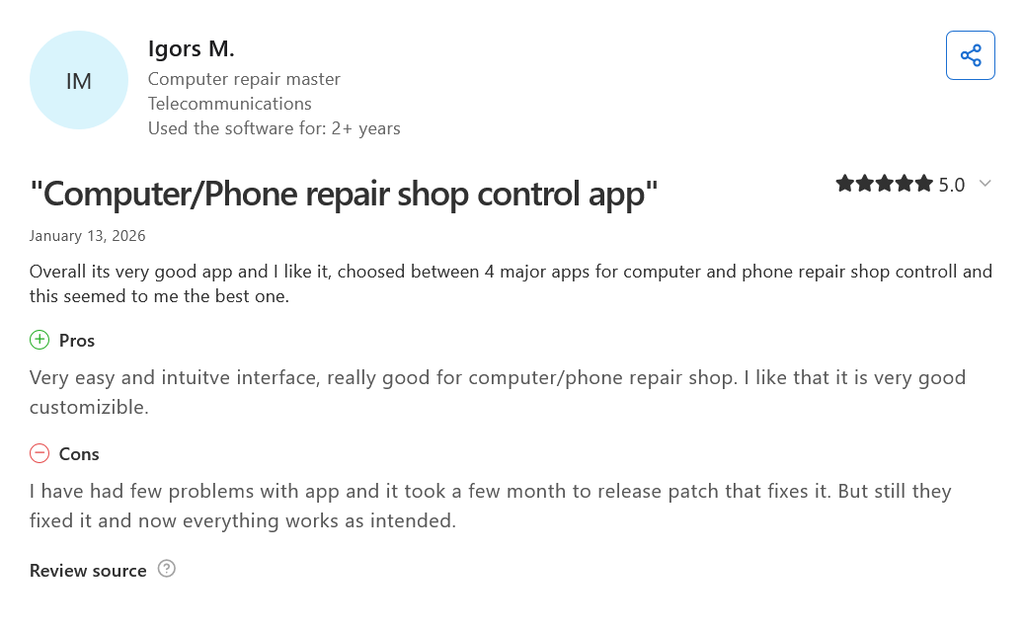
Another reviewer liked the mobile app and photo uploads but found the way the system handles dates problematic.
Pricing starts at €29 per month for the Startup plan, which includes three employees, with additional employees costing €5 per month.
The Business plan starts at €69 per month, while Enterprise starts at €99 per month.
There is also a €15-per-month Hobby plan for very small operations, although it limits you to two employees and 100 work orders or sales per 30 days.
Field Ascend
If you run a small field service business, Field Ascend gives you a way to manage work orders alongside scheduling, dispatch, customer communication, and preventive maintenance.
That makes it more relevant to businesses where technicians regularly travel to customer sites than to teams managing maintenance entirely in-house.
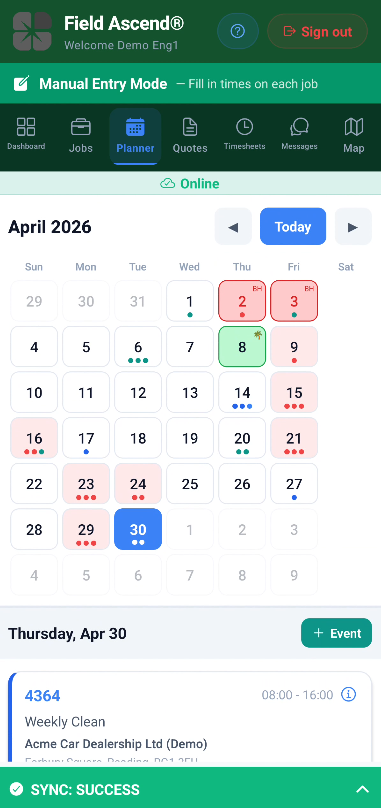
You can create jobs, assign them to technicians, and manage them from a planner board or map.
You can also connect preventive maintenance findings to follow-up repair jobs, then keep the completed work, labor, materials, and customer documentation together.
The platform also includes a customer portal, quotes, invoices, reports, and dashboards, so you can manage more of the service process from one place.
When it comes to user feedback, people generally like the software’s ease of use and flexibility.
One reviewer appreciated the different settings, filters, and views and highlighted the customizable preventive maintenance check sheets.
They also noted that the Projects module still needed further development.
Pricing-wise, the Pro plan costs $13 per user per month, with a minimum of three users, so pricing starts at $39 per month.
You get scheduling, dispatch, work orders, mobile access, preventive maintenance, customer portal visibility, quotes, invoices, reports, and dashboards.
There is also a 30-day free trial with no setup fee or required annual contract.
Conclusion
Hopefully, one of these tools caught your attention.
If you need a flexible work order and maintenance system that can grow with your team, WorkTrek is worth a closer look.
If you run a repair or service business, RO App may be the best fit, while Field Ascend makes sense if scheduling technicians and managing customer jobs are a big part of your day-to-day work.
Choose software that fits the way your team already works and make it better.
How Work Orders Help Manufacturers Improve Maintenance and Efficiency
Key takeaways:
72% of manufacturing leaders say undocumented fixes increase downtime.
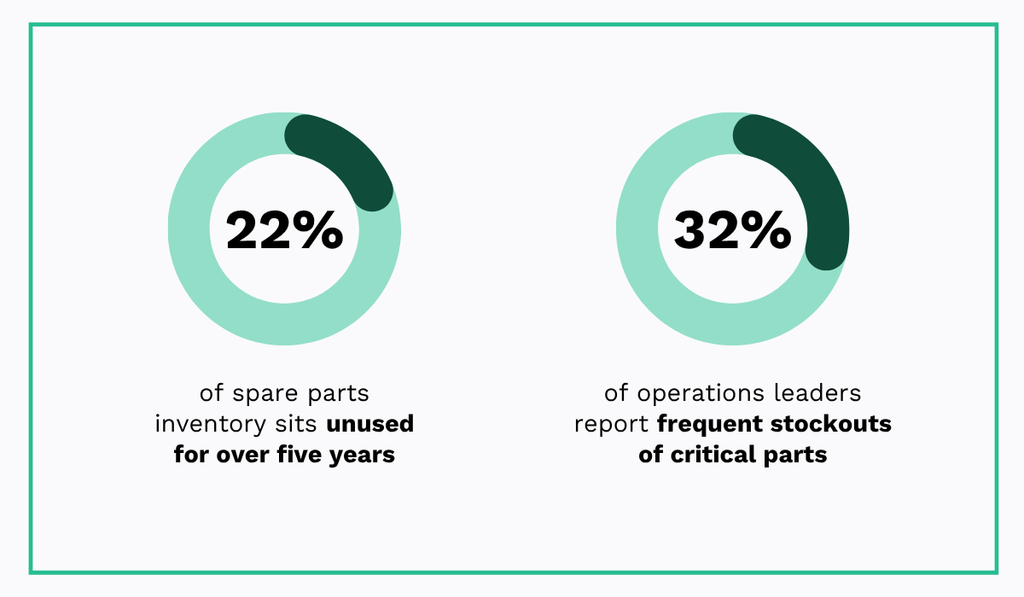
22% of inventory sits unused for over five years.
Digital work orders centralize work priorities, safety requirements, and parts data.
Keeping a maintenance team running efficiently requires constant coordination.
Technicians need clear direction on who is doing what, when, and with which parts, from scheduling routine inspections to assigning emergency repairs.
Work orders provide the structure and visibility required to make that happen.
In this article, we’ll cover 5 core aspects of work orders that give you control over maintenance workflows and efficiency.
Improving Maintenance Planning and Organization
Work orders give maintenance work a structure when it’s lacking.
A work request comes in, someone decides how urgent it is, a technician does the job, and the result gets written down.
That sequence is the same whether the work order is on paper, in a spreadsheet, or in CMMS software.
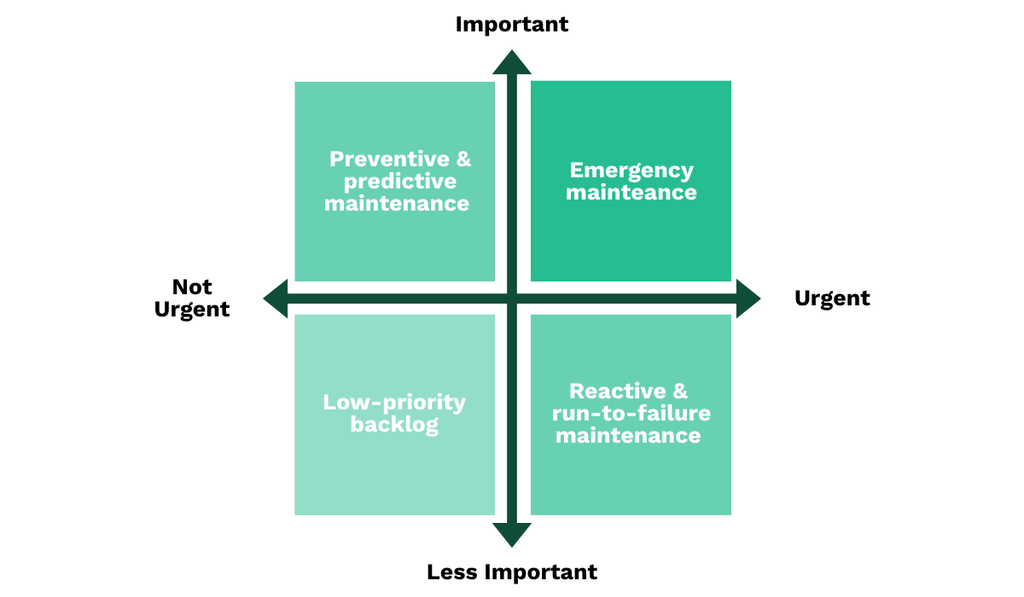
When this number is standardized and written down on a work order, a technician receiving a job marked at a certain priority will know when it needs to be done without much confusion.
Meanwhile, supervisors get the same benefit at a larger scale, since they can see and decide how the whole week might be scheduled.
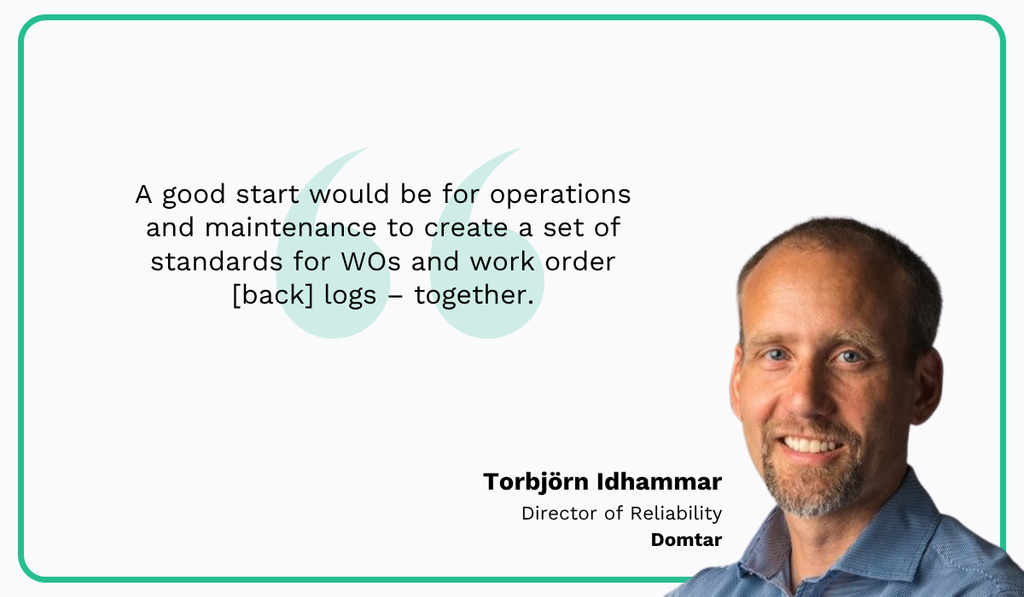
Of course, that coordination holds only when operations and maintenance departments agree on a standard for work orders.
Torbjörn Idhammar, Director of Reliability at pulp and paper manufacturer Domtar, made this point in an article on work order backlogs for the consultancy IDCON.
Idhammar’s reasoning is that the standard has to be built jointly because operations raise most of the work while maintenance teams carry it out.
Once both sides use the same definitions, a work order log starts answering key questions on its own.
It shows what will be finished this week, what is scheduled for next, and how many labor hours sit in the queue.
In turn, answering those questions week after week is how teams clear a maintenance backlog instead of watching it grow.
Reactive hours fall as the backlog shrinks, which leaves room for more planned preventive work.
Increasing Maintenance Team Accountability
Work orders also settle who is responsible for what.
A verbal request or a note on a desk says nothing about who accepted the job or when it was due.
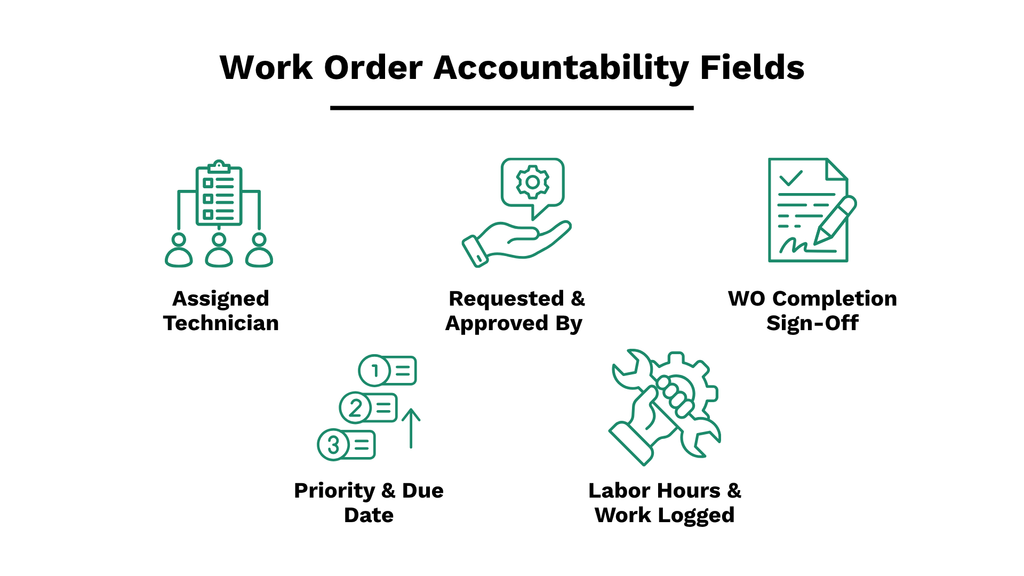
By contrast, a work order records the task, the person assigned to it, the deadline, and a description of what was done.
That same record can become useful weeks later, when a machine breaks down again and nobody remembers the earlier repair.
On top of that, written records help with a second problem: knowledge that stays with one person.
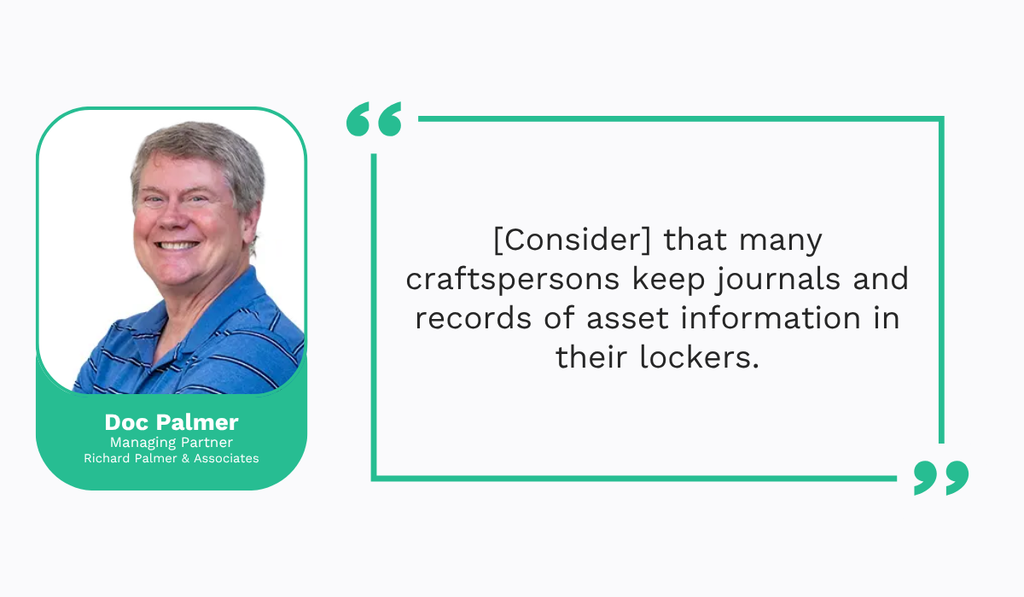
Doc Palmer, managing partner at Richard Palmer & Associates and author of McGraw-Hill’s Maintenance Planning and Scheduling Handbook, wrote about this in a column on planning and scheduling.
The term hidden factories comes from lean manufacturing, and it describes work that is never recorded anywhere, such as a quick adjustment made during a shift.
That work appears in no report, so the plant believes it loses less production time than it does.
A work order that is completed properly records that activity too, including short repairs nobody would think to mention.
Over time, the maintenance history comes closer to what happens on the floor, and the plant sees the full cost of its downtime.
Optimizing Spare Parts Management
Work orders can also help record how spare parts are used.
In fact, whenever a technician needs a certain part for a job, that should be logged in detail.
Over time, the records can start showing which components are replaced often and which have not been touched in years, which is important when we consider the following data on spare parts management.
The statistics come from SPARETECH, a company that works on spare parts data quality, which surveyed 300 manufacturing executives in the US and Europe for its 2025 report on the maintenance, repair, and operations (MRO) strategy gap.
Unused and missing parts are opposite problems, but plenty of plants have both.
That points to a visibility and documentation problem.
Phillip Slater, founder of SparePartsKnowHow.com and author of eight books on inventory management, explained it in an article on reading spare parts data.
Slater points out that spare parts planning is based on historical usage data, which describes what people do rather than what the machines need.
His recommendation, quoted below, follows directly from that.
Some of the issues that increase the gap include parts getting taken without the transaction being recorded, or spare parts being taken and not getting used after they leave the storeroom.
Slater’s idea is that the problem has to be corrected at the point where people record what they use.
One way this might be implemented is by having a rule that work orders cannot be closed without noting part numbers and quantity.
Digital work orders can make this requirement easier to meet, since a technician can track parts on their mobile device at the machine instead of noting it for later.
From there, a digital work order management system can store every movement in one place, including the work order a part was issued against and the warehouse holding it now.
As a result, purchasing gets real usage figures to order against, which is where a workable spare parts strategy begins.
Overall, better records make inventory management more efficient and less likely to delay a repair.
Improving Workplace Safety and Compliance
Safety in manufacturing depends on procedures being followed every time, and that is more likely when the instructions are written into the work order itself.
Let’s look at two workplace safety case studies and show how work orders fit in.
In May 2023, workers at a Dow plant in Louisiana did turnaround maintenance on a reflux drum and left work lights inside.
Two months later the lights had degraded enough to puncture a rupture disc, which caused explosions and released over 31,000 pounds of ethylene oxide.
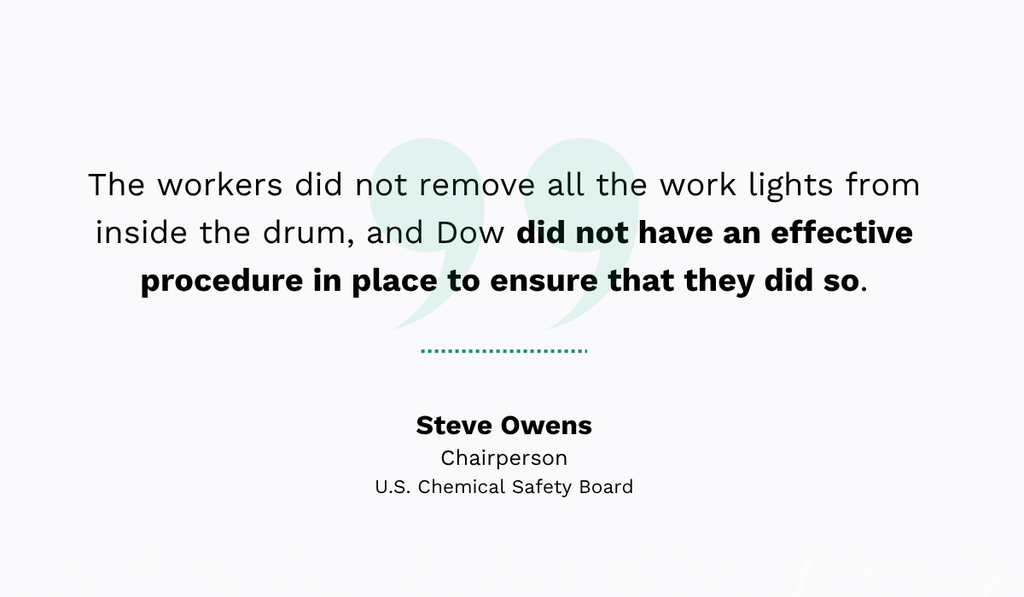
Steve Owens, who chairs the board, summarized the finding when the investigation report appeared in February 2026.
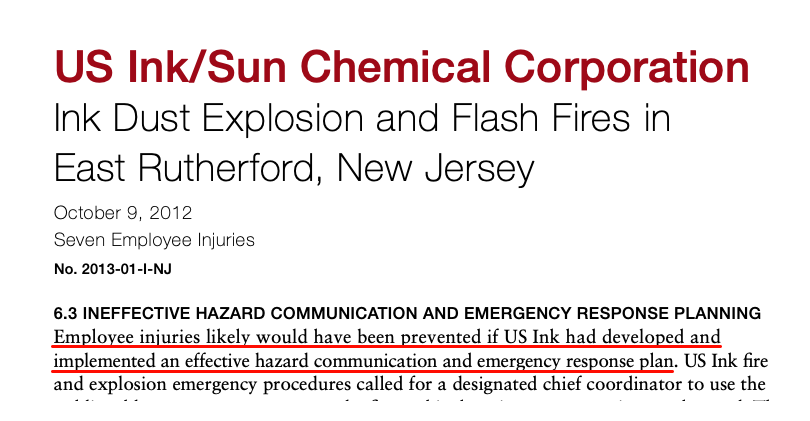
Hazard communication and emergency response planning are company wide programs, and the board’s case study found neither reached the people who needed them that day.
Parts of those programs can be written into individual work orders instead, especially if they’re digital.
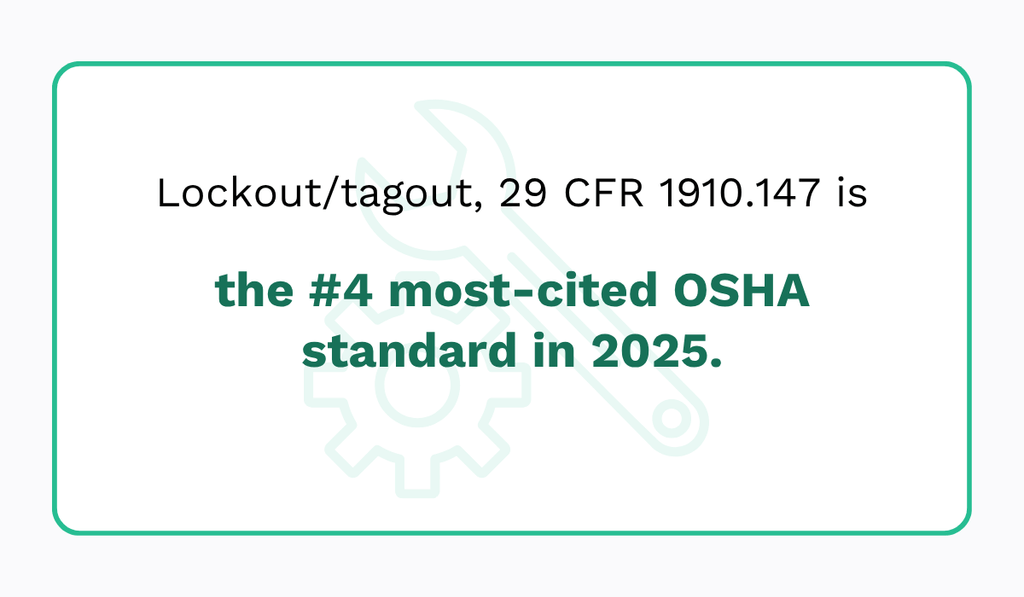
Consider a task with specific lockout/tagout requirements.
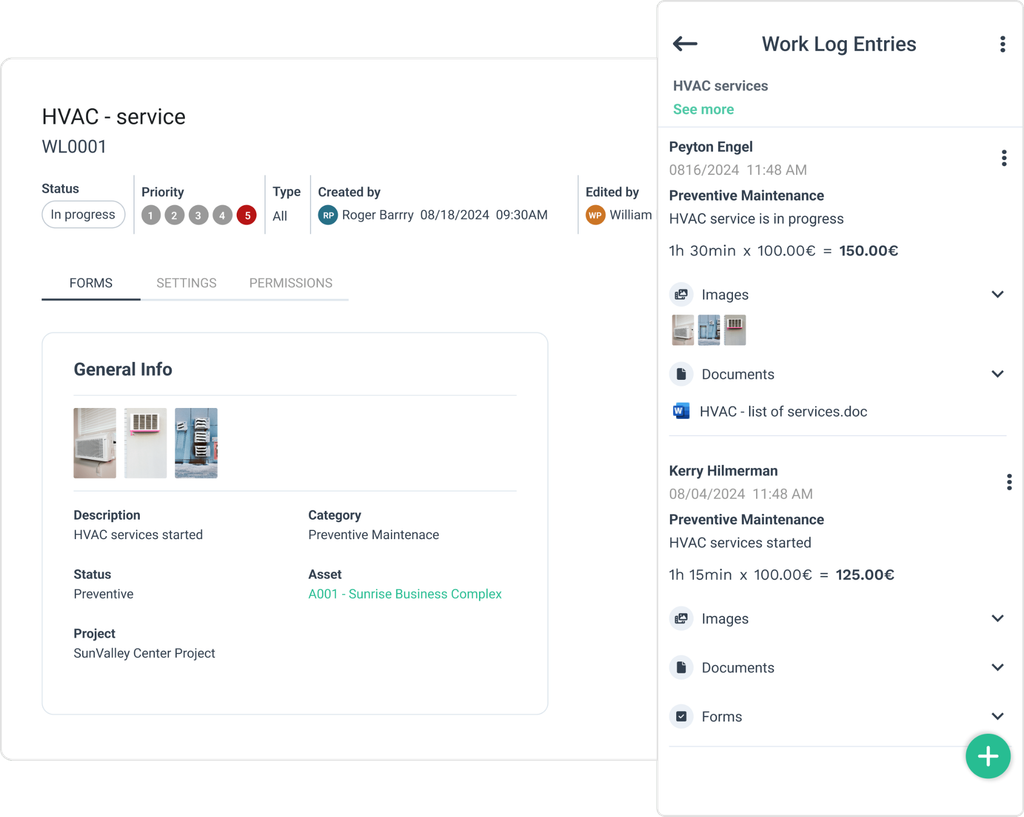
Typically, those instructions are kept in a binder a technician has to remember to look up, and the screen below shows the alternative.
A digital work order can list the hazards for that machine and the personal protective equipment (PPE) the task requires.
It can also include the isolation steps in order, so a technician sees the PPE requirement and the steps before starting work.
In the end, safety requirements change from job to job, which is why having them on the work order itself can be effective.
Reducing Unplanned Downtime and Production Disruptions
Everything described so far leads to the same outcome.
Work that gets prioritized, assigned, documented, and supplied with the right parts takes less time and goes wrong less often.
Fewer jobs turn into emergencies as a result, and fewer machines stop without warning.
Even so, reaching that position is difficult because a plant dealing with constant breakdowns has little time to change how it works.
Erik Hupjé, founder of Reliability Academy and a former maintenance manager at Shell and ConocoPhillips, explains why in an article on escaping reactive maintenance.
Hupjé describes a cycle in which repeat failures and ineffective preventive maintenance keep a plant reactive.
By his estimate, crews in that situation are productive for only 25% to 35% of their time, so nobody has the hours to remove the defects causing the failures.
Introducing work orders will not break that cycle immediately.
They do give the team a written list of every outstanding job and how urgent each one is.
Over a few months, better prioritized work and a smaller maintenance backlog leave more hours for scheduled jobs rather than reactive ones.
How far a team gets depends on the system it uses to manage the work.
A computerized maintenance management system (CMMS) such as WorkTrek keeps requests, assets, parts, and completed jobs in one place, so past work on a machine is visible the next time it fails.
WorkTrek covers a work order from the first request to the final sign-off, with custom fields, attached documents, safety information, and a change log.
It’s a mobile-first platform, so technicians can fill in the record from a phone at the machine rather than at the end of the shift.
Those records tend to be more accurate, because the details are still fresh.
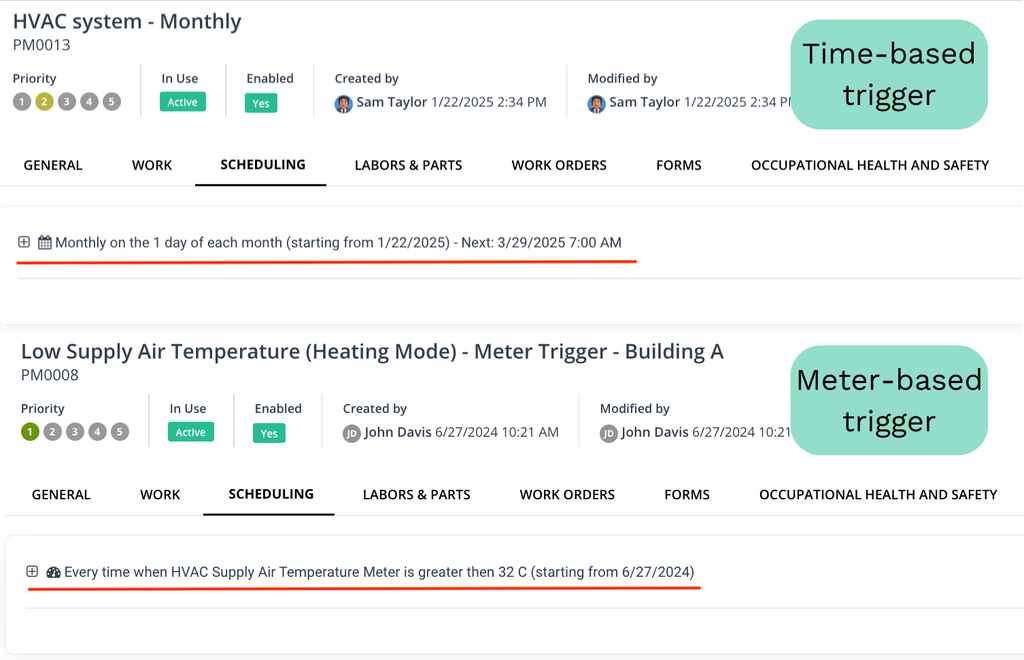
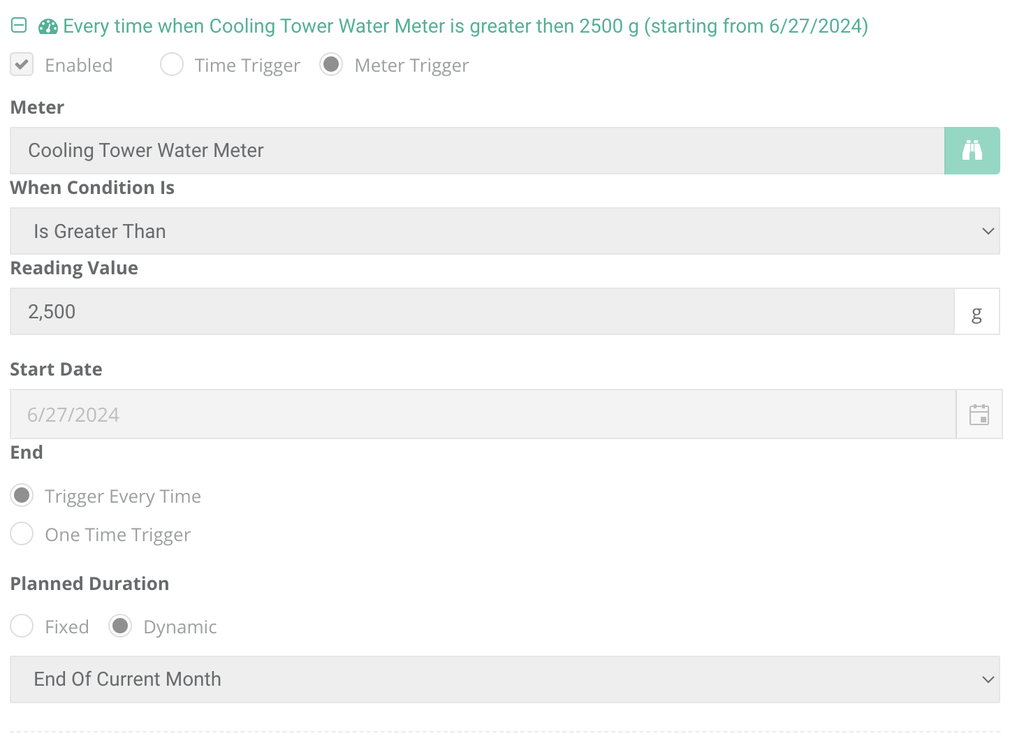
Work orders can also be created on a fixed schedule, or once a meter reaches a set reading.
Work orders that are created automatically remove a large part of the administrative effort, because routine jobs appear in the system without anyone writing them out or remembering when they are due.
That lighter workload and the record of every completed job allow the team to schedule more of its work in advance over time.
The reactive share shrinks as the planned share of the workload grows, and fewer machines stop without warning.
Conclusion
That covers what work orders do across a maintenance operation.
Most of it comes down to recording work properly and keeping that record in one place, which matters more than the paperwork suggests.
If you’re ready to upgrade your work order management, start small.
Pick one part of your workflow to improve, and let the records build from there.
Digital Work Order Management in Manufacturing: A Guide to Improving Productivity
Key takeaways:
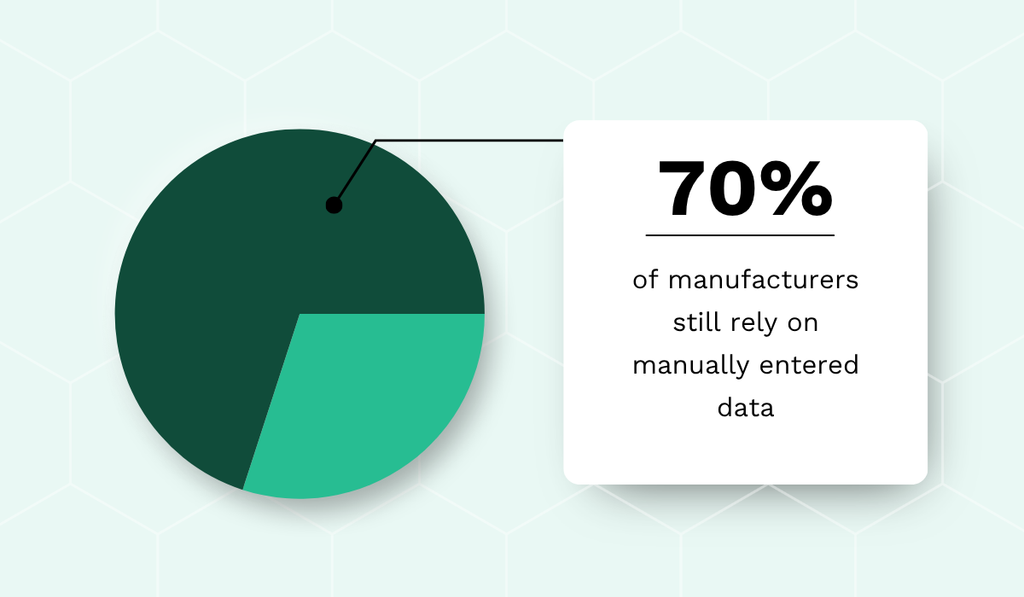
70% of manufacturers continue to collect and enter data manually.
A plant that tied its work orders to real-time OEE monitoring reduced downtime by 20%.
Intuitive, mobile-friendly work order tools lower the adoption barrier for workers.
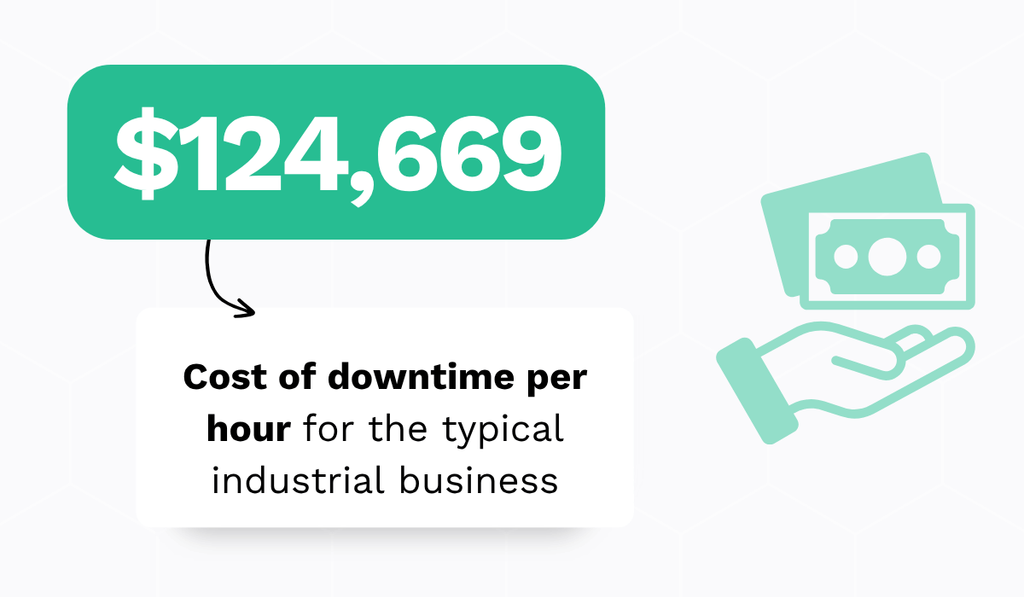
Did you know that one hour of unplanned downtime costs the typical industrial business around $125,000?
Manufacturers face these costs regularly, yet many of them run maintenance on paper forms and spreadsheets.
Digital work order management replaces that manual routine with connected processes that update in real time.
Read on if you want to understand how the digital approach works and how to adopt it without the usual challenges.
The Difference Between Digital and Traditional Work Order Process
Every maintenance job in a plant begins with a work order, so the way those orders are created and tracked shapes how the entire maintenance operation performs.
Simply put, a traditional process runs on paper forms and spreadsheets, while a digital process runs on software that connects everyone involved in the work.
Manual entry slows every step that depends on the data and introduces errors that spread into schedules and reports.
In fact, the digital approach exists because the manual one loses time at almost every step.
To see how, it helps to compare the two across the full work order management process.
Aspect
Manual process
Digital process
Creating a work order
Handwritten form or verbal request
Generated instantly from a service request
Assigning work
Whiteboard, phone calls, or whoever is nearby
Auto-assigned by priority, location, skill, and availability
Field access
Technician walks back to the office for instructions or manuals
Full job details, history, and manuals open on a mobile device
Tracking status
Manager walks the floor or calls technicians
Real-time status for every open order on one dashboard
Equipment history
Paper records in filing cabinets, slow to search
Searchable asset record, pulled up in seconds
Reporting
Hours spent compiling data by hand, often after the fact
Dashboards and reports update automatically as work is logged
The main difference is in how information is handled.
A manual process keeps information on paper or with individual people, so every update requires a walk to the office or a phone call.
A digital process keeps every request, assignment, status change, and completed job in one shared system that updates in real time.
Technicians open job details on a mobile device at the machine, managers follow progress without leaving their desk, and the equipment history builds itself with each closed order.
This means the same team can complete more work with less coordination effort.
Why Manufacturers Should Consider Digitalizing Their Work Orders
The efficiency gap alone makes a case for going digital, but manufacturing adds pressures that most other industries do not face.
Production runs on tight schedules, and a single stalled asset can stop an entire production line along with the revenue attached to it.
Regulators also watch the industry closely, so gaps in documentation carry consequences of their own.
The three benefits below show where digital work orders help manufacturers most.
Fewer Unplanned Line Stoppages
An unplanned line stoppage is among the most expensive events for a company, and reducing how often it happens is the clearest benefit of digitalized work orders.
The connection becomes visible through overall equipment effectiveness (OEE), the standard measure of how much of your planned production time is truly productive.
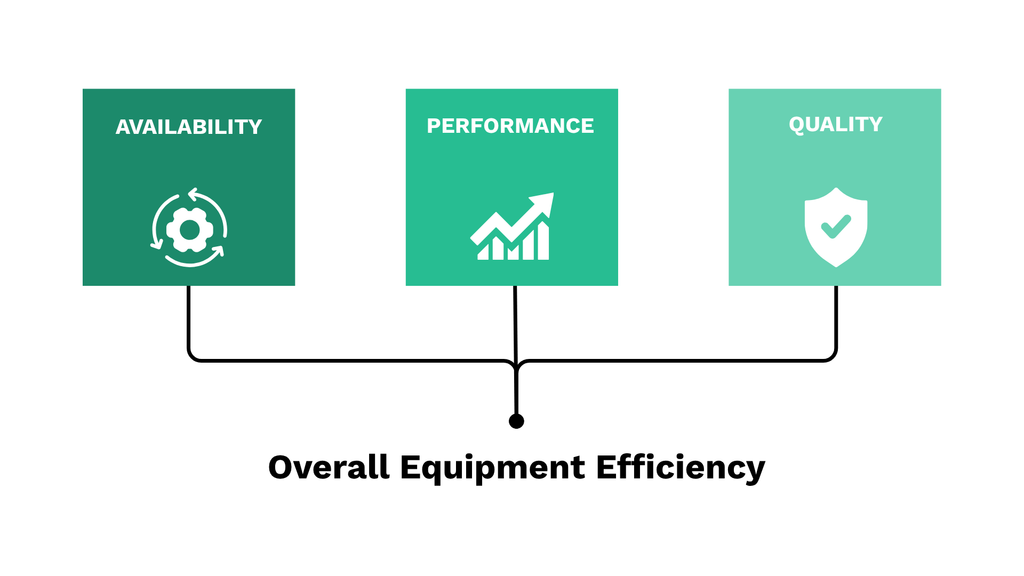
Digital work order systems can influence all three components of OEE.
Work orders tied to real-time machine data turn a developing machine issue, such as rising vibration or temperature, into a scheduled job before it forces the line to stop.
Maintenance then happens in a planned window instead of as an emergency, so availability rises, while slowdowns and minor stops are reported and resolved sooner.
Quality benefits as well, since equipment serviced on time produces fewer defective units.
These effects are not hypothetical.
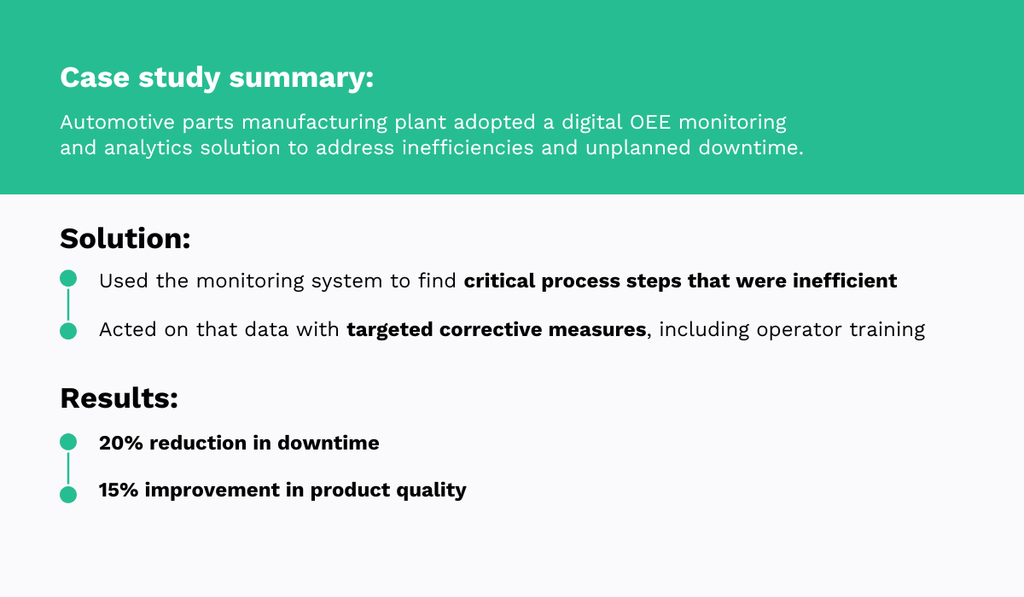
For a real-life example, TeepTrak describes an automotive parts plant that suffered frequent unexpected downtime caused by poor team coordination and inadequate performance monitoring.
The plant connected its work order management to real-time OEE monitoring, identified the process steps where inefficiencies concentrated, and corrected them, with operator training among the measures taken.
At that price, no source of inefficiency is minor enough to ignore.
Overall, digitalizing work orders gives you the data and the scheduling control to remove those inefficiencies, and fewer stoppages follow.
More Audit-Ready Compliance Documentation
Manufacturing is a heavily regulated industry, and maintenance records are a regular target of audits.
You answer to bodies like OSHA and the FDA depending on what you produce, and many plants hold ISO certifications that bring audits of their own.
Each of these expects every maintenance action to be documented and traceable.
Manual, paper-based processes force teams to reconstruct that documentation after the fact, so audit readiness sometimes becomes a rushed, periodic project.
Sarah Boynton, a manufacturing quality consultant at Quality Executive Partners, recalls situations from her career when organizations rushed to prepare for audits in this way.
However, even with planned audits, Boynton notes that the last-minute push rarely produces lasting change.
On top of that, we can add that reconstructed documentation brings errors, and individual records can be forgotten entirely.
With digital work order management, documentation stops being a separate task because every completed job generates its own record.
CMMS platforms and ERP solutions log each entry with a timestamp and the technician’s name, keep related documents in one place, and track the full history of every asset.
The same records serve managers beyond audits, as a searchable archive for analyzing failures and justifying decisions.
In a regulated environment, that combination of traceability and accessibility is what audit readiness means.
One Unified View Across Plant Systems
A digital work order system, as the previous section showed, acts as a central location for maintenance data.
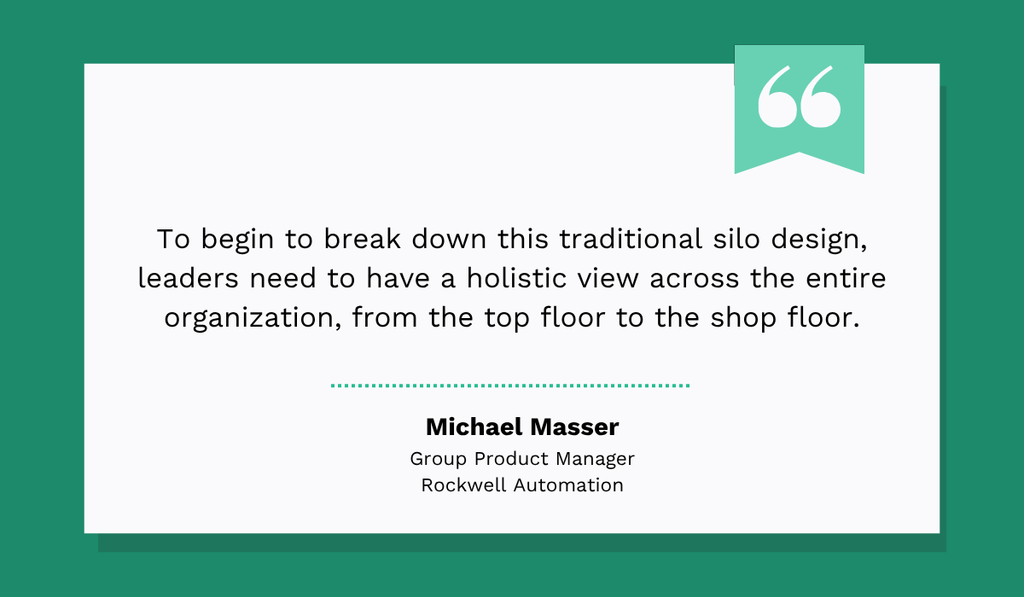
Its value grows when it connects with the rest of the plant, from the ERP to the MES and inventory records, so maintenance data and production data stop living in separate silos.
Michael Masser, Group Product Manager at Rockwell Automation, explained in an interview with Design News that this kind of cohesion is only possible when leaders can see the whole operation at once.
Consider a scheduler planning the following week of production without knowing that a critical press is due for servicing.
The maintenance window appears in the production plan automatically when systems are connected, and the required spare parts are reserved before the job starts.
Gains of this size are not surprising, since connected systems remove the delays and blind spots created by re-entering the same data in several places.
Decisions improve when every department works from the same current information.
A digital work order system that integrates with the rest of your plant turns maintenance from an isolated department into an active contributor to production planning.
Digitalizing Work Order Management in Manufacturing: Key Challenges
The benefits are clear, but reaching them takes more than purchasing software.
Digitalization projects in manufacturing fail for predictable reasons, and most of them have little to do with the technology itself.
The three challenges below cause the most problems in practice.
Resistance to Change from Operators and Maintenance Teams
Any new addition to an established workflow meets some resistance, and maintenance software is no exception.
One reason is that people build habits around the current process, even when that process costs them time every day.
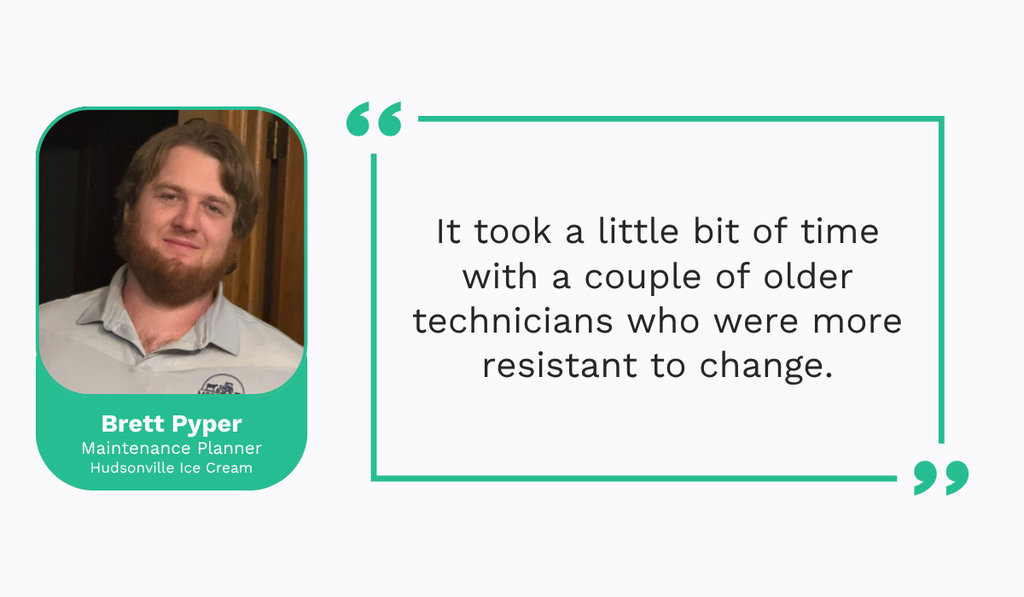
Pyper says that the solution is a gradual rollout with training along the way, so each worker sees how the system helps them before they are asked to depend on it.
Of course, an intuitive product makes this easier, because a tool that is easy to use needs less convincing.
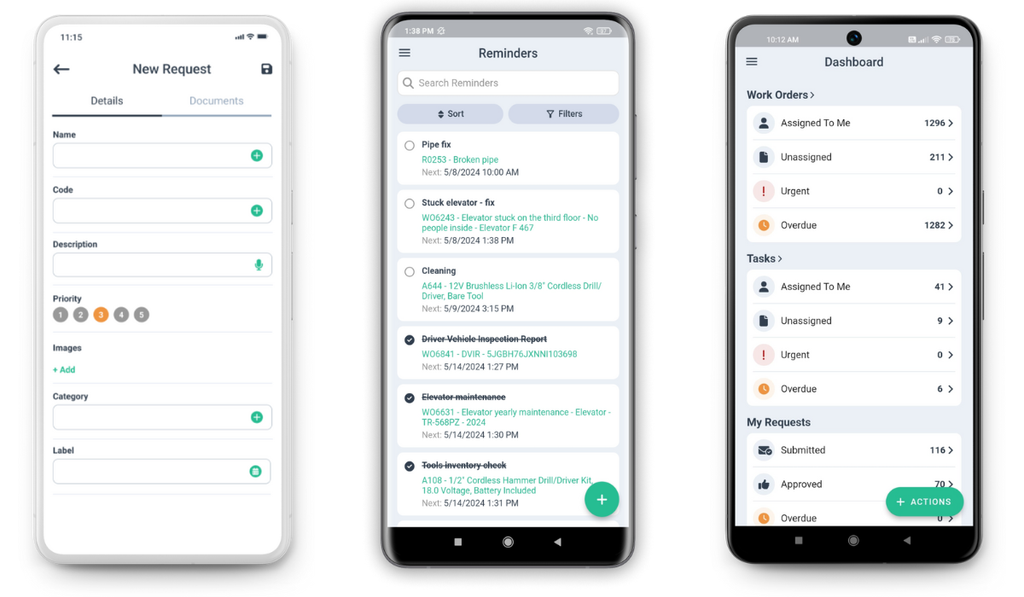
With WorkTrek, a technician can open a job on a phone, follow a checklist, attach a photo, and close the order without visiting a desktop or taking a paper note.
Despite the system being straightforward to use, it has a full set of features that cover the entire work order management process.
That balance of features and usability is what turns a skeptical crew into one that opens the app without being asked.
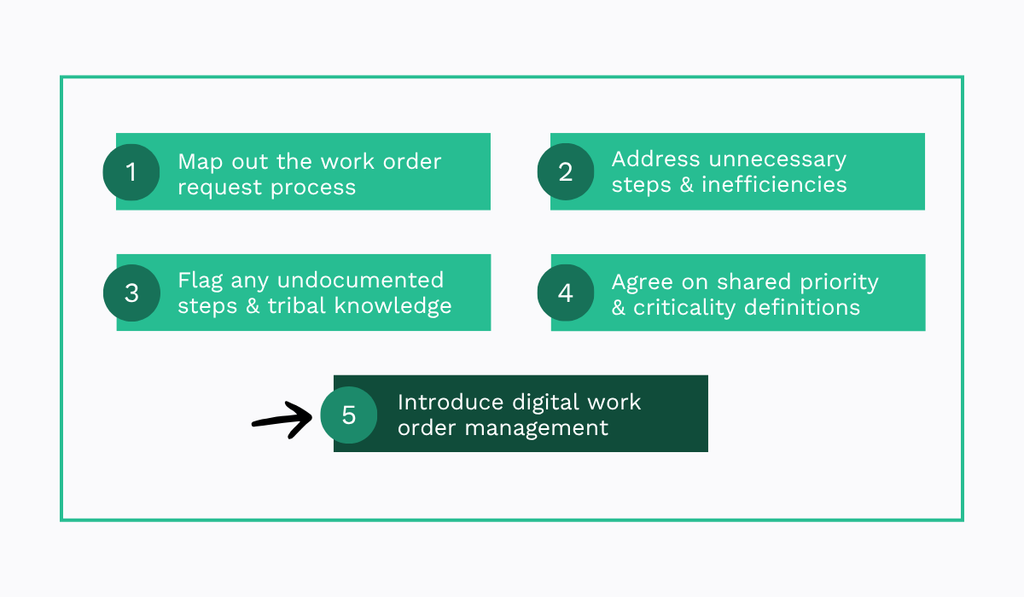
Defining the Right Workflow
A maintenance workflow that is broken or undocumented will not be repaired by digitization, no matter how capable the software is.
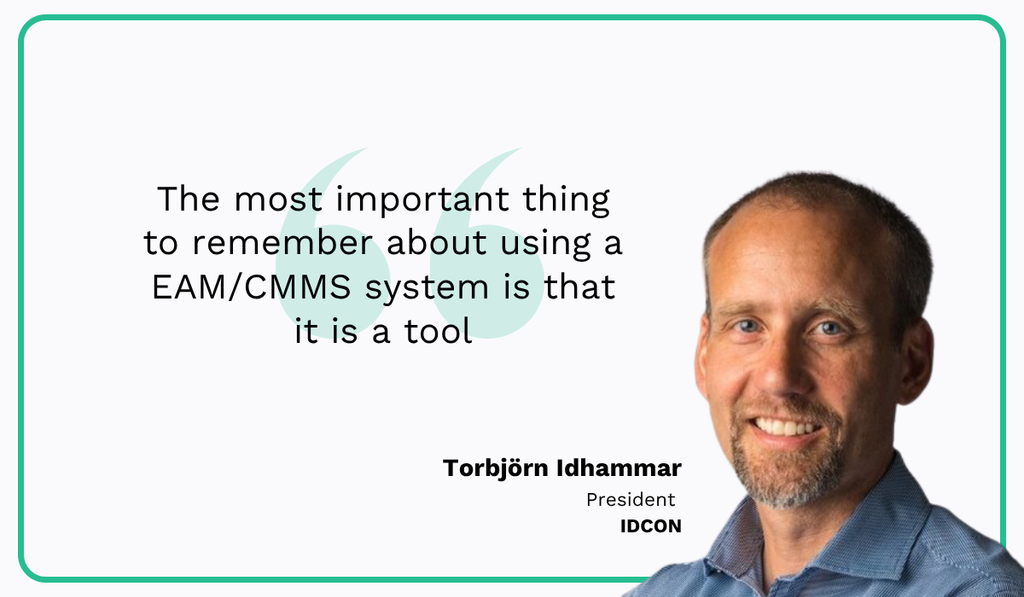
Tor Idhammar, president of the reliability consulting firm IDCON, makes this point about maintenance systems in particular.
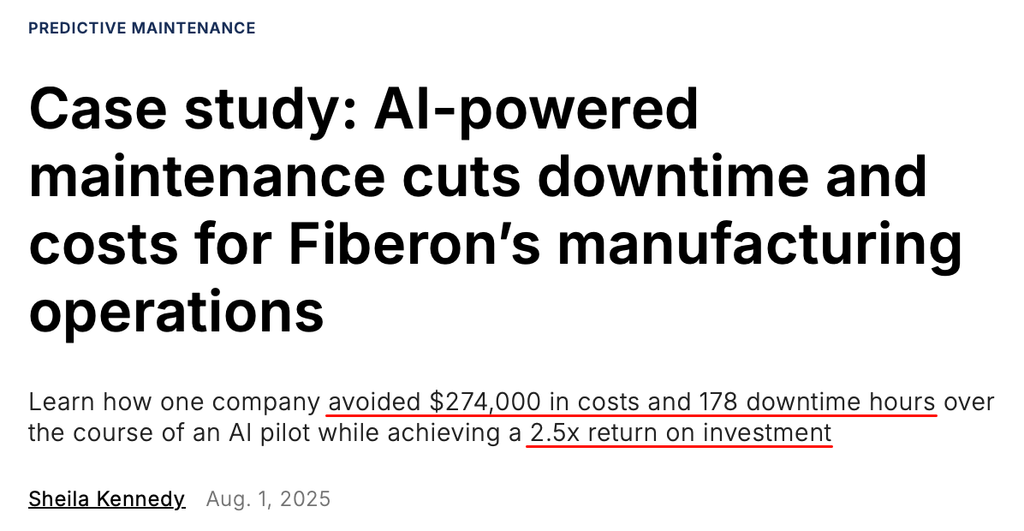
The company tracked avoided costs and downtime hours throughout its maintenance technology pilot, which is why it can state its return with confidence.
Had those figures gone unmeasured, there would be nothing to compare the investment against, and the program’s value would rest on impressions.
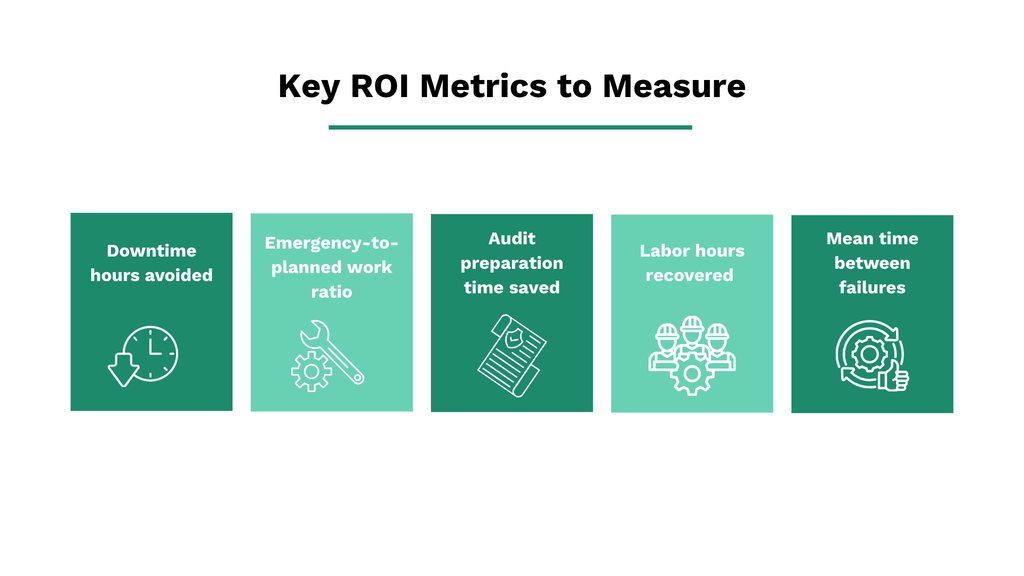
Your own metrics may vary according to what matters most in your operations.
In general, the ones below give a true sense of return on investment.
The best practice is to measure the metrics you select before implementing anything.
That gives you a baseline that describes how the operation performs today, before any software enters the picture.
Then introduce the system and keep measuring, which becomes easier with a digital solution that includes reporting and analytics capabilities.
The result should be a clear before-and-after comparison to see which improvements the system produced.
Conclusion
With that, we covered how the digital approach differs from manual processes and what it takes to adopt one successfully.
If a single idea stays with you, let it be that the data your plant already generates only creates value once it is captured and used.
The tools for that are established and proven, and every day spent on paper delays the gains.
So map your current workflow, then take the first step toward digitizing it.
Everything to Know About Air Compressor Maintenance
Key Takeaways:
Minor faults can progress until they damage expensive components.
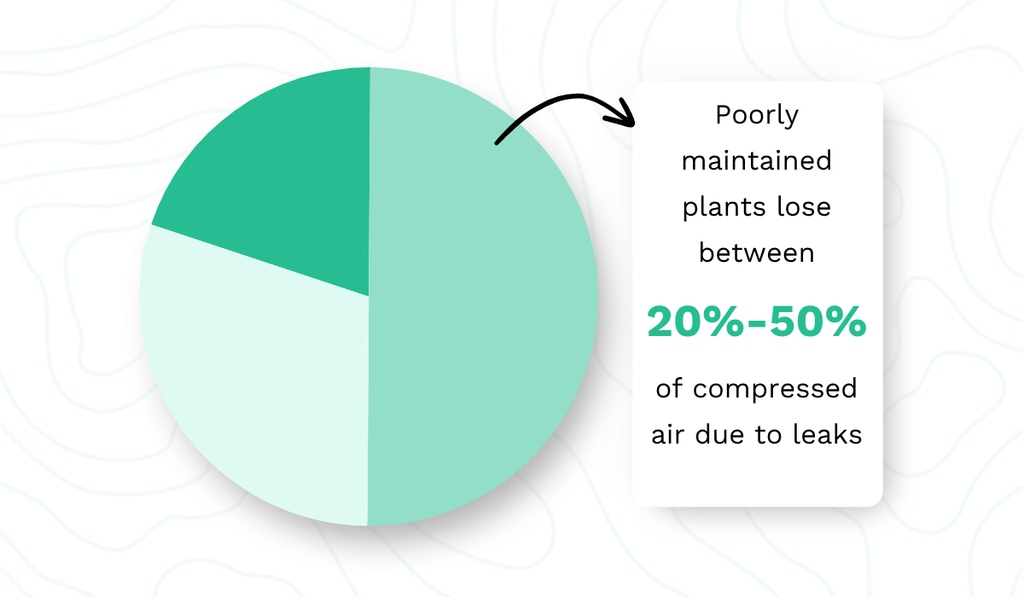
Poorly maintained plants lose between 20% and 50% of their compressed air to leaks.
The type of air compressor you operate determines how often it needs servicing.
Compressed air runs in the background of most facilities, but the equipment producing it is often overlooked until something stops working.
Air compressors need regular attention and maintenance, and the right schedule depends on more factors than most teams expect.
This article covers the benefits of proper compressor maintenance and how to schedule and successfully implement it.
Why Proper Air Compressor Maintenance Matters
Keeping air compressor maintenance on schedule is one of the easiest ways to improve how your operations run.
This practice has three major advantages, which we’ll outline next.
Extended Equipment Lifespan
Routine maintenance reduces wear on the components that work hardest, including filters, belts, bearings, seals, and the motor.
These parts degrade gradually rather than failing at once, so a filter change or belt check on schedule keeps the rest of the machine working in the conditions it was designed for.
When minor faults are corrected early, the compressor keeps operating within its intended specifications, which delays the point at which a major repair or full replacement becomes necessary.
This data applies directly to air compressor maintenance.
Just consider the number of components involved, each with its own service interval and failure pattern.
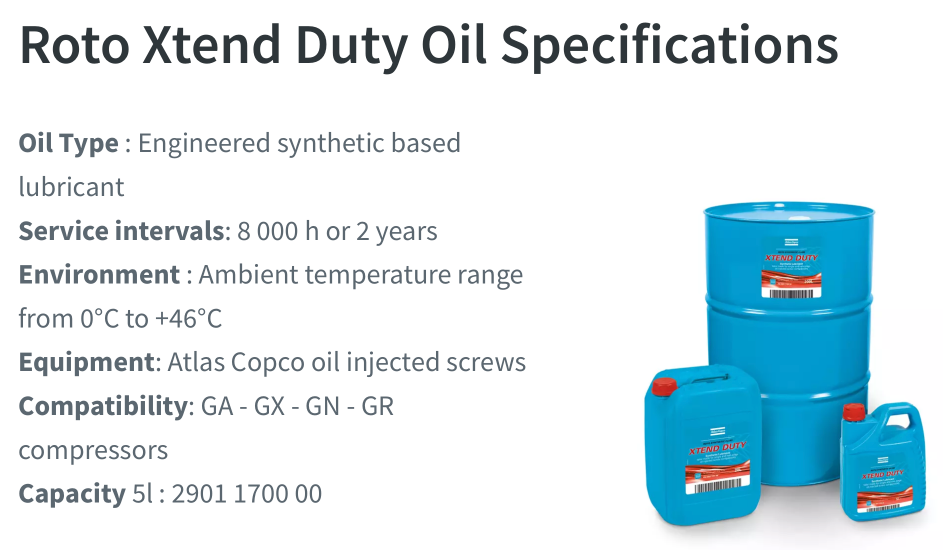
Even something as ordinary as a compressor lubricant oil has defined conditions for use and a recommended service interval, as this Atlas Copco specification shows.
When the oil operates in a different environment, or poor scheduling causes a missed service window, the component starts degrading.
Further along, degraded oil provides less cooling and lubrication, shortening the life of the rotors and bearings it protects.
The same problem appears on a larger scale.
For example, Arthur Pue, President of Engineering Sales Associates, assessed compressed air systems for manufacturers and wrote about what an uncorrected intake restriction does to a compressor.
Pue is describing the air end, the part that compresses the air and the most expensive component to replace.
Regular servicing of filters and oil protects it, which is where most of the lifespan gains come from.
Overall, a compressor that receives constant preventive attention will be more likely to reach the end of its design life instead of failing years earlier.
Reduced Downtime
Downtime is a serious problem in facilities that run continuous production because a stopped compressor interrupts every process connected to it.
The disruption is expensive, and it usually happens without warning, which leaves the team repairing equipment under pressure rather than at a convenient time.
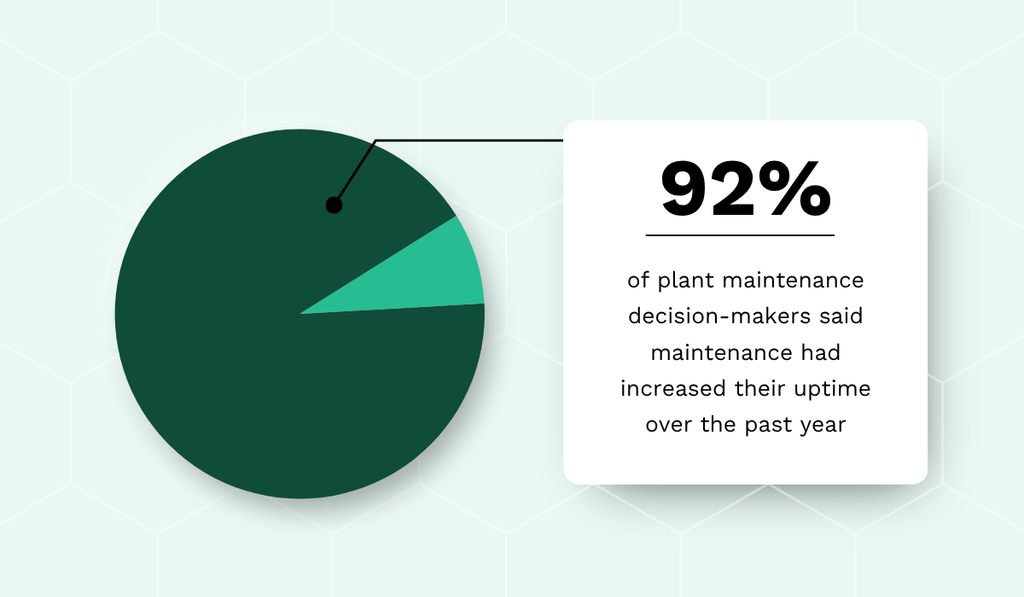
What most maintenance leaders agree on, according to data from ABB, a global technology company, is that maintenance prevents a large share of these interruptions.
The Swiss engineering firm surveyed 3,215 plant maintenance decision-makers around the world, and the majority reported gains in uptime over a single year.
Air compressors deserve particular attention here because compressed air is connected to so many other machines.
In other words, a compressor failure can therefore mean idle staff, scrapped material, and an emergency repair bill several times the cost of a planned service.
In facilities where compressed air is essential to daily operations, that repair also has to happen immediately, which means paying for parts and labor at whatever price is available that day.
Some warning signs deserve closer attention than others when you are trying to catch a failure early.
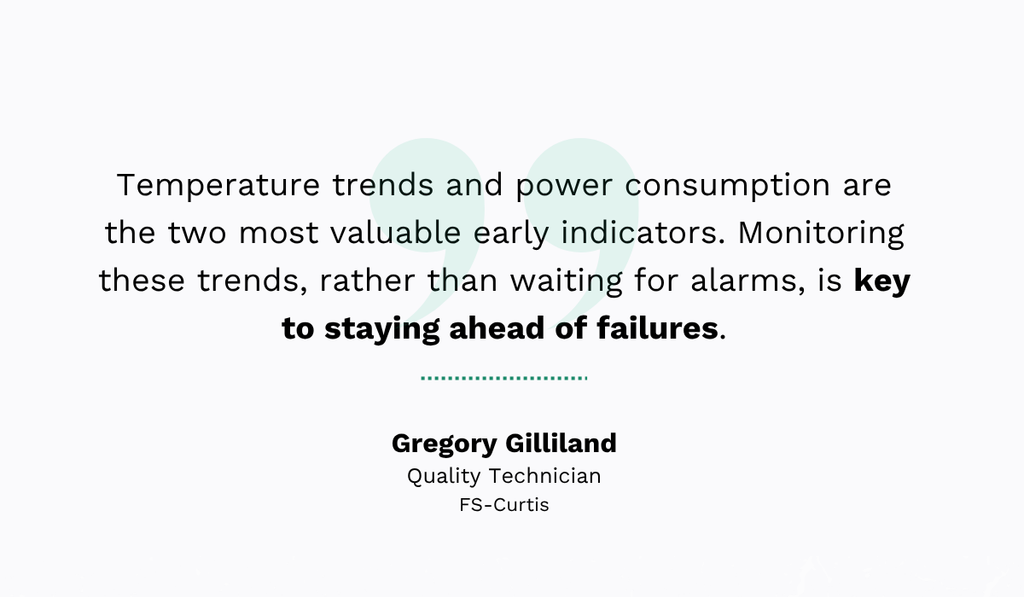
Gregory Gilliland, Quality Technician at FS-Curtis, a compressor manufacturer, was asked which readings give the earliest warning of trouble.
He elaborates that sharp temperature changes can indicate a clogged filter or a lubrication problem, while rising power consumption can signal general degradation across the system.
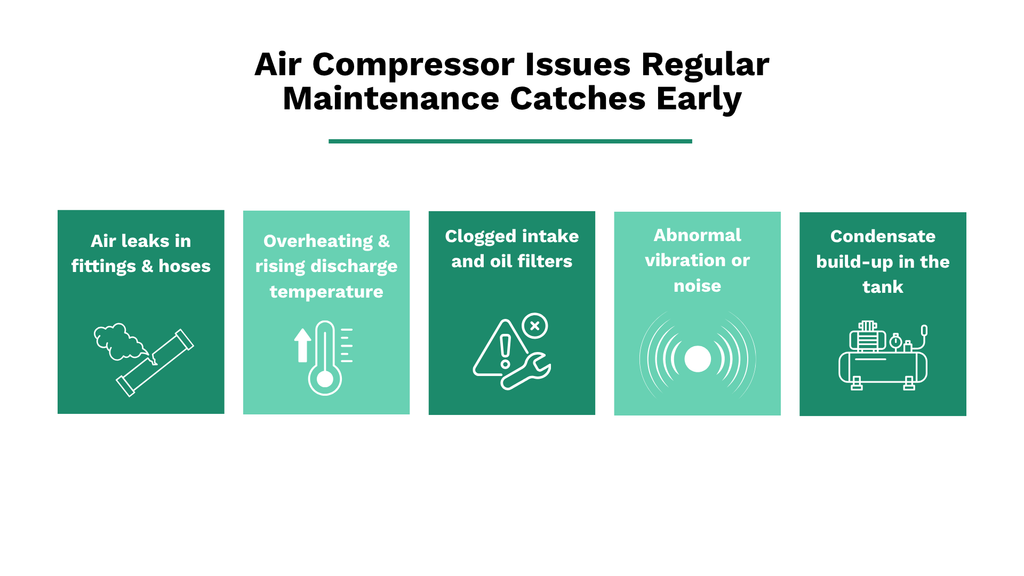
Regular maintenance can reveal several other signals beyond temperature and power consumption, shown below.
Each of these is better caught early because every one of them can progress from a minor annoyance into a failure that stops the machine.
For instance, a change in vibration can go unnoticed because a compressor is loud and vibrates during normal operation.
However, that change can be related to worn bearings or a misaligned coupling, and it may eventually require downtime you are trying to avoid.
Scheduled inspections give you the chance to act on these signals while the repair is still minor.
Increased Cost Savings
These two previous benefits also directly lower your operation costs.
After all, the money spent on maintenance is predictable, while the money spent on failures is not. Unplanned work always costs more than the same job performed on schedule.
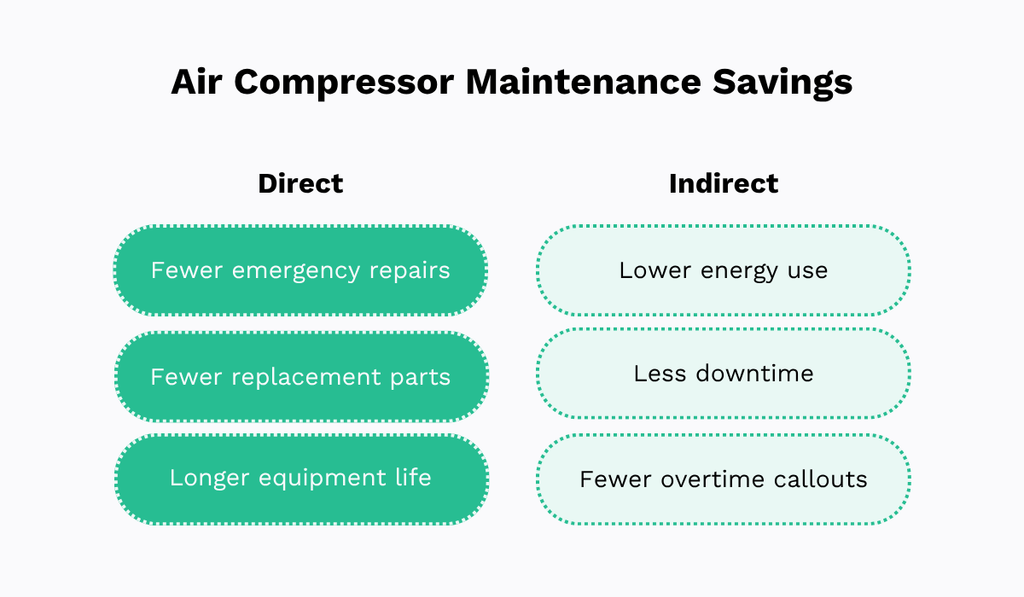
Longer equipment lifespan and less downtime are just two of several direct and indirect savings you can expect from regular air compressor maintenance.
On the one hand, direct savings prevent you from spending resources on extra parts or on emergency reactive maintenance when something breaks unexpectedly.
On the other hand, indirect savings start accumulating through lower energy bills and fewer worker overtime hours, which would have been required during repairs.
Beyond savings, proper maintenance also delivers measurable efficiency gains in the system itself.
If we consider guidance published by ENERGY STAR, the energy efficiency program run by the US Environmental Protection Agency, the scale of the waste becomes clearer.
They found that the condition of a plant’s compressed air system determines how much of its output is lost before it reaches the tools that need it.
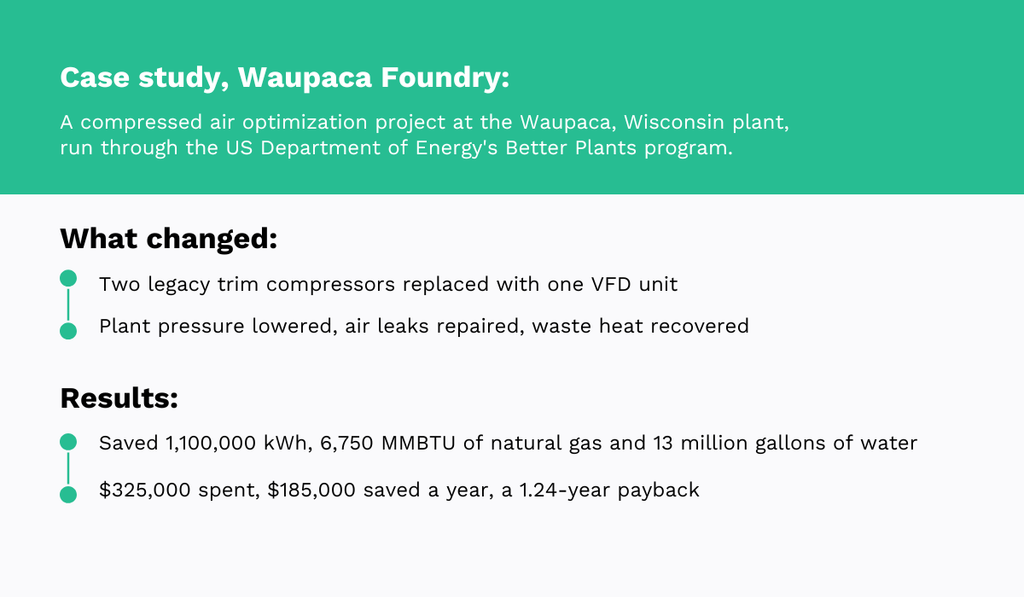
The foundry replaced aging equipment and corrected several long-standing problems in how its compressed air was produced and distributed.
This effort paid off with lower electricity, gas, and water consumption, and a return on the investment in a little over a year.
With regular maintenance, an upfront investment of this size becomes smaller because problems such as leaks and excessive pressure are corrected as they appear instead of accumulating for years.
That means the savings arrive gradually over time rather than through one large capital project.
How Often Is Air Compressor Maintenance Needed?
A logical next question to ask is what an air compressor maintenance schedule should look like.
The benefits are compelling, but resources have to be allocated sensibly, and servicing a machine more often than it needs wastes labor hours that other assets require.
There is no straightforward answer to this question, and it depends on your air compressor type.
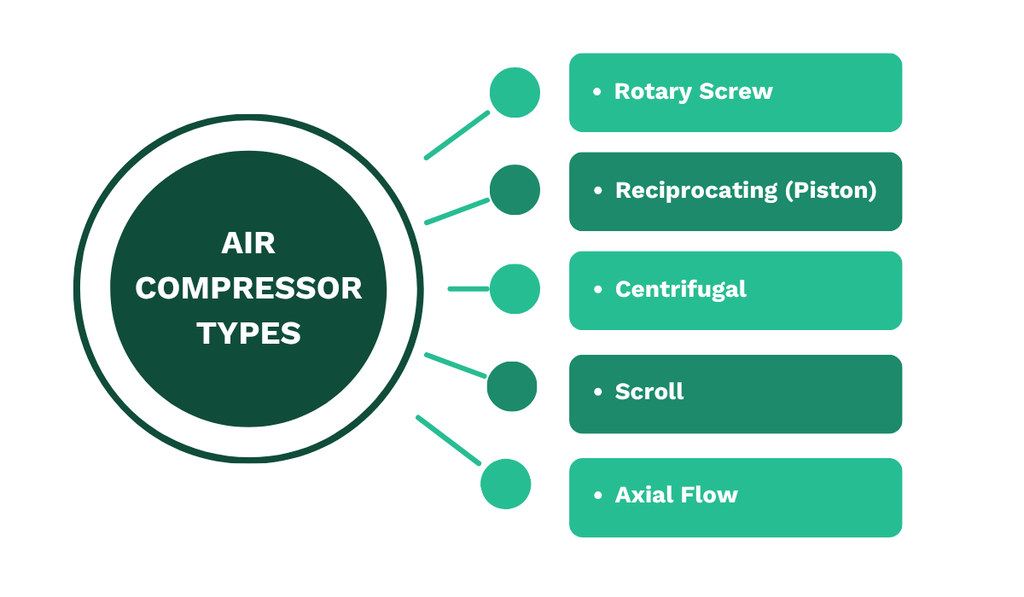
All these types have different requirements because they produce compressed air in different ways and wear differently as a result.
Reciprocating compressors use pistons, valves, and rings that are in constant contact, so they need frequent attention to those wearing parts.
Rotary screw compressors have fewer moving parts, but the oil, separator, and filters need changing on a defined cycle.
Centrifugal compressors have no rubbing parts in the air path, so routine attention moves to the lubrication system, the bearings, and vibration readings.
These are just a few examples to consider. A strong guideline to follow is reading the manual, which gives you the manufacturer’s own view of what each component needs and when.
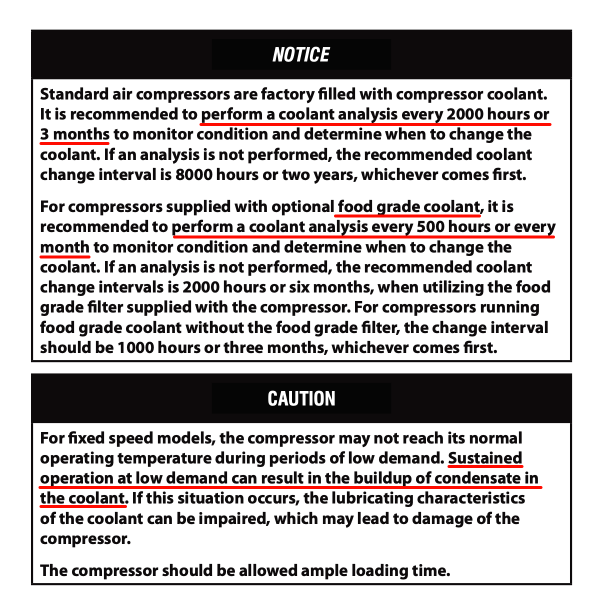
As an example, shown below is an excerpt from the Ingersoll Rand manual for a rotary screw compressor.
As shown, there are separate maintenance recommendations for the two types of coolant the compressor may use, and the intervals for food grade coolant are considerably shorter.
Plus, the caution is useful information because a compressor running at low demand may need more frequent checks, which is counterintuitive at first.
This last point concerns operating hours, one of several considerations that go beyond the compressor type and the components it uses.
Some other considerations are shown in the next table.
Operating hours
A unit running 24/7 hits each service interval far sooner than one used a few hours a day
Environmental conditions
Dust, heat, and humidity shorten filter and oil life, so intervals tighten
Load profile
A compressor near full load most of the day wears faster than one that idles unloaded
When we take the activity of the compressor and consider the environment it operates in and the intensity it runs at, we get a better idea of how far the manufacturer’s intervals should be adjusted.
With these pieces of information, you can start building a maintenance schedule for the individual components rather than for the machine as a whole.
Each part then receives attention on its own cycle rather than waiting for a single annual service visit.
Air Compressor Preventive Maintenance: The Key to a Successful Implementation
As you can see, the maintenance planning stage can be complex on its own.
But we need to consider that an effective preventive maintenance program requires more than following a checklist.
Maintenance teams need a reliable way to schedule tasks, document inspections, track repairs, and monitor equipment performance over time.
Phillip Schupp, a Multi-Site Reliability Engineer at Mauser Packaging Solutions, reviewed maintenance practices across 25 facilities and described what he found to Plant Services.
Individual sites had developed their own habits over the years, with some good at planning and others good at documentation.
Documentation is usually the first task to be skipped because it produces no immediate benefit to the technician doing it, and without a shared system nobody notices which practices work.
One way to correct this is to employ a modern computerized maintenance management system (CMMS).
These systems replace paper records and spreadsheets with a single source of maintenance information, and their core features are shown below.
These capabilities cover the entire maintenance process, from the moment a request is raised to the report that shows how the asset performed, and act as a central record for every technician.
As an example, WorkTrek is a CMMS that helps organizations manage air compressor maintenance more efficiently.
These triggers are configured once and then monitored continuously, with work orders generated automatically and sent to the assigned technician when the reading is reached, so nobody has to check the meter and remember what the number means.
For more routine inspections, scheduling works on time intervals in the same way, so daily and weekly checks appear without anyone remembering to create them.
That means the servicing intervals you established earlier are applied consistently, whoever happens to be on shift.
Conclusion
That covers what regular attention to your compressors returns and how to decide what it should look like.
The main point to remember is that compressed air equipment gives warning before it fails, provided somebody is scheduled to look.
Start with your manuals, adjust for how hard your machines work, and put the schedule somewhere it will be followed.