

Get a Free WorkTrek Demo
Let's show you how WorkTrek can help you optimize your maintenance operation.
Try for freeKey Takeaways:
- Manufacturers face a level of disruptions that hasn’t been seen since 2020.
- By providing training for all employees, Pepsci built a strong foundation for TPM.
- The 5S method helps maintain low inventory levels and cut down unnecessary costs.
Total Productive Maintenance (TPM) isn’t your average maintenance strategy.
It involves absolutely everyone, from operators to executives, in caring for assets, emphasizing shared responsibility, collaboration, and practices such as autonomous maintenance.
As a result, TPM offers numerous benefits, including increased productivity, prolonged asset lifespan, and reduced costs.
However, because of its broad scope, TPM can also be challenging to implement.
That’s why this article shows you exactly how to roll it out successfully.
We’ll walk you through seven steps, explaining how to execute each one effectively, which tools and methods can support the process, and what mistakes to avoid.
Let’s begin.
1. Secure Executive Support
First, you need a visible, ongoing commitment from senior leadership to support TPM as a long-term cultural and operational transformation.
After all, this new maintenance system will fundamentally change roles and responsibilities across the organization, from technicians and operators to executives themselves.
Without leadership backing, the program will inevitably face resistance, be seen as “extra work” rather than a priority, and ultimately fail.
That’s why it’s vital to educate senior leaders on the value of TPM.
Just remember that they already have a lot on their plates.
Dave Evans, Co-Founder and CEO of Fictiv, the operating system for custom manufacturing that streamlines mechanical parts sourcing, explains:

As a result, TPM must be positioned as a strategic enabler.
You need to clearly show how TPM helps organizations navigate uncertainty and improve overall business performance, not merely optimize maintenance activities.
In other words, link TPM outcomes to broader organizational goals.
Avoid focusing solely on metrics like fewer defects or improved preventive maintenance compliance.
Instead, translate those into benefits leaders care about, such as:
- Higher throughput
- Reduced overtime
- Lower operating costs
- Greater operational resilience
Feel free to support this with industry research and real-world case studies.
For example, in 2024, Bajaj Auto, a major Indian multinational automotive manufacturer, received the World-Class TPM Achievement Award for one of its facilities.
In the accompanying press release, the company highlighted tangible benefits of TPM, including increased agility in responding to sudden demand spikes.
Their President of Engineering, Pradeep Shrivastava, noted:

Stories like these provide concrete proof that TPM delivers measurable business value.
When leadership sees real examples and data, they’re far more likely to recognize TPM as a strategic advantage and commit to supporting the program.
2. Identify the Pilot Area
TPM can be difficult to implement successfully because it introduces a whole set of new behaviors, routines, metrics, and systems.
That’s why it’s best to start with a pilot project to reduce risk.
The area you choose for the pilot becomes a learning ground for these new practices and serves as a template for a facility-wide rollout.
If anything goes wrong at this stage, it is easier to correct, and you can capture valuable lessons before scaling the approach to the rest of the organization.
When choosing a pilot area, consider the following three questions:
| Question | Pro | Con |
|---|---|---|
| What’s the easiest to improve? | Selecting equipment that is easiest to improve allows you to achieve quick, visible wins. | This option may not fully test the robustness of the TPM process. |
| Where’s the bottleneck? | Choosing assets that are clearly constraining production can quickly increase total output and provide a rapid financial payback. | Using a critical asset as a pilot carries risk, as it may be offline longer than desired. |
| What’s the most problematic? | Fixing equipment that causes the most frustration is often well-received and helps build strong support for the TPM program. | This approach may not deliver immediate payback, and solving long-standing issues can take time. |
Now, you don’t have to choose the pilot area alone.
In fact, it’s best to involve employees from all parts of the business in the selection process.
After all, the project will affect everyone.
This collaborative approach is what Bajaj Auto used, according to Pradeep Shrivastava, whom we mentioned earlier:
“The most important part here is the reviews you do and the targets you set. The team sits together, brainstorms, and checks out ideas in order to achieve the goals set.”
He attributes the program’s success to this team-based decision-making process.
By deciding together, the organization gained a broader context, stronger commitment, and a shared belief in TPM.
3. Provide Training for Employees
TPM cannot succeed without proper training. All employees must understand what it is, why it matters, and their role in it.
Les Cyfko, former Director of Maintenance & Warehousing, Operations, Engineering, and Continuous Improvement at PepsiCo, understood this well over a decade ago.
At the time, he was responsible for implementing TPM alongside another efficiency program, Lean Six Sigma, and his first priority was training:

This created a strong foundation and ensured the successful implementation of both programs over time.
By prioritizing training, you can achieve the same.
For best results, consider scheduling training in stages.
Start with foundational training for everyone, covering the key pillars of TPM and core concepts such as OEE, loss types, and more.
Once that baseline is in place, move into role-specific training that connects theory to everyone’s daily work.
For example:
| Operators | Daily inspections, basic lubrication, and early problem detection |
| Maintenance teams | Advanced troubleshooting, predictive maintenance techniques, and root cause analysis |
| Leadership | Sustaining TPM, reviewing OEE data, and driving continuous improvement |
Above all, prioritize hands-on, practical training. That’s how most people learn best.
Giving everyone the opportunity to practice what they’ve learned ensures the knowledge is truly retained and translated into lasting improvement across the organization.
4. Restore Equipment to Prime Operating Condition
Now, it’s time for some real, practical work.
At this stage, have your team perform a deep clean and initial maintenance of the pilot equipment and the pilot area to restore them to their original designed performance.
Think of this as starting with a clean slate, helping everyone get on the same page regarding routine cleaning and maintenance procedures.
A widely used tool for this step is the 5S methodology, which consists of the following elements:
| Sort | Separate essential from non-essential items, removing unnecessary tools, parts, and clutter to free up space and minimize distractions. |
| Set in Order | Arrange necessary items logically so they are easy to find, use, and return, reducing wasted motion. |
| Shine | Clean the workspace and equipment regularly, turning cleaning into a form of inspection to detect issues like leaks or wear before they lead to breakdowns. |
| Standardize | Establish consistent procedures and visual controls (such as labels and color-coding) for the first three steps, turning them into habits. |
| Sustain | Build the discipline to maintain these standards through audits, training, and integration into the company culture, ensuring long-term success. |
The reason many use this methodology is simple: it works.
For instance, back in 2010, Hemas Manufacturing, a major Sri Lankan firm that produces various fast-moving consumer goods, won an award for its successful implementation.
According to Hemas FMCG Director at the time, Canicius Fernando, the concept was foundational for improving productivity:
“It facilitates a more organised working environment, helps maintain low inventory levels, cut down unnecessary costs, and saves money. Added to this is the high morale and enthusiasm among employees at all levels, thus increasing productivity in the long term.”
In short, when implemented correctly, 5S sets the tone for the rest of the TPM program.
It restores equipment and workspaces to peak operating condition and equips teams with the tools to maintain high productivity.
It is also particularly valuable for the next step.
5. Implement Autonomous Maintenance Practices
Once a baseline state of the equipment is established, the autonomous maintenance program can be implemented.
In this step, equipment operators are trained to take responsibility for routine maintenance tasks such as cleaning, inspection, lubrication, and minor adjustments.
However, remember that this does not turn operators into mechanics. They are simply becoming part of the broader maintenance system.
Eric Whitley, Director of Smart Manufacturing at L2L, a connected workforce platform unifying asset management and production performance, equates their role to that of a car driver:
“The driver of the car isn’t the mechanic who’s going to change the transmission. They’re the ones who put gas in, make sure there’s air in the tires […] that’s the operator. And then you [also] got a mechanic out there.”
Essentially, operators and maintenance personnel serve different but complementary roles.
That’s why it’s important to clearly separate operator tasks from maintenance tasks and train operators only on what is relevant to their role.
Drawing from the 5S methodology, create clear SOPs that outline their responsibilities, instructions, and safety procedures.
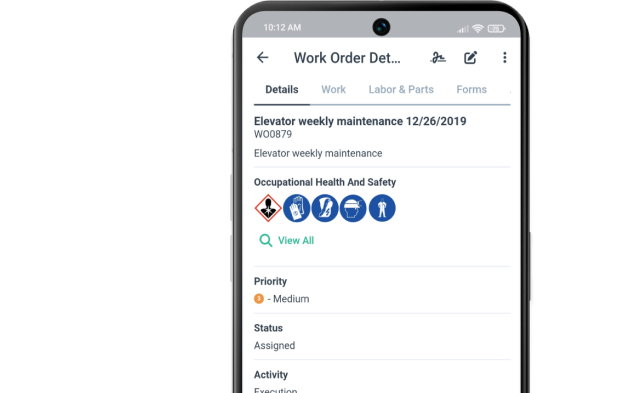
Digital checklists can be quite helpful here.
Operators can quickly pull them up whenever they need and tick off all the vital tasks, ensuring they’re following procedures consistently:

This not only makes their job easier but also helps catch small issues before they escalate, relieving pressure on the maintenance team and minimizing downtime.
After all, operators are the ones closest to the machines and are best positioned to notice early signs of problems.
That’s what makes their role in TPM invaluable.
6. Measure OEE to Identify Major Losses
TPM is highly data-driven.
Therefore, to implement it effectively and measure its success over time, you need to track the right metrics, aligning teams around facts rather than opinions.
That’s where OEE (Overall Equipment Effectiveness) plays the main role.
Considered the gold-standard metric for measuring efficiency in manufacturing, OEE analyzes production across three factors:
| Availability | Lost time due to equipment downtime (breakdowns, setups, adjustments) |
| Performance | Lost time when equipment runs slower than its maximum speed (idling, minor stops, reduced speed) |
| Quality | Lost output due to defects, rework, or scrap |
By measuring how well equipment converts planned production time into quality output, OEE helps identify major losses within a plant.
That makes it the foundation for improving productivity in every TPM program.
TPM identifies six “major” or “big” losses that harm efficiency:
- Breakdowns
- Setup and adjustment
- Idling and stoppages
- Slowdowns
- Quality defects
- Startup and yield losses
Interestingly, each of these losses corresponds to one of OEE’s three components:
| Availability | Breakdowns and setup/adjustment |
| Performance | Idling, stoppages, and slowdowns |
| Quality | Quality defects and startup/yield losses |
Analyzing losses in terms of these categories will help you identify areas for improvement more easily, enabling you to prioritize issues that matter most to you.
Just make sure you bring your supervisors, operators, and maintenance team into the conversation.
Together, analyze OEE and pick the single biggest loss to tackle first.
Study its symptoms and examine potential causes.
Here, the Ishikawa diagram, also called a fishbone or cause-and-effect diagram, is typically used to trace every symptom back to its root causes.

Once you understand what the issue is, how it affects productivity, and why it happens, you’ll be able to develop data-driven solutions, reducing risk and achieving your main goal: boosting productivity.
7. Introduce Proactive Maintenance
Finally, there can be no effective TPM without proactive maintenance.
Moving away from a reactive approach and adopting preventive or predictive programs is the most effective way to improve overall equipment reliability and stabilize production.
Zach Williams, Engineering Manager at Kito Crosby Australia, an industrial equipment supplier specializing in custom hoists and lifting solutions, explains why such programs are so effective:

Essentially, the goal is to prevent major failures that disrupt production through smaller, but frequent upkeep tasks and inspections.
However, for that maintenance strategy to work, you need a strong system that will support planning, scheduling, and efficient task execution.
That’s where a CMMS (Computerized Maintenance Management System) comes in.
A CMMS helps you plan, schedule, track, and optimize every maintenance task based on equipment history, condition monitoring, and production performance.
So, instead of relying on paper logs or tribal knowledge, maintenance becomes digitally controlled, predictive, and repeatable.
Our own CMMS, WorkTrek, was also designed with efficient proactive maintenance as the core priority.
Our preventive maintenance (PM) feature enables users to quickly and easily schedule recurring maintenance based on their operational and asset needs.
Whether tasks need to be performed daily, weekly, monthly, or yearly, you can set them up, assign them to the right personnel, and track their progress from one place.

WorkTrek also supports condition-based maintenance, allowing tasks to be scheduled based on meter readings, usage time, mileage, temperature, pressure, or other factors.

Additionally, work orders for recurring tasks can be prepared in advance using pre-built templates.
These templates include customizable required fields to ensure all vital information, from spare parts to SOPs, photos, and more, is consistently captured.

No more searching through scattered paperwork or calling around for important details.
Everything is centralized, organized, and visible in real time.
This makes it easier for technicians to follow schedules safely and correctly, while supervisors can track progress, identify inefficiencies, and plan future work.
In short, a CMMS makes your PM program more efficient, data-driven, and streamlined.
As a result, your maintenance team is much better positioned to maintain asset reliability and support your TPM efforts.
Conclusion
By now, you can probably tell that implementing TPM requires far more than adjusting maintenance schedules or increasing the number of inspections.
On the contrary, it demands a true culture change across the entire organization.
Many companies underestimate this fact and jump into TPM without a strong plan or stakeholder buy-in.
That’s when they encounter resistance, and their efforts ultimately fail.
Don’t follow in their footsteps.
Set your TPM efforts up for success by being upfront about what the journey will require, and just as importantly, by clearly communicating the value it can bring.
When people understand the “why” and are actively involved in shaping the plan, momentum builds naturally.
So, get everyone aligned early, and you’ve already cleared the biggest hurdle, creating a strong foundation for a TPM program that lasts and delivers real results.