

Blog

Operations & Maintenance
How to Streamline the Management of Maintenance Work Requests
Key Takeaways With an optimized work request process, maintenance becomes a strategic advantage rather than a reactive measure, setting an organization apart in terms of operational resilience and efficiency. We’ve created this guide to help you streamline your work request handling process. We’ll guide you through each phase, introduce helpful tools, and explain why each […]
Key Takeaways
Organizations risk incomplete submissions and waste valuable time without a standardized work request submission process.
CMMS solutions capture all relevant details for each stage of the work request lifecycle, streamlining communication and speeding up issue resolution.
Setting clear SLA response times keeps maintenance teams accountable and helps prevent conflicts.
With an optimized work request process, maintenance becomes a strategic advantage rather than a reactive measure, setting an organization apart in terms of operational resilience and efficiency.
We’ve created this guide to help you streamline your work request handling process.
We’ll guide you through each phase, introduce helpful tools, and explain why each step is essential.
By the end of this guide, you’ll have everything you need to take your work request procedures and maintenance strategy to a whole new level.
Standardize Work Request Submissions
Standardizing work request submissions ensures a consistent, efficient, and transparent process every time.
As a result, the likelihood of incomplete submissions and back-and-forth clarifications is significantly reduced, making it easier for maintenance personnel to follow up.
They know this very well at the 558th Aircraft Maintenance Squadron in the Warner Robins Air Logistics Complex.
Each aircraft repair document, mainly Maintenance Work Requests (MWRs), is carefully managed due to their significant impact on maintenance planning.
Robert Hall, the Chief of the 558th Aircraft Maintenance Squadron Planning Flight, elaborates:
[Strategic maintenance planning] involves making sure that all the Air Force Sustainment Center engineering requests are completed and planned by disposition instructions given. We approve MWRs ensuring they are written correctly; all technical data is correct and all codes are correct on the document.
And the results of this meticulousness are more than satisfactory, he says:
Last year we approved over 10,000 MWRs and reviewed 40-plus workload offers for new workload or incoming unplanned depot-level maintenance requirements. We had zero quality assurance findings for that year.
Work requests aren’t just paperwork but a foundation for more effective asset and facility maintenance.
However, this is true only if the submission procedure is well-defined.
Systemize the submission protocols to improve your work request and maintenance process. This includes determining:
who can submit requests
who reviews/approves them
what information to include in a request
how to submit requests (email, paper form, or a digital platform)
where to check request status
Outlining what information each request should include is particularly important.
This is what maintenance teams need the most to do their jobs.
A standardized template, like the one below, is the most effective.
Source: WorkTrek
It covers all the essentials, such as the requester’s name, problem description, due date, the asset in question, and priority level.
This way, you can easily capture the vital details without creating too much work for the requester.
This is exactly how an effective work request submission process should function.
Keep Work Requests Organized Using CMMS
After work requests are submitted, keeping them organized makes it easier for all stakeholders to document, track, and manage each request.
There’s no better tool than a computerized maintenance management system (CMMS).
CMMS solutions are designed to manage the entire work request lifecycle—from submission to resolution—capturing every detail and creating a single source of truth.
This is perfect for any organization with complex upkeep needs, such as Barnard College of Columbia University.
They have numerous work requests coming in daily for various facilities, such as dormitories, athletic centers, computing labs, and biomedical laboratories.
However, as one of their professors explains, CMMS stores all the upkeep data, including requests, in one place.
Illustration: WorkTrek / Quote: EdTech
This makes maintenance far more manageable.
Traditional methods like paper forms or emails simply lack this capability.
With those less effective systems, work requests often need to be more organized, slowing response times and increasing costly downtime.
Take it from Danielle Rivers, Business Services Manager at the real estate company Camden Property Trust.
She experienced the limitations of a paper-based work request system firsthand:
Back when we were using paper service request forms, our techs were losing 15 minutes just going to the office to get what they needed to get jobs started. They had to print the request forms and collect the keys necessary to get into those units. Then they had to walk back to the units to get the work done. Then it was back to the office again to print more request forms and gather more keys, and those forms had to be completed, and the manager had the job of closing out the tickets.
With a CMMS like our WorkTrek, all these inefficiencies are eliminated.
Each request is captured the moment it’s submitted and displayed in an easy-to-navigate table, like the one you see below.
Source: WorkTrek
You can quickly adjust your view, sorting and filtering requests by criteria such as completion dates or requester names, making it easy to find exactly what you need.
Essentially, WorkTrek enables you to approve or resolve requests and monitor their progress from start to finish in one centralized system accessible from anywhere.
It’s finally time to say goodbye to scattered files and hello to seamless, efficient work request management.
Properly Prioritize Work Requests
Setting up clear criteria for categorizing maintenance requests by urgency ensures issues are addressed in proper order rather than on a first-come, first-served basis.
That means critical issues get tackled first while less pressing ones wait their turn.
Prioritizing requests is crucial because maintenance can become chaotic without an effective system, leading to unplanned downtime, safety risks, and other complications.
Just look at what happened at Southern Illinois University.
Cockroaches infested dorm rooms during the winter break, and while requests were put in, the response was delayed, leaving students frustrated and unable to sleep in their dorms.
Source: The Daily Egyptian
Jim Hunsaker, their Senior Associate Director of Housing Operations, argued that there were no issues on their end and that there was an effective prioritization system in place:
For instance, a leaking shower or a sink that won’t turn off or any type of leak should be reported immediately, so we can take care of that. Otherwise, through the housing portal, a student will submit a maintenance request. If it’s bug issues or other non-emergency issues, we will prioritize those and take care of those as soon as we possibly can.
However, it seems like this system isn’t compelling enough.
In a small survey conducted by the Daily Egyptian, 88.1% of the students living in the dorms reported maintenance issues in their dorms.
This indicated a significant maintenance backlog, possibly caused by a lack of proper work request prioritization.
There isn’t a universal set of criteria for effective work request prioritization.
Some of the most common factors are asset criticality, maintenance complexity, and safety risks, but ultimately, each organization must develop its metrics.
For example, in St. Albert, Alberta, Canada, Coun. Mike Killick proposed adding “social value” as a priority factor for the city’s maintenance plan.
His proposal followed the council’s choice to delay repaving of St. Vital Avenue hill, despite its importance for events like the annual Soap Box Derby.
Source: St. Albert Gazette
As you can see, there’s no limit to how versatile these criteria can get.
Nevertheless, avoid getting overwhelmed right from the get-go.
Instead, start simple, maybe with four levels of priority shown below.
Source: WorkTrek
From there, you can refine your criteria as needed.
A key point to remember is that not all work requests are created equal, and they should not be treated that way.
Therefore, the more time you invest in setting these criteria, the smoother your operations will run.
Enable Real-Time Request Tracking
Real-time request tracking benefits everyone, from the requesters to maintenance personnel and managers.
It enables requesters to quickly check the status of their requests, while upkeep staff can access instructions at any point, helping them complete tasks without confusion or delays.
It’s hands-down the best way to keep everybody in the loop and avoid those time-draining follow-up calls and emails.
Many organizations, like The Upper St. Clair School District in Pennsylvania, use a cloud-based CMMS to unlock real-time work request monitoring.
Lou Angelo, district Director of Operations and Facilities, explains that this system allows workers to access all the data they need on their mobile devices.
Illustration: WorkTrek / Quote: EdTech
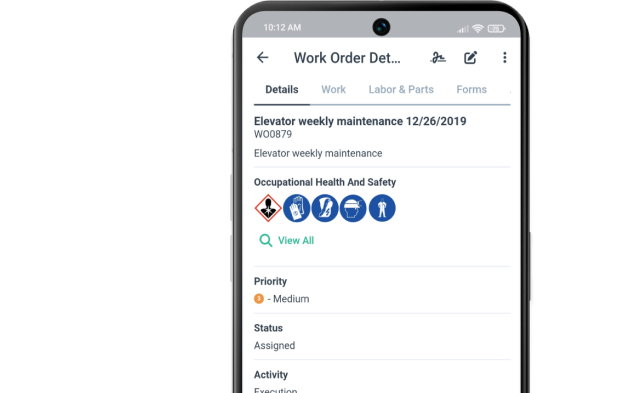
Many modern CMMS solutions offer mobile apps, making real-time tracking even more accessible.
Instead of tying users to a computer in the office, they let them view or submit work requests from anywhere as long as they have internet access.
Source: WorkTrek
Some CMMS solutions go further by automatically notifying users of request updates.
These updates can be triggered when a request is approved, closed, completed, or rejected, reducing the need for additional texts and calls to confirm statuses.
The bottom line is this: If you want to keep all the stakeholders updated with the latest information, consider implementing CMMS.
This tool is tough to beat when providing access to the freshest data possible.
Define Clear SLA Response Times
A Service Level Agreement (SLA) response time specifies the timeframe within which the upkeep provider should acknowledge or begin addressing a work request.
Clearly defining this criterion for different request types is an absolute must.
It helps establish expectations, reduces conflicts and misunderstandings, and holds maintenance teams accountable to meet agreed standards.
That’s why websites for government agencies, universities, or other organizations often showcase their maintenance response times.
For instance, the response times for Transform Housing, an organization that offers housing to homeless individuals, are below.
Source: Transform Housing
You’ll also notice that response times are typically aligned with the priority level of the issue: urgent issues get addressed sooner, while routine repairs take somewhat longer.
Rosanna Fischer, Vice President of KDM Management Inc., a company helping condominium corporations with day-to-day operations, provides some benchmarks in property management.
Illustration: WorkTrek / Quote: LinkedIn
To define your SLA response times, refer to the priority matrix you created earlier as a foundation for your decision-making.
Once you’ve defined them, tracking compliance is simple using CMMS.
Since the system records when each request is submitted and resolved, it’s easy to spot any instances of noncompliance.
Plus, with CMMS reporting features, you can pull a complete summary of overdue requests for any period, like the example below.
Source: WorkTrek
If overdue requests are frequent, it may signal a need to reevaluate your response times or even examine your work request process for other inefficiencies.
Let’s take a look at how to approach that.
Track Maintenance Work Request KPIs
Regularly monitoring and analyzing work request KPIs is crucial for identifying bottlenecks and areas for process improvement.
Over time, this can improve your maintenance efforts as a whole.
Think about it. If you’re not tracking the efficiency of your work request process, small inefficiencies can slip by, quietly building into larger issues that can disrupt the entire upkeep cycle.
For example, if your team consistently responds slowly to repair requests and nobody monitors them closely, requests will eventually pile up.
This backlog will prolong maintenance issues, leading to all sorts of problems, from safety issues to delays.
Take it from the San Antonio Independent School District (SAISD).
Some schools within the district experienced critical failures of air conditioning systems, sometimes even forcing teachers to send students home due to excessive heat.
Source: News 4 San Antonio
Despite the problem occurring amid a heat wave, the schools couldn’t resolve it on time, so some had to shut down.
The cause of this slow response was poor handling of work requests.
SAISD records showed 4,765 open work orders across district buildings, with 1,725 related to heating and cooling repairs.
District officials noted these numbers were somewhat inflated by duplicate requests but acknowledged the need for a better work request/order system to manage repairs more effectively:
We are working to reduce the number of duplicate work orders in the system, which can happen when multiple requests are made by multiple people. [...] We are moving toward a priority system with our work orders. We address the highest priority work orders first, such as requests made to mitigate HVAC or safety issues. Later this fall, we will be transitioning to a new work order system with improved analytics.
This is a powerful reminder of why monitoring the work request process is so important.
If SAISD had kept a closer eye on theirs, they could have flagged issues earlier, implemented an adequate prioritization system, and avoided a backlog that disrupted their schools.
Granted, tracking KPIs won’t magically erase all inefficiencies, but it will help you spot trouble before it escalates.
So, to get started, focus on a few key KPIs, like:
number of service requests in the backlog (open requests)
percentage of service requests completed on time
total number of completed service requests
average service request response time
customer satisfaction rating
Tracking these metrics keeps you in control of your processes, providing the insights needed to address issues proactively.
You won’t have to put out fires constantly but enjoy a smooth, disruption-free work request process.
Conclusion
You can expect significant improvements across your operations by streamlining this essential part of maintenance management.
You can expect shorter wait times between identifying and resolving issues.
As a result, your organization will experience reduced equipment downtime, smoother workflows, and fewer operational delays.
This is a massive win for your overall productivity.
Work request management affects your entire maintenance lifecycle.
Therefore, investing in this area means investing in the better reliability and efficiency of your assets and facilities.

Operations & Maintenance
Complete Guide to Machine Maintenance
What exactly is machine maintenance, and has it changed? Modern machine maintenance has evolved beyond the simple "fix it when it breaks" approach.
Today's maintenance strategies combine sophisticated monitoring techniques with preventive measures to ensure equipment reliability while optimizing costs.
Illustration: WorkTrek / Data: Plant Engineering
Understanding the main types of machine maintenance helps organizations make informed decisions about their maintenance programs. This article is a complete guide to machine maintenance.
The Evolution of Machine Maintenance
Maintenance strategies have transformed alongside technological advancement. What began as simple reactive repairs has developed into a complex field incorporating predictive analytics and proactive measures.
Illustration: WorkTrek / Data: Infraspeak
This evolution reflects our growing understanding of how equipment fails, how to prevent these failures efficiently, and how to incorporate them into the right types of maintenance.
Preventive Maintenance: The Scheduled Solution
Preventive maintenance introduces regularity to equipment care through scheduled inspections and services.
This is the holy grail of all maintenance approaches, but it can be more costly to execute.
This approach mirrors regular vehicle maintenance, where services occur at specific intervals regardless of condition.
This strategy effectively reduces unexpected failures and extends equipment life, though it may sometimes result in unnecessary maintenance.
Illustration: WorkTrek / Data: MaintainX
Preventive maintenance benefits organizations with critical equipment with clear wear patterns. Manufacturing facilities often implement this approach for production-critical machinery where consistent operation is essential.
For maintenance managers, the key is balancing maintenance frequency with operational needs—too frequent maintenance wastes resources, while insufficient maintenance risks failure.
Reactive Maintenance: The Basic Approach
Unlike preventive maintenance, reactive maintenance, sometimes called corrective maintenance, represents the most straightforward maintenance strategy.
Equipment runs until complete failure occurs, at which point repairs are made.
So what's the catch?
This approach requires minimal initial planning and lower upfront costs, but it often results in longer downtimes and higher repair expenses.
Illustration: WorkTrek / Data: Technomax
This strategy works well for non-critical equipment where replacement costs less than prevention. Use reactive maintenance for backup systems or quickly replaceable components where failure won't significantly impact operations.
The simplicity of reactive maintenance comes at a cost. Unexpected breakdowns can halt production, create safety hazards, and lead to cascade failures in connected systems.
Are there times you can use reactive? This approach is viable if for your simple and non-critical equipment.
Predictive Maintenance: The Data-Driven Future
Predictive maintenance represents the intersection of traditional maintenance practices and modern technology.
By utilizing condition-monitoring equipment and data analysis, organizations can anticipate failures before they occur. This approach optimizes maintenance timing and reduces unnecessary interventions.
Illustration: WorkTrek / Data: Reliable Plant
Implementing predictive maintenance requires significant initial investment in monitoring equipment and personnel training.
However, organizations operating expensive machinery or those where downtime carries substantial costs often find this investment worthwhile.
Proactive Maintenance: The Root Cause Solution
Proactive maintenance focuses on identifying and eliminating the sources of equipment failure. Rather than simply preventing failures, this approach aims to fundamentally improve system design and operation.
This strategy requires deep analysis of failure patterns and a commitment to continuous improvement.
Organizations implementing proactive maintenance often see long-term benefits through reduced maintenance requirements and improved equipment reliability.
This approach is valuable in facilities with recurring equipment problems or those seeking to optimize their maintenance programs comprehensively.
Usage-Based Maintenance: Just-in-time maintenance
Usage-based maintenance is a strategic approach that schedules maintenance activities based on actual equipment utilization rather than calendar time.
This method recognizes that wear and deterioration primarily occur during operation. This makes, metrics like operating hours, cycles completed, or production volume more relevant than fixed time intervals.
Think of it like maintaining a car based on miles driven rather than months owned. A vehicle driven 50,000 miles in one year needs maintenance sooner than one driven 5,000 miles in the same period.
Similarly, two identical machines might require different maintenance schedules based on their workload in industrial settings.
Condition-Based Maintenance: The X-Ray method
Condition-based maintenance is a sophisticated approach that relies on real-time equipment health monitoring to determine when maintenance is necessary.
Source: WorkTrek
Rather than following fixed schedules or usage metrics, this method uses various smart sensors and monitoring tools to track key performance indicators. The signals from the sensors can then provide insight into potential problems.
Think of it like modern health monitoring – just as a smartwatch tracks vital signs to detect health issues early, condition-based maintenance uses sensors to monitor equipment vital signs such as vibration, temperature, oil condition, or noise levels.
Source: WorkTrek
When these indicators deviate from normal ranges, they trigger maintenance actions.
For example, a manufacturing facility might use vibration sensors on rotating equipment to detect subtle changes that indicate bearing wear.
Similarly, thermal imaging can identify unusual heat patterns suggesting electrical or mechanical problems.
This real-time monitoring allows maintenance teams to address issues at the optimal time – not too early, which wastes resources, and not too late, which risks equipment failure.
Software Tools for Machine Maintenance
Trying to run any of the above maintenance approaches manually will be painful. Managing work orders and parts using a paper-based approach will be slow and error-prone.
This is where implementing a CMMS system like WorkTrek comes in.
Source: WorkTrek
There are several benefits to implementing a CMMS system to manage your machine maintenance needs. They include:
Work Order Management
Preventive Maintenance Automation and Scheduling
Asset Management
Inventory Control
Resource Planning
Reports and Analytics
How to Create an Effective Maintenance Strategy
There is not a single maintenance program that can fit all scenarios.
Instead, they combine elements from each strategy based on equipment criticality, resource availability, and operational requirements. The key lies in understanding each equipment's role in operations and failure patterns.
Consider a manufacturing facility as an example. Critical production equipment might warrant predictive maintenance with sophisticated monitoring systems.
Support equipment could operate under a preventive maintenance schedule.
Less critical components might follow a reactive maintenance approach. Meanwhile, persistent problem areas become targets for proactive improvement efforts.
Making the Right Choice
Sometimes, selecting the correct maintenance strategy is not easy. Before making your decision, you need to evaluate several factors.
Equipment criticality plays an important role – more important machinery justifies more sophisticated maintenance approaches. Cost considerations must balance immediate expenses against long-term savings. Resource availability, including skilled personnel and monitoring technology, often constrains strategy selection.
The most effective maintenance programs evolve continuously. Regular assessment of maintenance outcomes helps organizations refine their approaches. This might mean shifting some equipment to different maintenance strategies or adjusting maintenance intervals based on observed performance.
Looking Forward: The AI-Driven Evolution of Machine Maintenance
The future of machine maintenance is poised for a technological revolution. Artificial Intelligence and Machine Learning are transforming traditional maintenance approaches into sophisticated, predictive systems that can fundamentally change how we care for equipment.
The Rise of Intelligent Maintenance Systems
Modern AI systems can process vast amounts of sensor data to detect impossible patterns for human operators to identify.
These systems learn from historical maintenance records, real-time operational data, and equipment specifications to create increasingly accurate failure predictions.
For example, an AI system might notice that a particular motor's power consumption pattern, combined with subtle vibration changes, indicates an impending bearing failure weeks before traditional monitoring methods detect any issues.
Machine Learning algorithms continuously improve their predictive capabilities through exposure to new data. As these systems observe more equipment failures and maintenance interventions, they refine their understanding of failure mechanisms and early warning signs.
This learning process creates a virtuous cycle where prediction accuracy increases over time, leading to more precise maintenance scheduling and fewer unexpected failures.
Digital Twins and Simulation-Based Maintenance
Digital twin technology represents another frontier in maintenance evolution. These virtual replicas of physical equipment can simulate operating conditions and predict wear patterns with unprecedented accuracy.
By running thousands of simulations under various conditions, maintenance teams can better understand how different operating parameters affect equipment life and optimize maintenance schedules accordingly.
These digital models become increasingly sophisticated as they incorporate more real-world data. They can simulate entire production systems, helping maintenance teams understand how equipment interactions might lead to cascading failures or unexpected stress points.
This system-level view enables more strategic maintenance planning that considers the entire operation rather than just individual pieces of equipment.
The Integration of IoT and Edge Computing
The proliferation of Internet of Things (IoT) sensors provides the foundation for AI-driven maintenance systems.
These sensors can monitor everything from temperature and vibration to acoustic signatures and power consumption patterns. Edge computing capabilities allow for real-time processing of this data directly at the equipment location, enabling immediate response to developing issues.
Illustration: WorkTrek / Data: Newark
This distributed intelligence creates new possibilities for maintenance automation. When they detect potential problems, smart sensors can automatically adjust operating parameters to reduce stress on equipment.
They can also trigger maintenance requests automatically when they identify specific condition patterns, reducing the delay between problem detection and corrective action.
Augmented Reality in Maintenance Operations
Augmented Reality (AR) technology revolutionizes how maintenance personnel interact with equipment. AR systems can overlay real-time sensor data, maintenance history, and repair instructions directly onto equipment as technicians view it through smart glasses or mobile devices.
This technology reduces repair times and improves accuracy by providing contextual information exactly when and where it's needed.
Illustration: WorkTrek / Data: FieldCricle
Future AR systems will likely incorporate AI-powered assistance that can guide technicians through complex repairs, automatically identify parts, and provide real-time feedback on repair quality.
These systems might even predict what tools and parts will be needed for specific repairs, streamlining maintenance operations and reducing downtime.
Predictive Analytics and Resource Optimization
Advanced analytics platforms are beginning to optimize maintenance timing and resource allocation across entire facilities. These systems can more effectively predict parts requirements, optimize inventory levels, and schedule maintenance personnel.
To create optimal maintenance schedules, they consider equipment criticality, maintenance history, current operating conditions, and even weather forecasts.
Incorporating machine learning into these systems enables them to adapt to changing conditions automatically. They can adjust maintenance schedules based on production demands, personnel availability, and economic factors like energy costs or raw material prices.
Challenges and Considerations
While AI and machine learning offer tremendous potential for improving maintenance operations, their implementation presents several challenges.
Organizations must consider data quality and quantity requirements, integration with existing systems, personnel training needs, and cybersecurity implications.
Success requires a strategic approach that balances technological capabilities with practical implementation considerations.
Data privacy and security concerns also need careful attention as maintenance systems become more connected and data-driven. Organizations must implement robust security measures to protect their equipment data and maintenance management systems from cyber threats.
The Human Factor in Future Maintenance
Despite increasing automation, human expertise remains crucial in maintenance operations. Maintenance personnel's role will evolve from reactive repair work to more strategic activities such as system optimization, data analysis, and predictive planning.
This evolution requires new skills and training approaches to prepare maintenance teams for changing responsibilities.
The most successful maintenance programs of the future will likely combine AI capabilities with human insight and experience.
While AI systems can process vast amounts of data and identify patterns, human judgment remains essential for understanding context, making strategic decisions, and handling unique situations that AI hasn't encountered before.
Industries that Depend on Machine Maintenance
Several industries depend on machine maintenance to keep their operations running smoothly. Below are a few examples:
Manufacturing
Manufacturing is perhaps the most obvious example, where production lines depend on properly functioning equipment. Consider an automotive assembly plant: Every robot, conveyor belt, and welding machine needs regular maintenance to ensure cars can be produced without interruption. A single hour of downtime could mean hundreds of vehicles not being completed on schedule.
Transportation
The transportation sector relies heavily on maintenance, particularly in aviation. Aircraft maintenance isn't just about efficiency—it's a matter of safety. Airlines follow strict maintenance schedules for every component, from engines to landing gear. Similarly, railroad companies must maintain their locomotives and tracks to prevent accidents and ensure on-time performance.
Energy
Energy production presents another fascinating case. Power plants, whether nuclear, coal, or renewable, require constant maintenance to generate electricity reliably. For instance, wind farms need regular inspection and maintenance of turbine bearings, gears, and blades to maximize power generation and prevent failures during high winds.
Food Services
The food and beverage industry depends on maintenance tasks to meet strict hygiene standards and maintain production quality. Think about a large brewery: The brewing equipment, bottling lines, and refrigeration systems need precise maintenance to ensure consistent product quality and prevent contamination.
Healthcare
Healthcare facilities represent a critical application of maintenance. Medical equipment like MRI machines, ventilators, and surgical tools must be maintained meticulously to ensure patient safety and accurate diagnoses. A malfunctioning piece of equipment could be a matter of life and death.
Mining
Illustration: WorkTrek / Data: Innovapptiove
Mining operations showcase how maintenance can impact both safety and productivity. Underground mining equipment operates in harsh conditions, dealing with dust, moisture, and extreme temperatures. Regular maintenance of drilling machines, ventilation systems, and transport equipment is essential to prevent accidents and maintain production targets.
Telecommunications
Even the telecommunications industry, which might not immediately come to mind, relies heavily on maintenance. Cell towers, data centers, and network infrastructure require constant upkeep to maintain the connectivity we take for granted. A single failed cooling system in a data center could disrupt services for millions of users.
Summary
The future of machine maintenance lies in the intelligent integration of AI, machine learning, and human expertise. These technologies promise to make maintenance more predictive, precise, and cost-effective than ever before.
Choosing the right maintenance strategy depends on your organizational goals and budget.
Organizations that embrace these advances while thoughtfully addressing implementation challenges will gain significant competitive advantages through improved equipment reliability and reduced maintenance costs.
As these technologies evolve, the key to success will be maintaining flexibility in maintenance strategies and being ready to adopt new approaches as they prove their value.
The future of maintenance is not just about fixing machines – it's about creating intelligent, adaptive systems that keep equipment running at peak efficiency while minimizing costs and downtime.

Enterprise Asset Management
9 Best Practices for Machine Maintenance
Machines are the backbone of many industries. They work hard daily, but like any tool, they need care to keep running smoothly. This article answers the question of the best practices for machine maintenance.
Machine maintenance is a set of actions that keep equipment running at peak efficiency and safety. It involves regular checks, repairs, and part replacements.
Source: WorkTrek
Good machine maintenance can save money and time. It helps avoid sudden breakdowns that can halt production. It also makes machines last longer, which means less money spent on new equipment. Plus, well-maintained machines are safer for workers to use.
There are different ways to maintain machines. Some companies check their machines on a set schedule, and others use tech to spot problems before they get big. The best approach depends on the type of machines and how they're used.
Key Takeaways
Regular maintenance extends machine life and improves safety
A mix of scheduled checks and tech-based monitoring works best for an effective maintenance strategy
Good record-keeping helps track machine health over time End File# bitagentorg/Prompts Human: I'm looking for ways to improve my mental health through exercise. Can you give me some suggestions?
Understanding the Importance of Machine Maintenance
Regular machine maintenance can keep equipment running smoothly and safely. It extends the life of machines, prevents costly breakdowns, and ensures workplace safety.
Regular upkeep also helps companies comply with regulations.
Preventive vs Reactive Maintenance
Preventive maintenance is a strategy for preventing problems before they start. It includes regular inspections, cleaning, and parts replacement. This approach helps avoid unexpected breakdowns and costly repairs.
Reactive maintenance only fixes issues after equipment failure. While it may seem cheaper initially, it often leads to more expenses in the long run. Broken machines can halt production and cause missed deadlines.
Illustration: WorkTrek / Data: Plant Engineering
Companies that use preventive maintenance for their maintenance operations tend to have less unplanned downtime.
Their machines last longer and work more efficiently.
Reactive maintenance, however, can result in frequent disruptions and higher repair costs.
A mix of both approaches is often best. Some parts may need regular replacement, while others can wait until they show signs of wear.
Impact on Machine Lifespan
Good maintenance can greatly extend a machine's useful life and reduce unplanned downtime. Regular care keeps parts in good condition and catches small issues early, preventing minor problems from turning into major failures.
Well-maintained machines also work more efficiently. They use less energy and produce higher-quality output, which can lead to significant savings over time.
Neglected machines, in contrast, tend to break down more often. They may need to be replaced sooner, which is a big expense for companies. Poor maintenance can also void warranties, leaving businesses to cover repair costs.
Safety and Compliance Implications
Proper machine maintenance is key to workplace safety. Faulty equipment can cause accidents, injure workers, or damage property. Regular checks help spot potential hazards before they cause harm.
Source: WorkTrek
Many industries have strict rules about equipment maintenance. Following these rules helps companies avoid fines and legal issues. It also protects workers and builds trust with customers.
Daily maintenance checklists can help ensure all safety checks are done. These might include checking guards, emergency stops, and warning systems. Keeping detailed maintenance records is also important for proving compliance during inspections.
1. Develop a Maintenance Schedule
Creating a solid maintenance schedule is vital for keeping machines running smoothly. It helps prevent breakdowns and saves money in the long run.
Assessing Machine Usage Patterns
To create a good maintenance schedule, you must know how often machines are used. Look at when and how long each machine runs. Keep track of how many items it makes or how many hours it works daily.
Source: WorkTrek
Some machines might run all day, while others only work a few hours. Busy machines need more frequent checks, while less-used equipment can wait longer between maintenance.
Use a chart or spreadsheet to record this info. It will help spot patterns in machine use. This data guides when to plan maintenance tasks.
Identifying Maintenance Intervals
Once you know usage patterns, set up maintenance intervals. These are regular times to check and fix machines.
Usage-based maintenance schedules work well for many businesses. They match maintenance to how much a machine is used.
Check the machine manual for guidance. It often lists how often parts need care. Some tasks, like oiling moving parts, might be done daily, and others, such as deep cleaning, could be done weekly or monthly.
Make a list of all maintenance tasks for each machine. Group them by how often they need to be done. This will help create a clear, easy-to-follow schedule.
2. Train and Support Staff
Proper execution is key to a successful maintenance program. It requires well-trained staff and organized processes to keep equipment running smoothly.
Staff Training and Engagement
Maintenance technicians play a crucial role in carrying out maintenance strategies. They need ongoing training to stay current with new technologies and best practices.
Regular skill assessments help identify areas for improvement. Hands-on training sessions allow technicians to practice techniques safely.
Illustration: WorkTrek / Data: qualtrix
Encouraging technician input on maintenance processes boosts engagement. This can lead to valuable insights for optimizing procedures.
Creating clear career paths within the maintenance team promotes the retention of skilled staff. Offering opportunities for advancement keeps technicians motivated.
Recognition programs that reward excellence in maintenance execution reinforce best practices. This fosters a culture of continuous improvement.
Utilizing Maintenance Checklists
Detailed checklists ensure consistent maintenance execution across shifts and personnel. They provide step-by-step guidance for both routine and complex tasks.
Digital checklists allow real-time updates and easy access on mobile devices. This improves efficiency and reduces the chance of steps being missed.
Source: WorkTrek
Customizing checklists for specific equipment models helps technicians address unique maintenance needs. Including photos or diagrams can clarify complex procedures.
Regular review and updates of checklists keep them aligned with current best practices. Technician input helps refine and improve checklist content over time.
Integrating checklists with work order systems streamlines documentation and reporting, creating a clear record of completed maintenance activities.
3. Leverage Technology in Machine Maintenance
New tech tools help keep machines running smoothly. They make maintenance easier and more precise.
Implementing Maintenance Software
Maintenance software helps track and plan machine upkeep. It stores information on each machine's history and needs, making scheduling repairs and checkups simple.
Good software alerts when work is due and keeps parts inventories up to date, preventing shortages that could stop work.
Many programs create reports on machine health. These show which machines need the most care and spot trends in breakdowns.
Some software links to mobile devices. This lets workers check and update information right at the machine, saving time and reducing mistakes.
Utilizing Predictive Maintenance Tools
Predictive maintenance tools use data to spot problems early. They watch how machines work and find signs of trouble.
IoT sensors on machines collect key information. They track things like heat, vibration, and noise. When these changes occur, it often means something's wrong.
Smart software analyzes this data. It can tell when a part is likely to fail, helping to fix issues before they cause breakdowns.
Some tools use AI to get even smarter. They learn what's normal for each machine, making their predictions more accurate over time.
These tools can save money, reduce surprise breakdowns and wasted parts, and help machines last longer.
4. Inventory Management for Maintenance Parts
Good inventory management keeps machines running smoothly. It helps technicians find parts fast and avoid costly delays.
Organizing Spare Parts Inventory
A well-organized spare parts inventory is key for quick repairs. List all parts for each machine on a detailed equipment bill of materials (BoM). Group similar items together and label shelves clearly.
Set up a barcode system to track parts easily. This speeds up finding and restocking items. Keep frequently used parts close at hand. Store less common items farther away.
Use bins or drawers to separate small parts. This prevents mix-ups and loss.
For big parts, use sturdy shelves or racks. Make sure they can hold the weight safely.
Clean and inspect the storage area often. This keeps parts in good shape and ready for use.
Streamlining Parts Requisition
A smooth parts requisition process saves time and cuts downtime. Set up clear steps for ordering new parts and train staff to request items properly.
Use inventory management software to automate orders. Set reorder points for each part. When stock gets low, the system can automatically order more.
Create a priority system for urgent needs. This helps get critical parts faster. Have a list of backup suppliers for key items. This helps if the main supplier is out of stock.
Keep good records of part usage. This data helps predict future needs and shows which parts break most often. Use this information to improve your stocking strategy.
5. Regular Cleaning and Lubrication
Clean machines work better and last longer. Good lubrication cuts down on wear and tear. These steps help keep machines running smoothly.
Setting Cleaning Protocols
Make a cleaning plan for each machine. Some need daily wipes, others weekly scrubs. Use the right cleaning products for each part. Harsh chemicals can hurt some materials.
Train workers on proper cleaning methods, show them how to clean without damaging parts, and set up a cleaning schedule to ensure nothing is missed.
Keep cleaning supplies handy. This makes it easy for workers to clean as needed. Use checklists to track what's been cleaned and when.
Pay extra care to spots that get dirty quickly. They might need more frequent cleaning. Clean sensors and controls with care to keep them working properly.
Choosing the Right Lubricants
Pick lubricants made for your specific machines. The wrong type can cause damage. Check the machine manual for lubricant recommendations.
Use high-quality lubricants. Cheap ones might save money now but cost more later. Keep different lubricants for different machines separate to avoid mix-ups.
Illustration: WorkTrek / Data: Noria
Apply the right amount of lubricant. Too little will not protect parts; too much can attract dirt and cause problems.
Follow the machine maker's instructions on how much to use.
Set up a lubrication schedule. Some parts need daily oiling, others less often. Keep records of when each machine was last lubricated. This helps prevent both over and under-lubrication.
6. Focus on Quality Control During Maintenance
Quality control is vital for effective machine maintenance. It helps prevent errors, ensures consistency, and improves overall equipment performance.
Standardizing Maintenance Procedures
Standardized procedures are key to quality control in maintenance. They create a clear framework for all maintenance tasks.
Start by documenting each maintenance process step-by-step. Include detailed instructions, required tools, and safety precautions.
Illustration: WorkTrek / Data: Karbon
Use checklists to ensure no steps are missed. This reduces defects and improves product quality.
Train all maintenance staff on these procedures. Regular refresher courses help keep everyone up-to-date.
Implement a system to track procedure compliance. This could be a digital platform or simple paper forms.
Review and update procedures regularly. This keeps them relevant as equipment and technologies change.
Conducting Regular Inspections
Regular inspections are crucial for maintaining equipment quality. They help catch issues early before they become major problems.
Set up a schedule for routine inspections. Depending on the equipment, this might be daily, weekly, or monthly.
Create detailed inspection checklists. These should cover all critical components and functions of each machine.
Train inspectors thoroughly. They should know what to look for and how to spot potential issues.
Use advanced equipment for quality control measures. This might include vibration analyzers or thermal imaging cameras.
Document all inspection results. Keep records of findings, actions taken, and follow-up needed.
Analyze inspection data over time. Look for patterns or recurring issues that might indicate larger problems.
Act promptly on inspection findings. Quick responses to minor issues can prevent major breakdowns.
7. Documentation and Record Keeping
Keeping detailed records is key for effective machine maintenance. Good documentation helps track issues, plan repairs, and show compliance with safety rules.
Maintaining Accurate Maintenance Logs
Accurate record-keeping is vital for machine upkeep. Use a standard form for all equipment logs. At the top, include the machine name, model, and serial number.
Implementing a CMMS system like WorkTrek will help you digitize the storage and maintenance of logs.
Source: WorkTrek
Write down the date, time, and type of maintenance done. List parts replaced and any issues found—note who did the work.
Keep logs up to date after each service. This helps spot patterns in breakdowns and shows which machines need more care.
Digital logs make searching old records easy. They can send reminders for scheduled upkeep, too.
Evaluating Maintenance Outcomes
Regular reviews of maintenance records reveal important trends. For example, look at how often each machine breaks down and check if certain parts fail more than others.
Compare actual repair times to estimates. This helps plan future work better.
Track costs for parts and labor on each machine.
Use this data to make smart choices. It might show when to replace old equipment or point out staff training needs.
Good documentation proves that the work was done right. This matters for safety checks and insurance claims.
8. Consider ROI and Economics
Keeping machines in good working order impacts a company's finances. Smart maintenance practices can save money and boost profits.
Calculating Maintenance ROI
Return on investment (ROI) shows whether maintenance efforts are worth the cost. To calculate ROI, compare the money spent on upkeep to the savings from fewer breakdowns.
Track repair costs, downtime losses, and productivity gains. Use this data to make a simple equation:
ROI = (Savings - Maintenance Costs) / Maintenance Costs x 100
A positive ROI means maintenance is paying off. Aim for at least 10% ROI to justify spending.
Source: WorkTrek
Preventive maintenance often yields the best ROI. It catches minor issues before they become big, costly problems.
Budgeting for Maintenance Costs
Planning for maintenance expenses helps avoid surprises. Set aside 2-5% of your total operating budget for upkeep.
Break down costs into categories:
Labor
Parts and materials
Tools and equipment
Training
Regular inspections can reduce unexpected expenses. Schedule checkups based on machine age and use.
Keep spare parts on hand for common repairs. This cuts downtime and rush shipping fees.
Track spending closely. Look for trends to predict future needs. Adjust your budget yearly based on real costs and machine performance.
Summary
In conclusion, effective machine maintenance is a technical necessity and a strategic investment in operational excellence.
Organizations implementing comprehensive maintenance programs that blend preventive and reactive approaches can significantly reduce costs, minimize downtime, and extend equipment life.
Integrating modern technologies like IoT sensors and AI-driven predictive tools has revolutionized maintenance practices, allowing for more precise and proactive interventions. Success ultimately depends on the commitment to consistent procedures, thorough documentation, and ongoing staff training.
As industries continue to evolve, maintaining this balanced approach to equipment care will remain crucial for maximizing productivity, ensuring workplace safety, and maintaining competitive advantage.
The future of machine maintenance lies in this harmonious combination of traditional best practices and innovative technologies, supported by well-trained teams and robust management systems.

Operations & Maintenance
Manufacturing Maintenance: Best Practices to Follow
Key Takeaways
An organized asset inventory with spare parts on hand reduces repair downtime.
Preventive maintenance can cut downtime (surpassing $500,000 per hour).
A CMMS simplifies maintenance scheduling and management.
Keeping technicians informed and setting realistic timelines prevents rushed inspections.
Effective maintenance isn’t just about keeping machines running—it’s about keeping your entire operation on track.
Equipment failures can spiral into dangerous situations with surging costs without a solid maintenance plan.
But here’s the good news: by adopting a few smart maintenance practices, you can avoid breakdowns, reduce costly downtime, and make maintenance a smooth, integrated part of your production process.
So here are five best maintenance practices that every manufacturing operation should have:
1. Develop a Comprehensive Asset Inventory
A well-organized asset inventory is the backbone of any effective maintenance plan. It’s a go-to guide for every piece of equipment you rely on.
Each inventory entry should include item details, from equipment specifications, maintenance history, location, and OEM recommendations to user manuals.
Source: WorkTrek
By having this information readily accessible, your maintenance team has a clear picture of what’s in the facility, what requires regular care, and what might be nearing the end of its lifecycle.
This enables planners to anticipate needs accurately, and technicians can conduct repairs quickly and precisely.
A detailed inventory also tracks important performance metrics, such as mean time between failures (MTBF).
This data reveals how often breakdowns occur, helping you predict maintenance needs and plan replacements before issues arise.
Additionally, centralizing this data lets you easily track maintenance costs over time.
Source: WorkTrek
This can help you identify high-cost or high-risk equipment and make more informed budgeting and cost-control decisions.
Another critical component of a comprehensive inventory is having essential spare parts on hand.
Maintenance Engineer Willys Juma highlights how important this can be for minimizing downtime:
Illustration: WorkTrek / Quote: Linkedin
If you follow his advice, you’ll be ready when a part breaks down, and you won’t have to wait for shipments or deal with extra downtime.
Handling this level of information, however, becomes challenging without digital tools.
While it’s possible to keep this inventory in spreadsheets, it becomes harder to stay organized the more assets you have.
Asset management software or a computerized maintenance management system (CMMS) becomes invaluable here.
These systems make it easy to update your asset records, access critical information quickly, and have all your asset information in one place.
Source: WorkTrek
As you’ll see later, a CMMS like this can be a game-changer for your maintenance.
All in all, a solid inventory foundation with the right digital tools sets your team up for success and ensures your facility is always ready to respond.
2. Do More Preventive Maintenance
Preventive maintenance is a proactive way to keep equipment running by handling small issues before they become big.
This maintenance type reduces unexpected breakdowns, extends equipment life, and cuts repair costs.
Why is this so important?
The financial impact of downtime speaks for itself.
Siemens’ True Cost of Downtime report found that unplanned downtime in automotive manufacturing can cost over $2 million—per hour!
In the Oil & Gas sector, an hour of downtime costs nearly $500,000.
Illustration: WorkTrek / Data: Siemens
With stakes this high, it’s clear why a solid preventive maintenance strategy is critical for keeping production on track and preventing revenue loss.
And many maintenance professionals recognize these benefits.
One survey revealed that companies moving towards preventive maintenance experience 52.7 % less unplanned downtime.
Illustration: WorkTrek / Data: NCBI
So, how do you set up an effective preventive maintenance program?
Start by creating a risk-based priority system.
Identify which machines are most critical to your production and schedule preventive maintenance around them.
Trey Eckert, Sales Director at M&S Reliability Group and a former maintenance planner, explains how to determine which assets are the most critical:
Illustration: WorkTrek / Quote: Linkedin
Essentially, focus on the equipment without backups first, so you’re covered where it counts most.
But let’s be real—implementing preventive maintenance isn’t always a walk in the park.
It takes careful planning, diligent scheduling, and a dedicated team to handle it all.
But this is where a CMMS (computerized maintenance management system) can simplify things.
3. Help Yourself with CMMS
When managing maintenance, a CMMS can be one of the best investments for your operation.
A good computerized maintenance management system not only keeps all your asset information organized but also automates tasks like scheduling, tracking work orders, and monitoring inventory levels.
By having all this information in one place, you can see at a glance what’s been done, what’s due next, and what’s running low in stock.
Source: WorkTrek
Let’s take an example from our own CMMS, WorkTrek.
Instead of juggling spreadsheets or hand-written logs, WorkTrek lets you directly set up recurring maintenance tasks, assign them to technicians, and even send mobile notifications to keep everyone in the loop.
For field technicians, these notifications mean they’re updated the minute they’re assigned a work order.
Source: WorkTrek
But that’s not all.
With a few clicks, WorkTrek allows technicians to attach photos of their inspections, review equipment manuals, and check asset specifications on their mobile devices.
Source: WorkTrek
When something urgent comes up, employees can quickly submit service requests through the app or request portal.
Then, you can instantly create work orders and assign tasks, making it easy to prioritize requests and send technicians where needed most.
Source: WorkTrek
One standout feature is WorkTrek’s ability to integrate with meters.
For example, if your water meter reaches a certain level, you can input that information into the system, and WorkTrek can automatically create a work order for an inspection or repair.
Source: WorkTrek
This kind of automation ensures that maintenance happens exactly when needed, so you avoid all those costly breakdowns and unplanned downtime.
In short, a good CMMS like WorkTrek gives you more options than spreadsheets ever could, helping you keep equipment running smoothly without the chaos of manual tracking.
Think of it as an extra set of hands that keeps everything organized and ready when needed.
However, even with this fantastic tool, planning, and scheduling maintenance requires thoughtfulness to minimize disruption to production.
That leads us to our next best practice.
4. Plan for Maintenance During Slow Times
To minimize disruptions to production, schedule maintenance during low-demand times—like overnight shifts or weekends.
It’s no wonder why banks or phone providers schedule app maintenance late at night.
They choose off-peak times to affect as few users as possible.
The same principle applies to manufacturing: performing maintenance during slow periods lets you keep productivity steady without impacting operations.
After all, maintenance is costly—not just in resources but in time.
In fact, 31% of facilities report they spend 30 hours or more each week on scheduled maintenance.
Illustration: WorkTrek / Data: Plant Engineering
Imagine if all those hours were taken out of production time—it would dramatically impact output every week.
Instead, you avoid interruptions by timing maintenance around low-demand periods and maintain a consistent production flow.
You need strong coordination between the maintenance and production departments to make this possible.
To make this coordination smoother, Sachin Fatangare, Head of Quality & EHS at Ingersoll Rand, suggests using a centralized scheduling system:
Illustration: WorkTrek / Quote: Linkedin
But for that, you first need a tool that can access isolated production data from systems such as SCADA, PLC, and BMS.
Luckily, many modern CMMS have this ability.
By pulling real-time data on production cycles and asset conditions, a CMMS can help you identify ideal maintenance windows with minimal disruption to operations.
With these insights, planning maintenance around production flow becomes a straightforward, data-driven process.
5. Keep Your Maintenance Staff Informed
A maintenance plan is only as good as the team that carries it out.
For maintenance to be effective, your technicians need clear, up-to-date information on every relevant detail—from recent equipment changes and new safety protocols to troubleshooting best practices.
When staff is well-informed, they perform tasks more accurately and efficiently, reducing the risk of downtime and costly errors.
On top of that, they can follow safety and compliance guidelines.
According to a recent survey, 81% of manufacturing companies cite staff training as their top strategy for compliance, while 69% emphasize building a safety-focused culture.
Illustration: WorkTrek / Data: Limble
Clear communication supports these goals, helping staff follow procedures to stay compliant and avoid costly mistakes, creating a safer, regulation-ready work environment.
Regular training and open communication also empower technicians to address maintenance needs proactively.
With a solid understanding of equipment updates and specific failure points, they can spot issues before they escalate.
However, for proactive maintenance to succeed, management must also set realistic timeframes.
However, this is often not the case, as Preston Powell, a diesel mechanic, notes:
“They preach faster, faster, then they miss putting oil in the engine... and it blows up.”
Rushing maintenance tasks may seem efficient but can lead to expensive repairs and unexpected downtime.
Another experienced technician, Paul Orme, highlights the dangers of prioritizing speed over thoroughness:
Illustration: WorkTrek / Quote: Linkedin
Rushing technicians may save time in the short term, but it can compromise equipment reliability and lead to preventable breakdowns later on.
The takeaway?
Equip your team with knowledge, prioritize training, and set practical expectations.
Only then can technicians complete tasks safely and thoroughly and catch potential issues before they fail.
Open communication and realistic timelines from management foster a culture where quality maintenance is achievable, leading to reliable production and fewer unexpected costs.
And that’s what every manufacturer wants, and there are no two ways about it!
Conclusion
Stakes are high in manufacturing.
That’s why a successful manufacturing maintenance strategy requires proactive planning, coordination, and consistent communication.
From implementing an efficient CMMS to prioritizing staff training, each practice works together to keep operations smooth and equipment running at peak performance.
By adopting them, you’ll be well on your way to building a resilient maintenance strategy that supports long-term success in your manufacturing facility.
So, make these five best practices a part of your operations.

Operations & Maintenance
10 Tips For An Effective Maintenance Plan
Machines break down, equipment fails—these are facts of life in any industry. However, a well-maintained plan can help reduce problems and keep things running smoothly. This article covers 10 tips for an effective maintenance plan and approach.
A smart approach to maintenance and upkeep saves time and money in the long run.
Illustration: WorkTrek / Data: Inspectione
An effective maintenance plan includes regular checks, timely repairs, and smart resource use. It helps prevent unexpected breakdowns that can halt work and cost a lot of cash. With the right plan, businesses can keep their gear in top shape and avoid big headaches.
This post will share 10 key tips for creating a strong maintenance strategy. These ideas can help any company improve how it cares for its equipment and facilities. These tips cover all the bases for better maintenance, from setting clear goals to using new tech.
Understanding Maintenance Planning
Maintenance planning is key to keeping equipment running smoothly. It helps prevent breakdowns and saves money. Good planning makes work easier and more efficient.
Benefits of Preventive Maintenance
Preventive maintenance stops problems before they start.
It enables machines to last longer and function more efficiently. This type of care reduces the likelihood of sudden breakdowns that can halt work.
Source: WorkTrek
Regular check-ups catch small issues early. Fixing these small problems costs less than big repairs later and means less machine downtime.
Preventive maintenance helps plan work better. Teams can schedule fixes at a time that's best for the business. This means less rush and stress.
Preventive care also improves safety. Well-kept machines are less likely to cause accidents, keeping workers safe and happy.
Differentiating Maintenance Strategies
Different maintenance plans fit various needs. Some focus on fixing things only when they break, while others try to prevent breaks before they happen.
Illustration: WorkTrek / Data: Present Status and Future Growth of Advanced Maintenance Technology and Strategy in US
Reactive maintenance waits for problems to occur. It's simple but can lead to big, costly fixes. This works for small, cheap parts, but not for essential machines.
Predictive and preventive maintenance tasks utilize data to anticipate when components may fail. They also regularly check machine health, which helps identify and fix issues at the right time.
Illustration: WorkTrek / Data: Machinery Lubrication
Condition-based maintenance watches how machines work. It fixes them when signs show they need help, saving time and money by not fixing things that don't need it.
Setting Maintenance Goals
Effective maintenance goals drive performance and align with business needs. They provide clear targets for teams to work towards and measure progress.
Defining SMART Objectives
SMART goals—specific, measurable, achievable, relevant, and time-bound—are key to maintenance success.
For example, a SMART maintenance goal could be: "Reduce equipment downtime by 10% within 4 months through scheduled maintenance and staff training."
This goal is:
Specific: Focuses on equipment downtime
Measurable: 10% reduction
Achievable: Through defined actions
Relevant: Improves operational efficiency
Time-bound: 4-month timeframe
Illustration: WorkTrek / Data: Healthy Happy Impactful
Teams should set 3-5 SMART goals to focus efforts without overwhelming staff.
Aligning with Business Outcomes
Maintenance goals must align with broader company objectives to enhance asset performance. This ensures maintenance efforts contribute to organizational success.
Key business outcomes to consider:
Cost reduction
Productivity improvement
Quality enhancement
Safety improvement
Regulatory compliance
For instance, if a company aims to cut costs, a maintenance goal might be to extend equipment lifespan through preventive care. This reduces replacement expenses and downtime.
Regular meetings between maintenance leaders and executives help ensure that goals are aligned. Goals should be reviewed quarterly and adjusted as business needs change.
Assessing Your Current Maintenance Operations
A thorough assessment of your maintenance operations is key to developing an effective plan. This involves examining your equipment and procedures to pinpoint areas that need improvement.
Audit Current Equipment and Processes
Start by taking stock of all your equipment. Make a list of each machine, its age, condition, and maintenance history.
This inventory will help you identify patterns and potential problem areas, enabling you to reduce equipment failures.
Next, review your current maintenance processes and set specific maintenance tasks.
Consider how frequently you perform maintenance tasks and who is responsible for them. Verify if you utilize a computerized maintenance management system (CMMS) to manage work orders and schedules.
Analyze your maintenance data, including repair frequency, downtime, and costs. These numbers can reveal which machines need the most attention and where you spend the most money.
Identify Areas for Improvement
With your audit complete, it's time to find ways to enhance your maintenance operations. Look for equipment that frequently breaks down or requires expensive repairs. These might need more frequent check-ups or replacements.
Examine your maintenance schedules. Are you performing too much reactive maintenance?
Source: WorkTrek
Shifting towards preventive maintenance could reduce unexpected breakdowns and costs.
Consider your staff's skills. Do they have the right training for your maintenance technicians to handle all maintenance tasks? Identifying skill gaps can guide future training plans.
Lastly, review your parts inventory. Ensure you have the right parts on hand to avoid delays in repairs. An organized inventory system can save time and money.
Developing a Maintenance Strategy
A good maintenance strategy helps keep equipment running smoothly and prevents costly breakdowns. In the long run, it saves money and time.
Selecting the Right Maintenance Model
Proactive preventive maintenance is key to an effective strategy. This approach aims to resolve issues before they cause problems, which is preferable to maintenance team members constantly reacting to breakdowns.
Different models work for different needs:
Preventive Maintenance:
Preventive maintenance involves regular checks and servicing to prevent breakdowns. It follows a schedule based on time or usage. This approach reduces downtime, improves reliability, and extends the equipment's lifespan. For managers and technicians, it ensures tasks are planned, cuts emergency repairs, and keeps operations running smoothly.
Predictive Maintenance:
Predictive maintenance utilizes data and sensors to identify issues early. It tracks performance to predict failures before they happen. This approach reduces downtime, lowers costs, and improves reliability. For managers and technicians, this means addressing issues promptly and maintaining equipment in optimal condition.
Condition-based:
Condition-based maintenance monitors equipment in real-time to determine when maintenance is needed. It targets issues only when signs of wear appear. This approach eliminates unnecessary work, conserves resources, and enhances reliability. It helps managers and technicians identify and resolve problems quickly, preventing breakdowns.
Source: WorkTrek
Select a model that aligns with your available resources and goals. Mix and create hybrid models for the best results.
For example, preventive measures can be used for simple tasks, and predictive measures for critical machinery.
Balancing In-House and Outsourced Tasks
Decide which tasks to do in-house and which to outsource. This balance affects maintenance costs and quality.
Illustration: WorkTrek / Data: Limble
In-house pros:
Better control
Faster response times
Deep knowledge of equipment
Dedicated team members
Outsourcing pros:
Access to specialists
Reduced labor costs
Focus on core business
Cost savings
Smaller maintenance team
Hire a maintenance planner to manage this balance and help with strategic planning. This would enable the maintenance manager to assign tasks based on skill and cost, allowing other staff to focus on their primary responsibilities and enhance operational performance.
Train your team on new tech and methods. This keeps skills sharp for in-house work. Pick partners with a good track record and clear communication for outsourced tasks.
Creating a Maintenance Schedule
A well-planned maintenance schedule keeps equipment running smoothly and prevents unexpected breakdowns. It helps businesses save time and money by organizing tasks efficiently.
Prioritizing Maintenance Activities
To create an effective maintenance schedule, list all equipment that requires upkeep and define the routine maintenance tasks. Rank tasks by importance, focusing on critical machines for daily operations. Consider how often each item breaks down and the associated repair costs.
Illustration: WorkTrek / Data: Machinery Lubrication
Consider the impact of equipment failure on production and safety. Machines that could cause accidents or stop work should be a top priority.
Use data from past maintenance records to spot patterns. This helps predict when things might break and schedule fixes before problems happen.
Frequency of Maintenance Tasks
Determine how frequently each task needs to be performed. Some equipment might need daily checks, while others only need yearly service.
Follow manufacturer guidelines for maintenance intervals. But adjust based on your actual usage and conditions. Machines used more frequently or in harsh environments may require more frequent maintenance.
Create a calendar that shows when each task is due. Use different colors or symbols to distinguish between daily, weekly, monthly, and yearly tasks. This makes the schedule easy to read at a glance.
Source: WorkTrek
Be flexible with your schedule. Leave some open slots for unexpected repairs or changes in production needs.
Implementing a Preventive Maintenance Program
A preventive maintenance program helps keep equipment running smoothly and avoids costly breakdowns. It involves creating a schedule, defining regular inspections, and maintaining equipment to catch issues early.
Establishing Preventive Maintenance Routines
Begin by creating a list of all the equipment that requires maintenance. Note how often each item should be checked or serviced. Create a schedule that spreads out the work over time.
Use a computerized maintenance management system to track tasks and send reminders. This will help ensure that nothing is missed.
Source: WorkTrek
Set up checklists for each piece of equipment and scheduled maintenance tasks. Include steps like checking oil levels, tightening bolts, or cleaning filters. Make the checklists easy to follow.
Keep good records of all maintenance done. This helps spot patterns and plan future work.
Training for Maintenance Staff
Proper training is key for an effective preventive maintenance program. Teach staff how to use the maintenance tracking system and follow checklists.
Source: WorkTrek
Give hands-on training for different types of equipment. Show how to spot early signs of wear or damage. Practice proper repair techniques.
Offer ongoing education to keep skills up to date. This could include classes on new technology or safety procedures.
Encourage staff to share knowledge. Set up a system for reporting and fixing problems quickly.
Regular training helps staff work more efficiently and safely. It also leads to better equipment care and fewer breakdowns.
Utilizing Maintenance Software
Maintenance software is key for effective upkeep. It streamlines processes and boosts efficiency.
Features of CMMS
Computerized Maintenance Management Systems (CMMS) offer many helpful tools. They track assets, schedule tasks, and manage work orders.
Asset tracking enables teams to know the location and condition of their equipment. This helps plan repairs and replacements.
Source: WorkTrek
Scheduling features automate maintenance tasks. This ensures regular upkeep and prevents breakdowns.
Work order management tracks repairs from start to finish. It shows who did what and when, improving accountability.
CMMS also stores equipment manuals and repair histories. This info helps techs fix issues faster.
Reports and analytics show trends in equipment performance. Teams can spot problem areas and make smart decisions.
Integrating with Other Systems
CMMS works best when linked to other business systems. This creates a smooth flow of data across departments.
Source: WorkTrek
Connecting to inventory systems ensures parts are always in stock. When stock levels are low, the CMMS can trigger automatic replenishment orders.
Linking to accounting software simplifies cost tracking. It's easy to see how much is spent on each asset or repair.
Integration with HR systems helps manage technician schedules. It ensures the right people are assigned to each job.
Integrating with production systems enables better planning and enhanced preventive maintenance activities. Maintenance can be scheduled during downtimes to minimize disruptions.
Mobile apps let technicians access the CMMS in the field. They can update work orders and check manuals on the go.
Monitoring and Improving Maintenance Processes
Tracking key metrics and constantly refining processes are crucial for an effective maintenance plan. These practices help identify areas for improvement and boost overall efficiency.
Key Performance Indicators (KPIs)
KPIs are vital tools for measuring the effectiveness of maintenance. Common maintenance KPIs include:
Equipment uptime
Mean Time Between Failures (MTBF)
Mean Time To Repair (MTTR)
Planned Maintenance Percentage (PMP)
Overall Equipment Effectiveness (OEE)
Source: WorkTrek
Tracking these metrics enables maintenance teams to identify trends and make informed, data-driven decisions. For example, a low MTBF may indicate the need for more frequent preventive maintenance.
Regular review of KPIs allows teams to set realistic goals and measure progress over time. This data-driven approach leads to more efficient resource allocation and improved equipment reliability.
Continuous Process Improvement
Maintenance processes should evolve to meet changing needs. Regularly reviewing and improving processes is key to maintaining effectiveness.
Steps for continuous improvement include:
Gather feedback from maintenance staff
Analyze maintenance data and KPIs
Identify bottlenecks or inefficiencies
Develop and test improvement strategies
Implement successful changes
Source: WorkTrek
Encourage a culture of innovation that allows staff to suggest improvements. This approach helps identify practical solutions to everyday challenges.
Adopting new technologies, like predictive maintenance tools, can also enhance processes. These tools use real-time data to predict potential failures, reducing reactive maintenance tasks.
Ensuring Safety and Compliance
A well-maintained plan ensures worker safety and compliance with regulations. It helps avoid accidents and legal problems. Regular checks and fixes make equipment safer to use.
Adhering to Safety Standards
Safety rules are key for maintenance work. Develop clear safety policies for all tasks and activities. Train workers on the proper use of tools and the correct use of protective gear.
Set up safety checks before each job. Look for hazards such as loose parts or electrical issues and address them immediately.
Source: WorkTrek
Use safety signs and labels on equipment to mark danger zones.
Keep work areas clean and well-lit to prevent trips and falls.
Hold regular safety meetings. Discuss near-misses and ways to improve. Reward workers who follow safety rules well.
Environmental Regulations and Compliance
Maintenance must follow environmental laws. Employees must be aware of the rules for handling chemicals and waste, and use eco-friendly cleaning products whenever possible.
Set up proper disposal for oils, coolants, and other fluids. Don't let these leak into drains or soil. Keep good records of all waste disposal.
Check air filters and emissions regularly. Fix leaks in air or fluid systems quickly. This will reduce pollution and save energy.
Stay current on changing laws. Join industry groups to stay informed about new regulations. Train staff on environmental best practices often.
Create a plan to deal with spills or accidents. Have cleanup kits ready. Know who to call in case of a major problem.
Reviewing and Adjusting the Maintenance Plan
Regular reviews of your maintenance plan are crucial for its success. Schedule quarterly or annual review meetings to evaluate the plan's effectiveness.
These reviews assess key performance indicators (KPIs) such as equipment uptime, repair costs, and maintenance response times. Compare actual results to your goals.
Look for patterns in equipment breakdowns and failures. This can reveal areas where preventive maintenance needs improvement.
Get feedback from maintenance staff and equipment operators. They often have valuable insights into what's working and what isn't.
Use data from your computerized maintenance management system (CMMS) to inform decisions. This tool can provide detailed reports on maintenance activities and costs.
Be prepared to make adjustments based on your findings. This might include:
Changing maintenance frequencies
Updating maintenance procedures
Investing in new equipment or tools
Providing additional staff training
Remember, an effective maintenance plan is never static. It should evolve with your organization's needs and technological advancements.
Continuously monitor the results of your adjustments. This ongoing process ensures your maintenance plan remains effective and efficient over time.
Conclusion
A solid maintenance plan is necessary for any business that uses equipment or facilities. The tips in this article can help you create a plan that works. Set clear goals, assess your current status, and utilize preventive maintenance and software to stay ahead.
Keep safety and compliance in mind as well. Review and adjust your plan regularly to keep it up to date. It might seem like a lot of work upfront, but it's worth it. A good maintenance strategy saves you time and money in the long run. It means less downtime and fewer surprise costs.
Plus, it keeps your business running smoothly, allowing you to stay competitive. Ultimately, taking good care of your equipment and facilities is just business sense.

Facility Management
8 Essential Goals for Successful Facility Maintenance
Successful facility maintenance keeps buildings safe, efficient, and comfortable. It involves regular upkeep, repairs, and improvements to ensure everything runs smoothly. Setting clear goals for facility maintenance helps teams stay focused and achieve better results.
Facility managers and technicians struggle with maintenance issues that lead to costly breakdowns and unhappy occupants.
By setting smart goals, maintenance teams can prevent problems before they happen and create better spaces for everyone. Reducing equipment failures and downtime is often a top priority.
Source: WorkTrek
Facilities management goals include energy efficiency, safety, sustainability, and cost control. These goals help buildings last longer and work better.
Maintenance teams can significantly improve a facility's performance with the right strategies and tools, such as computerized maintenance management systems (CMMS).
This article provides 8 goals for successful facility maintenance tasks.
Key Takeaways
Clear maintenance goals help prevent costly breakdowns and improve building performance.
Goals should address equipment reliability, energy use, safety, and sustainability.
Regular inspections and proactive maintenance are key to meeting facility maintenance objectives .
Understanding Facility Maintenance
Facility maintenance keeps buildings and equipment in good working order. It involves different types of upkeep and repairs to ensure safety, efficiency, and longevity.
https://youtu.be/MHJCwNUSzm4
The Role of Facility Management
Facility management oversees the upkeep of buildings and equipment. It plans and carries out maintenance activities to keep everything running smoothly.
Illustration: WorkTrek / Quote: Camcode
Managers create schedules for regular checks.
Facility managers also look for ways to save money and energy. They might upgrade old systems to more efficient ones.
Types of Maintenance
There are several approaches to facility maintenance:
Reactive maintenance: Fixing things after they break
Preventive maintenance: Regular upkeep to avoid breakdowns
Predictive maintenance: Using data to guess when repairs are needed
Proactive maintenance: Fixing root causes of problems
Illustration: WorkTrek / Data: ReliablePlant
Each type has its place in a good maintenance plan. Preventive maintenance helps avoid sudden breakdowns. It includes tasks like changing air filters or oiling machinery.
Predictive maintenance uses sensors and data to spot problems early. Fixing issues before they get worse can save money.
Proactive maintenance looks at why problems happen and tries to stop them for good. It might involve redesigning systems or changing how things are used.
1. Set Realistic Maintenance Goals
Setting clear goals is key for effective facility maintenance. Good goals guide teams and boost performance. They should be specific, measurable, and focused on efficiency.
Goal Setting Principles
The goals need to align with the facility's needs. Look at past issues and plans. Pick the areas that need the most improvement.
Set both short-term and long-term goals. Short-term goals may aim to fix current problems, while long-term goals focus on preventing future issues.
Get input from maintenance staff. They know the daily challenges and their ideas can lead to more realistic and achievable goals.
Review and update goals regularly. What worked last year may not fit now. Be ready to adjust as needs change.
Specific and Measurable Goals
Measurable goals let teams track progress. Use numbers when possible. For example:
Cut emergency repairs by 15% this year
Complete 95% of scheduled maintenance on time
Reduce equipment downtime by 20%
Make goals clear and simple. Everyone should understand what to do. Break big goals into smaller steps.
Use a mix of different goals. Some might focus on costs, others on safety or quality. This gives a complete picture of maintenance success.
However, safety guidelines should always be outlined, and safety standards must be followed.
Achieving Operational Efficiency
Efficiency goals help save time and money. They make the most of resources. Some ideas:
Cut repair time by 10% through better parts inventory.
Lower energy use by 5% with improved HVAC maintenance tasks. Even regularly cleaning filters can help improve energy efficiency.
Increase productive work hours by reducing travel time between jobs
Track equipment histories to spot trends. This helps plan better maintenance schedules.
Train staff on new methods and tools. Skilled workers are more efficient. Set goals for training hours or certifications earned.
Use technology to boost efficiency. Set goals for adopting new software or automating tasks. This can speed up work and cut errors.
2. Develop a Maintenance Plan
A well-structured maintenance plan is key to keeping facilities running smoothly. It helps prevent issues, extends equipment life, and saves money.
Let's explore the essential parts of a good plan.
Crafting a Maintenance Schedule
A maintenance schedule is the backbone of any good plan a facility manager creates. It lists all tasks and their due dates, including daily, weekly, monthly, and yearly jobs.
Routine Maintenance tasks might include:
Checking HVAC filters
Testing safety systems
Cleaning gutters
Inspecting roofs
Check lighting features
Ground Maintenance
Test fire alarms & extinguishers
Source: WorkTrek
The schedule should be flexible and change as the facility's needs change.
Use CMMS software to track tasks and send reminders. This helps ensure that nothing is missed.
Importance of Regular Inspections
Maintenance technicians should regularly catch small issues before they become big problems. They help keep the facility safe and working well.
Source: WorkTrek
Inspections should cover all parts of the building.
Key areas to inspect:
Electrical systems
Plumbing
Structural elements
Safety equipment
Keep records of all inspections. Note what was checked and any problems found. This info helps plan future maintenance and spot trends. It also helps prove the facility is following safety rules.
Aligning with Best Practices
Using proven methods makes maintenance more effective and keeps operational costs low. It helps teams work smarter, not harder.
Best practices in facility maintenance are constantly changing as new technology is developed.
Some current best practices:
Use data to make decisions
Train staff regularly
Adopt green maintenance methods
Plan for emergencies
Illustration: WorkTrek / Data: Digital Adoption
Join professional groups and attend training to stay current on industry standards. This helps the team learn new skills and ideas and keeps the facility competitive and efficient.
3. Implement CMMS Software
Getting away from paperwork and using facility management software can help you meet your maintenance goals better. They help streamline operations, improve efficiency, and reduce costs.
Utilizing CMMS Software
CMMS software is a powerful tool for maintenance management. It helps track work orders, schedule preventive maintenance, and manage inventory. CMMS systems store equipment data, maintenance histories, and spare parts information in one centralized database.
Key features of CMMS software include:
Automated work order generation
Preventive maintenance scheduling
Asset lifecycle tracking
Inventory management
Reporting and analytics
Quickly outline Maintenance process and tasks
Centralize all maintenance activities
Source: WorkTrek
Computerized maintenance management systems improve communication between maintenance teams and other departments.
They also allow for better resource allocation and cost reduction and help identify recurring issues.
Benefits of Integrating IoT
The Internet of Things (IoT) is changing facility maintenance. IoT sensors collect real-time data on equipment performance and environmental conditions.
IoT integration offers several advantages:
Predictive maintenance: Sensors detect potential issues before they cause breakdowns
Energy optimization: Smart systems adjust heating, cooling, and lighting for efficiency
Remote monitoring: Managers can track facility conditions from anywhere
Data-driven decisions: Analysis of IoT data leads to better maintenance strategies
IoT devices can trigger automated work orders when they detect problems. This reduces response times and prevents minor issues from becoming major failures.
Asset Tracking and Management
Effective asset tracking and management are essential for facility maintenance. Good asset management extends equipment life and reduces replacement costs.
Source: WorkTrek
Key components of asset management include:
Asset inventory: Detailed records of all equipment and systems
Maintenance histories: Logs of all repairs and services performed
Performance tracking: Monitoring of asset efficiency and downtime
Lifecycle planning: Scheduling replacements and upgrades
Asset tracking systems use barcodes or RFID tags to monitor equipment location and status. This improves accountability and reduces the loss or theft of valuable assets.
Regular audits of asset data ensure accuracy and help identify opportunities for improvement. Good asset management leads to better budget planning and resource allocation.
4. Optimizing Maintenance Costs
Keeping maintenance costs low is key for any facility. Smart planning and the right tools can save money and time. Let's look at some ways to do this.
Reducing Equipment Downtime
Downtime costs money. To reduce it, plan and create maintenance schedules for all machines, fix small issues before they become big problems, and train the maintenance team to spot trouble early.
Illustration: WorkTrek / Data: FlagShip
Use tech to help. Put sensors on machines to catch issues quickly. This can stop breakdowns before they happen. Keep spare parts on hand for quick fixes.
Make sure everyone knows how to use and care for equipment. Good training means fewer mistakes and less downtime.
Cost Savings Strategies
Smart buying saves cash. Look for deals on parts and supplies. Buy in bulk when it makes sense. But don't overstock - that ties up money.
Fix or replace? Know when each is best. Sometimes, a new machine costs less in the long run than fixing an old one.
Use energy-wise equipment. It costs more upfront but saves money over time. LED lights and smart thermostats cut power bills.
Teach your team about saving money. Every little bit helps; even small changes can add up to big savings.
Maintenance Cost Benchmarking
Compare your costs to others. This will show you where you can do better.
It would help to examine similar facilities to see how they manage costs.
Track your numbers over time. See if you're improving—set goals based on these numbers.
Use software to gather and analyze data. It makes tracking easier and more accurate. Look at things like repair costs, energy use, and labor hours.
Share what you learn. If one area is doing well, find out why. Then, use those ideas in other places. Always look for ways to improve.
5. Focus on Safety and Compliance
Illustration: WorkTrek / Data: 360training
Safety and compliance are key parts of facility maintenance. They keep people safe and follow important rules.
Adherence to Regulatory Standards
Facility managers must know and follow all safety rules, including building codes, fire safety, and health standards. Regular checks help catch problems early.
Source: WorkTrek
Regulatory compliance is a must for all facilities. It avoids legal issues and builds trust. Managers should keep good records of all safety efforts.
Facilities must meet ADA rules for access and follow environmental laws about waste and energy use.
Safety gear and emergency plans are also key.
Efficient Communication and Training
Clear safety info helps everyone stay safe. Signs, memos, and meetings can spread the word. Staff should know what to do in emergencies.
Regular training keeps safety skills sharp. This includes first aid, fire safety, and how to use safety gear. New workers need extra training on facility rules.
Illustration: WorkTrek / Data: 360training
Drills help test emergency plans. They show what works and what needs fixing. After each drill, teams should discuss how to do better next time.
A good safety culture comes from the top down. Managers should lead by example and follow all safety rules.
6. Implement Sustainable Maintenance Practices
Sustainable maintenance practices focus on reducing environmental impact while improving efficiency. These approaches help facilities save money and resources over time.
Promoting Energy Efficiency
Energy efficiency is key to sustainable facility maintenance. Upgrading lighting systems to LEDs can significantly cut energy use. Regular HVAC maintenance ensures optimal performance and reduces waste.
Smart building technologies help monitor and control energy consumption. Automated systems can adjust lighting and temperature based on occupancy and time of day.
Illustration: WorkTrek / Data: Security Infowatch
Proper insulation and sealing of buildings prevent heat loss in winter and cool air escape in summer. This reduces the workload on HVAC systems and saves energy.
Train employees on energy-saving habits like you do with your family at home.
Simple actions like turning off lights and equipment add substantial savings when not in use.
Investing in Sustainable Equipment
Choosing sustainable equipment is vital for long-term facility maintenance. Energy-efficient appliances and machinery may cost more upfront but save money over time through lower energy bills.
Water-saving fixtures like low-flow toilets and faucets reduce water consumption. In some facilities, these devices can cut water usage by up to 30%.
Sustainable cleaning products and methods protect both the environment and employee health. Green cleaning solutions reduce harmful chemical exposure and minimize waste.
Illustration: WorkTrek / Data: Smithers
Renewable energy systems, such as solar panels or wind turbines, can power facilities partially or fully. These investments pay off through lower utility costs and reduced carbon footprint.
Regular maintenance of sustainable equipment ensures peak performance. This maximizes energy efficiency and extends the lifespan of eco-friendly installations.
7. Continuously Evaluate Maintenance Performance
Measuring and analyzing maintenance performance is key to improving facility operations. It helps identify areas for improvement and track progress over time.
Using Key Performance Indicators
Facility managers rely on key performance indicators (KPIs) to assess maintenance effectiveness. Common KPIs include equipment uptime, mean time between failures (MTBF), and maintenance backlog.
Equipment uptime measures the percentage of time assets are operational. A higher uptime indicates better maintenance practices.
MTBF tracks the average time between equipment breakdowns. Longer MTBF suggests improved reliability and maintenance.
The maintenance backlog shows the volume of pending work orders. A smaller backlog often points to more efficient workflows.
Other useful KPIs include:
Asset lifespan
Soruce: WorkTrek
Work order completion rate
Energy efficiency
Cost per maintenance task
Safety protocols
Space utilization
Asset downtime
Energy saving measures
Centralize maintenance requests
Analyzing Maintenance Data
Regular data analysis helps optimize maintenance strategies. Managers should review KPI trends monthly or quarterly to spot issues early.
Comparing current performance to past data and industry benchmarks provides context. This helps set realistic goals for improvement.
Illustration: WorkTrek / Data: pelican
Computerized maintenance management systems (CMMS) can automate data collection and analysis. These tools generate reports on key metrics, saving time and increasing accuracy.
Analyzing work order data can reveal common issues and bottlenecks in maintenance workflows. This information guides process improvements and resource allocation.
Tracking asset performance over time helps predict future maintenance needs and informs decisions about equipment replacement or upgrades.
Summary
In conclusion, achieving operational excellence in facility maintenance requires a thoughtful, proactive approach that balances reliability, efficiency, safety, and sustainability. Setting clear and measurable goals tailored to a facility's needs is the foundation for success.
Prioritize preventive and predictive maintenance to reduce costly downtime and extend equipment's lifespan. Implement energy-efficient upgrades and sustainable practices to reduce costs and environmental impact.
Leverage technology like CMMS and IoT to optimize processes and provide better visibility to maintenance tasks.
Equally important is fostering a skilled and informed workforce through regular training and open communication.
Regularly evaluating performance with key metrics allows facility managers to identify areas for improvement and adapt strategies as needs evolve.
Ultimately, a well-structured maintenance plan ensures smooth operations and creates safer, more efficient, and sustainable spaces for everyone involved.

Enterprise Asset Management
Push vs Pull-Through Inventory Management
Inventory management is critical for balancing supply and demand in any business. The Push and Pull inventory management systems are two primary strategies for managing inventory.
Push Systems relies on forecasted demand to determine production and inventory levels. Goods are produced or ordered in advance, anticipating customer needs.
Pull Systems respond directly to customer demand, triggering production or replenishment only when needed.
Source: WorkTrek
Understanding the pros and cons of each approach is key to optimizing supply chain efficiency, reducing costs, and meeting customer expectations.
This article will explore push-pull systems' mechanics, applications, and implications to help you identify the best fit for your operational goals.
Pull Through Manufacturing
A pull inventory management system is a lean approach based on actual customer demand, not forecasts. It’s part of the Just-in-Time (JIT) framework that reduces waste and improves efficiency by synchronizing material delivery with production needs.
This approach keeps inventory at the minimum levels required for current production. This approach can improve operational effectiveness and reduce the costs of excess stock.
Lean Inventory Policy
The pull inventory management and control systems align with lean manufacturing principles, with more output, fewer resources, and minimal waste.
These systems allow you to limit inventory to what’s necessary and synchronize production schedules with current market demand to streamline your workflow and avoid overproduction.
These systems efficiently use resources, reducing waste and costs and improving cash flow—a good outcome for any business.
How Pull-Through Works
In the pull inventory system approach, production only follows consumer demand, unlike push systems driven by forecasts.
Work is initiated when there is a need, which means production is aligned to immediate market demand, reducing the risks of overproduction and excess inventory.
This is also referred to as JIT within lean manufacturing principles; raw materials are delivered just in time for production.
Inventory inventory strategy in a pull system is based on actual sales and stock usage data, not forecasts, so you don’t overstock.
Toyota does this. As part of its pull strategy, it keeps minimal raw materials at different stations along the production line.
By doing this, you align material availability with real customer demand patterns and achieve continuous production without waste, thereby increasing efficiency across the operation.
Benefits of Pull-Through Systems
Pull inventory management systems can deliver significant benefits, especially cost reduction and operational efficiency.
The most significant benefit is lower initial costs of lower stock levels.
Companies can reduce excess and unnecessary spending by producing according to customer orders. This reduces storage costs and frees up funds for use elsewhere.
Pull systems have a big advantage in being aligned to actual customer demand versus push systems, based on forecasts that often result in overproduction. Pull inventory management can respond quickly to real-time demand, so you get a better match to market requirements and reduce preparation time.
This approach will satisfy customers and give you a competitive edge in a fast-changing market.
Understanding Push-Through Inventory Systems
A push inventory management system is where anticipated demand forecasts drive production and inventory levels.
Illustration. WorkTrek / Data: StockIQ
This approach relies heavily on predictions and historical sales data to determine how much inventory should be produced and stocked ahead of consumer orders.
By manufacturing goods based on expected demand, businesses aim to ensure product availability and minimize the risk of stockouts.
Benefits of Push-Through Systems
Push inventory management systems, sometimes called push systems, offer several advantages, particularly in maintaining product availability and optimizing production scheduling.
Illustration. WorkTrek / Data: Hollingsworth
One key benefit is the ability to plan and manage long production runs, which can lead to economies of scale and lower per-unit manufacturing costs.
By producing in bulk, businesses can reduce the frequency of production line changes, minimize downtime, and improve operational efficiency.
Additionally, push systems can buffer against sudden spikes in demand, ensuring that products are readily available for consumers without delays.
Illustration: WorkTrek / Data: SupplyChainBrain
This readiness can improve customer satisfaction and loyalty, reducing the likelihood of stockouts and backorders.
Furthermore, push systems allow for better utilization of storage facilities, as inventory can be strategically placed in locations that facilitate quick distribution to retailers or end consumers.
Overall, push systems require accurate demand forecasting to be effective, but when appropriately managed, they offer significant benefits regarding production efficiency, cost savings, and customer satisfaction.
Push vs. Through Systems
Pull systems and push systems differ in how they trigger production. Push systems produce based on forecasted market demand, delivering ahead of actual sales to ensure product availability.
Source: WorkTrek
However, this preventive approach can result in overproduction, excess inventory, and extra costs when demand doesn’t meet the forecast.
On the other hand, pull systems only produce when there is a specific customer order, so output is aligned to immediate market demand. This approach reduces waste by keeping just enough stock for current demand and minimizes the risk of overproduction.
Pull systems achieve operational efficiency and flexibility by producing to current market demand through customer orders.
These characteristics make them ideal for industries with short lead times, and demand fluctuates wildly.
Inventory Management Strategies
Both push and pull inventory management systems require reasonable stock control.
Push systems rely on forecasts of customer demand to inform production and buying decisions, which can result in excess stock if projections are wrong—the need for a significant initial investment in inventory results in higher storage costs and lower cash flow.
On the other hand, pull inventory management is triggered by actual customer orders, so you don’t accumulate unnecessary stock and reduce storage costs.
Pull strategies use past sales data to fine-tune the production schedule to market demand.
This is ideal for industries like consumer electronics, where products move quickly through the market. This approach reduces waste and improves cash flow and operational efficiency.
Cost Implications
In inventory management, the cost implications of push and pull systems are big. Push systems can result in higher costs because of the need for precise demand forecasting and the risks of unsold goods.
These systems require a big initial investment in inventory, which can result in higher storage costs and waste if sales don’t materialize. Excess stock can occupy valuable storage space and immobilize capital that can be used elsewhere.
Conversely, pull inventory management systems lower total costs by reducing waste and excess inventory.
Pull systems aim to reduce storage costs and improve operational efficiency by producing confirmed orders and keeping low inventory buffers.
These systems also have risks, such as higher manufacturing costs due to repeated need-based reordering or difficulty meeting customer demand if not appropriately controlled.
Agility and Responsiveness
Push and pull systems are different in their ability to adapt and respond to market changes.
Production adjustments in pull systems can be immediately based on customer demand, reducing the risk of overproduction or stockout and improving responsiveness and operational efficiency.
By matching inventory to current consumption trends, manufacturers ensure that production is aligned with market demand, reducing excess stock and increasing customer satisfaction.
Conversely, push systems are highly dependent on accurate forecasts of customer demand, a task that becomes more challenging as markets move quickly.
Pull systems' inherent flexibility and agility give them a competitive advantage by allowing businesses to react faster to changing customer demand and market shifts.
Pull Through System
Moving to a pull system requires careful planning and strategy to navigate the challenges. Start by analyzing your current processes and identifying the areas that need attention.
Examine your production flow, inventory management, and supply chain processes thoroughly to ensure alignment with actual demand and reduce waste.
Incorporating technology is key to a successful pull system. Advanced inventory management software or CMMS software with inventory management can significantly improve real-time tracking and data consolidation, allowing manufacturers to respond quickly to market demand and supply chain changes.
Comprehensive training and robust change management are required to ensure people can use pull systems properly. Open communication and consistent feedback build trust, which makes the transition smoother for all parties involved in the shift from traditional to pull-based systems within the modern supply chain.
Source: WorkTrek
Current Processes
Assessing the current manufacturing process is critical to moving to a pull system. As part of the assessment, you should identify inefficiencies and opportunities to improve and align the production process with actual demand.
Streamlining the process and adopting flexible inventory management will reduce waste and improve operational efficiency.
Identifying the operational constraints that hinder performance is important. This ensures that the new system will be tailored to customer needs as they arise, responsive to real-time demand.
Training and Change Management
Training and change management are key to a successful pull system. Training programs should focus on the principles of pull systems, such as just-in-time and kanban, to ensure employees understand the new process.
Simulation helps employees understand the impact of the pull system on operations and prepares them for the transition.
Open communication and employee feedback builds trust and buy-in for the change.
Push-Pull Hybrid
In a push-pull hybrid, the benefits of push and pull systems are combined to create a new manufacturing approach.
By incorporating push strategies that forecast demand with pull strategies for actual customer needs, this hybrid system allows producers to produce components ahead of time and adapt quickly by shifting to a more responsive push-pull system when market demand surges.
This synergy will perfect inventory management and operational efficiency.
This two-pronged approach is ideal for industries with variable customer demand. It handles flow items through predictive pushes and unique items in reactive mode.
This will increase agility and quick response, and inventory will sync with customer demand fluctuations.
By combining the strengths of push and pull, production can achieve the efficiency needed to stay competitive in fast-paced markets.
Hybrid Benefits
Hybrid push-pull systems combine push and pull elements, with a push strategy for core products and a pull strategy for special products. This will maintain optimal inventory levels.
This integrated approach will manage variable demand by applying push to base product lines and pull to final customization. In short, the hybrid approach will have more control over inventory and agility to respond to market demand changes.
Hybrid Examples
Several companies have employed a hybrid push-pull system. Below are a few examples:
Zara (Inditex)
Zara, the fast-fashion retailer, is renowned for its innovative hybrid push-pull system:
Push component: Based on historical data and forecasts, Zara produces and promotes basic clothing items (e.g., plain T-shirts and jeans).
Pull component: For trendy, fashion-forward items, Zara uses a pull strategy, quickly responding to real-time sales data and customer preferences.
This approach allows Zara to balance having staple items always in stock while remaining highly responsive to fashion trends.
Toyota
Toyota's production system is a classic example of a hybrid push-pull approach:
Push component: Long-term production planning and procurement of raw materials are based on forecasts.
Pull component: The actual assembly of vehicles is triggered by customer orders using a Just-In-Time (JIT) system.
This strategy helps Toyota maintain efficiency while remaining flexible to market demands.
Walmart
Walmart utilizes a sophisticated hybrid push-pull system:
Push component: Based on forecasts, staple goods and products with predictable demand are pushed to stores.
Pull component: Walmart uses real-time sales data for items with variable demand to pull inventory through its supply chain.
This strategy helps Walmart maintain its reputation for always having a wide range of products in stock while minimizing waste and overstock situations.
These real-world examples demonstrate how companies across various industries leverage hybrid push-pull systems to balance their supply chains' efficiency, responsiveness, and cost-effectiveness.
The key is identifying which products or components are best suited for push or pull strategies within each business's context.
Demand Forecasting in Pull Through
Pull inventory management relies on demand forecasting, which is critical to sync production with customer needs.
Aligning production to market demand will minimize stockouts and excess inventory. A thorough analysis of historical sales, current market conditions, and customer behavior is required to forecast future demand accurately.
Exact forecasting is key to minimal inventory and a production schedule that matches immediate customer demand.
To manage inventory through pull systems, you need real-time information and communication with suppliers for timely replenishment.
By using advanced analytics and artificial intelligence, such as machine learning, manufacturers can improve forecasting accuracy and be more agile in responding to market changes.
This will improve operational efficiency, facilitate faster fulfillment of customer expectations, and make them more competitive.
Ways to Improve Forecasting
Pull systems can use various methods to get accurate demand forecasting. Forecasting from sales data uses current transactions and future business to estimate future manufacturing requirements and keep inventory in sync with customer demand. More accurate forecasting can be achieved through advanced analytics and machine learning, which look into many factors, such as industry trends, customer behavior, and broader economic variables.
Forecasting from qualitative analysis uses market knowledge and expert insight to capture changes in customer preferences that historical data may miss. Graphical forecasting plots trend lines in the data so companies can see variations in sales that raw numbers can’t.
Using these methods will allow producers to refine their demand forecasting. This will ensure that the production schedule meets customer needs and reduces excesses.
Historical Sales Data
Pull systems rely heavily on demand forecasting, which relies heavily on historical sales data to identify patterns and customer buying behavior from previous seasons. This data is used with quantitative analysis to forecast future demand and is good for companies with stable sales histories.
Adding qualitative analysis, such as expert insights, to these quantitative methods will improve forecasting accuracy. For companies that want to practice just-in-time production, this refined forecasting is critical—it will allow them to keep inventory optimal and align production with actual customer needs in the market.
Challenges and Solutions in Pull-Through
Implementing pull systems in inventory management is complex, especially when dealing with an unpredictable supply chain and getting suppliers to cooperate.
Synchronizing many operational processes to match customer demand can be tricky and, if not done right, results in shortages, lost sales, and unhappy customers. Companies may also encounter resistance from employees who are used to pushing systems. So, they will need thorough training and support to make this transition.
To overcome these challenges, you need strategies and contingency plans. Employees should be involved in continuous improvement and open communication channels to ease the cultural shift to pull systems.
Build strong partnerships with suppliers and introduce advanced inventory management practices to reduce supply chain variability and operational efficiency.
Supply Chain Variability
Managing inventory in pull systems to match customer demand can be challenging, especially when dealing with supply chain variability that can cause stockpiling, longer lead times, and not meeting service levels.
Illustration. WorkTrek / Data: Avery Dennison
To mitigate these issues, tactics like reducing lot sizes and increasing the frequency of deliveries can be beneficial, making them more agile and quick to respond to changes.
Contingency plans are critical to overcome supply chain disruptions and production schedules to match customer demand.
Advanced inventory management systems and real-time data integration can help producers respond more to supply chain variability. Monitoring current inventory and using advanced analytics for forecasting is key to predicting future demand scenarios.
This will make operations more efficient and keep inventory lean without sacrificing on-time delivery to customers.
Supplier Collaboration
To keep the pull process going, it would help if you built strong partnerships with suppliers. Sharing information and data with suppliers will enable them to respond faster and supply to actual demand.
Illustration: WorkTrek / Data: Relex Solutions
Frequent interaction and shared goals between manufacturers and suppliers will build trust in each other and make the supply chain more efficient.
This is key to controlling supply chain variability and ensuring inventory is adjusted to meet customer needs.
Pull Through Case Studies
Many industries have proven the benefits of pull systems in real life. Toyota is well known for its Just-In-Time (JIT) system, where they only procure raw materials when needed for production orders. This has made Toyota more efficient in production and has helped it quickly respond to market demand changes.
Case studies from the automotive and consumer electronics industries show how pull strategies benefit these industries.
Pull systems can optimize inventory management, reduce lead times, and improve manufacturing efficiency.
Case Study 1: Dell Just-In-TimeModel
Dell revolutionized the computer industry with its pull-based, just-in-time (JIT) inventory management strategy
Some key aspects of Dell's approach include:
Materials for production are received only when needed, based on actual customer orders
Inventory is not held for more than six days to reduce storage costs
Demand forecasting must be highly accurate to make the system work
Waste is eliminated where possible, including waste from defects and overproduction
By implementing this pull system, Dell minimized unnecessary inventory storage while still efficiently meeting customer demand. This allowed them to reduce costs and offer customized products with short lead times.
Countdown NZ's Real-Time Inventory App
New Zealand grocery chain Countdown launched an innovative pull-based inventory system using a real-time sales app called Compass
Key features include:
Suppliers can monitor sales of their products in any Countdown supermarket nationwide in real-time
The system provides data on stock levels, orders, pricing, and sales trends
Historical data is used to predict sales and alert suppliers if actual sales deviate from expectations
Suppliers can quickly identify issues and take action to replenish stock as needed
This pull system allows Countdown to maintain optimal inventory levels by giving suppliers the information and lead time needed to deliver the right products to the right stores at the right time. It has improved on-shelf availability and reduced excess inventory.
Dell and Countdown demonstrate how pull-based systems can help companies reduce costs, improve efficiency, and match supply with customer demand. The key is using real-time data and close supplier collaboration to respond quickly to changing needs.
Conclusion
In summary, it is important to understand the difference between push and pull strategies when building efficient manufacturing systems. Focusing on just-in-time demand in pull systems will result in cost savings, operational efficiency, and quick response using lean inventory management practices. This will ensure the production schedule is aligned with customer needs, reduce excess, and increase agility.
Preparation, technology, and change leadership are key to transitioning to a pull strategy in inventory management. Hybrid push-pull models are a strategic compromise that uses the best of both worlds to keep inventory levels optimal and be agile to market changes. Examples from various industries show how these can transform traditional manufacturing.

Operations & Maintenance
5 Ways to Streamline Repairs and Maintenance
Key Takeaways
A CMMS simplifies maintenance management and reduces downtime.
Automated spare parts alerts prevent repair delays.
Inspection records identify recurring issues and ensure safety.
Predictive maintenance boosts uptime by 10-20% using advanced technology.
Does it feel like your equipment is breaking down more than it should?
Perhaps you want to reduce downtime, cut costs, or keep your team focused on proactive tasks instead of scrambling to fix issues.
Whatever the reason, streamlining repairs and maintenance could be the key to running a smoother, more efficient operation.
In this article, we’ll cover five powerful ways to achieve this.
Combining all five will maximize your equipment’s lifespan and see notable improvements in efficiency, safety, and cost savings.
Let’s dive in!
Adopt a CMMS
Centralizing and automating maintenance tasks is essential to simplifying your workload, and that’s where a computerized maintenance management system (CMMS) truly helps.
A CMMS brings all aspects of maintenance management under one roof—from work orders and asset history to task scheduling and inventory tracking.
This level of organization is why 72% of maintenance professionals rely on a CMMS to streamline operations.
Illustration: WorkTrek / Data: UpKeep
Take our own CMMS, WorkTrek, as an example.
It’s packed with features to streamline your maintenance tasks, making it easier to track equipment information and maintenance history all from a single cloud platform.
You can have every asset’s manual, safety requirements, and checklists accessible instantly.
That information lets you easily plan future maintenance tasks and schedule preventive maintenance based on time intervals or meter readings.
Source: WorkTrek
Moreover, thanks to our mobile CMMS, technicians can access information from the field, see exactly what’s needed for a repair, follow step-by-step instructions, and use the correct safety gear.
Source: WorkTrek
They can also quickly text a colleague if they need specific information or to troubleshoot a problem.
With this level of automation and organization, repairs and maintenance tasks are completed accurately and on schedule.
Besides this more operational maintenance workflow improvement, a CMMS can also help you make important decisions based on accurate data.
Let’s take budgeting as an example.
With WorkTrek, you can generate detailed reports on how much each work order costs.
Source: WorkTrek
Then, you can analyze this data to understand spending patterns, budget more accurately, and avoid overspending on maintenance.
All in all, when you adopt a good CMMS with features that span from work order management and preventive maintenance scheduling to reporting and analytics, you streamline every maintenance step.
Organize Your Spare Parts Management
As you’ve likely experienced firsthand, nothing brings a repair to a standstill faster than a missing part.
Waiting for the correct part doesn’t just waste valuable time—it can also increase costs.
The shipping expenses skyrocket due to expedited shipping needs, and purchasing in smaller quantities increases prices per unit.
Moreover, as waiting for parts prolongs equipment downtime, it disrupts production schedules, ultimately impacting your facility’s bottom line and customer satisfaction.
Source: WorkTrek
That’s why a well-managed parts inventory is essential.
To minimize downtime and prevent delays, maintain an organized inventory of frequently used parts and emergency spares.
Maintenance experts like Johan Romieu from Sanofi swear by this approach, claiming it can be a game-changer.
Illustration: WorkTrek / Quote: Linkedin
With the right parts, repairs stay on schedule, and your team can avoid scrambling for components.
You can take spare parts management one step further by automating the reordering process.
With a CMMS, you can track parts usage and get automatic alerts when stock runs low, so you’re never caught without a crucial component.
For example, in WorkTrek, you can set low-stock alerts that notify you when inventory levels fall below a specified threshold.
Source: WorkTrek
This way, you can stay stocked and carry out maintenance repairs more efficiently.
WorkTrek’s inventory capabilities extend beyond alerts and reordering.
Using barcodes or QR codes, you can track parts, access their histories across different warehouses, and even search by specific serial numbers for faster identification.
A CMMS also provides insights into parts consumption per machine or work order.
Source: WorkTrek
With this data, you have better control over spare parts costs and can streamline your maintenance process.
So, make sure to rethink how you manage your spare parts!
Conduct Regular Machinery Inspections
One of the simplest yet most powerful ways to streamline repairs and maintenance is by establishing a routine inspection schedule.
Routine checking and cleaning of your equipment keeps it in optimal condition, but you will also be more likely to notice potential problems before they grow.
For instance, an inspection might reveal an unusual noise from a machine—an early indicator of a mechanical issue you can address before it leads to a breakdown.
Beyond cost savings, regular inspections also help ensure the machinery is safe.
Dale Golgart from KPA, safety management and workforce compliance software, agrees:
Illustration: WorkTrek / Quote: KPA
Poorly maintained machines can lead to safety hazards and all sorts of incidents, so it’s crucial to stay ahead of these risks.
To make the inspection process thorough and consistent, develop a standardized checklist for each type of equipment.
Source: WorkTrek
This checklist should outline what needs to be checked, like oil levels or filters, and specify how often these checks should be performed.
Some machines require oil checks every week, while others need them monthly.
To determine the best timeframe, follow the manufacturer’s maintenance manual.
This matters for multiple reasons, some mentioned in the quote by Tyler Smith, Product Manager at Volvo.
Illustration: WorkTrek / Quote: CONEXPO-CON/AGG
Keeping detailed records of each inspection is as important as the inspection itself.
Recording findings, actions taken, and repairs completed create a dependable history of each machine’s condition, which can guide future maintenance.
Karthik Preyeswary, Senior Inspector Engineer at DEMIRS, highlights the importance of this practice:
Illustration: WorkTrek / Quote: Linkedin
Therefore, document each inspection.
It will be easier to detect recurring issues and identify which machines need more frequent maintenance or replacement.
Additionally, detailed records support regulatory compliance, protecting your facility from potential liabilities.
Train Staff in Preventive Maintenance Practices
Preventive practices streamline maintenance, while reactive ones disrupt it.
Therefore, train your maintenance team on preventive practices.
When each team member knows how to handle basic tasks—like lubrication, cleaning, and regular inspections—small issues don’t escalate into major, disruptive problems.
To ensure your preventive maintenance training is effective, focus on these key areas:
Make sure your staff understands workplace safety practices, so they can work safely and avoid accidents.
Provide core training on how your facility’s equipment works and what each component does.
Teach staff to recognize early signs of trouble and how to troubleshoot problems quickly.
Allow staff to work with actual equipment, building confidence and giving them real-world experience.
Keep your team updated on the latest tools and techniques in maintenance to ensure they are using the best methods.
However, training alone isn’t enough; it must be accompanied by a cultural shift from reactive, last-minute repairs to planned, preventive maintenance.
Joe Kuhn, a seasoned plant manager and industry coach, highlights that many facilities still operate in a "reactive mode," where the team feels comfortable “saving the day” when equipment breaks down.
https://youtu.be/MiEOIpJq75s?feature=shared&t=114
Source: Joe Kuhn on YouTube
Yet, moving toward preventive maintenance demands changing that mindset, which doesn’t happen overnight.
According to Kuhn, the key to this shift is building a proactive culture “one positive experience at a time:”
Culture changes one experience at a time. So, all you have to do today is create one new positive experience. Hey, today we're going to plan the schedule and kit one job we're going to have. We're going to anticipate downtime for our detractors to wrench time. We're going to get this thing done in eight hours, we're going to turn it over to production and everything's going to be okay.
This involves finding small, consistent preventive maintenance methods until they become second nature.
For example, start with a single job: schedule it, prepare the tools and parts in advance, and complete it without delays.
Completing one preventive task like this creates a small “win,” showing the team the value of maintenance planning and attention to detail.
Over time, these small wins add up, gradually creating a reliable maintenance culture.
So yes, you need a good training program, but persistence is the real key.
Consistently and gradually promoting a collective preventive mindset will lead to more engaged staff who perform maintenance efficiently and take ownership of keeping the facility running smoothly.
Implement Predictive Maintenance Technologies
Predictive maintenance (PdM) is a level-up from preventive maintenance and another good practice for streamlining repairs.
With various technologies like IoT sensors, data analytics, and artificial intelligence (AI) that monitor your equipment’s real-time condition and by analyzing critical data points, PdM can forecast potential failures before they occur.
It’s preventive maintenance but based on more data.
Tim White, a former reliability engineer and current engineering consultant at XMPro, highlights the importance of using machine learning models for detecting anomalies.
https://youtu.be/MNWovRO1yDs?feature=shared
Source: XMPro on YouTube
For example, event intelligence platforms can process data from various sources—including digital twins—to identify patterns and provide immediate alerts.
This means your maintenance team can act swiftly, guided by prescriptive analytics that not only notifies them of potential issues but also offers solutions for addressing them.
Facilities that have adopted PdM report impressive results.
Deloitte’s research shows it can boost equipment uptime by 10-20%.
Illustration: WorkTrek / Data: Deloitte
Therefore, it’s not surprising that 47% of facilities cite improved uptime as their main reason for implementing PdM.
Illustration: WorkTrek / Data: PwC
These numbers, along with the predictive maintenance market valuation data, indicate that an increasing number of facilities are adopting predictive maintenance to improve operational reliability.
And how could they not, since this type of maintenance bridges the gap between routine upkeep and emergency response?
All things said, there’s no better way to streamline maintenance than with the machines' insights.
Conclusion
As someone deeply familiar with the challenges of maintenance management, you know that every minute of uptime counts.
Whether adopting a CMMS, streamlining spare parts management, or leveraging predictive maintenance, each approach can significantly increase it.
By implementing these five methods, you’ll shift from reactive to proactive maintenance and create a culture that supports your efforts. In the end, these practices do more than streamline repairs—they build a more resilient and productive facility.
If you want to achieve that, rethink how you maintain today and take the first step toward a better future!

Operations & Maintenance
10 Standards Maintenance Professionals Should Be Aware Of
There are two ways to standardize maintenance operations: develop your own procedures and guidelines or adopt already-established industry standards.
The latter is often more efficient, providing a reliable path to effective and safe maintenance practices, regardless of your specific industry.
However, with so many standards, figuring out which ones are right for you can take time and effort.
That’s why we explored ten essential standards every maintenance professional should know, offering a brief overview and explaining why they’re important.
Let’s get started.
ISO 55000: Asset Management Standards
Developed by the International Organization for Standardization (ISO), ISO 55000 serves as a foundation for more efficient asset management.
This is a family of three interconnected standards, each serving a unique purpose:
ISO 55000
Introduces the core concepts for developing a long-term asset management plan aligned with an organization’s goals, business policies, and stakeholder needs.
ISO 55001
Provides a detailed framework for establishing, implementing, maintaining, and improving a successful asset management system.
ISO 55002
Supports ISO 55001 implementation with additional clarification, examples, and guidance for setting up an asset management system in accordance with ISO 55001 requirements.
If your company owns and manages any kind of assets, these guidelines can help you unlock greater value.
You can extend asset useful lives, reduce downtime, minimize risk, and more.
Consider the example of the Metropolitan Atlanta Rapid Transit Authority (MARTA), which became North America's first transit agency to earn ISO 55000 certification in 2019.
According to David Springstead, former MARTA’s Chief of Rail Operations, the certification made a real difference.
Illustration: WorkTrek / Quote: Mass Transit
To learn more about this series of standards and get certified yourself, it’s best to review the official ISO 55000 documentation.
It offers everything you need to set up an asset management system that complies with the standard, giving you a clear path to optimized asset performance and value.
ISO 13374 Standards: Condition Monitoring and Machine Diagnostics
The ISO 13374 series of standards establishes protocols for managing, processing, and communicating machine condition data.
This opens the door to smarter, more effective asset health tracking and maintenance scheduling.
The series is divided into several parts:
ISO 13374-1:2003
General guidelines for data processing, communication, and presentation specifications.
ISO 13374-2:2007
Requirements for an effective data processing the condition monitoring architecture needs to adhere to.
ISO 13374-2:2007
Requirements for efficient data communication within this system.
ISO 13374-4:2015
Requirements for presenting information to support technical analysis and decision-making.
Manufacturing, energy, and transportation industries where equipment reliability and efficiency are paramount particularly benefit from adopting ISO 13374 standards.
These guidelines ensure data from multiple sources is processed uniformly, offering a more accurate, reliable view of each asset’s health.
As a result, organizations can move from reactive to predictive or condition-based maintenance, where they can address issues before they lead to costly failures.
This directly translates to fewer disruptions, lower repair costs, and a big boost to overall operational efficiency.
ISO 18436 Standard: Competence Requirements for Condition Monitoring Personnel
This is another internationally accepted standard that helps organizations take asset condition monitoring to the next level.
It provides structured requirements for the training, experience, and testing personnel responsible for tracking and diagnosing machines' health.
ISO 18436 divides into sub-standards for specific techniques, such as vibration analysis (ISO 18436-2), field lubricant analysis (ISO 18436-4), etc.
The standard also defines four competency levels for each of these skills:
Category I
Basic data collection knowledge
Category II
Ability to conduct diagnostics under supervision
Category III
Proficient in condition-monitoring program diagnostics and management
Category IV
Expert level, capable of developing and optimizing condition-monitoring programs
These guidelines help companies ensure employees are qualified to perform condition monitoring procedures efficiently and safely.
And this is more important today than ever before.
According to Andy Hancock, Global VP of SAP’s Digital Supply Chain Centre of Excellence, condition-monitoring tools are advancing rapidly.
Illustration: WorkTrek / Quote: Supply Chain Digital
Maintenance professionals must keep pace with these advancements.
That’s precisely where ISO 18436 comes in, keeping our maintenance technicians sharp, agile, and capable of delivering reliable insights about the assets’ health and performance.
ISO 14224: Equipment Reliability and Maintenance Data Standard
ISO 14224 instructs petroleum, natural gas, and petrochemical companies on effectively collecting reliability and maintenance (RM) data.
It covers the methodology for the information collection and what data needs to be collected.
The key data categories include:
Equipment Data
e.g., equipment taxonomy and attributes
Failure Data
e.g., failure cause, failure consequence
Maintenance Data
e.g., maintenance action, resources used, maintenance consequence, downtime
Computerized Maintenance Management Systems (CMMS), like WorkTrek, play a vital role in implementing ISO 14224 effectively.
These systems provide the digital infrastructure to automatically record, organize, analyze, and report all sorts of asset data, reducing the need for manual data entry and minimizing human error.
You get clean, standardized, and accurate asset lists with all vital insights, from equipment names and locations to their entire service histories.
Source: WorkTrek
This consistency is crucial for meeting ISO 14224 requirements, driving better decision-making, and ultimately improving performance and reliability across the board.
ISO 45001: Occupational Health and Safety Standard
ISO 45001 sets concrete criteria for planning and implementing occupational health and safety (OH&S) policies.
By following these guidelines, companies can successfully identify various hazards, control risks, and reduce workplace injuries and incidents.
Currently, ISO 45001 is in the midst of a three-year revision project focused on more effectively addressing diversity, inclusion, and worker well-being.
Troy Winters, Senior Health & Safety Officer at the Canadian Union of Public Employees and the project leader, explains what the ISO 45001 standard is all about:
Illustration: WorkTrek / Quote: Canadian Occupational Safety
Considering that private sector employers reported 2.8 million nonfatal workplace injuries and illnesses in 2022, there’s a serious need for stronger safety standards.
Illustration: WorkTrek / Data: U.S. Bureau of Labor Statistics
Maintenance personnel, especially those working on high-risk tasks or with heavy equipment, must be particularly mindful of ISO 45001.
For them, safety protocols are not just a checklist item but a key to their well-being.
SAE JA1011 and JA1012: Reliability-Centered Maintenance (RCM) Standards
Developed by the Society of Automotive Engineers (SAE), The JA1011 standard was initially created to boost the reliability of assets and safety in commercial aviation.
However, its application has since broadened to other sectors.
Both standards are now used across many companies, establishing best practices and criteria for Reliability-Centered Maintenance (RCM) processes.
According to SAE, an organization must answer the following seven questions to ensure adherence to RCM standards:
What are the asset’s functions and desired performance standards in its current operating context?
How can it fail to fulfill these functions (functional failures)?
What causes each functional failure (failure modes)?
What occurs when each failure happens (failure effects)?
Why does each failure matter (failure consequences)?
What proactive tasks and intervals should be set to predict or prevent each failure?
What actions should be taken if a suitable proactive task cannot be identified (default actions)?
With JA1011 and JA1012 standards, companies can find effective answers to these questions.
SAE JA1011 establishes the foundational principles and methodologies for RCM, helping companies develop cost-effective upkeep strategies based on risk and criticality assessments.
Meanwhile, SAE JA1012 provides practical guidance on implementing the RCM process outlined in JA1011 through detailed explanations, interpretations, and examples.
Together, these standards empower organizations to identify necessary maintenance, prioritize, and execute it effectively.
The result is higher asset performance, reliability, and significant cost savings.
NFPA 70B: Electrical Equipment Maintenance Standard
NFPA 70B, developed by the National Fire Protection Association (NFPA), provides guidelines for efficient electrical equipment maintenance programs.
These guidelines apply to a range of settings, from plants and institutional and commercial buildings to large residential complexes.
The goal is the same regardless of the facility: improving the safety and reliability of electrical systems.
Interestingly, NFPA 70B became an enforceable standard only recently.
Originally issued in 1973, it was considered a recommended practice until it gained enforceability last year.
Josh Knott, Director of Construction & Technical Sales at Leviton, explains why this change matters:
The NFPA 70B standard now prescribes the frequency and type of testing required for all electrical equipment, while also incorporating recommended practices to further enhance the resiliency and viability of the electrical infrastructure. It uniquely balances the priority of worker safety with protection against operational disruptions.
Making NFPA 70B a must-follow rule represents a big step forward.
This change not only boosts the reliability of critical electrical equipment but also significantly improves safety for those working with these systems.
ANSI TAPPI TIP 0305-34:2008 Standard for Maintenance Checklists
The ANSI TAPPI TIP 0305-34:2008 standard provides guidelines for organizations and upkeep personnel to develop daily, weekly, and monthly maintenance checklists.
This standard acts as a starting point. Maintenance engineers can customize the lists based on the company’s needs, asset configurations, and other factors.
Within the realm of upkeep, checklists are vital.
They ensure every component is thoroughly inspected, every task completed, and every issue resolved on time—keeping operations running smoothly and safely.
Asphalt plants are just one example of facilities relying on scheduled maintenance checklists.
Steve Elam, Operations Manager at Stansteel/Hotmix Parts, the company offering asphalt plant parts and services, elaborates:
Illustration: WorkTrek / Quote: For Construction Pros
By following such a systematic process, maintenance becomes more organized.
As a result, equipment stays in top condition for much longer.
Therefore, if you aim to streamline your maintenance management, consider implementing ANSI TAPPI TIP 0305-34:2008.
It could make all the difference in keeping your operations (and equipment) running at peak performance.
MIMOSA Open Information Standards
The Machinery Information Management Open Standards Association (MIMOSA) provides a detailed set of standards that support data exchange and integration across a broad range of Operations & Maintenance (O&M) systems.
At its core, MIMOSA drives interoperability. It aims to make systems, applications, and devices connect and communicate.
These interoperable systems are key to smarter decision-making, real-time monitoring, and breaking down data silos.
Brianna Perry, Product Marketing Manager at Fleetio, a fleet management platform, explains how harmful silos can be in the context of fleet maintenance.
Illustration: WorkTrek / Quote: Fleet Owner
Data silos can make the management of all kinds of assets less efficient.
MIMOSA, luckily, tackles all these inefficiencies head-on by empowering maintenance teams to share, analyze, and act on critical data across connected platforms and technologies.
Consequently, data flows freely, reaching the right people at the right time and facilitating faster, better-informed maintenance.
Industrial Internet Consortium Reference Architecture (IIRA) Standards
The Industrial Internet Reference Architecture (IIRA) is a framework from the Industrial Internet Consortium (IIC), designed to empower easier development and integration of industrial IoT systems.
In a statement following its 2017 update, John Tuccillo, former Chairman of the IIC’s Steering Committee, perfectly summarized the core purpose of this series of standards:
Illustration: WorkTrek / Quote: IoTHub
Essentially, the IIRA enables organizations to adopt IIoT solutions confidently, mitigating concerns about designing systems from scratch or encountering compatibility issues.
This is particularly valuable for maintenance professionals, as IoT-based systems are the foundation for predictive maintenance and remote condition monitoring.
These systems pull live data from machinery (e.g., temperature, vibration, and wear) and send it to analytics platforms, where predictive models forecast potential problems.
In practice, service personnel can use IIRA-driven insights to access real-time conditions of their equipment and make proactive, data-backed decisions about repairs.
This allows them to avoid unnecessary work and keep critical assets running.
Conclusion
While this list doesn’t cover every maintenance-related standard, it provides a strong starting point to help you manage your maintenance process effectively.
When deciding which standards to implement, identify your primary maintenance challenges.
For example, if safety is a top concern, ISO 45001 could be a good choice.
If you struggle with data reliability, consider standards that address this, such as ISO 14224 or the MIMOSA standards.
Choosing the right standard becomes much simpler once you've pinpointed your key challenges.
From there, carefully review all relevant documentation, begin implementing, and watch your operations transform.
Before you know it, your maintenance will be smoother and more reliable.
Good luck!
Make your work easier.
Try for free.
Book a demo