

Blog

Operations & Maintenance
Repair Tracking Software: A Complete Overview
We will provide a complete overview of repair tracking software and show how it improves visibility, organization, and repair workflows.
Key Takeaways:
Facility managers rank work order tracking as their single biggest time-consuming task.
CMMS is the most widely adopted type of repair tracking software.
Repair tracking tools work best when workflows are mapped out before implementation.
Keeping track of repairs gets complicated quickly, especially when teams rely on spreadsheets or lack dedicated systems.
And that’s probably why you’re here.
If you're a maintenance or facilities manager looking for a clearer picture of how repair-tracking software works and whether it's worth adopting, this article is for you.
In this overview, we will cover what these systems do, the main types available, their benefits, and what to watch out for during implementation.
What Repair Tracking Software Does
In essence, repair tracking software helps teams manage the full lifecycle of repair work, starting from when an issue is reported until it is resolved.
It's used across a wide range of settings, from manufacturing plants to property management, or simply wherever equipment and assets need regular attention.
Most solutions share a common set of core features, some of which are shown below.
Source: WorkTrek
At a minimum, these systems track work orders from the initial request through assignment and execution.
The best tools make this process straightforward at every step, with managers able to create and assign work orders from a desktop, while technicians in the field submit requests and update their progress from a mobile device.
Source: WorkTrek
Beyond work order tracking, a good repair tracking system should handle the full process end-to-end.
This includes things like tracking parts used during a repair, or maintaining a service history for each asset over time.
Many systems also support preventive maintenance scheduling alongside reactive work.
The overall goal with these systems is to give teams a centralized place where all repair activity is recorded and easy to act on.
Why You Need Repair Tracking Software
You might wonder why you'd need specialized software when spreadsheets can technically get the job done.
The answer comes down to efficiency and how well you're using your team's time.
According to JLL's 2024 State of Facilities Management Technology report, facility managers ranked work order tracking as the single biggest time-consuming task, with WO assignment and dispatch coming in fourth.
Illustration: WorkTrek / Data: JLL
In other words, a large portion of a manager's time goes towards WO management.
Not to mention that, for technicians, time spent tracking down job details or updating records manually is time not spent on repairs.
That adds up quickly in terms of labor costs and delays.
Repair tracking software helps by automating or significantly optimizing these tasks.
The image below summarizes a case study from McKinsey that shows how this plays out in practice.
Illustration: WorkTrek / Data: McKinsey
While the chemicals company needed a few weeks to set up the new platform, the productivity gains are well worth it, with completed maintenance tasks roughly doubling after implementation.
These results are something that Richard Jeffers, managing director at Two6 Services and asset management veteran, would not find surprising.
In fact, in a comment for The Manufacturer, he had the following to say:
Illustration: WorkTrek / Quote: The Manufacturer
Jeffers points out that, unfortunately, underreliance on repair and maintenance tracking systems is a recurring issue, with many teams still running their operations out of Excel.
However, he makes the case that as maintenance becomes more preventive and data-driven, teams without the right tools will fall further behind.
Getting the right repair tracking system in place is a straightforward way to close that gap.
Examples of Repair Tracking Software
To get a better sense of what repair tracking looks like in practice, it helps to examine specific solution types.
We'll cover three types of systems, going over what they do and some examples of each.
Enterprise Asset Management (EAM) Software
EAM software is designed to manage assets across their entire lifecycle, from acquisition through disposal.
These systems are typically adopted by large organizations because of the scale and complexity of what they're managing.
A large hospital or utility company, for example, can have thousands of assets spread across multiple sites, and keeping track of all of them without a dedicated system quickly becomes unmanageable.
The features that come with EAM software reflect that scope, as shown in the table below.
FeatureDescriptionAsset lifecycle managementTracks assets from acquisition through disposalFinancial trackingMonitors depreciation, ROI, and total cost of ownershipWork order managementCreates, assigns, and tracks maintenance tasksCompliance and audit trailsMaintains records for regulatory requirementsMulti-site managementManages assets across multiple locations
As you can see, EAM software covers a wide range of functions, with the full asset lifecycle at the center of everything.
IBM Maximo is one of the most widely known platforms of this type, used across a range of industries from energy to manufacturing.
Shown in the image below is its operational dashboard, featuring capabilities for creating and tracking work orders, predictive maintenance, and analytics.
Source: IBM
Beyond these core features, a tool like Maximo includes AI and IoT-driven predictive maintenance, compliance tracking, and spatial asset management.
While some of these features are shared with other repair tracking tools, the scale and depth of EAM platforms mean they tend to be less focused on the day-to-day simplicity that field technicians or smaller teams need.
They are systems built for enterprises, which means there is a learning curve involved, and implementation typically requires significant time and resources.
For organizations with large, complex asset portfolios, this might be a worthwhile investment, while for others, it may be more than necessary.
Field Service Management (FSM) Software
FSM software is designed with the main focus being the logistics side of repair work, making sure the right technician gets to the right job as efficiently as possible.
The feature set follows that priority, covering things like dispatch, scheduling, route planning, and real-time communication between the office and field staff.
FeatureDescriptionDispatch and schedulingAssigns jobs based on technician location, skills, and availabilityRoute optimizationPlans efficient travel routes between service callsMobile work ordersTechnicians access and update jobs from the fieldStreamlined communicationSends real-time arrival estimates and status updatesParts and inventoryTracks van stock and field parts usageService contract managementManages SLAs, warranties, and recurring service agreements
These tools are built around the idea that the technician is constantly moving, and the system's job is to make that movement as smooth as possible.
Salesforce’s Field Service Management solution is a good example of how this looks in practice.
Source: Salesforce
The platform gives dispatchers a real-time view of technician availability and job status, making it straightforward to assign and adjust work as the day unfolds.
It is a strong fit for organizations like telecom providers or home services companies, where dispatching field teams is a core daily operation.
For teams working primarily within a single facility, though, FSM may not be the best choice, as the internal repair tracking and asset history features tend to be lighter.
In that case, a more maintenance-focused system would likely be a better fit.
Computerized Maintenance Management System (CMMS)
CMMS tools are some of the most widely used types of maintenance systems, with data like the following RS report showing wide adoption over alternatives like EAM tools.
Illustration: WorkTrek / Data: RS
The decrease in EAM software usage in favor of CMMS makes sense.
After all, EAM covers a broader range of financial and enterprise functions, but that added scope can make it more complex than necessary.
So, for most teams, a CMMS is the most practical fit for repair tracking because it is built for day-to-day operations.
The core features of these systems are outlined below.
FeatureDescriptionWork order management with mobile field accessCreates, assigns, and tracks maintenance tasks from request through completionPreventive maintenance schedulingAutomates recurring maintenance based on time intervals, meter readings, or usage thresholdsAsset managementMaintains a centralized registry of equipment with service history, warranties, and location dataInventory and parts trackingMonitors spare parts stock levels, usage per work order, and triggers reorders when stock is lowReporting and analyticsTracks KPIs such as mean time between failures, maintenance costs, and technician productivity
WorkTrek is a good example of a CMMS built with repair and maintenance teams of all sizes in mind.
It covers the core work order tracking functions without adding unnecessary complexity, which means teams can get it up and running without a steep learning curve.
On top of that, WorkTrek includes a mobile app that gives technicians full access to their work orders and tasks while in the field.
Source: WorkTrek
From the field, workers can submit repair requests and update job status directly from their phone, acting as an FSM tracker.
Plus, all activity is centralized in one place, giving managers a clear overview of ongoing repairs and scheduled maintenance at any given time.
That combination of accessibility and focused functionality is exactly what makes CMMS the go-to choice for repair tracking.
Biggest Mistakes Companies Make During Implementation
Finding the right type of repair tracking software is only part of the work.
How you implement it and how prepared your team is largely determine whether it delivers the results you're looking for.
Here, we’ll cover three common mistakes during implementation.
Implementing Before Defining Processes
Many companies buy repair tracking software before they have a clear picture of how their repair process should actually flow.
Getting a capable system in place is one thing, but expecting it to structure the entire process for you is another.
In fact, Kurt Johnson, former product manager for Fluke’s eMaint CMMS, points out that most CMMS implementations fall short because of preparation and change management, regardless of how good the software is.
Illustration: WorkTrek / Quote: PCT
Without a defined step-by-step workflow, teams end up with inconsistent processes and confusion about how to use the tool.
After all, managers and technicians need to know which features apply to which situations and what data needs to be captured at each stage.
For that reason, mapping out your repair tracking flow first is vital.
Below, you can see an example of one such flow.
Source: WorkTrek
While we simplified the steps, each part of the workflow should be carefully looked at to see where the repair tracking tools come in and the procedures that need to be followed.
When logging repair work, for instance, you might define which data points are required, such as parts used or time taken, and then configure the system to enforce that through mandatory fields or preset templates.
Going through each step of your workflow in this way gives you and your team the needed clarity to use the tool correctly.
Choosing Software That’s Too Complex
Repair tracking systems vary widely in scope, and a common mistake is selecting a platform that goes well beyond what your team actually needs.
When a system has more features than the team can realistically use, parts of it get ignored, and the tool ends up being used at a fraction of its capacity.
According to Zylo, the average rate of unused software is 36% annually, meaning a substantial share of what organizations pay for delivers no value.
Illustration: WorkTrek / Source: Zylo
The straightforward takeaway is to focus on software that matches what your team actually does day to day.
Oracle EAM is a useful example here. It's a highly capable system, but look at what is required just to get it implemented.
Source: Oracle
If you're managing assets across a large enterprise with dedicated IT resources, that setup may well be justified.
But for most, it's a significant amount of overhead for a system that covers far more than their repair tracking needs.
A better approach is to map out your repair-tracking flow first, and use free trials or demos to test how well a tool supports your workflow before you commit.
That way, the decision is based on actual fit rather than feature count.
Underestimating Change Management
All the planning and preparation can go to waste if your team isn't on board with the new system.
Even well-chosen software tends to fall short when employees aren't meaningfully involved in the rollout.
There are three aspects of change management worth paying attention to here.
Source: WorkTrek
Training and onboarding might seem like an obvious step, but organizations consistently underestimate it.
According to Yooz, 1 in 7 employees actively refuse to adopt new technology at work.
The same report found that almost half of all professionals surveyed believed better training would significantly improve adoption rates.
Illustration: WorkTrek / Data: Yooz
Beyond training, you also want to involve workers before the system goes live.
They should have input on how workflows are structured and explore which features should and can be a part of their day-to-day routine.
Considering that frontline technicians understand the actual work better than anyone else, their perspective can often surface practical issues that wouldn't be visible from a management level.
That can be the case even after the system is live, so keeping feedback channels open is essential.
Ultimately, only by listening to your team and acting on what they share can you make a repair tracking system rollout that holds up over time.
Conclusion
That covers everything you need to know about repair tracking software.
You have a solid understanding of how this software functions, what to look for in your own solution, and common challenges encountered during implementation.
Hopefully, we provided enough information to help you make a more informed decision about your operations.
Whether you're comparing software options or planning a rollout, use what you've read here to move forward with confidence.

Operations & Maintenance
Digital Work Order Management: A Maintenance Revolution
Key Takeaways:
Workers are more likely to adopt digital tools when they make their work easier.
Redimix reduced maintenance costs by 66% through digitization.
CMMS tools help standardize recurring work through templates and service catalogs.
Maintenance teams often struggle simply because information gets lost.
A work order sits on someone’s desk, a technician doesn’t get the latest update, or an inspection note never makes it into the spreadsheet.
Three weeks later, nobody remembers who touched the asset last, or whether the repair actually solved the problem.
That’s exactly why more organizations are moving away from paper forms, spreadsheets, and disconnected systems toward digital work order management.
Let’s see how it works and why you, too, need it.
How Digital Work Order Management Works
The easiest way to understand digital work order management is by looking at the day-to-day problems it solves.
In a traditional setup, work orders are often scattered across spreadsheets, whiteboards, emails, paper forms, or even text messages.
It’s only natural that in such an environment requests get missed, technicians lose time tracking down information, and managers struggle to see what’s completed, what’s overdue, and where bottlenecks are forming.
Digital work order management brings all of that into one centralized system.
Instead of manually creating, assigning, updating, and tracking work, you can manage the entire work order lifecycle digitally, from the initial request through completion and reporting.
A good way to visualize this is through a platform like WorkTrek.
In WorkTrek, maintenance teams can create work orders directly from incoming service requests instead of relying on calls, emails, or handwritten notes.
Source: WorkTrek
From there, supervisors can assign jobs based on priority, urgency, location, asset type, or technician availability.
Digital systems also give technicians access to the information they actually need while they’re in the field.
Rather than walking back to the office for instructions or paperwork, technicians can open a work order on a mobile device and immediately see:
Task details
Asset history
Safety instructions
Checklists
Required parts
Attached images or documents
That’s a huge difference from relying on tribal knowledge or hoping someone remembered to include all the details in an email.
With CMMS like WorkTrek, teams can also standardize recurring work through templates and service catalogs.
So instead of recreating the same preventive maintenance work order over and over, maintenance planners can predefine labor estimates, required materials, safety procedures, forms, and step-by-step instructions in advance.
Source: WorkTrek
This consistency matters more than many teams realize.
Standardized work orders help reduce missed steps, improve documentation quality, and make onboarding new technicians significantly easier.
Some systems also simplify maintenance across multiple identical assets or entire production lines.
Instead of creating separate work orders for each unit, teams can group work under a single work order while still tracking labor, materials, and completion details for each asset.
Source: WorkTrek
In larger operations, this can significantly reduce administrative work and make recurring maintenance easier to coordinate.
Digital work order management also improves follow-through.
If an inspection uncovers a failed component or another issue that requires additional work, you can generate follow-up work orders on the spot rather than relying on someone to remember to create a new request later.
Source: WorkTrek
Because everything is tracked digitally, managers gain much better visibility into overall maintenance activity.
Instead of piecing together updates from different people, they can quickly see completed work, overdue tasks, labor hours, parts usage, recurring failures, and preventive vs. reactive maintenance trends.
All of that data is centralized within dashboards and reports, giving teams much better visibility into maintenance performance.
Source: WorkTrek
At its core, digital work order management is really about one thing: removing friction from maintenance operations.
Less time chasing paperwork, less guesswork, less duplicated communication, and a much clearer picture of what’s actually happening in your facility.
Why Digital Work Orders Outperform Manual Systems
Paperwork orders, spreadsheets, whiteboards, sticky notes… Most maintenance teams have used some combination of all four.
And to be fair, they can work for a while.
However, once operations grow, assets multiply, or teams spread across multiple sites, manual systems usually start creating more problems than they solve.
Read on to see how digital work order management changes that.
Increased Data Reliability
With manual systems, maintenance data is rarely as reliable as teams think it is.
From paperwork getting misplaced and technicians documenting repairs differently to important updates ending up buried in emails, spreadsheets, or handwritten notes.
And once work orders start moving between departments or shifts, keeping records complete and consistent becomes much harder.
That becomes a serious problem when teams need to investigate recurring failures, review maintenance history, prove compliance, or make budgeting decisions based on past repairs.
So, here’s what digital work orders do differently.
To begin with, going digital creates a centralized, standardized record of maintenance activity, where every update, inspection, completed task, labor entry, and attached document is stored in one place and directly tied to the asset or work order.
That means less guesswork and far fewer information gaps.
At Fleet Readiness Center East (FRCE), a Naval Aviation maintenance and repair depot, aircraft maintenance teams previously managed thousands of paper work orders during repair and overhaul operations.
Those documents regularly moved between teams and accumulated handwritten notes, inspection stamps, tabs, and revisions throughout the maintenance process.
Eric Macey, work lead at the depot’s New River detachment, recalls:
“Tracking that many work orders is never easy, especially when they are often moved or passed from person to person.”
But the real issue was the lack of consistency and traceability that came with it.
Records were difficult to locate, updates were missed, and maintenance history often depended on manually sorting through large volumes of documentation.
However, after implementing an electronic work order system, maintenance records, inspection plans, and quality checkpoints became centralized and searchable.
Teams could quickly retrieve work history, verify completed tasks, and track maintenance activity across the entire operation.
That level of traceability is especially important when something goes wrong.
As Wesley Crocker, the depot’s electronic work package manager, explained, if a torque wrench was later found to be out of tolerance, teams previously had to manually search paper records to identify every aircraft or component connected to that tool, and that “could take months.”
With digital work orders, they can now retrieve that information in seconds.
“Whereas now, with the electronic work order system, we could just type in that torque wrench number into the database and within seconds, the system would show us everything it has been used on.”
Most facilities aren’t maintaining military aircraft, of course.
Still, the underlying challenge is the same everywhere: maintenance decisions are only as good as the information behind them.
And when records are incomplete, inconsistent, or difficult to access, reliability suffers across the entire operation.
Greater Operational Efficiency
Manual work order systems create friction everywhere.
Technicians waste time tracking down paperwork, asking for updates, or trying to determine whether an issue has already been reported by someone else.
Supervisors spend hours coordinating work manually instead of actually managing operations.
And once teams are spread across multiple facilities or shifts, communication gaps can lead to delays, duplicate work, and reactive maintenance.
Digital work order management removes a lot of that operational drag.
Camp Fire Heart of Iowa experienced that firsthand.
The non-profit organization manages 60 buildings across 168 acres, plus five additional locations, all with the budget limitations typical of non-profits.
When Blake Barrett became Facilities Director, maintenance requests were still being handled through sticky notes.
Illustration: WorkTrek / Quote: UpKeep
That created several operational problems at once:
Maintenance requests disappeared
Duplicate issues were difficult to identify
Requesters had no visibility into job status
Completed work wasn’t documented consistently
Communication across sites became difficult to manage
After implementing a digital work order system, the organization gained a much more structured workflow.
Staff and volunteers could submit requests directly through the platform, making it easier to track work from submission to completion.
“Now it's been great that we've been able to have the ability for people to request, whether it's our staff. We also have volunteers set up that they can request through the email setup. That allows it to make sure that we're not losing any of those requests.”
The improvements went beyond request tracking.
Because maintenance history and work order data were centralized, technicians could review prior repairs before starting work rather than relying solely on tribal knowledge or verbal handoffs.
The system also helped Camp Fire Heart manage one of its biggest operational challenges: seasonal staffing.
Every summer, the organization rapidly expands its workforce, including international staff members.
According to Barrett, built-in language support and easier access to maintenance information significantly improved onboarding and day-to-day coordination.
Digital work orders also gave the team better visibility into workload planning and recurring issues.
By analyzing maintenance data, Barrett could identify which locations generated the most requests, where staffing adjustments were needed, and which problems should be addressed proactively before becoming larger failures.
“I really want to be able to schedule my staff in an accurate way where it doesn't feel like I'm overloading their daily work schedule.”
That visibility helped the organization gradually move away from reactive firefighting and toward more proactive maintenance planning.
That’s where a lot of the efficiency gains happen.
Not just from eliminating paperwork, but from helping maintenance teams coordinate work more effectively, reduce communication gaps, and spend less time reacting to problems they never had visibility into before.
Reduced Long-Term Costs
One of the biggest misconceptions about digital work order management is that it’s just another software expense.
In reality, manual systems often cost far more over time through:
Unnecessary downtime
Poor scheduling
Lost labor hours
Reactive repairs
Inventory problems
Inconsistent documentation
A large portion of those costs comes from inefficiency itself.
When technicians spend time chasing paperwork, searching for information, or manually coordinating work, that lost time quickly adds up across the entire operation.
Daniel Golub, former General Manager of Hippo CMMS, summed it up well:
“When maintenance professionals don’t have to waste time filling out paperwork, scrolling through e-mails looking for spreadsheet attachments, or running to the office to pick up their next assignment, departments get more bang for their maintenance buck.”
That’s exactly what companies like Redimix gained after moving away from spreadsheets, sticky notes, and maintenance knowledge stored mostly in employees’ heads.
To create a more structured operation, Redimix implemented a CMMS that centralized work orders, procedures, maintenance records, inventory data, and reporting.
With better visibility into maintenance activity, the company improved scheduling, strengthened preventive maintenance, and made better repair-versus-replace decisions.
The results were significant.
Within two years, Redimix reduced winter maintenance costs by 66% and lowered overall maintenance spend by 53.9%.
Illustration: WorkTrek / Data: MaintainX
That’s really the bigger story behind digital work order management.
Yes, digital orders replace paper.
But they also give maintenance teams the visibility and structure they need to work more efficiently, make better decisions, and spend less time reacting to preventable problems.
And all this combined leads to lower operating costs over time.
How to Digitize Work Order Management Successfully
Hopefully, the benefits above already make a strong case for moving away from paper, spreadsheets, and disconnected maintenance workflows.
However, implementing digital work order management successfully takes more than just buying software and rolling it out company-wide.
The facilities that get the best results usually do three things well: they understand their existing process, choose a system that fits their operation, and ensure people fully adopt it.
Map Your Current Workflow
A lot of maintenance teams think they already know their process.
Then they actually map it out and realize half the workflow depends on verbal communication, tribal knowledge, or workarounds people created years ago.
That’s why process mapping matters before implementing any new system.
The easiest way to do this is to take a single work order (preferably a recent reactive repair) and trace it from beginning to end.
Start with the original request:
How was the issue reported?
Who received the request?
How long did it sit before someone responded?
Who decided the priority level?
How was the technician notified?
Where did the technician find asset information or repair instructions?
How were labor hours and parts recorded?
How was the completed work documented?
Who confirmed the job was actually finished?
Write each step down exactly as it happens today, even if the process feels messy.
That’s important because most bottlenecks hide in the unofficial parts of the workflow:
Phone calls
Side conversations
Spreadsheets nobody updates consistently
Technicians relying on memory
Approvals stuck in inboxes
Duplicate requests nobody notices
Once the process is mapped out visually, problem areas usually become much easier to spot.
Source: WorkTrek
For example, you may realize that requests are getting delayed before assignment, or discover technicians spend too much time searching for information or manually entering the same data into multiple places.
This step also helps organizations avoid a common mistake: digitizing flawed processes rather than improving them first.
If approvals are already unclear or documentation is inconsistent, moving those same habits into software won’t solve much.
Choose The Right System For Your Business
Not every organization needs the same type of maintenance software.
Some teams simply need a better way to create, assign, and track work orders.
Others need broader CMMS functionality like preventive maintenance scheduling, inventory tracking, asset management, reporting, or mobile field access.
Larger operations may also want condition monitoring tools that automatically generate work orders when equipment readings cross certain thresholds.
The right choice usually depends on a few factors:
Company size
Number of assets
Number of sites
Maintenance maturity
Reporting requirements
Technician workflows
Internal technical skills
Usability matters too.
A system packed with features won’t help much if technicians avoid using it because it feels overly complicated.
That’s one reason mobile accessibility has become such a major factor in software adoption.
If technicians can quickly open work orders, upload photos, log parts, and close tasks directly from the field, the system becomes part of their workflow instead of an extra administrative step.
Source: WorkTrek
The best systems usually feel less like “another tool” and more like a central operating system for maintenance work.
Don’t Neglect Change Management
Implementing software is relatively easy, but getting people to consistently change how they work is much harder.
Even good systems fail when teams continue relying on texts, whiteboards, side spreadsheets, or verbal updates simply because those habits feel more familiar.
Good change management focuses on helping people actually adopt the new process. That usually includes:
Clear communication about why the change is happening
Proper onboarding and training
Leadership support
Realistic rollout timelines
Simple, standardized workflows
Ongoing feedback from technicians and supervisors
It also helps when teams quickly see practical value from the new system. Derrick Colyer, senior business development manager, explained it well:
Illustration: WorkTrek / Quote: Food Engineering
That’s an important point.
Technicians are far more likely to embrace digital work orders when the system actually makes their day easier; less paperwork, fewer phone calls, less duplicated communication, and faster access to information.
Because ultimately, successful digital transformation in maintenance is all about building processes people can realistically follow every day.
Conclusion
Maintenance teams already deal with enough uncertainty. Work order management shouldn’t add more of it.
By going digital, teams gain clearer visibility into maintenance activity, faster communication, more reliable data, and far less time wasted chasing information.
And over time, those improvements compound.
Better planning replaces constant firefighting, makes decisions easier to justify, and significantly lowers overall maintenance costs.

Operations & Maintenance
How Maintenance Teams Can Avoid the Top OSHA Violations
Key Takeaways:
Following HazCom standards ensures workers understand hazards.
LOTO remains a top OSHA violation.
Continuous employee training through OSHA-authorized programs is essential.
OSHA citations cost US employers hundreds of millions of dollars every year, with a single willful violation reaching over $165,000.
Maintenance teams are especially exposed because they regularly work with hazardous chemicals, energized equipment, and moving machinery.
If you're looking to strengthen your safety practices and avoid common citations, this article covers practical steps to stay compliant and avoid some common OSHA violations.
Implement Effective Hazard Communication
The first standard to address is Hazard Communication, commonly referred to as HazCom.
We start with HazCom, as it had the second-highest number of recorded OSHA violations in fiscal year 2025, with over 3,010 citations.
Illustration: WorkTrek / Data: OSHA
At its core, HazCom is about making sure every worker understands the chemical and physical hazards they are exposed to in the workplace.
To stay compliant, it's important to have a well-maintained HazCom program in place, with some essential elements to focus on, as shown below.
Source: WorkTrek
For starters, proper documentation and hazard classification are needed to ensure that every hazard on site is identified and accounted for.
Without this foundation, workers have no reliable way to know what they're handling or what precautions to take.
When it comes to chemical hazards, OSHA's Hazard Communication Standard (HCS) is aligned with the Globally Harmonized System of Classification and Labeling of Chemicals (GHS).
That means using GHS-compliant labels is required, just like the one shown below.
Source: Moonstarprint
These labels provide standardized hazard information through signal words, pictograms, and precautionary statements, making them easy to read and understand regardless of the worker's background.
Additionally, GHS labels give maintenance workers access to critical safety information before they handle a chemical.
That being said, labels are still quite brief, so Safety Data Sheets (SDS) are also necessary for any HazCom program.
SDS are detailed documents covering everything from a chemical's properties to its health effects and safe handling procedures.
With the most recent changes, OSHA now requires these to follow a standardized 16-section format.
Fortunately, SDS search providers like the one shown below make it easy to look up sheets for specific chemicals.
Source: Chemical Safety
For example, if a technician needs to use a solvent for the first time, the label might tell them to wear gloves and avoid inhalation, but an SDS would specify exactly which type of gloves are resistant to that chemical and what respirator rating is required.
In short, a solid HazCom program and the right safety info ensure your team always knows what they're working with and how to stay safe doing it.
Ensure Technicians Always Use the Right PPE
PPE is the last line of defense when other controls aren't enough to eliminate a hazard, and OSHA requires employers to provide it and enforce its proper use.
In fact, two PPE-related standards appear among the top 10 most-cited violations for 2025.
For instance, respiratory protection, i.e., standard number 1910.134, ranks fifth with 2,294 citations.
Source: OSHA
A few spots below is eye and face protection, which comes in at ninth place, and covers the use of safety glasses, goggles, and face shields.
Of course, these being the most frequently cited doesn't take away from the importance of other PPE categories.
The table below maps some common hazards to the appropriate protection.
HazardPPE RequiredChemical splashChemical-resistant gloves, goggles, face shieldAirborne dust/fumesRespirator (N95, half-face, or full-face depending on exposure)Moving machinerySafety glasses, hard hat, steel-toe bootsElectrical workInsulated gloves, arc-flash rated clothingFalling objectsHard hat, safety-toe footwear
Now, you might be wondering why PPE violations are so common if it comes down to simply putting on the right equipment?
As Doug Parker, former Assistant Secretary for Occupational Safety and Health, explains, the issue often starts with availability and fit.
Illustration: WorkTrek / Quote: US Department of Labor
In fact, in December 2024, the US Department of Labor established a rule specifically requiring properly fitting PPE in the construction industry.
While that rule targets construction, the same principle applies to maintenance teams.
However, even when PPE is available and fits correctly, workers sometimes forget or skip it due to tight schedules or simply not knowing the protection requirements for a specific job.
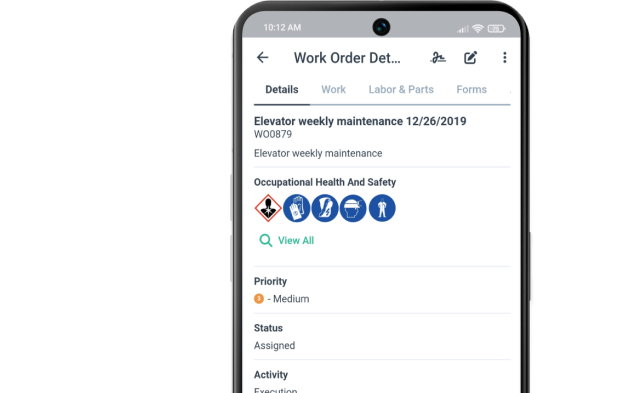
One practical solution is to outline the required PPE directly within work orders, ideally in a digital system, as shown below.
Source: WorkTrek
The safety icons highlighted in the image show exactly what pieces of equipment need to be worn for that particular job, removing any guesswork for the technician.
Ultimately, making PPE available and all requirements visible at the point of work are the simplest ways to close the gap between policy and practice.
Build a Strong Lockout/Tagout Program
Control of hazardous energy, commonly known as lockout/tagout (LOTO), is an essential safety standard that protects workers from the unexpected release of stored energy during maintenance and servicing.
It's also one of the most heavily cited OSHA standards, ranking fourth in 2025 by number of citations, with 2,562 violations recorded.
Illustration: WorkTrek / Data: OSHA
The reason OSHA enforces LOTO so strictly is that violations in this area frequently lead to serious injury or death.
This makes a well-built LOTO program a non-negotiable part of any maintenance operation.
On the equipment side, building a LOTO program requires proper locks, tags, hasps, and lockout kits assigned to each authorized employee.
Source: LockoutTAG
But equipment alone is just the start.
What matters more is LOTO training and establishing structured protocols that everyone follows consistently.
If your team is not yet trained in proper lockout/tagout procedures, there are a variety of resources available.
Online courses like the one shown below cover the essentials and are aligned with OSHA standards.
Source: 360training
This kind of general training is a solid foundation, but you also want to train your team on the specific equipment they manage.
Every machine has different risks, so LOTO procedures should be written for each piece of equipment individually, not applied as a generic template.
If you usea computerized maintenance management system (CMMS), it's worth checking whether the system supports attaching LOTO procedures directly to work orders.
As shown below, some systems can display hazard information, required PPE, environmental considerations, and step-by-step LOTO procedures all in one place.
Source: WorkTrek
This approach ensures that every technician sees the correct safety steps before they begin work, reducing the risk of shortcuts or missed steps.
Maintain Machine Guards
Moving machinery is one of the most common sources of serious workplace injuries, which is why machine guards exist.
These are physical barriers or safety devices designed to prevent workers from coming into contact with moving parts like blades, rollers, gears, and belts during operation.
OSHA enforces strict standards around machine guarding, and the penalties for non-compliance can be severe.
The following case illustrates just how costly and dangerous a violation can be.
Source: Business Insurance
Assuming you have guards installed, it's important to keep them in good condition through regular maintenance.
The type of work involved closely resembles general equipment maintenance, with some of the key practices shown below.
Source: WorkTrek
Getting this right is critical because a damaged or poorly maintained guard can be just as dangerous as having no guard at all.
Operators and less specialized personnel can perform daily visual checks to confirm guards are in place and undamaged, and handle basic cleaning and lubrication.
However, for more involved work like replacing worn parts or conducting detailed inspections of guards, trained maintenance workers should be assigned.
When it comes to this type of work, prevention and proper scheduling are key. A CMMS platform like WorkTrek can help you manage these tasks.
Source: WorkTrek
WorkTrek is a system that can centralize all your asset and work order data in one place.
For machine guarding specifically, it allows you to create recurring inspection schedules for every guarded machine and attach guard-specific checklists to preventive maintenance work orders.
Any planned and unplanned work can be easily viewed at a glance on a chart such as the one shown below.
Source: WorkTrek
Work can also be prioritized based on urgency, which is important when an issue needs immediate attention.
For instance, if a daily inspection reveals a cracked machine guard on a key component, that finding can be logged as a high-priority work order.
With WorkTrek's mobile app, the same task can be immediately pushed to the maintenance team's devices, potentially preventing a serious injury before the next shift begins.
Overall, keeping equipment and its machine guards maintained and functional is one of the most straightforward ways to protect workers and avoid safety violations.
Perform Safety Audits Regularly
OSHA has been gradually increasing the number of workplace inspections it conducts each year.
As seen in the graph below, their programmed and unprogrammed inspections have steadily risen, with the total reaching an all-time high in 2024.
Illustration: WorkTrek / Data: OSHA
Instead of waiting for an inspector to find safety concerns at your facility, it's far better to identify and address them yourself through regular internal safety audits.
In essence, these audits should be designed to surface hazards, unsafe practices, and compliance gaps.
For guidance on what these audits should cover, you can take direction from OSHA itself. Their inspection priorities FactSheet outlines exactly what their inspectors look for during a visit.
Source: OSHA
As the document outlines, imminent danger situations and severe injuries are naturally the top priority, along with follow-up inspections for previous violators.
However, OSHA also takes worker complaints into account, meaning any concern that employees raised but management didn't address can become a violation waiting to happen.
The goal of an internal audit is to catch all of these issues beforehand, ideally covering several key aspects, which are illustrated below.
Source: WorkTrek
Prevention-focused activities such as workplace walkthroughs, hazard identification, and PPE compliance checks should be the primary focus, as these are the issues most likely to be flagged during an unannounced inspection.
However, you also need to review past incident records and worker injuries to verify that those issues haven't reoccurred.
The same applies to any prior OSHA violations, which should be tracked and documented to show that corrective actions were completed and sustained.
While conducting these audits, following a structured checklist is helpful as it gives you a consistent format for flagging potential issues and documenting findings.
Source: WorkTrek
Digital tools make this process much easier, and when done right, they provide a centralized record where all audit results are stored.
These records are especially valuable if an OSHA inspection does occur, as they demonstrate a proactive commitment to workplace safety.
Train Your Employees
Employee training ties into every practice we've covered in this article.
Whether it's knowing how to read a chemical label, selecting the right PPE for a job, or following LOTO procedures correctly, none of these standards work if the people performing the work haven't been properly trained.
As Bryan Christiansen explains in an article on creating safety training programs, the goal is both to ensure safety and regulatory compliance.
Source: WorkTrek / Quote: ISHN
Just remember that effective training is not a one-time event.
Hazards change, equipment gets updated, and regulations evolve.
A technician who was trained two years ago may not be aware of a new chemical on site or a revised LOTO procedure for a recently modified machine.
That's why training plans need to be continuous and repeated at regular intervals. Some key moments when training is needed are the following:
During onboarding for all new hires
Whenever new equipment, chemicals, or processes are introduced
After a workplace incident or near-miss
After changes in regulations or internal safety procedures
As an annual scheduled refresher
The good news is that various OSHA-authorized training centers exist to help teams build this foundation, and the results are quite positive.
For instance, this OSHA-authorized Online Center published pre- and post-training scores across multiple safety metrics.
Source: OSHA Online Center
These results show significant improvements across the board, from theoretical knowledge to actual safety behavior and protocol adherence on the job.
To summarize, when workers understand the rules and why they exist, they're far more likely to follow them consistently.
So investing in regular, job-specific training is one of the most effective ways to reduce violations and build a team that takes safety seriously.
Conclusion
That covers six practical ways maintenance teams can avoid some of the more common OSHA standard violations.
We covered specific standards such as hazard communication, PPE, and lockout/tagout programs, as well as more general tips, including focusing on employee training and conducting safety audits.
You can now use what we talked about to review your current safety practices and close any gaps before an inspector finds them for you.

Operations & Maintenance
The 5 Levels of Maintenance
Key Takeaways:
Even the simplest upkeep tasks help ensure operational efficiency.
Without reliable data, technicians cannot execute more complex tasks effectively.
Some tasks cannot be handled by either in-house or external upkeep teams.
Not all maintenance work is created equal.
Some tasks take a few minutes and a screwdriver, while others require a full factory rebuild.
To make sense of this range, the French standards body AFNOR defined five levels of maintenance in its X 60-010 standard.
If you're looking to better understand which tasks belong where and who should handle them, this article breaks down each level in simple terms.
Level 1: Simple Interventions
To begin with, level one refers to the most basic maintenance activities.
These are routine preventive interventions performed on easily accessible components and are typically part of everyday operations.
You can see some of the more common maintenance tasks at this level in the image below.
Source: WorkTrek
These activities are usually carried out during regular shifts or scheduled walkthroughs, and they pose no safety risk as long as basic instructions are followed.
Take equipment lubrication as a simple example.
An operator applies lubricant to designated points on a machine to reduce friction and prevent premature wear.
Many pieces of equipment will have stickers marking the exact lubrication points, which removes any guesswork and makes the process easy to follow, even for someone with no technical background.
Source: Fuel Stickers
This shows that the level of expertise required at Level 1 is quite low.
There's no diagnosis involved, no complex decision-making, and no need for specialized technical knowledge.
The person performing the task simply follows clear instructions.
Because of this, Level 1 maintenance can be carried out autonomously by non-specialized staff rather than dedicated personnel. Some of the roles that commonly handle these tasks include:
Machine operators
Production staff
Facility workers
Entry-level technicians
As for tools, Level 1 maintenance requires very little beyond what's already available on the floor.
Simple visual guides for the equipment help point workers to the right spots, and standardized maintenance checklists, like the ones shown below, guide and document the work.
Source: WorkTrek
These checklists typically list each piece of equipment alongside the specific actions to be completed and how often.
When they’re stored and used within a computerized maintenance management system (CMMS), checklists help make sure nothing gets missed and create a record that can be referenced later if needed.
Finally, any consumables used during Level 1 interventions are simple supplies like replacement bulbs, lubricant, oil, or cleaning fluid. No spare parts or specialized materials are involved.
Overall, Level 1 maintenance is simple by design, but when performed consistently, it keeps equipment running smoothly between more involved interventions at higher levels.
Level 2: Medium Complexity Interventions
Moving up to level two, which includes maintenance tasks that are a step above the basics but still follow standard, documented procedures.
While interventions on this level still don't require major equipment disassembly or advanced tools, they do go beyond what an untrained operator would be comfortable handling on their own.
Below, we've illustrated the three main categories of Level 2 tasks.
Source: WorkTrek
To see what this looks like in practice, consider this simple troubleshooting guide for a Hytrol conveyor.
This table is found in their standard manual, which includes guidelines and procedures for installing, operating, and maintaining the conveyor.
Source: Device Report
As you can see, these are not overly complex repairs.
Replacing a worn chain, tightening a loose set screw, or checking for overloading are all straightforward tasks that follow documented procedures.
However, they still require a degree of technical understanding to carry out correctly and safely.
Because of this, Level 2 work is typically handled by personnel with some formal training or hands-on experience.
The roles that commonly perform these tasks include:
Trained maintenance technicians
Skilled operators with equipment-specific training
Junior maintenance staff under supervision
Level 2 sits at the boundary between what a skilled operator can handle and what requires a dedicated maintenance team member.
As such, this level is where the handoff between production staff and the maintenance department is key.
For instance, an operator might flag an overheating issue with equipment during a routine inspection.
To avoid potential unexpected downtime, the operator would typically use modern CMMS software, such as WorkTrek, for submitting these observations as work orders.
Source: WorkTrek
Once submitted and approved by management, this work order would sit in a centralized location where maintenance staff can pick it up immediately.
This kind of structured collaboration between operators and technicians is what makes Level 2 upkeep efficient, as issues get communicated clearly and reach the right people faster.
Finally, unlike Level 1, spare parts also come into play at this level.
These typically include consumable components like belts, filters, fuses, hoses, and similar items that wear out over time and need periodic replacement.
To summarize, Level 2 maintenance bridges the gap between basic operator-level care and the more specialized work that comes at higher levels.
Level 3: Complex Interventions
Level 3 is where maintenance work becomes significantly more involved.
At this level, tasks require specialized knowledge and expertise, and often involve a proper diagnosis before any repair work can begin, as well as partial disassembly of the equipment.
Common tasks at this level are shown in the illustration below.
Source: WorkTrek
Unlike Levels 1 and 2, where the task is usually clear from the start, Level 3 interventions often begin with troubleshooting.
The technician needs to identify the root cause of a problem before deciding on the appropriate repair, which requires both experience and technical reasoning.
For example, say a production motor starts producing unusual vibration.
A maintenance technician would be assigned to diagnose the issue and could determine that a bearing is worn out and needs replacement.
Before ordering the part, they would check the facility's inventory management system to see if the correct bearing is already in stock.
They can also pull up the motor's schematics and diagrams, since partial disassembly will be required to complete the repair.
Source: WorkTrek
In this case, the part is in stock, so the repair can proceed without delay.
Because of this complexity, Level 3 work is carried out by qualified, specialized personnel, including roles like:
Specialized maintenance technicians
Mechanical fitters
Industrial electronics technicians
Hydraulic and pneumatic specialists
If the specific work goes beyond what the assigned maintenance technician can handle on their own, support from senior engineers or external specialists may be brought in.
This is especially common when the root cause is unclear or when the repair involves components the technician hasn't worked with before.
Level 3 maintenance is also where technical skill and good data start to converge, and technicians will typically rely on specialized measuring instruments to complete their work.
In our production motor example, this might involve accelerometers, such as the ones shown below, that measure vibration to confirm the diagnosis.
Source: PCB
Overall, while the repairs themselves require expertise, the efficiency of the work depends heavily on having the right information measured, recorded, and accessible when the technician needs it.
Without that, even a skilled technician ends up waiting or working without full context, which slows everything down and can lead to repeat failures.
Level 4: Highly Complex Interventions
Level 4 represents major maintenance work that goes well beyond standard repairs.
These are significant interventions, often involving full equipment overhauls, advanced diagnostic techniques, and extended downtime.
As you can see from the image below, the scope of work at this level is much broader.
Source: WorkTrek
These tasks are technically demanding and are more challenging, both in terms of safety and operational impact.
In fact, a mistake during a Level 4 intervention can result in extended downtime or damage to expensive equipment, which is why the process requires careful planning and supervision.
As an example, consider the following case of a large industrial fan brought in for dynamic balancing.
Source: GES Group
Because of the complexity of the task, the team at GES Group typically recommends bringing such equipment to their workshop, unless it is impractical or uneconomical to move.
That’s why level 4 work is most often done by specialists in dedicated workshops, as it requires controlled conditions and a level of precision that's hard to achieve on the production floor.
The roles that typically handle these interventions include:
Certified specialists like vibration analysts and thermographers
Specialized teams working under supervision
OEM technical advisors
In many cases, the team works under the supervision of a senior engineer or maintenance manager who oversees the process and signs off on the work before the equipment is returned to service.
Of course, specialized equipment and tools are used for this kind of work, which allows workshop teams to measure, diagnose, and correct issues with a level of accuracy that general maintenance tools can't match.
When it comes to deciding to move forward with a Level 4 intervention, it's important to consider whether an overhaul is really necessary.
Some of the most common scenarios that justify work of this scale are shown below.
Source: WorkTrek
Each of these signals points to the same underlying idea: the asset is no longer performing as it should, and smaller repairs aren't going to bring it back to baseline.
At this point, extensive maintenance work usually becomes both more cost-effective and more reliable.
Level 5: Actions Carried Out By Manufacturer
Level 5 is the highest and most complex level of maintenance.
At this point, the work goes beyond what even the most skilled in-house or external maintenance teams can handle.
These are full-scale reconstruction or refurbishment operations that require manufacturing-grade equipment, factory conditions, and deep knowledge of the original design.
The scope of work at this level typically includes the activities shown below.
Source: WorkTrek
The methods and tools used at Level 5 are essentially the same as those used during the original manufacturing of the equipment.
This is what distinguishes it from all other levels.
The equipment as a whole, or major parts of it, are being rebuilt rather than repaired.
A good example of this kind of work comes from a 40-MW biomass-fired power plant in Michigan that suffered a catastrophic steam turbine failure.
Since sourcing a replacement turbine, along with a matching generator and auxiliary equipment, was nearly impossible on short notice, the plant turned to Sulzer, a global power generation services company.
Source: Power
Sulzer sourced an almost identical mothballed unit from Maine, performed a complete disassembly, and rebuilt the turbine at its Houston facility in about eight months.
As you can see, Level 5 work is almost always carried out by external parties with direct ties to the equipment's design and production.
The roles that typically handle these interventions include:
OEM engineers and factory technicians
Authorized rebuilders or certified service centers
Manufacturer's R&D teams, in cases involving upgrades or retrofits
In most cases, the equipment is shipped off-site to the manufacturer's facility or a certified service center.
The in-house maintenance team's role at this level is primarily coordination, documentation, and preparation.
Level 5 maintenance is rare and expensive, but for high-value equipment, it can be significantly more cost-effective than purchasing new.
The decision usually comes down to comparing the rebuild cost and the replacement cost, factoring in the expected remaining life of the refurbished asset.
When it makes financial sense, a manufacturer-level rebuild can restore equipment to like-new condition and extend its operational life by years or even decades.
Conclusion
That covers the five levels of maintenance.
We went through each level one by one, looking at what the work involves, who carries it out, and the kinds of tools and resources typically needed.
We also included some examples of work for each level, which hopefully gives you a clearer framework for categorizing your own maintenance work.
Use this guide to structure your maintenance planning and decide where each task fits best.

Operations & Maintenance
Types of Maintenance Tasks
Key Takeaways:
Most facilities aren’t yet ready for advanced maintenance strategies.
The total cost of work-related injuries reached $176.5 billion in 2023.
Users of condition-based maintenance report a 42% increase in uptime.
In this article, we walk you through various maintenance tasks, from the simplest to the most advanced.
You’ll learn what each one involves and whether it’s truly a necessary part of your upkeep strategy, or if it may be better to exclude it from your program in favor of a more effective approach.
Because, in the end, there are many different ways technicians can maintain reliability, and not all of them are suitable for every operation.
Reactive Maintenance Tasks
Let’s start with the simplest of maintenance tasks.
These are present in most facilities and are fairly straightforward to manage.
Corrective Repairs
This is the most basic type of maintenance task.
Corrective repairs are exactly what they sound like: equipment is fixed only after a fault or failure has occurred.
This is often called “run-to-failure” maintenance because assets are allowed to operate until they stop working.
According to research, despite the increasing availability of more advanced upkeep approaches, methods, and strategies, this remains the second most common type of maintenance activity overall.
That said, the use of reactive maintenance is slowly declining, with its share in maintenance strategies dropping from 57% in 2024 to 38% in 2025.
Illustration: WorkTrek / Data: MaintainX 2024, MaintainX 2025
This is happening because the low initial cost and simplicity of these tasks are often outweighed by their drawbacks.
Corrective repairs do not prevent damage. They address issues only after they occur.
As a result, they leave the door open to costly consequences such as unplanned downtime, safety risks, and secondary damage to other components.
Because of this, corrective repairs have gained a somewhat negative reputation in the maintenance world, with more teams looking to transition toward proactive strategies.
Still, it’s important to recognize that there is a place for this type of task in a well-balanced maintenance program.
Corrective maintenance is suitable for equipment that is:
Low-cost
Low in criticality
Easy to repair
Low risk in terms of safety
Low impact on production
For such assets, there is no need to invest in expensive predictive systems or complex preventive schedules.
Corrective repairs work just fine here, allowing daily operations to continue smoothly without unnecessary time and resource expenditures.
Emergency Repairs
Emergency repairs are immediate, unplanned maintenance interventions carried out in response to sudden and critical equipment failures.
Unlike corrective repairs, which can sometimes be scheduled after a fault is detected, emergency repairs are non-negotiable and highly time-sensitive.
They must be performed right away to protect worker safety, maintain operational efficiency, and safeguard the bottom line.
To better understand the potential impact, take a look at the findings from the 2023 National Safety Council (NSC) report.
As it turns out, the total cost of work-related injuries reached $176.5 billion that year, averaging $1,080 per worker.
Additionally, these injuries resulted in 70 million lost workdays, with an estimated 55 million more expected in future years due to injuries sustained during that period.
Illustration: WorkTrek / Data: NCS
In other words, safety incidents carry significant and lasting consequences.
Emergency repairs aim to mitigate these consequences by addressing risks and restoring operations as quickly as possible.
However, despite their short-term benefits, they are generally undesirable.
In fact, they are widely considered the most expensive and inefficient form of maintenance due to operational disruption, high downtime costs, and the potential for secondary damage.
It’s no surprise that organizations strive to minimize them.
Research consistently shows that unplanned downtime can cost hundreds of thousands of dollars, and that those costs are only rising.
Illustration: WorkTrek / Data: MaintainX
Therefore, in a well-managed maintenance strategy, emergency repairs should be rare rather than routine.
If they persist, they may be a sign of deeper issues, such as a poor maintenance strategy or other hidden inefficiencies within the maintenance department.
Preventive Maintenance Tasks
Preventive maintenance is a big step up from reactive upkeep. It can significantly reduce unplanned downtime and all the accompanying problems.
Let’s see which types of tasks it encompasses.
Inspection
Inspections, whether visual, sensory, or basic instrument-based, are the first and most fundamental step of any successful proactive maintenance program.
Their primary objective is to identify potential problems before they materialize and disrupt operations.
While inspections don’t directly fix issues, they play a vital role in informing maintenance decisions.
Bret Kasubke, Director of Customer Equipment Solutions at United Rentals, the world’s largest equipment rental company, agrees:
Illustration: WorkTrek / Quote: Equipment Journal
He adds that inspections provide structure and visibility into equipment maintenance, enabling companies to reduce downtime and improve cost control.
They can even extend the lifespan of machinery and help reduce the risk of catastrophic equipment failures, which may lead to serious safety issues on worksites.
In short, inspection is one of the simplest yet most powerful maintenance tasks.
However, its effectiveness depends heavily on consistency, proper training, and timely follow-up actions. Without proper execution and response, inspections are practically ineffective.
That’s why more teams are turning to CMMS solutions to improve their inspection efficiency.
These systems allow users to schedule recurring tasks, set due dates, and receive alerts for overdue tasks, ensuring nothing is overlooked.
Paper forms and spreadsheets are replaced with digital checklists, helping teams follow correct safety and operating procedures every single time:
Source: WorkTrek
Some CMMS platforms can even automatically generate follow-up work orders when inspections reveal issues.
In any case, inspections serve as the first line of defense against unexpected equipment failure and costly operational disruptions.
Because of this, they are integral to any successful modern maintenance program.
Scheduled Replacement
Scheduled replacement is a maintenance task in which a component is replaced at predefined intervals, regardless of its current condition.
It’s based on the assumption that the component has a predictable wear-out life, after which the probability of failure increases significantly.
These replacement intervals are typically determined using:
Manufacturer recommendations
Historical failure data
Safety or regulatory requirements
Ideally, the interval is set just before the wear-out phase begins; late enough to maximize useful life, but early enough to prevent failures.
This type of task helps reduce unexpected breakdowns in wear-out components, ensuring consistent equipment performance and minimizing risk in critical systems.
It’s also relatively easy to plan and schedule.
However, these benefits do come with trade-offs.
Scheduled replacement can be wasteful, as components may be replaced while they are still functional.
After all, not all components wear out predictably, so premature replacement can lead to higher material and labor costs over time.
With many maintenance teams already struggling to stay within budget and manage costs, these activities can be difficult to justify if applied too broadly.
Illustration: WorkTrek / Data: UpKeep
Today, with the ever-increasing material and labor expenses, optimizing resources is more important than ever.
Now, this doesn’t mean scheduled replacement should be avoided altogether.
Instead, it should be applied selectively, specifically when:
The component exhibits a clear wear-out failure pattern
The cost of failure exceeds the cost of early replacement
In the end, scheduled replacement can support smoother operations and help protect mission-critical assets.
You just need to learn when and how to apply it.
Scheduled Restoration
Scheduled restoration is a planned maintenance task that restores a component to its original or near-original condition at fixed intervals.
These are your common upkeep tasks every technician is familiar with, such as cleaning, adjusting, calibrating, or overhauling.
So, unlike scheduled replacement, the component is retained and serviced rather than discarded.
This makes scheduled restoration a more cost-effective option of the two.
It still helps extend asset life and ensure smooth operation, but without as much material and labor waste.
Terri Ghio, former President of the manufacturing optimization solution FactoryEye North America, illustrates the financial benefit with an example:
Illustration: WorkTrek / Quote: Pet Food Processing
Ghio is right.
Keeping assets in good condition is more cost-effective than repairing them after complete failure or fully replacing components that could have been restored instead.
However, scheduled restoration is also more complex to plan and execute.
The timing needs to be right, technicians must have the right skills and tools, and they need to follow proper procedures.
In asset-heavy organizations, this isn’t always easy, especially when teams rely on outdated maintenance management tools like spreadsheets or paper forms.
These make it harder to access vital information and increase the risk of tasks being overlooked.
Fortunately, CMMS solutions like WorkTrek help eliminate these inefficiencies by automating, monitoring, and recording every step of the restoration process, as well as other maintenance tasks.
With WorkTrek, you can schedule restoration tasks based on time intervals or condition-based metrics such as usage time, mileage, temperature, or pressure.
Source: WorkTrek
This ensures that tasks are performed at the right time on the right equipment, reducing the risk of missed interventions.
No more “I forgot”. The system sends notifications when the due date approaches.
When it’s time to perform a task, technicians can access detailed work orders directly on their mobile devices and quickly see everything they need to know.
This includes photos, step-by-step instructions, safety guidelines, required tools, and more.
Source: WorkTrek
After completing the task, they can close out the work order on the spot, adding their signature and attaching photos if needed.
Source: WorkTrek
Meanwhile, managers and supervisors can monitor progress in real time, track labor allocation and costs, and make adjustments as necessary.
In short, WorkTrek makes scheduled restoration more predictable, traceable, and resource-efficient.
With this level of control and visibility, ensuring your valuable assets receive the best possible care becomes significantly easier.
Failure Finding
A core concept in Reliability-Centered Maintenance (RCM), failure-finding tasks are planned maintenance activities designed to detect hidden or latent failures within a system.
These failures are not apparent during normal operation but can prevent a system from performing its protective or critical function when required.
Kleber Siqueira, Owner and Principal Consultant at Navitas Consulting, an organization specializing in Asset Management and RCM, explains:
“Failure finding is a reliability-centered maintenance strategy aimed at detecting latent failures in systems that do not operate under normal conditions. These ‘hidden’ functions are only activated during abnormal or emergency scenarios, making their reliability both critical and difficult to observe.”
Common examples include testing backup generators to ensure they start during a power outage or verifying that fire suppression systems and alarms are fully operational.
These tasks are not necessarily about improving performance, but about ensuring readiness and strengthening operational resilience.
As such, they play a vital role in maintaining safety, productivity, and even regulatory compliance.
Siqueira outlines several methods used in failure-finding activities:
Functional TestingSimulates real operating conditions or injects test signals to verify system responseProof TestingPeriodic, structured testing designed to uncover hidden failures not detected during normal operationMaintenance TestingRoutine inspections and basic functional checks that reveal mechanical degradation, such as corrosion, wear, or obstructionAudits and ReviewsFormal evaluations of testing processes and results to ensure completeness, compliance, and timely corrective actionsHistorical Data AnalysisData-driven assessments using trends, failure modes, and metrics like mean time between failures (MTBF) to anticipate performance decline
Despite their importance, failure-finding tasks are often overlooked because the failures they target remain invisible during normal operations.
However, when these failures do surface, the damage, typically in the form of downtime, safety incidents, and financial loss, is already significant.
That’s why failure-finding tasks should be considered a non-negotiable component of any proactive upkeep program, just like inspections and scheduled restorations or replacements.
While the issues they address may be hidden, their impact can still be substantial.
Predictive Maintenance Tasks
Predictive maintenance is the latest and most advanced form of asset upkeep.
It’s also the most complex, involving a range of tasks that depend on cutting-edge technologies and rich, reliable data.
Condition Monitoring
Condition monitoring tracks the real-time health of equipment using IoT sensors, measurements, and diagnostic tools.
Instead of relying on scheduled maintenance or reacting to failures, it detects early signs of deterioration, enabling maintenance teams to intervene before issues escalate.
This is a core component of predictive maintenance programs.
By optimizing maintenance timing with better precision, condition monitoring helps avoid both over-maintenance and under-maintenance, along with the risks associated with each.
That way, organizations benefit from well-maintained assets without wasting resources.
In fact, an ABB survey found that users of condition-based maintenance report a 42% increase in uptime.
Illustration: WorkTrek / Data: ABB
No wonder there’s a growing interest in this approach.
For instance, Chevron El Segundo Refinery in California adopted condition monitoring to improve the reliability of its hydrotreating process unit.
The refinery operates 24 hours a day, 7 days a week, and processes nearly 270,000 barrels of crude oil per day.
Condition monitoring is perfect for such demanding environments, helping detect and diagnose mechanical issues in critical assets.
Charles Mooneyham, Leader of Chevron Machinery Projects, commented:
Illustration: WorkTrek / Quote: Reliable Plant
That’s right.
For organizations with the necessary budget, expertise, and personnel, condition monitoring can be one of the most effective ways to minimize downtime and improve operational efficiency.
Trend Analysis
While condition monitoring collects data, trend analysis interprets it, turning these measurements into actionable insights.
Largely powered by AI nowadays, trend analysis evaluates both historical and real-time data to identify patterns, deviations, or gradual deterioration in equipment performance.
The goal, of course, is to anticipate failures and schedule maintenance interventions at the most cost-effective time.
So far, this strategy seems to have been delivering very good results.
For example, a 2022 study by Deloitte showed that companies using predictive maintenance report reduced facility downtime, increased labor productivity, and lower new equipment costs.
Illustration: WorkTrek / Data: Deloitte
In other words, predictive maintenance, powered by condition monitoring and trend analysis, promises results that no other maintenance strategy has achieved before.
It almost makes you wonder why we don’t see this implemented in every asset-heavy organization.
The answer is quite straightforward: the required software and hardware can be expensive, and there aren’t many workers who know how to interpret the data correctly.
For many organizations, the issue goes even deeper than that.
Effective trend analysis requires a solid data foundation.
This means maintenance records must be absolutely accurate, complete, and up to date; otherwise, poor input data will lead to unreliable predictions.
Unfortunately, plenty of companies likely don’t have this in place just yet.
The 2025 research from Zapium shows that many teams still operate at a low level of maturity, relying on manual processes with no systematic way to track tasks, materials, and related data.
Illustration: WorkTrek / Data: Zapium
In such environments, important information is more likely to be error-prone, outdated, or missing entirely.
As such, it cannot support effective trend analysis.
Hopefully, this will change in the coming years, with more teams able to implement predictive maintenance and unlock the full potential of their facilities.
Conclusion
Ultimately, there is no one-size-fits-all approach when it comes to maintenance.
No single strategy will solve every problem on its own. More often, the best results come from combining several methods and types of tasks tailored to your specific situation.
So, feel free to use a run-to-failure approach for less critical assets, but remember that vital equipment should be managed with more proactive maintenance strategies to reduce risk.
At the same time, don’t feel obligated to adopt the most advanced technologies and processes if your budget or in-house expertise doesn’t currently support them.
A good strategy is always built around the real needs and capabilities of your operations, assets, and workforce.
Listening to them is what ultimately drives effectiveness

Operations & Maintenance
6 Types of Foundational Maintenance Processes
Key Takeaways:
Schneider Electric uses CBM to reduce unnecessary work and cut costs.
MRO inventory control costs can be three times higher than the purchase price.
Reactive maintenance work still dominates the industry.
In most facilities, maintenance problems rarely come from a single failure.
They grow quietly, from a missing part here, a delayed inspection there, or a workaround that, over time, becomes standard practice.
ultimately, these issues compound, turning what should be a controlled system into something unpredictable and unreliable.
So what’s the difference between teams that stay reactive and those that stay in control?
Structure.
High-performing maintenance teams rely on a set of core processes that bring consistency into everyday work, from how tasks are performed to how decisions are made.
Read on to learn about the six foundational maintenance processes and why each of them is necessary for your facility.
Workplace Organization
Spend a day with a maintenance team, and you’ll quickly notice how much time is influenced by the state of the workplace.
It isn’t just about the equipment itself, but everything around it, including tools, spare parts, documentation, and even how work areas are laid out.
When these are disorganized, even simple tasks take longer than they should. Time is lost searching for tools, navigating cluttered spaces, or working around avoidable obstacles.
However, with the 5S methodology, every workplace, including the maintenance department, can become organized.
Developed within Toyota, 5S was designed to bring order and clarity into industrial environments.
It’s often described as a workplace organization method, but in reality, it goes much deeper than that.
Juan Felipe Pons, a Lean construction trainer and consultant, writes in his article:
“The 5S methodology was born at Toyota in the 60s under an industrial environment to achieve better organized, tidier, and cleaner workplaces to increase productivity and to obtain a better working environment.”
At its core, 5S is about making the workplace intuitive, so that anyone can quickly find what they need, identify abnormalities, and perform tasks consistently.
Here’s how each step applies in a maintenance environment:
Sort (Seiri)Remove unused tools, obsolete spare parts, and unnecessary materials from the workspace. Keep only what is truly needed.Set in Order (Seiton)Assign fixed locations for tools and parts based on frequency of use. Use labels, markings, and color coding to make everything easy to find and return.Shine (Seiso)Regularly clean work areas and equipment to maintain safe conditions and quickly spot leaks, wear, or damage.Standardize (Seiketsu)Establish clear procedures and visual standards to maintain organization and ensure consistency across shifts and teams.Sustain (Shitsuke)Reinforce habits through training, audits, and accountability.
This methodology changes how people interact with their environment.
When teams follow its five steps, tools are where they’re needed, workspaces are clean enough that issues stand out immediately, and storage reflects actual usage.
One experienced practitioner on Reddit captured this idea well:
“Stop asking, ‘Is this area clean?' and start asking, 'Could someone brand new walk up to this workstation and know within 60 seconds what's running, what's behind, and what's broken?’ That turns (5S) from a cleaning exercise into an information problem, which is what it was always supposed to be.”
5S rarely feels like a breakthrough initiative at first.
But in many facilities, it marks the point where maintenance stops being chaotic and starts becoming intentional.
Spare Parts Management
Spare parts management rarely gets much attention until something breaks and the part you need isn’t there.
Most teams have experienced some version of this.
A production line stops, everyone scrambles, and it turns out the missing component is inexpensive, easy to store, and absolutely critical.
Michal Bernát, a maintenance and operations consultant, and Milan Kulhánek, a Deloitte supply chain expert, describe a situation that’s all too common:
“I once witnessed a situation where a critical production line stopped because of a cheap part worth less than ten euros. Since the warehouse ‘didn’t consider it important,’ it wasn’t in stock.”
What makes spare parts management so challenging is finding the right balance.
On one hand, you face the risk of stockouts and costly downtime. On the other hand, there is the cost of holding inventory that may never be used.
And that cost is often underestimated.
The true cost of MRO inventory, including storage, handling, and administrative overhead, can reach two to three times the purchase price.
Illustration: WorkTrek / Data: ERA Group
That’s why effective spare parts management is essential for both reliable maintenance operations and cost control.
So, this is how the most efficient teams ensure they manage spare parts properly.
First, they prioritize.
Not every part requires the same level of attention.
Critical components, especially those tied to high-impact assets, must always be available, while less important items can be managed more flexibly.
Second, they keep their inventory accurate.
Often, they rely on cycle counting, in which small portions of inventory are regularly verified, rather than occasional full audits that disrupt operations and still leave gaps.
Third, they manage obsolescence.
As equipment evolves and suppliers change, some parts become outdated.
Without a process to track this, organizations end up tying up capital in inventory that has no real value.
This is where a CMMS like WorkTrek can help you.
Instead of relying on spreadsheets or tribal knowledge, you can centralize all spare parts data, track usage over time, and set minimum stock levels for critical items.
Source: WorkTrek
When inventory drops below a defined threshold, the system can trigger alerts or reordering workflows, reducing the risk of unexpected shortages.
Source: WorkTrek
Just as importantly, this constant visibility into spare parts will help you identify slow-moving or obsolete parts, making it easier to clean up inventory and avoid unnecessary carrying costs.
When you improve spare parts management, ordering becomes more intentional, critical parts are always in stock, and those “we thought we had it” moments become far less frequent.
Criticality Analysis
Just like not every spare part is equally important, not every asset deserves the same level of attention.
Yet in many facilities, maintenance resources are spread evenly across equipment that does not carry the same level of risk.
That approach usually works until a single failure reveals which assets truly matter.
Criticality analysis is a foundational process that helps you prevent that.
It allows you to evaluate equipment based on the impact its failure would have on your operations, so you can focus time, budget, and expertise where it matters most.
In practice, you can assess assets using factors such as:
Production impactHow severely a failure would disrupt outputSafety riskWhether failure could create hazards for employeesEnvironmental impactPotential for spills, emissions, or compliance issuesRepair costThe cost of restoring or replacing the assetRedundancyWhether backup equipment can keep operations running
Once these factors are scored, you can rank assets in a criticality matrix, giving you a clear basis for decision-making.
This is where criticality starts to shape your maintenance strategy.
Highly critical assets may warrant predictive maintenance, continuous monitoring, and tighter control of spare parts.
Lower-priority assets, on the other hand, may be maintained with simpler approaches or even run to failure when the business risk is minimal.
Source: Reliable Plant
For example, letting a non-critical exhaust fan run to failure may be perfectly acceptable if it doesn’t impact production, safety, or compliance.
In contrast, applying the same strategy to a critical asset would introduce significant risk.
This is exactly the kind of trade-off criticality analysis is designed to clarify.
Diego Galar, a professor of condition monitoring at Luleå University of Technology, explains how this thinking applies in practice:
Illustration: WorkTrek / Quote: Barbara
In other words, not everything should be monitored.
The goal of criticality assessment is to determine what should.
Many teams begin with a basic matrix that weighs the probability of failure against its consequences, as this Redditor explains, helping them quickly identify which assets deserve the most attention:
“Critical path analysis or 5x5/10x10 matrix weighing probability of failure vs consequence of failure. This gets you started. Or in operation today, find the top 5-10 assets with “downtime” and decent failure data.”
From there, you can refine your analysis using real failure data and operational experience.
That shift in thinking matters because your maintenance resources are always limited.
Without prioritization, you end up spreading effort too thin, giving every asset the same level of attention while the most important ones remain exposed.
Criticality analysis changes that. It helps you move from reacting to the loudest problem toward making decisions based on operational risk.
Over time, that leads to better resource allocation, stronger reliability, and a clearer connection between maintenance and performance.
Production–Maintenance Coordination
In most facilities, maintenance and production depend on each other, but they don’t always work in sync.
The disconnect usually comes down to priorities.
Production is focused on output and meeting targets. Maintenance is focused on reliability and preventing failures.
When perspectives aren’t aligned, small gaps in communication quickly turn into recurring problems.
William Jacobyansky, Owner of Strategic Maintenance Consortium, describes how common this issue is:
Illustration: WorkTrek / Quote: Reliable Plant
This disconnect shows up in everyday work.
Maintenance completes a repair and hands the equipment back.
Production resumes operation, but early warning signs, such as unusual noise, vibration, or minor performance drops, go unreported or ignored.
Days later, the same issue returns, often as a larger failure.
That’s why coordination between production and maintenance is a foundational process.
It ensures that equipment care, inspections, and planned maintenance aren’t carried out in isolation, but as part of a shared, continuous effort.
One of the most effective ways to achieve this is through Operator-Driven Reliability (ODR).
With ODR, operators take on basic maintenance tasks, such as cleaning, inspections, and lubrication, while also acting as the “eyes and ears” of maintenance.
Instead of waiting for breakdowns, teams catch issues while they are still small and manageable.
For example, SKF Group, a Swedish bearing and seal manufacturing company, implemented ODR to help customers improve equipment reliability and reduce breakdowns.
By equipping operators with digital tools to monitor machine condition and track trends over time, they enabled faster detection of issues and more efficient responses.
As explained in the video below, the impact was tangible: teams reduced downtime, lowered repair costs, and shifted maintenance from reactive fixes to proactive intervention.
https://www.youtube.com/watch?v=Zvtpta52pfI
Source: SKF Group on YouTube
In one case, addressing issues before failure reduced repair costs from €5,000 to €1,700, simply by acting earlier.
Just as importantly, this approach changed how teams worked together.
Operators became active contributors to equipment reliability, while maintenance teams focused more on preventive and improvement work instead of constant firefighting.
Downtime Planning
Downtime is unavoidable. The difference is whether you control it or it controls you.
This is the biggest challenge of preventive maintenance.
Even the best PM program eventually requires equipment to be taken offline, so the question becomes not if downtime happens, but how well it’s planned.
Most organizations understand the value of preventive maintenance. Yet in practice, many still spend the majority of their time reacting to unplanned work.
According to industry research, 71% of teams consider preventive maintenance foundational.
However, fewer than 35% actually spend most of their time on planned activities, meaning reactive work still dominates in many facilities.
Illustration: WorkTrek / Data: MaintainX
The cost of that reactivity is high.
A recent global study by ABB found that 83% of industry leaders estimate unplanned downtime costs at least $10,000 per hour, with many placing the figure as high as $500,000 per hour.
Source: ABB
In the same report, nearly half of the respondents said they experience equipment-related interruptions at least monthly, and some as often as weekly.
Oswald Deuchar, Global Head of Modernization Program at ABB Motion Services, puts it bluntly:
“Unplanned downtime is costing industry up to half a million dollars per hour – yet one in three businesses hasn’t modernized their motor-driven systems in the last two years. That’s more than a missed opportunity, it’s a silent crisis.”
What makes unplanned downtime so disruptive isn’t just the failure itself, but everything around it:
The scramble for spare parts
Rushed diagnostics
Rescheduled work
The ripple effects across production
Planned downtime creates a completely different dynamic.
Instead of reacting, you define the scope of work in advance. Tasks are prioritized, parts are prepared, and labor is scheduled before the shutdown begins.
That preparation reduces delays and prevents the “while we’re here” expansion that often derails timelines.
Just as importantly, planned downtime doesn’t end when production resumes.
Post-shutdown reviews help you understand what worked, what caused delays, and where assumptions didn’t hold.
Over time, this feedback loop improves future planning and execution.
In short, when downtime is unmanaged, it becomes a constant disruption. However, when it’s planned and continuously improved, it becomes a controlled, strategic activity.
Preventive Maintenance Optimization
Putting a preventive maintenance program in place is only the starting point.
After failures, teams add new tasks but rarely remove old ones. At the same time, maintenance intervals stay the same even as equipment usage and conditions change.
As a result, maintenance becomes either excessive or insufficient, and in both cases, effectiveness drops.
So, if you want to ensure your maintenance strategy stays aligned with how equipment actually behaves, you have to continuously optimize it.
In practice, most inefficiencies fall into two categories:
Over-maintenance, or doing too much, too often
Under-maintenance, or missing early signs of failure
Optimization is about striving to correct both.
One of the most effective ways to do that is through condition-based maintenance (CBM).
Instead of relying only on fixed schedules, CBM uses real-time condition data, such as temperature, vibration, and load, to determine when maintenance is actually needed.
At Schneider Electric, this approach has helped teams move away from rigid schedules toward more targeted interventions, reducing unnecessary work while catching issues earlier.
As India Gibson, launch leader for EcoCare at Schneider Electric, explains:
“We’re involving methods of monitoring the condition of the equipment based on different parts of the infrastructure.
We’re understanding better how the gear is performing, and we’re supporting the maintenance intervals based on what needs to be enhanced or maintained.”
CBM is one way to make maintenance more dynamic, but it’s not the only way to optimize performance.
Even without advanced condition monitoring, you still need visibility into what maintenance is being done, how often, and at what cost.
That’s where a CMMS can be the greatest ally.
With WorkTrek, for instance, you can collect and structure maintenance data at scale, tracking KPIs such as PM compliance, work order completion rates, MTBF, and MTTR.
Source: WorkTrek
You can also generate reports such as cost per work order, maintenance cost per asset, or the planned vs. unplanned work ratio.
Source: WorkTrek
This gives you a clear picture of how your maintenance strategy is performing in practice.
For example, you can see whether preventive tasks are actually reducing failures, whether certain assets are driving disproportionate costs, or whether maintenance effort is aligned with risk.
Based on this data, you can then adjust intervals, remove unnecessary tasks, and focus resources where they create the most impact.
Over time, maintenance stops being a fixed schedule and becomes a system that continuously improves through feedback and data.
Conclusion
Well-run maintenance is the result of multiple processes working together.
When workplaces are organized, spare parts are under control, priorities are clear, teams are aligned, downtime is planned, and preventive work is continuously refined, upkeep starts to feel less reactive and far more predictable.
Naturally, this can’t happen overnight.
But with the right foundations in place, it becomes much easier to move from constant firefighting to a system that supports reliability, efficiency, and long-term performance.
The one question remains: How many of these six processes are you actually implementing in your facility today?

Operations & Maintenance
Everything to Know About Maintenance Criticality Assessment
Key Takeaways:
Criticality assessments help direct resources to the assets that matter most.
A criticality-based upkeep optimization helped one company reduce costs by 86%.
Different criticality levels call for different maintenance strategies.
A CMMS improves the efficiency of criticality assessments.
Not all equipment requires the same level of maintenance.
Some assets can fail without much consequence, while others can halt production or put people at risk.
If you're looking for a structured way to figure out which is which, a maintenance criticality assessment (MCA) can help.
This article covers what this practice is, why it matters, and how to do it well.
What is Maintenance Criticality Assessment
First, let's define what a maintenance criticality assessment actually is.
MCAs are structured processes for evaluating and ranking equipment based on the potential consequences of its failure.
The goal is to give maintenance teams an objective way to determine which assets need the most attention, so that time, budget, and effort are directed where they matter most.
This assessment is based on multiple dimensions, with some of the most common ones shown below.
Source: WorkTrek
The idea behind these dimensions is that equipment failure can affect a facility in different ways.
A breakdown might impact production output, create safety hazards or environmental damage, and so on.
Of course, the specific dimensions used in assessments will vary depending on company requirements and the type of work being done.
A common one would be production impact, with a rating scale for this dimension shown below.
Source: WorkTrek
A level 1 criticality assessment, meaning a high production impact asset, might be a main conveyor belt on a packaging line.
If that belt breaks down, the entire line stops, and no products move forward.
On the other hand, assets such as office air conditioning units or backup lighting systems often have no meaningful impact on production.
And that's the essence of criticality assessments.
Ratings like these are assigned for each dimension, and the overall score of an asset is determined by combining the results.
Below, you can see a criticality table that combines four dimensions for the overall assessment and criticality scoring.
Source: eMaint
As with the rest of the process, the weight given to each individual score can vary, which directly affects the final criticality level.
However, while the specific dimensions and their weights vary by organization, the core process of MCAs stays the same.
The Importance of Maintenance Criticality Assessment
With all of this in mind, let's now look at why performing a criticality assessment is important, looking at three specific benefits it brings to your maintenance program.
Focuses Your Maintenance Efforts
One of the main benefits of an MCA is that it helps focus maintenance resources appropriately.
Without clear maintenance prioritization, organizations might follow rough scheduled maintenance intervals for their equipment and allocate resources based on limited data.
The problem with this approach is that it can waste valuable time and budget on low-priority equipment, while potentially neglecting the key assets that keep operations running.
As maintenance expert James Kovacevic explains, a structured approach based on MCAs helps remove that guesswork.
Illustration: WorkTrek / Quote: Accendo Reliability
In fact, once the criticality dimensions and their rankings are in place, maintenance teams can match the time and effort spent according to each asset's importance.
For example, consider the following criticality levels and the corresponding maintenance strategies.
Source: WorkTrek
The logic behind this tiering is straightforward.
High-criticality assets need proactive strategies because their failure would cause the most damage, so you want to catch problems before they develop.
For instance, a primary compressor on a production line might warrant vibration sensors that detect wear weeks in advance.
Medium-criticality equipment doesn't justify that level of investment, but still benefits from regular scheduled check-ups.
And, for low-criticality assets, it often makes more financial sense to simply let them run until they fail, since the cost of replacing them reactively is lower than the cost of monitoring them.
Ultimately, by matching maintenance strategies to criticality levels, you can make the most out of your existing resources.
Reduces Risk
Another important benefit of MCAs is that they help identify the equipment whose failure could lead to serious consequences.
As we saw when discussing criticality dimensions, equipment can be assessed on whether its breakdown can create serious safety hazards, environmental damage, or shut down production entirely.
In other words, we can assess the severity of the breakdown.
During an MCA, this severity can be mapped on a simple equipment criticality matrix, like the one shown below, and compared against the probability of the breakdown occurring.
Source: WorkTrek
On top of that, some organizations take detectability into account, which covers how easy or difficult it is to spot a developing failure before it actually happens.
In short, an asset with severe consequences that is also hard to monitor and prone to frequent breakdowns would score higher than one that rarely fails and is easy to inspect.
To see what this process would look like in practice, let’s consider the March 2025 explosion at Chuo Spring's auto parts plant in Japan.
The incident happened when a dust collector in the plant exploded and killed one worker while injuring two others.
Source: Reuters
What makes this case especially concerning is that a similar accident had occurred at the same factory in 2023.
While we can't know the exact circumstances of this event, a proper criticality assessment should have flagged dust collectors in environments with combustible materials as high-severity.
The risk of a recurring accident would also be marked as high probability, since it had already happened once before.
Considering both of these factors, the appropriate action would be to ensure these assets receive the highest level of monitoring and maintenance to prevent a safety issue.
Of course, this is a simplified example, but it illustrates the core idea: MCAs give upkeep teams the framework to identify high-risk assets and act on them before a failure turns into an incident.
Streamlines Costs
When every asset is treated the same, teams inevitably overspend on equipment that doesn't need much attention, while underspending on the assets that drive the most downtime cost.
An MCA helps correct this imbalance by making sure maintenance budgets go where they'll have the most impact.
To understand the scale of the problem, consider Siemens' 2024 True Cost of Downtime report.
It reveals that the average large manufacturing plant loses around 27 hours of production time per month to unplanned downtime.
Illustration: WorkTrek / Data: Siemens
According to the same report, that translates to an average of $253 million in lost costs per facility per year.
A large portion of this cost can be traced back to maintenance that wasn't properly prioritized, leading to avoidable asset breakdowns.
With an MCA in place, predictive and preventive maintenance can be directed at the assets where failures are most costly, while fewer resources could be spent on equipment where the consequences of failure are minimal.
A good example of this cost reduction in action comes from a chemical destruction company that partnered with GP Strategies to optimize its maintenance program.
As shown in the summary below, these optimization efforts were based on asset criticality.
Illustration: WorkTrek / Data: GP Strategies
By focusing predictive maintenance effort on the assets that posed the greatest operational and safety risk, while reducing work on non-critical equipment, the company was able to achieve significant savings.
In fact, even though the company already had a planned maintenance program in place, this strategy reduced costs by 86%.
The takeaway is that when maintenance spending is guided by criticality rather than rigid maintenance schedules, the results can be substantial.
Maintenance Criticality Assessment Best Practices
Now that we've covered what MCA is and why it matters, let's go over some best practices that can help you get the most out of the process.
Involve a Cross-Functional Team
A criticality assessment is only as good as the input that goes into it.
Since criticality covers multiple dimensions, the people evaluating those dimensions need to come from different parts of the organization.
After all, a maintenance technician will have a very different perspective on an asset than a safety officer or a production manager, and all of those viewpoints are needed for an accurate assessment.
The table below shows some key functions to include and what each brings to the process.
MaintenanceFailure history, repair frequency, and hands-on knowledge of recurring issuesOperations / ProductionHow each asset affects output, throughput, and schedulingSafety / EHSWhich equipment poses risks to worker health, safety, or environmental complianceEngineeringDesign specifications, failure modes, and expected equipment tolerancesProcurementSpare parts lead times, component availability, and cost of emergency sourcing
Each of these teams sees equipment through a different lens, which is why their input is needed.
Of course, these different perspectives need to be properly communicated and aligned.
Here, we’d echo this recommendation from Infraspeak, which is that organizations should create a unified approach to MCA and combine various relevant criticality dimensions.
Illustration: WorkTrek / Quote: Infraspeak
Without this alignment, different departments may end up using different criteria or scoring scales, which leads to inconsistent rankings and confusion when it comes time to act on them.
The bottom line is that the more perspectives you include from the start, the more accurate and reliable your criticality rankings will be.
Review and Update Regularly
After criticality has been discussed and agreed upon by multiple teams, one instinct might be to keep things unchanged for as long as possible.
After all, the process took effort to complete, and the results feel solid.
However, criticality is not static.
Equipment ages, production demands shift, and new regulations can change the consequences of a failure overnight.
That's why it's recommended to schedule a full review annually or biannually, during which you reassess all assets using your most recent data and business priorities.
These reviews may reveal that some assets have moved up or down in criticality since the last assessment, which means their maintenance strategies need to be adjusted accordingly.
But maybe even more important are the unscheduled, event-driven reviews.
These are conducted whenever a major change occurs that could affect criticality rankings, with some common situations shown below.
Source: WorkTrek
As a simple example, if a backup pump is decommissioned, the primary pump it was supporting is now a single point of failure, and its criticality score should reflect that immediately rather than waiting for the next annual review.
The same applies to external changes.
New environmental regulations might increase the severity rating of certain equipment, while a surge in customer demand could turn a previously moderate-impact machine into one where any downtime directly affects delivery commitments.
Ultimately, combining scheduled reviews with event-driven updates keeps your criticality data current and ensures your maintenance plan stays aligned with the reality on the ground.
Integrate with CMMS
Finally, technology can play a significant role in making your MCA process more efficient and easier to maintain over time.
Out of the systems available, a CMMS (Computerized Maintenance Management System) is the most widely adopted software for managing maintenance operations.
Illustration: WorkTrek / Data: Plant Engineering
When you consider the benefits a CMMS brings to maintenance criticality assessment specifically, it's easy to see why adoption is so high:
Centralized storage of asset data, maintenance history, and failure records
Automated scheduling of preventive maintenance tasks based on criticality tiers
Work order prioritization aligned with criticality rankings
Real-time tracking of downtime events and their causes
Reporting and analytics for reviewing and refining criticality scores over time
Take our CMMS WorkTrek, for instance.
It can act as a centralized hub for all asset and maintenance data, making it straightforward to execute action plans after a criticality assessment is completed.
As a simple example, you could schedule preventive maintenance on regular time or meter-based triggers for any assets that were marked as high and medium-criticality.
Source: WorkTrek
If one of these scheduled inspections reveals an issue, follow-up work orders can be triggered automatically, and the data captured fed directly into future criticality reassessments.
Data points that you can track also include downtime events, as shown in the availability report below, giving you a clear record of unplanned failures and their causes.
Source: WorkTrek
This kind of data is especially valuable when reviewing criticality rankings, since it shows you exactly which assets are causing the most disruption.
For instance, if your data shows that an asset has had several urgent repairs and hours of downtime in the past 2 months, that pattern of recurring failures could justify raising its criticality score and shifting it to a more proactive maintenance strategy.
Overall, using a CMMS like WorkTrek alongside your maintenance criticality assessments helps keep the process active and grounded in real data, so your upkeep priorities stay accurate as conditions change over time.
Conclusion
That covers everything you need to know about maintenance criticality assessment.
We went over the key dimensions of asset criticality and how assessments are usually performed.
Then we looked into ways how criticality assessments benefit your maintenance program, along with some best practices to make the process work effectively and sustainably over time.
Hopefully, this gives you a clearer picture of how to prioritize your assets.
Take these ideas back to your team and start putting your maintenance resources where they'll have the largest impact.

Operations & Maintenance
Industrial Maintenance Best Practices
Key Takeaways:
The majority of leaders say PM is a foundational part of their strategy.
83% of facilities estimate that unplanned downtime costs at least $10,000/hour.
PdM reduces breakdowns by up to 70% and lowers costs by around 25%.
Maintenance teams today are under constant pressure.
They are expected to reduce downtime, extend asset life, improve safety, and do more with fewer resources.
This is especially true in industrial environments, where even a single hour of unplanned downtime can cost thousands, if not hundreds of thousands, of dollars.
Yet, many facilities still operate reactively. That gets them nowhere.
The ones that perform better consistently don’t rely on quick fixes. They rely on proven practices.
Read on to learn about the five most important industrial maintenance practices, why they matter, and how companies benefit from them.
Build Better Preventive Maintenance
If you look at high-performing maintenance teams, one thing stands out immediately: they’re not constantly reacting.
That doesn’t mean failures don’t happen. It means they are far less frequent and rarely come as a surprise.
Preventive maintenance is what makes this possible, and most organizations already practice it in some form.
According to industry research, the majority of maintenance leaders say preventive maintenance is a foundational part of their strategy.
Illustration: WorkTrek / Data: MaintainX
However, the same report shows where things start to break down in practice.
Apparently, 58% of facilities still spend less than half their time on scheduled maintenance, and fewer than 35% dedicate the majority of their time to preventive work.
Illustration: WorkTrek / Data: MaintainX
That gap is what makes PM less efficient.
Preventive maintenance is not just about having schedules, but about how consistently and intelligently you execute those schedules.
When it’s done well, the impact is straightforward: fewer unexpected failures, longer asset lifespan, and more predictable operations.
You can see this clearly in environments where equipment reliability is non-negotiable.
At Northwell Health, the largest healthcare provider in New York, maintenance teams faced a growing issue with steam systems critical for heating and sterilization.
Steam traps, small yet essential components, were failing across facilities. Each failure meant wasted energy, higher costs, and potential operational risk.
Instead of reacting to failures as they occurred, Northwell implemented a structured, preventive maintenance program.
Source: ACHR News
They routinely inspected steam traps, identifying early signs of failure, and repaired or replaced components before they caused larger issues.
The results were measurable.
Since 2022, the program has led to over $2.4 million in combined energy savings and reduced natural gas consumption by nearly one million therms, with a return on investment achieved in just 1.4 years.
Just as importantly, it improved system reliability across hospitals where downtime directly affects patient care.
As Haneef Khan from Northwell’s Energy Steering Committee put it:
“The energy and cost savings were staggering. Combine that with incentive funding for energy reduction by National Grid and ConEd, we can achieve payback in well under 12 months by proactively maintaining steam traps, system insulation and heat exchangers across our hospital portfolio.”
This is what effective preventive maintenance looks like in practice.
It’s not reactive work done on a schedule, but a structured effort to eliminate avoidable failures before they happen.
And once that foundation is in place, the next challenge becomes clear: executing it consistently, without tasks slipping through the cracks.
Digitize Maintenance Workflows
Having a well-structured preventive maintenance plan is one thing. Executing it consistently, day after day, is where most teams struggle.
In many facilities, schedules still live in spreadsheets. Work orders are written on paper or passed along verbally. Technicians rely on experience to fill in missing details.
If something is overlooked or done incorrectly, there’s often no clear record of what happened or why.
When relying on manual workflows, tasks get delayed, maintenance history becomes incomplete, and managers lose visibility into what’s actually happening on the floor.
This is why digitization is so important.
Instead of relying on disconnected tools and manual coordination, high-performing teams centralize their maintenance operations in a single system, often using CMMS solutions.
In a CMMS, work orders, asset history, schedules, documentation, and spare parts data all live in one place, and more importantly, they’re accessible in real time.
Source: WorkTrek
WorkTrek, our very own CMMS, is built precisely for this purpose.
In WorkTrek, you can easily maintain a complete equipment registry and schedule preventive maintenance for each asset.
WorkTrek lets you create work orders and attach all the necessary information, including step-by-step procedures, checklists, and PPE requirements for each maintenance task.
Source: WorkTrek
You can assign tasks to technicians, and they can see required PPE, potential hazards, and detailed procedures directly within the work order, often from a mobile device in the field.
Source: WorkTrek
WorkTrek records every action, creating a reliable history that teams can actually use.
The impact of this kind of visibility is immediate.
Matjaž Valenčič, O&M Manager at InterEnergo, a renewable energy provider in Central Europe, describes it from experience:
Source: WorkTrek
That’s the real value of digitization. It makes maintenance visible, structured, and repeatable.
Once that level of consistency has been established, something else becomes possible: you can start using the data generated by your own operations to make better decisions.
Use Data to Drive Maintenance Decisions
When you digitize maintenance workflows, you can stop relying on assumptions.
Instead of asking what might be going wrong, you can see it: which assets fail most often, how long repairs actually take, and where time and budget are being spent.
However, that visibility only creates value if it changes how you make decisions.
Many organizations collect large amounts of maintenance data and stop there.
Reports are generated, dashboards reviewed, but planning and prioritization stay the same.
High-performing teams do the opposite. They use data to continuously adjust how maintenance is executed.
They focus on a few key metrics, such as:
Mean time between failures (MTBF)
Mean time to repair (MTTR)
Asset downtime
Maintenance backlog
Cost per asset
With a system like WorkTrek, this data is captured automatically as work is completed.
You can see how many tasks are overdue, how often work orders are reopened, whether jobs are completed on time, and how actual upkeep costs compare to what was planned:
Source: WorkTrek
Over time, that builds a clear picture of where execution is breaking down.
However, this data alone only tells you where to look. It doesn’t tell you why things keep failing.
That’s why you need root cause analysis.
Across industrial environments, a relatively small number of issues tend to drive the majority of failures.
Research from Oxmaint shows that factors like inadequate lubrication, normal wear, improper installation, and contamination account for a significant share of equipment breakdowns, often with warning signs that appear weeks or even months in advance.
Source: Oxmaint
When teams take the time to investigate these patterns properly, the goal shifts from fixing the same issue repeatedly to eliminating it altogether.
So, if a component fails, you don’t just replace it. Instead, you ask what caused the failure:
Was lubrication missed?
Was the equipment operated outside normal conditions?
Was the original installation flawed?
Techniques like fault tree analysis, fishbone diagrams, or simply reviewing maintenance and operating history help uncover these underlying causes.
Source: WorkTrek
This is where data and execution connect.
If work orders are completed properly, failure causes are recorded consistently, and asset history is accurate, each intervention adds to your understanding of the problem.
And you can prevent it at the core.
Adopt Predictive Maintenance
Defining the right moment to intervene in advance is one of the main goals in industrial maintenance.
It makes sense.
If you act too early, you waste time and resources on unnecessary work. Act too late, and you’re dealing with unplanned downtime.
In asset-intensive industries, that trade-off is expensive.
According to a global report by ABB, 83% of facilities estimate that unplanned downtime costs at least $10,000 per hour, with 76% putting the figure as high as $500,000 per hour.
Source: ABB
Predictive maintenance is one of the most effective ways to combat this problem.
Instead of relying on fixed schedules or historical averages, predictive maintenance uses real-time data to detect early signs of failure.
Subtle changes, such as increased vibration, temperature shifts, or abnormal energy consumption, indicate that something is starting to degrade.
The goal is not just to prevent failure, but to intervene at the optimal moment.
This is also why interest in predictive strategies has grown quickly.
The 2022 Report by ATS found that nearly half of organizations were already planning to evolve toward predictive maintenance, driven by the need to reduce unplanned downtime and improve efficiency.
Illustration: WorkTrek / Data: ATS
When implemented well, the results are significant.
A study by Deloitte shows that predictive maintenance can reduce breakdowns by up to 70% and lower maintenance costs by around 25%, while also extending asset lifespan.
You can see what that looks like in practice in large-scale industrial environments.
BlueScope, a global steel manufacturer, implemented predictive maintenance using Siemens’ Senseye platform across multiple sites.
By analyzing real-time machine data and applying AI-driven insights, their teams were able to detect failures before they occurred, without interrupting production.
Over three years, they avoided approximately 2,000 hours of unplanned downtime across operations in Australia, New Zealand, and Southeast Asia, and prevented more than 50 major process interruptions.
Colin Robertson, Digital Transformation Manager for Asset Management at BlueScope, explains:
Illustration: WorkTrek / Quote: Siemens
The real advantage of predictive maintenance is the right timing.
Maintenance, driven by predictive technology, becomes a responsive, data-driven function that aligns with how equipment actually behaves.
In environments where downtime carries a high operational and financial cost, that level of precision makes all the difference.
Create a Reliability-Focused Culture
Even the most advanced maintenance strategy will fail if the organization doesn’t support it.
You can have preventive schedules in place, digitized workflows, accurate data, even predictive tools, but if communication is weak, training is inconsistent, or teams work in silos, you will have a problem.
For example, tasks can get done differently depending on who’s on shift. Important details don’t get shared. Problems repeat because no one connects the dots.
Over time, that erodes reliability.
This is why high-performing facilities treat maintenance not just as a function, but as a shared responsibility across operations, engineering, and leadership.
Reliability becomes part of how work is done, not just something maintenance is expected to “fix.”
A big part of that comes down to investing in people.
As Gregory Wortman, former Operations Manager at Redimix, puts it:
“When consistent training doesn’t happen, we deviate from best operational practices. This makes mistakes more likely. When you can’t maintain equipment yourself, you’re forced to pay emergency rates to subcontractors who may not know how to properly fix it.”
In other words, underinvesting in capability creates avoidable cost and risk.
But culture is also largely about how teams work together.
Facilities where reliability issues have persisted for years understand this very well.
For instance, at Rio Tinto’s aluminium operations in British Columbia, a critical piece of equipment—the carbon crusher—had been causing repeated disruptions.
Frequent blockages required constant manual intervention, sometimes every 20 minutes, creating both production losses and safety risks for frontline workers.
The problem wasn’t new. What changed was how it was approached.
Instead of treating it as a maintenance issue alone, the organization brought together operations, maintenance, asset management, and technical teams to work on it collectively.
Frontline workers dealing with the problem daily were actively included in identifying and solving the issue.
As one millwright involved in the project noted:
Illustration: WorkTrek / Quote: Rio Tinto
The shift from siloed work to shared ownership made the difference.
By combining practical field experience with structured problem-solving and engineering support, the team addressed the root causes of the issue, not just the symptoms.
The results were significant:
Fewer stoppages
Improved safety conditions
More than $10 million in annual savings
This is what a reliability-focused culture looks like in practice.
It’s not built through a single initiative, but through consistent behaviors: clear communication, ongoing training, cross-functional collaboration, and a willingness to learn from the people closest to the work.
Because in the end, maintenance performance isn’t just driven by processes or technology. It’s sustained by the people who use them every day.
Conclusion
Industrial maintenance breaks down when work stays reactive, disconnected, and inconsistent, not because teams lack effort or expertise.
The practices behind high-performing teams are not complicated, but they are deliberate.
Preventive maintenance reduces avoidable failures. Digitized workflows bring structure and visibility to execution.
Data and root cause analysis eliminate recurring issues. Predictive maintenance improves timing. And a reliability-focused culture ensures all of it actually works in practice.
Together, these five best practices turn maintenance into a controlled, predictable function, one that spends less time reacting and more time keeping operations running the way they should.

Operations & Maintenance
Industrial Maintenance Costs to Keep in Mind
Key Takeaways:
In the steel industry, a critical machine failure can cost around $300,000.
Labor is one of the highest fixed upkeep costs.
Manufacturers are experiencing a rise in costs due to tariff-related price increases.
At first glance, industrial maintenance spending might seem straightforward.
You pay technicians, buy spare parts, fix equipment when it breaks, and move on.
However, once you look more closely, the picture becomes more complex.
Some costs stay stable year after year. Others fluctuate depending on production levels, equipment condition, or supply chain pressures.
And then there are the costs nobody wants to see: unexpected failures that bring production to a halt.
Most industrial maintenance expenses fall into four broad categories: fixed costs, variable costs, administrative costs, and failure costs.
Each one affects your maintenance budget in a different way.
Let’s start with the easiest category to understand.
Fixed Costs
Fixed costs are the expenses that stay relatively stable regardless of how much equipment is running.
Even if production slows down for a while, these costs still exist. That’s why they usually form the baseline of a maintenance budget.
One of the highest fixed costs is labor.
Maintenance teams rely on skilled technicians who understand complex equipment and systems. Their salaries don’t change just because a machine runs less this month.
According to recent data, the average industrial maintenance technician in the United States earns about $56,640 per year, or $27.23 per hour.
Source: WMFHA
On the lower end of the spectrum, technicians earn around $46,000 annually, while the top 10% make more than $67,000.
Geography also matters here.
Technicians in states like California, Kentucky, Georgia, and Florida tend to earn more due to industry demand and cost of living.
Source: WMFHA
However, these numbers only tell part of the story.
When technicians talk about their jobs online, you start to see the real range of salaries across industries.
For example, one maintenance lead working in a Midwest bakery plant shared that he earns $36 per hour, handling mechanical and electrical work after transitioning from ten years in automotive repair.
A journeyman industrial electrician working at a hydroelectric power station reported earning $56.81 per hour in Canadian dollars, maintaining high-voltage substations and generators that power an aluminum smelter.
Source: Reddit
Different industries pay differently. Different regions pay differently.
But the point is the same across the board: skilled maintenance labor is a permanent cost of keeping industrial operations running.
Software is another fixed cost that has become standard in modern maintenance departments.
Many teams now rely on a Computerized Maintenance Management System (CMMS) to track work orders, schedule preventive maintenance, manage spare parts, and store asset histories.
Most CMMS platforms operate on a subscription model.
For example, WorkTrek CMMS offers a Starter plan at $29 per user per month, while the Professional plan costs $49 per user per month for larger teams.
Source: WorkTrek
The enterprise plan offers additional capabilities.
Vendors may also offer extra modules or integrations that increase the final price. CMMS pricing can be surprisingly complex once you start comparing options.
However, from a budgeting perspective, it still behaves like a fixed cost.
Once a system is implemented, companies expect to pay for it consistently.
If you're curious about how these pricing structures work in more detail, our CMMS pricing guide explores the topic further.
There’s one more cost that doesn’t always get discussed in maintenance conversations: equipment depreciation.
Every piece of industrial equipment slowly loses value as it ages and accumulates wear.
Accountants track that loss in value through depreciation.
Say a particular production machine costs $500,000 and is expected to operate for ten years.
In simple terms, the company may record about $50,000 in depreciation each year.
It’s not a cash payment like buying spare parts or paying technicians, but it still represents the long-term cost of owning and operating that equipment.
Since it gets spread evenly over time, it behaves like another predictable expense in the maintenance budget.
Variable Costs
Fixed costs are predictable. Variable costs are not.
These expenses change depending on how much equipment runs, how hard it works, and how quickly parts wear out.
Spare parts are the most obvious example.
Bearings, seals, belts, sensors, filters, and lubricants all need to be replaced at different intervals.
The more equipment operates, the more frequently these components need attention:
Source: Discount Forklift Brokers
Consumables fall into the same category.
Oils, greases, coolants, and cleaning materials may seem inexpensive on their own, but across a large facility, those small purchases add up quickly.
Then there’s labor flexibility.
During busy production periods or planned shutdowns, facilities often bring in contractors or temporary technicians to help handle the workload.
External factors can also influence these costs. Supply chains play a larger role in maintenance budgets than many people realize.
According to S&P Global’s Flash Purchasing Managers’ Index report released in March 2025, manufacturers have recently experienced a sharp rise in input costs as suppliers pass tariff-related price increases on to U.S. companies.
That means the same spare part you bought last year may cost noticeably more today.
Here’s why this matters.
When variable costs start rising faster than expected, they often signal a deeper issue.
Aging equipment, inefficient maintenance practices, or poorly managed spare parts inventories can all drive unnecessary spending.
Tracking these trends helps maintenance teams identify where improvements are needed.
Administrative Costs
Not every maintenance cost involves turning a wrench.
Administrative costs support the systems, processes, and knowledge that keep maintenance operations running smoothly.
They include the cost of:
Training programs
Vendor management
Safety documentation
Compliance efforts
Planning tools
These expenses often receive less attention because they don’t directly fix equipment.
However, they still matter.
Training is a good example.
Industrial technology evolves constantly, and maintenance teams must stay current with new systems, software, and safety standards.
For instance, the EU Machinery Regulation 2023/1230, which will fully apply starting January 20, 2027, introduces updated requirements related to machinery safety, digital systems, and industrial cybersecurity.
Source: OSHA Europa
Companies operating within the EU will need to ensure that their equipment and procedures meet those standards.
Training programs that explain regulatory changes such as this one cost around €590 (about $740) per participant, depending on the provider.
Source: Intertek
Multiply that across an entire maintenance team, and the administrative cost becomes clear.
These expenses may not grab your attention immediately, but they quietly shape how effective and compliant a maintenance program really is.
Failure Costs
Failure costs appear when equipment breaks down unexpectedly and production stops.
When that happens, the financial impact can spread quickly.
Some of those costs are immediate and fall into the direct cost category:
Emergency repair labor
Overtime pay
Contractor assistance
Expedited shipping for spare parts
However, the indirect costs, such as production delays, missed delivery deadlines, lost revenue, safety risks, and damaged customer relationships, often hit harder.
As Virve Viitanen, Global Head of Customer Care and Support at ABB Motion Services, puts it:
“On top of the obvious direct financial costs, downtime also presents businesses with several indirect costs, like reputational damage, health and safety risks, loss of team morale, and insurance premium rises.”
Industry data highlights how serious these losses can become.
A 2024 Siemens study found that the annual cost of an idle production line at a large automotive plant has reached $695 million, which is 1.5 times higher than it was just five years earlier.
In heavy industry, the average annual downtime cost sits around $59 million, representing a 1.6-fold increase since 2019.
Source: Siemens
Even smaller failures can add up quickly.
According to ABB Motion Services, downtime in the food and beverage sector can cost anywhere from $4,000 to $30,000 per hour.
Paper manufacturers lose up to $25,000 per hour when key equipment stops running. In the steel industry, a critical machine failure can cost around $300,000.
Here’s another interesting insight.
The State of Industrial Maintenance Report 2025 found that 74% of maintenance teams reported that unplanned downtime stabilized or decreased over the past year.
Illustration: WorkTrek / Data: MaintainX
That sounds like progress.
But only 20% said the cost of downtime actually decreased.
In other words, breakdowns may be happening less often, but when they do happen, they are more expensive.
That’s why many organizations focus heavily on preventive maintenance and predictive strategies.
The goal is simple: catch problems early and avoid the catastrophic failures that shut down production.
Still, those strategies only work if maintenance teams have the right systems to plan work, track equipment history, and ensure preventive tasks are completed.
How WorkTrek Helps Reduce Maintenance Costs
Maintenance teams already know that preventing problems is cheaper than fixing them after a breakdown.
The difficult part is staying organized enough to consistently perform preventive maintenance.
But the goal isn’t simply to reduce spending.
As Greg Wortman, operations manager at Redimix, explains:
“It’s not about cost-cutting. It’s about training your team and maintaining your equipment so that you don’t incur the costly downtime.”
That’s really the idea behind a CMMS like WorkTrek.
The software doesn’t eliminate maintenance costs. Instead, it helps teams manage them more effectively.
In practice, the savings usually show up in three places:
Fewer unexpected failures
Less wasted labor
Better long-term asset decisions
Let’s start with preventive maintenance.
Most facilities already have preventive maintenance programs in place.
The problem is that those programs often depend on spreadsheets, emails, or paper checklists.
When production gets busy, planned inspections or lubrication tasks get postponed.
A technician might plan to check a motor next week, but the reminder gets buried in a spreadsheet or lost in someone’s inbox.
A few months later, that missed task turns into a failed bearing or overheated motor.
WorkTrek helps prevent that situation by enabling preventive maintenance scheduling.
Maintenance managers can create recurring tasks based on time intervals, equipment usage, or operating hours, and assign them to technicians.
Source: WorkTrek
Instead of relying on memory or scattered notes, the maintenance schedule becomes part of the daily workflow.
Over time, that consistency helps reduce unexpected equipment failures.
Spare parts management is another area where maintenance costs can quietly grow.
Anyone who has worked in maintenance has seen the situation before. A machine fails, a technician heads to the parts room, and the required component isn’t there.
Now someone has to place an urgent order, often paying for expedited shipping while production waits.
In other cases, the opposite problem occurs: the same part is purchased multiple times because no one realizes it is already on a shelf somewhere.
WorkTrek helps solve this by digitizing spare parts inventories and giving teams a clear picture of what is actually in stock.
Source: WorkTrek
Maintenance managers can set inventory thresholds, so the system alerts them when critical components start running low.
Source: WorkTrek
That makes it easier to reorder parts in advance and avoid expensive last-minute purchases.
It also reduces duplicate purchases and excess inventory that ties up budget and storage space.
Communication is another area where small inefficiencies can add up over time.
When maintenance teams rely on scattered notes, spreadsheets, or verbal updates, important details can easily get lost.
A technician might spend an hour troubleshooting a recurring issue without realizing someone already solved the same problem last month.
The information exists somewhere, but it isn’t easy to find.
WorkTrek keeps asset histories, work orders, and documentation in one place.
Source: WorkTrek
Before starting a job, technicians can quickly review previous repairs, see which parts were used, and understand the equipment's past issues.
That saves time during troubleshooting and helps ensure repairs are done correctly the first time.
Then there’s the long-term view.
Over time, WorkTrek collects data about repairs, spare parts usage, and equipment performance, and you can easily generate various reports from that data.
Source: WorkTrek
That information becomes valuable when maintenance managers start looking for patterns.
A report might show that one pump requires significantly more repairs than similar equipment. Another report might reveal that a certain motor consumes far more spare parts than expected.
With that information, you can investigate the root cause, adjust maintenance schedules, or decide when replacing an asset makes more financial sense than continuing to repair it.
With all that said, WorkTrek doesn’t reduce maintenance costs by forcing teams to spend less.
It reduces costs by helping maintenance teams stay organized, prevent failures, and make better decisions about how resources are used.
Conclusion
Industrial maintenance costs take many forms.
Some expenses remain stable year after year, such as technician salaries and software subscriptions.
Others fluctuate depending on production levels, spare parts usage, and supply chain conditions.
Administrative requirements support the maintenance program behind the scenes, while unexpected equipment failures can have the greatest financial impact.
Maintenance teams that understand these cost categories are better equipped to control them.
With clear processes, reliable data, and the right tools in place, you can reduce downtime, manage spending more effectively, and keep operations running reliably for the long term.
Make your work easier.
Try for free.
Book a demo