

Get a Free WorkTrek Demo
Let's show you how WorkTrek can help you optimize your maintenance operation.
Try for freeKey Takeaways:
- Cooling tower problems are connected and need to be addressed together.
- Mechanical parts like fans and gearboxes are hard to inspect while the tower runs.
- A CMMS like WorkTrek keeps failure and repair history of each tower in one place.
- Compare repair and replacement over the tower’s expected remaining service life.
Most cooling tower problems are water-side issues like scale and biological growth, mechanical problems like worn fans and gearboxes, or damaged structural parts.
Many begin with small changes that are easy to miss.
An unnoticed problem reduces cooling capacity and can end in emergency repairs and unplanned downtime, or even pose a health risk.
This guide explains how some common cooling tower problems develop and how to prevent them.
Common Cooling Tower Problems
Cooling tower problems are usually grouped by the part of the system they affect.
We’ll cover water-side, mechanical, and structural issues in the following sections.
This grouping helps with diagnosis, but you need to remember that the problems themselves are often connected.
Water-Side Problems
Water-side problems start in the water that circulates through a cooling tower.
As water evaporates, dissolved minerals remain in the circulating water and become more concentrated. Airborne particles and contaminants in make-up water also enter the system.
Together with conditions such as warm temperatures and stagnation, these can contribute to the four problems shown below.
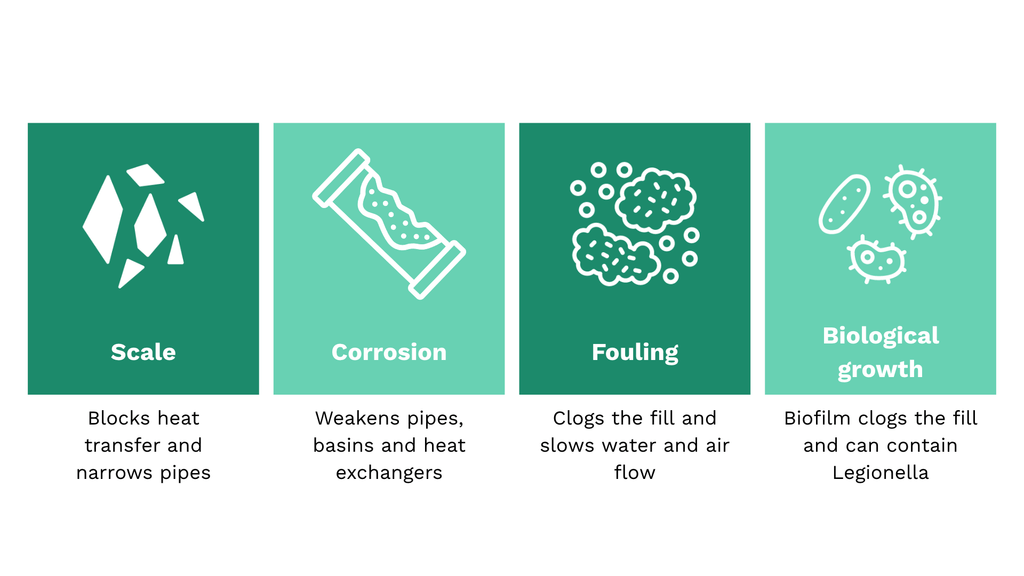
First, scale can form on hot surfaces, such as heat exchanger tubes, where it reduces heat transfer.
Its rough surface and the sediment in slow-moving water can then give bacteria a place to attach, contributing to biological growth.
Some of these bacteria produce a layer of slime, called biofilm, once they attach to a surface.
This can lead to a fast buildup of deposits, as Brad Buecker, senior technical consultant at SAMCO Technologies, explained.
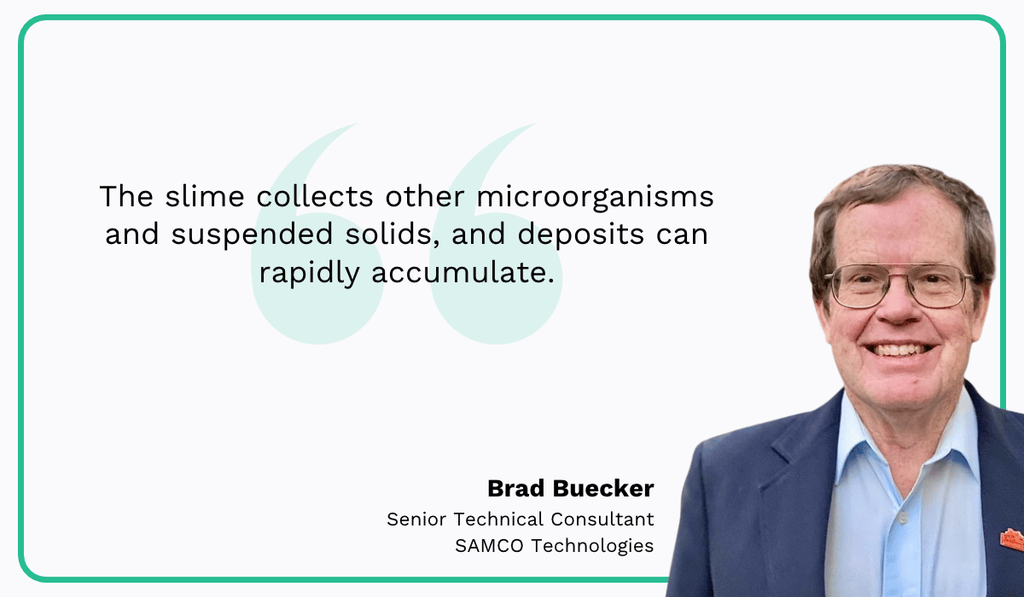
Buecker adds that these deposits lead to corrosion because the metal beneath a deposit corrodes faster than the exposed metal around it.
The rust adds to the deposits as well, so each problem makes the others worse.
As you can see, all four issues are closely connected.
They are usually managed through one water treatment program, as treating only one problem at a time leaves the others free to return.
These programs usually combine blowdown, which removes concentrated water from the system, with scale and corrosion inhibitors and biocides that kill microorganisms.
Most facilities look for a water treatment specialist to design the program, because the right treatment depends on each specific tower.
Changes in conductivity, visible deposits, or rising make-up water use can signal a problem and warrant investigation.
Not addressing these problems can harm people, since biological growth can include Legionella bacteria, which cause Legionnaires’ disease.
Consider the following case of a Legionnaires’ outbreak on New York City’s Upper East Side in 2026, with some concerning figures shown below.
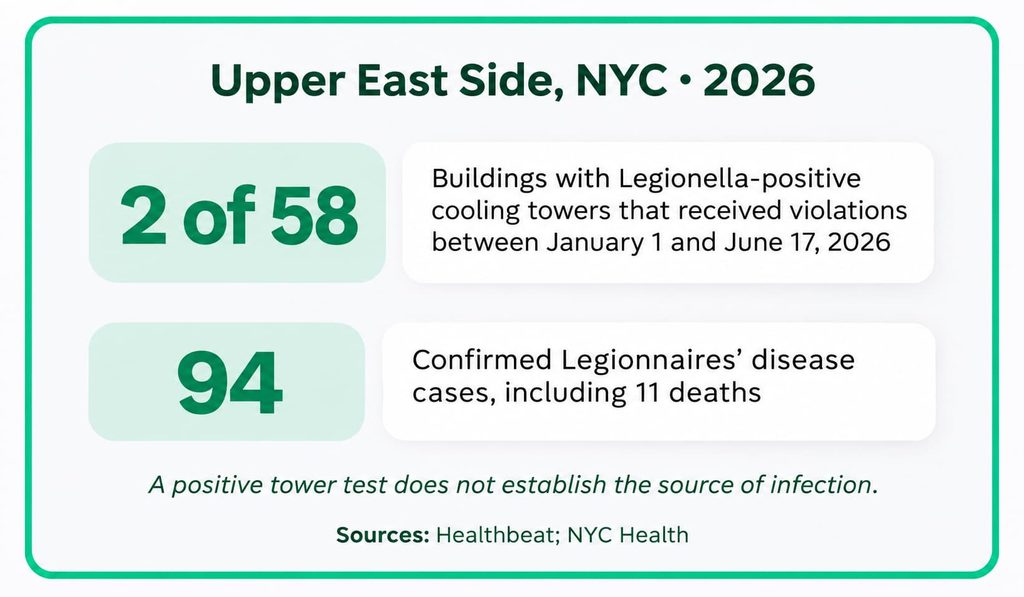
Cooling towers release droplets into the air, and people nearby can inhale those that carry the bacteria.
The outbreak shows why routine testing, documented corrective action, and follow-up are essential. A positive cooling tower test alone, however, does not establish that the tower caused the outbreak.
In short, water-side problems develop together, so one treatment program should control all of them.
Mechanical Problems
Another set of issues concerns the moving parts that pull air through the tower. A failure in these parts reduces airflow across the fill, which lowers how much heat the tower can remove.
Any of these components can be affected, including the fan, drive shaft, gearbox, and motor.
Each has some commonly occurring issues, as shown in this table.
| Component | Common issues | Typical causes |
|---|---|---|
| Fan | Imbalance, cracked blades | Corrosion, ice, debris |
| Drive shaft | Misalignment, worn couplings | Poor alignment, loose mounts |
| Gearbox | Oil leaks, worn gears and bearings | Low oil, water in the oil, misalignment |
| Fan motor, including VFD-related effects | Overheating, bearing damage | Moisture, overload, VFD-related bearing currents |
New or increasing vibration, unusual noise, and oil leaks are warning signs that warrant investigation.
For instance, the fan is a moving part that needs to stay balanced.
A minor imbalance creates vibration, which wears the bearings, gearbox, and drive shaft over time.
Wear in the fan assembly can also lead to wider damage, as the following example reported by Tyler Lee shows.
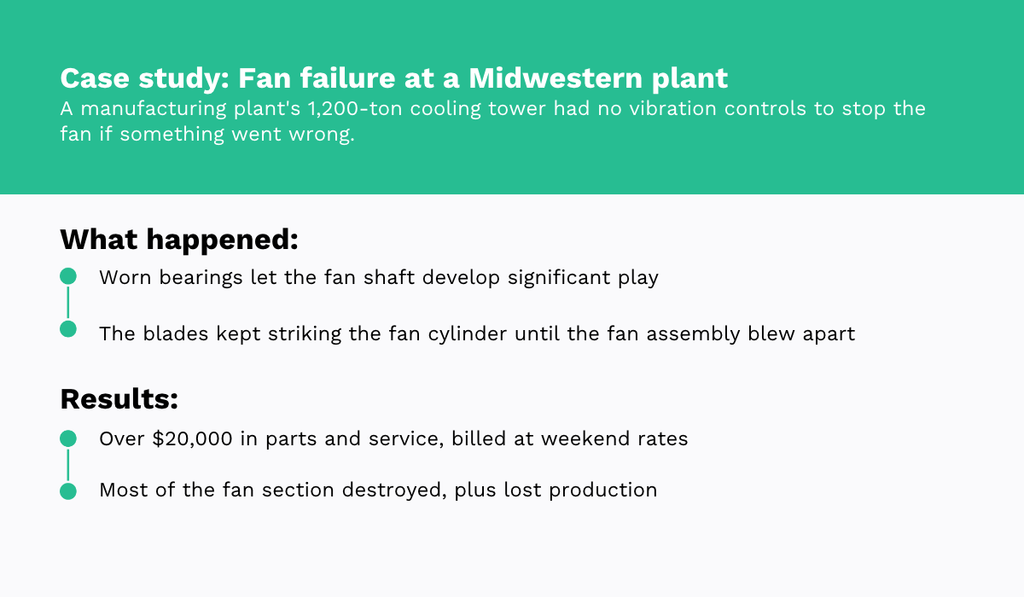
Writing in 2023, Tyler Lee of Chesapeake Systems recalled this earlier failure, which cost the owner over $20,000 in parts and service alone, excluding lost production.
He elaborates that the damage was found only when a facility engineer noticed the water was not cooling enough.
Corrosion, cracks, and ice on the blades can cause the same imbalance, so they need regular inspection.
Or, consider the gearbox, which reduces the motor’s speed to the slower speed the fan needs.

Low oil, water in the oil, or misalignment with the drive shaft can wear its gears and bearings.
Gearboxes are also difficult to access because they are mounted in the center of the fan cylinder.
In a 2015 MaintWorld article, Emerson’s Cranford Johnstone described how limited access to operating cooling tower gearboxes can make manual condition checks difficult.
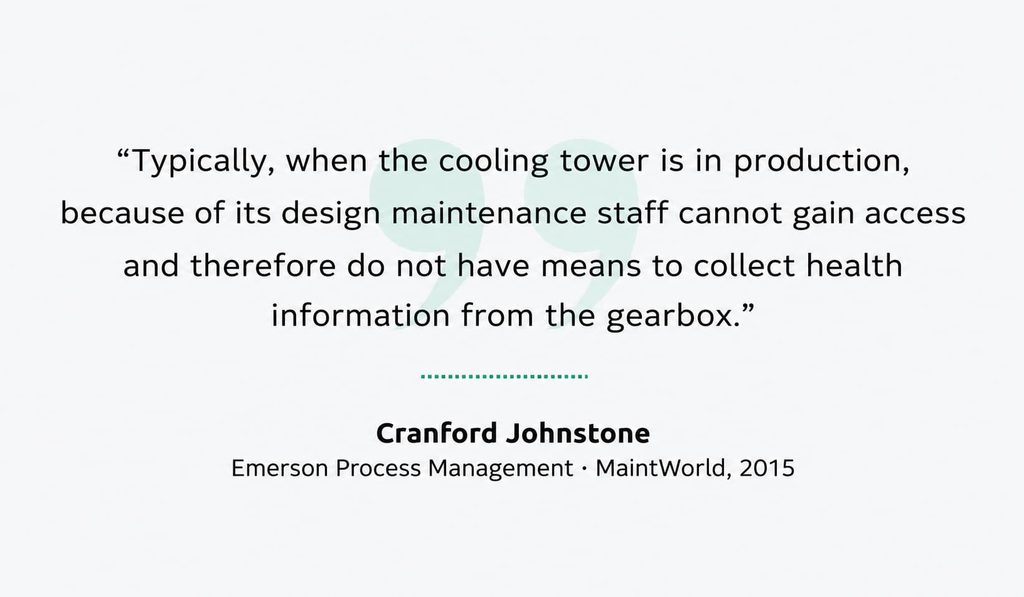
The article notes that impending failures can go unnoticed during long periods of operation between scheduled shutdowns for maintenance.
In these cases, vibration and temperature sensors that stay mounted on the gearbox can be used, notifying staff when a reading is problematic.
This continuous monitoring combined with inspections during planned downtime can help find these problems before they disrupt the tower.
Structural Problems
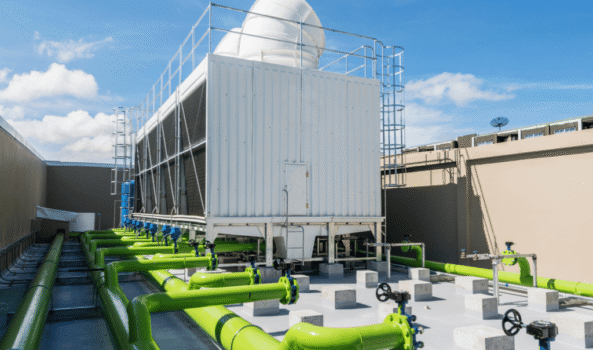
Finally, there are issues with the tower’s structure, which holds and directs the water.
Structural deterioration can be difficult to spot, especially in components that are not readily accessible.
These issues most commonly affect the following components:
- Casing
- Basin
- Fill
- Drift eliminators
- Water distribution nozzles
Many factors can damage these components, including age, water chemistry, debris, heat, and sunlight.
Look for visible casing leaks, uneven water distribution, and damaged or displaced components.
One damaged part can also affect the water and the rest of the tower.
For example, a leaking basin loses treated water, so the tower needs more fresh water and chemicals.
This increases water and treatment costs and can disrupt the intended balance between make-up water and blowdown.
Blocked nozzles can distribute water unevenly over the fill, reducing effective cooling. Damaged or incorrectly installed drift eliminators can allow more water droplets to escape.
Or, consider fouling, a common issue with fill.
Film fill has narrow channels that spread water into thin layers, and these channels collect scale, dirt, and biofilm over time.
In a case study published in 2025 about a 2023 project at Vietnam’s Ca Mau Fertilizer Plant, Brentwood Industries reported how much weight fouling had added to the fill after a decade of operation.
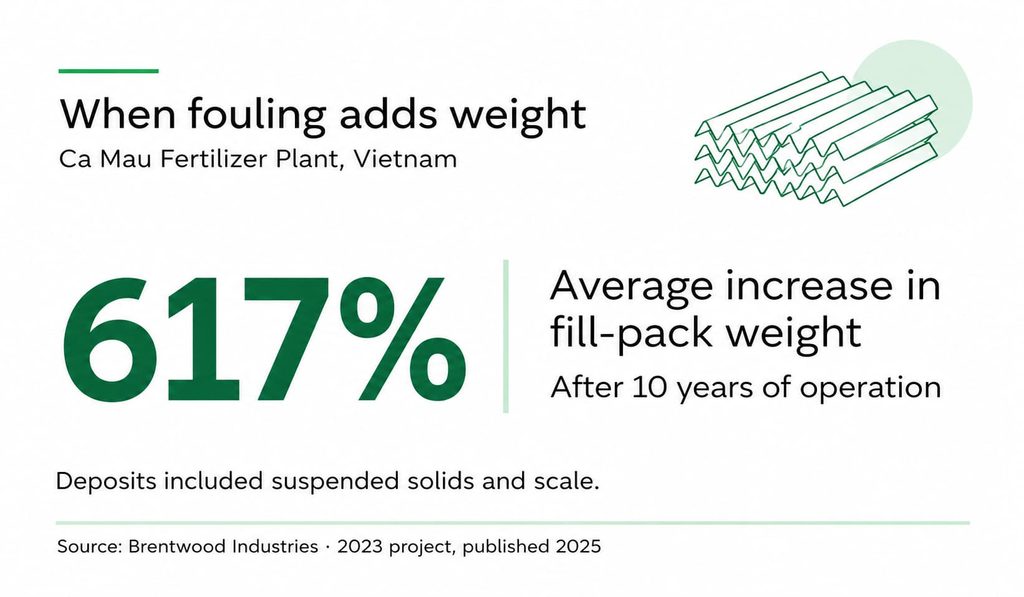
The fouling came from solids and scale in the plant’s river water, and cooling performance dropped sharply.
Brentwood and Bateco replaced the fouled fill with an offset-fluted design selected for its resistance to fouling. Following the upgrade, the plant’s cold-water temperature fell from 32.0°C to 29.9°C.
Without waiting for damage this severe, teams can target issues like these with scheduled cleaning of the fill and nozzles.
Another common structural problem in cold climates is freeze damage and ice buildup.
Ice forms on the fill, louvers, and structure in freezing weather, especially when heat load or water flow is low.
Freezing risk depends on the tower’s design, heat load, water distribution, and operating conditions.
SPX Cooling’s manufacturer guidance highlights the importance of heat load, water flow, and regular inspections during subfreezing weather.
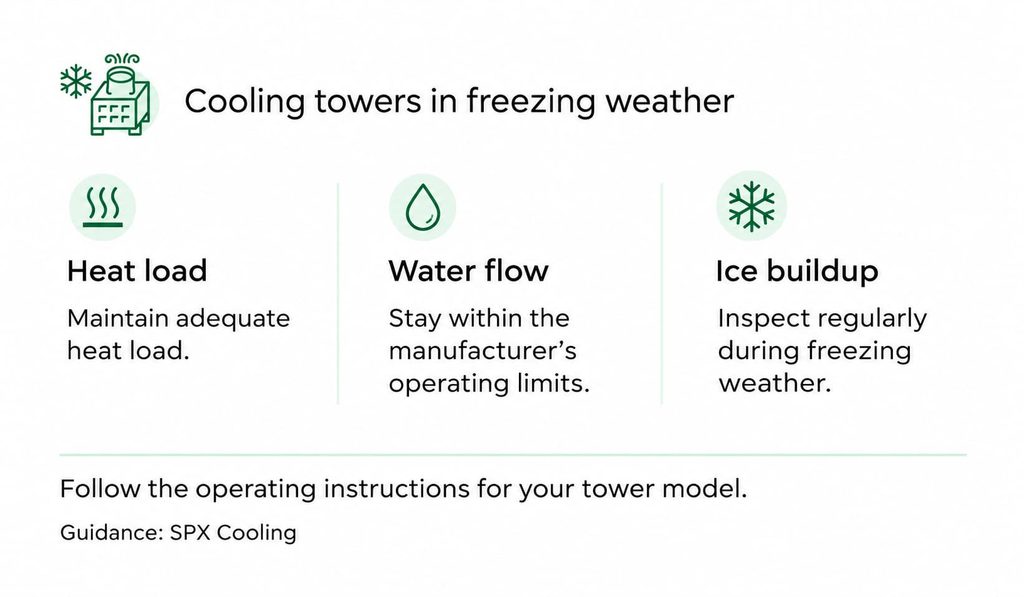
Follow the manufacturer’s cold-weather operating instructions and inspect for ice buildup during subfreezing weather.
Accumulated ice can crack the fill, bend louvers, and damage the structure.
Regular inspections help teams identify structural deterioration and ice buildup before they cause more extensive damage.
Repair or Replace a Cooling Tower?
Many of these issues can be managed through routine maintenance and targeted repairs.
Repeated failures, major structural deterioration, or an inability to meet operating requirements call for a broader repair-or-replacement assessment.
Several factors affect this choice, as our guide to repairing or replacing equipment explains, and the key ones are below.
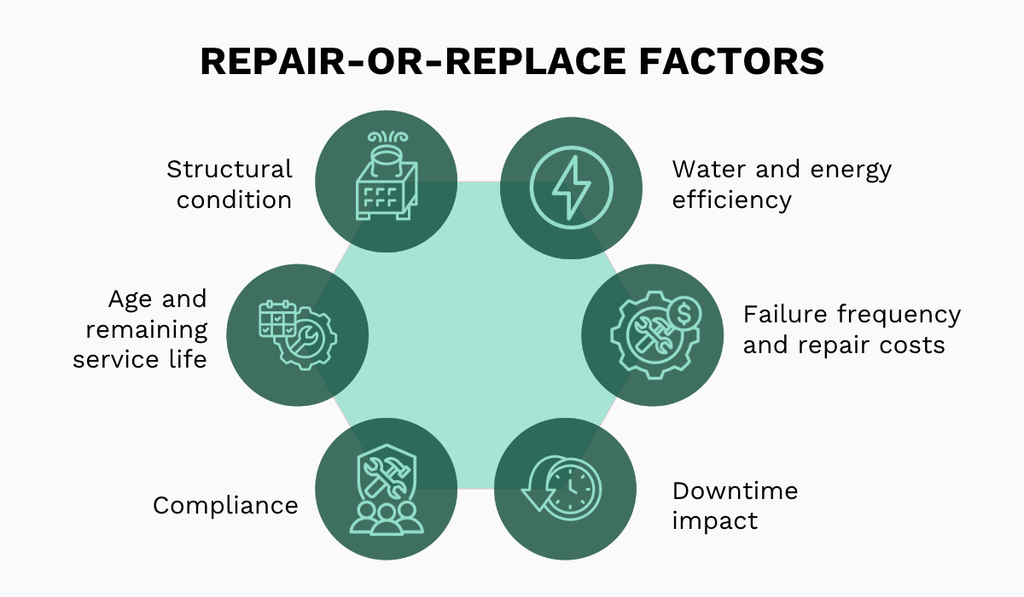
Initially, repair is usually the better option, since it restores a young, sound tower for less than a new one.
You might use coatings and sealants to fix leaks and corrosion, or replace single worn components one at a time.
Have structural deterioration and major mechanical damage assessed by the manufacturer or a qualified service specialist before selecting a repair method.
The cost comparison changes, however, once failures start repeating.
In ABB’s 2023 survey, the median self-reported cost of unplanned downtime was close to $125,000 per hour. This cross-industry estimate is not specific to cooling towers; use your plant’s actual downtime costs when comparing options.
Depending on the component and available redundancy, a failure may reduce cooling capacity or require a shutdown until repairs are completed.

Over multiple failures, these costs can grow larger than the repair bills themselves.
Repair scope and remaining service life also matter. In a 2026 regulatory filing, Kentucky Power compared expanded reinforcement of its Mitchell Unit 2 cooling tower with construction of a new mechanical-draft tower.
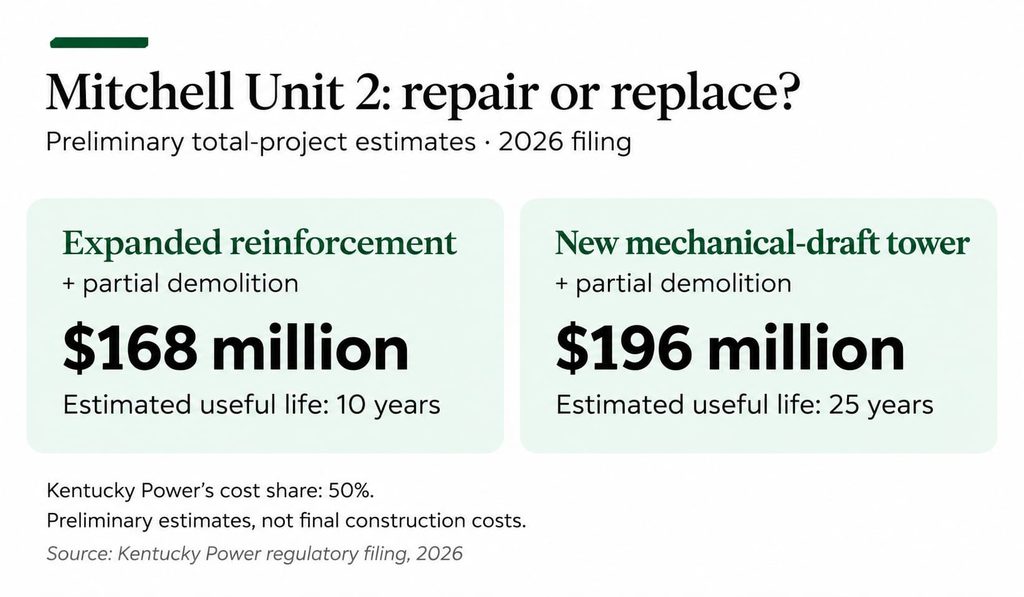
The filing’s preliminary total-project estimates included partial demolition, with Kentucky Power responsible for a 50% share. The expanded reinforcement option would require no outage. The comparison also considered service life and the likelihood of further investment after repairs.
Specialized materials, contractors, and any required shutdowns can also affect the total cost of an option.
Compare the full cost of each option over the expected remaining service life, including maintenance, operation, and any production losses.
Replacement may reduce operating costs, although projected savings should be assessed against the full project cost. Habitat Magazine reported one such projection for a New York City co-op.
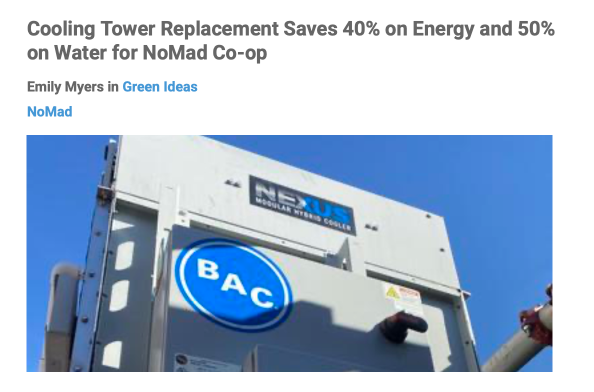
The NoMad co-op in New York City replaced its badly rusted tower with a three-cell unit that scales cooling to demand.
Habitat reported a $460,000 project and projected a reduction of around 30% in the tower’s operating costs. The replacement was paired with pump upgrades and VFDs, and the savings had not yet been verified through summer operation when the article was published in 2024.
The rule of thumb is to repair while failures are isolated and think about investing in a new tower once repairs and downtime costs increase significantly.
How to Prevent Cooling Tower Problems
To prolong a cooling tower’s life and avoid costly repairs or early replacement, you need to think about prevention.
Monitoring and prevention work best as one process, where each inspection’s results are used to plan the next task.
This process has several aspects, some of which are listed next.
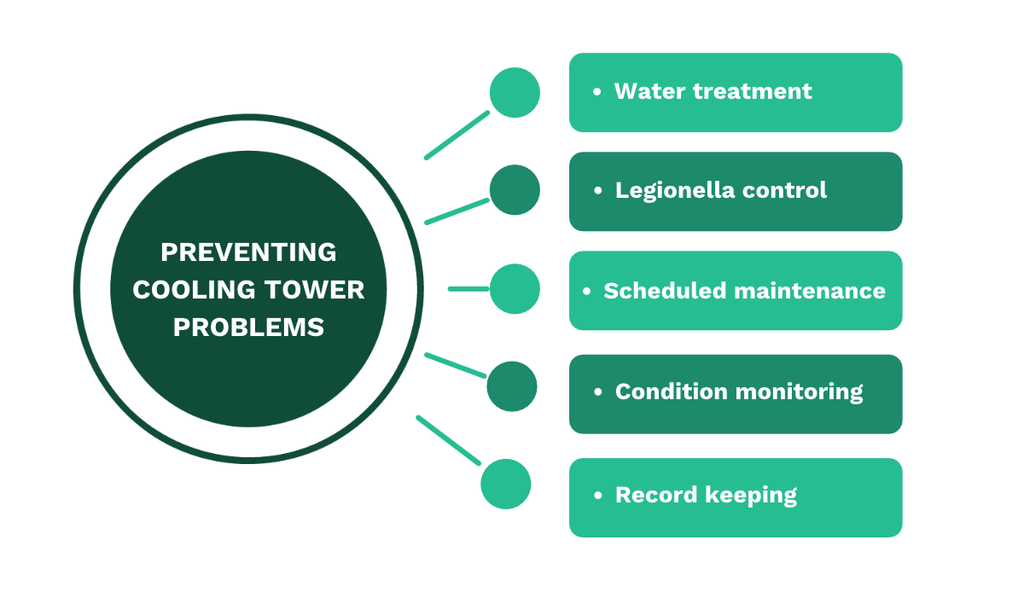
As an example, consider a water treatment program that prevents scale, corrosion, and biological growth.
Coordinate water treatment with a documented water management program (WMP) for Legionella risk, covering responsibilities, monitoring, control measures, corrective actions, and records.
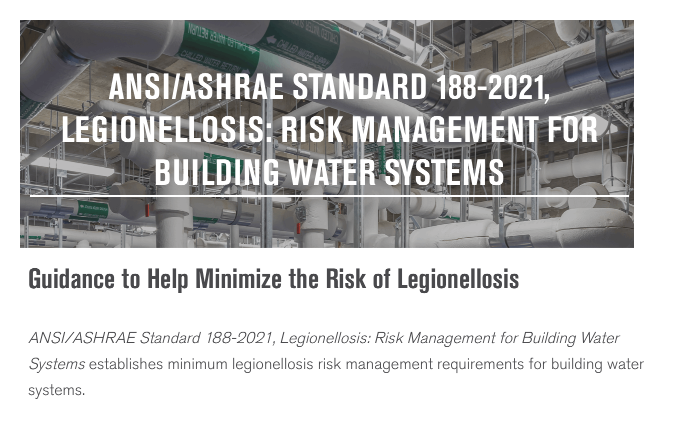
ASHRAE Standard 188-2021 sets minimum requirements for managing Legionella risk in building water systems, including cooling towers. The CDC cooling tower toolkit provides practical control guidance.
While setting up your prevention program, it’s useful to review these requirements, along with any local rules for your site.
Plus, you need condition monitoring for early warnings, with vibration analysis, temperature, and water quality readings showing changes before a failure.
Our cooling tower maintenance checklist covers this and other preventive tasks in detail.
If you go through the checklist, you may notice that there’s a lot to keep track of.
A computerized maintenance management system (CMMS) like WorkTrek can help you organize most of these tasks for your preventive program.
It can schedule recurring maintenance on a time basis or trigger work orders from meter readings such as temperature. The HVAC examples below illustrate triggers that can also be configured for cooling tower maintenance.
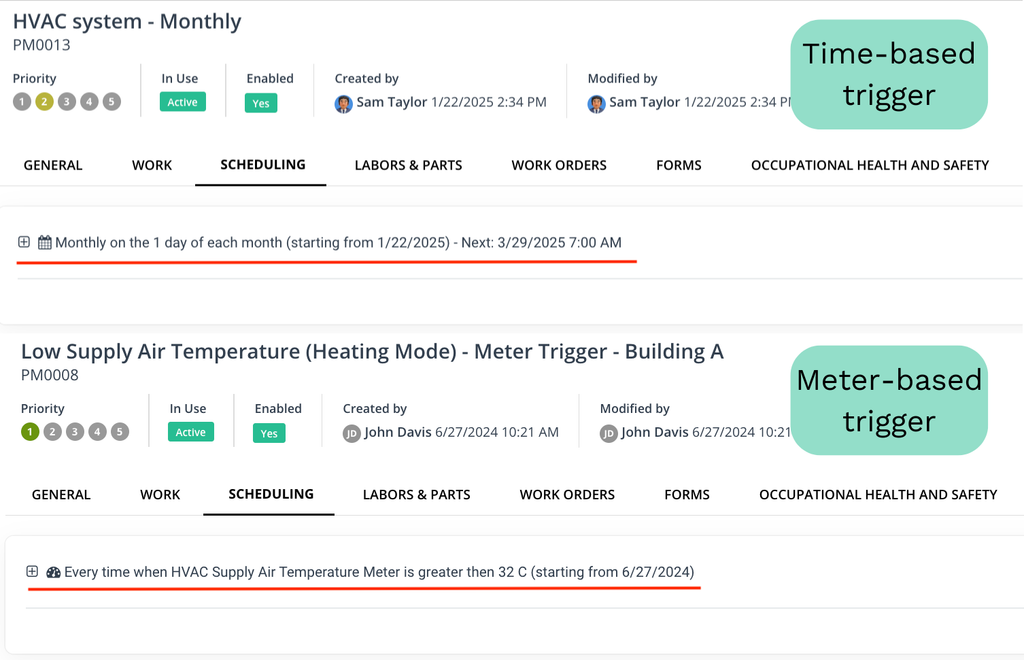
For each maintenance job, all inspection results can be recorded within the system, and failed inspections can automatically create follow-up work orders.
What you get is the failure and repair history of each tower in one place, so the team can see which problems repeat.
These records help the team adjust the maintenance plan over time.
If fill repeatedly clogs, investigate the source of the deposits before increasing cleaning frequency. Root cause analysis draws on water quality, treatment records, and operating conditions to identify why the problem keeps returning and guide corrective action.
This approach can reduce preventable failures and help extend the tower’s service life.
Conclusion
Failure and repair records are most useful when they lead to a change in maintenance.
Recurring problems should prompt an investigation into the cause, rather than another identical repair.
As a next step, list the failures and repairs on each tower over the past year, and check which ones keep recurring.
Repeat problems show where your maintenance plan needs to change first.