


Get a Free WorkTrek Demo
Let's show you how WorkTrek can help you optimize your maintenance operation.
Try for freeKey Takeaways:
- Audits and inspections often happen unannounced, so you need to be prepared.
- CMMS like WorkTrek keep inspections scheduled and records centralized.
- Auditors treat undocumented work as missing work, even when it was done correctly.
Inspections check whether a specific asset meets a requirement, while audits independently review evidence against a whole set of requirements.
They can happen without warning and thoroughly look at your records and assets.
A computerized maintenance management system (CMMS) keeps you ready for both, helping you schedule every inspection and record your findings.
With a CMMS, data is collected daily instead of teams having to gather data binders and spreadsheets before each audit.
How to Stay Audit-Ready With a CMMS
Audit readiness comes from diligence and everyday maintenance work: inspections done on schedule and properly recorded and documented.
An audit then becomes a review of records the team already has.
The five steps below show how to build a CMMS audit routine, from listing every obligation to checking readiness on a regular schedule.
1. List Every Inspection and Audit Your Facility Faces
The first step is to list every external inspection and audit, which are different from an internal maintenance audit of your own program.
Scott Shankle, Chief Quality & Regulatory Officer at medical device manufacturer Tecomet, discussed how audits have changed in a BONEZONE article.
He explains that one of the two main challenges he sees is the number of audits, as shown below.
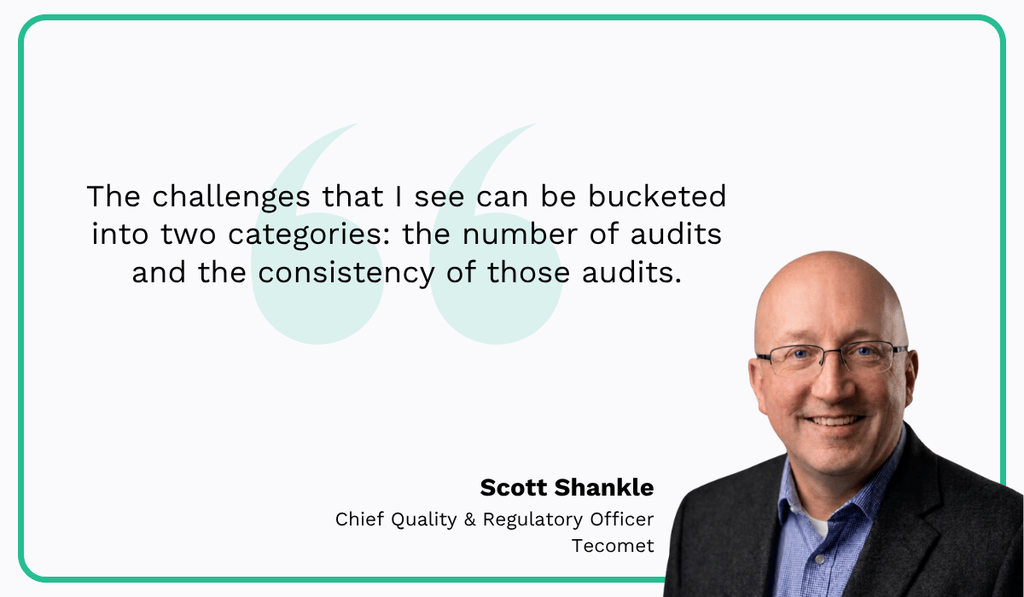
He adds that audits now come from regulators in many countries, each with growing documentation demands.
In other words, it’s worth making a thorough list of every inspection and audit your facility might face.
The list will differ by facility type and location. In general, consider these organizations:
- OSHA and state safety agencies
- The Environmental Protection Agency (EPA)
- The Food and Drug Administration (FDA)
- Certification bodies for ISO standards
- Customers and insurers
You might structure this list of obligations like the table below.
| Obligation | Who requires it | Assets | Frequency | Evidence expected | Owner |
|---|---|---|---|---|---|
| Overhead crane inspection | Regulator: OSHA 29 CFR 1910.179(j), (m) | Hooks, hoist chains, running ropes | Daily visual and monthly thorough inspection. | Monthly certification record with date, inspector’s signature, and the hook/chain/rope ID | Maintenance supervisor |
| Portable fire extinguishers | Regulator: OSHA 1910.157(e) | All extinguishers on site | Monthly visual and annual maintenance check | Annual maintenance date recorded and kept 1 year after last entry or the life of the shell | Facilities / EHS |
| ISO 9001 certification audit | Standard / certification body | Measuring equipment (clause 7.1.5), production infrastructure (7.1.3) | Surveillance audit at least once per calendar year. Certificate valid for 3 years | Calibration records against traceable standards and maintenance records | Quality manager + maintenance manager |
Each row names the obligation and the body that requires it.
The asset, frequency, and owner columns turn each row into regulatory-driven maintenance work with a clear scope, schedule, and responsible person.
Of course, the evidence column is key, since it records what the inspector or auditor will ask to see.
Once the table is complete, you have a register that every later step relies on.
2. Set Up Each Inspection as a Recurring Work Order With a Checklist
When you collect all the requirements, you need to analyze them and build checklists from the exact wording of each one.
For instance, let’s examine the EPA’s Spill Prevention, Control, and Countermeasure (SPCC) rule in Title 40 of the Code of Federal Regulations (CFR), Part 112, shown below.
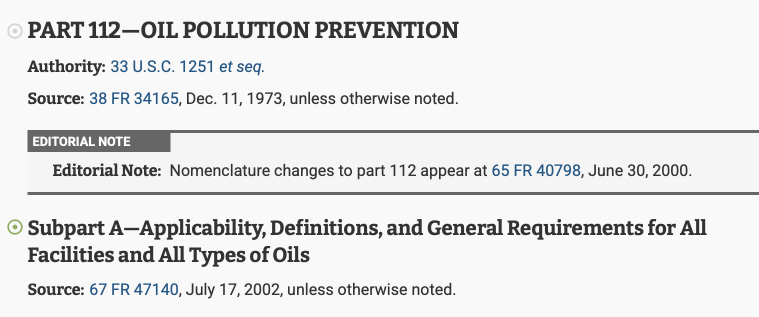
We want to turn the lines of this regulation into items a technician can mark as passed or failed.
An example of how some of these lines can be converted into checklist items is shown in the image below.
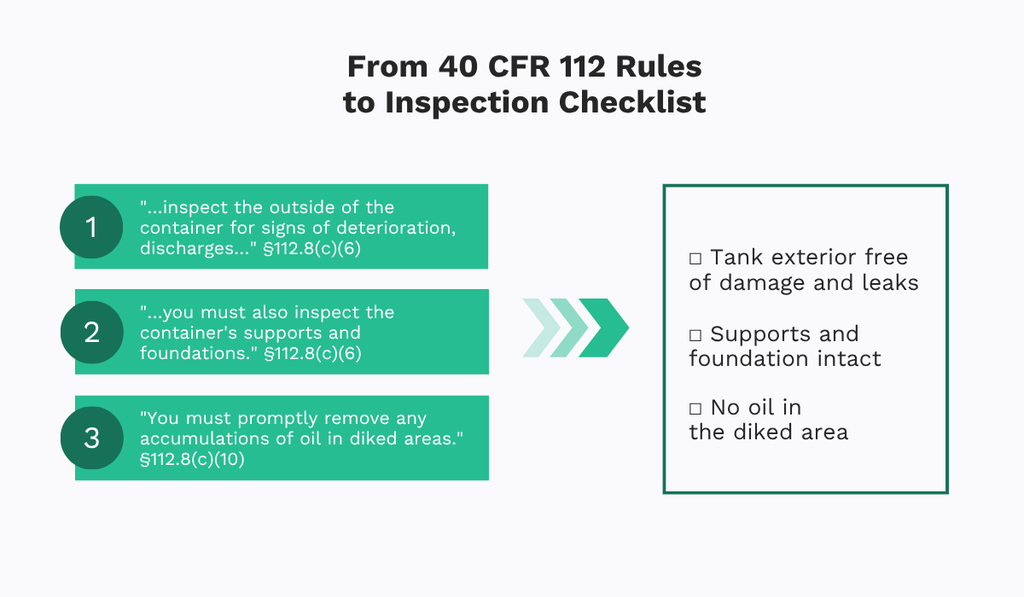
Each excerpt becomes one plain-language item a technician can check at the tank.
Of course, writing these checklists takes time at first, but a few preventive maintenance checklist best practices can make the process easier.
Once these checklists are written, you can create them in a CMMS as recurring work.
WorkTrek is maintenance inspection software with checklists and inspections features that let you attach custom forms to preventive maintenance tasks and work orders.
You can create recurring inspection schedules with due dates, and the system sends alerts when an inspection becomes overdue.
These schedules can cover every inspection on your register and appear in the scheduler shown below.
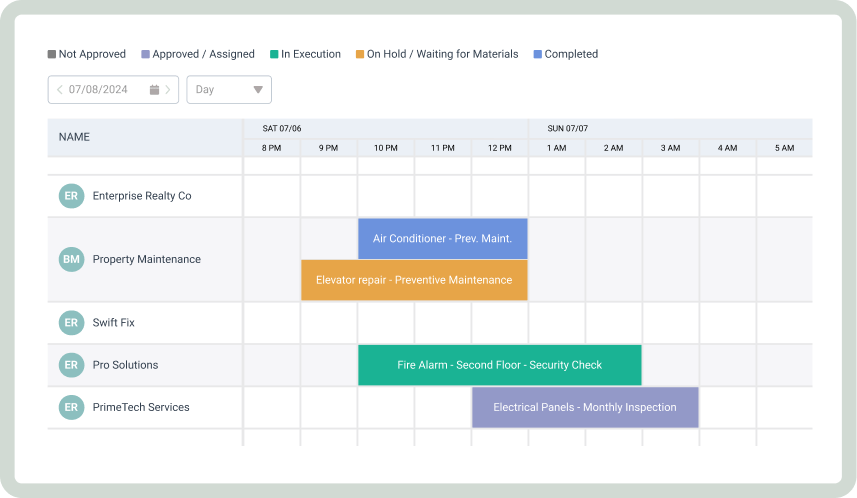
A facility or maintenance manager can see required inspections next to regular maintenance and can assign each to the right team.
Each work order can include the checklist you built, and technicians can complete it in the WorkTrek mobile app.
This means results are recorded at the asset, with the name, date, and time captured automatically.
Every obligation on the register now has a date, an owner, and a clear checklist.
3. Record Inspection Results as Evidence
When inspections are performed, useful data can be collected about the condition of every asset.
After an inspector finishes, the result shouldn’t be recorded only as a completed task.
Auditors accept records as evidence when they show what was checked, what was found, who did it, and when.
Record the findings yourself if an external inspector doesn’t provide a written report, and attach any certificates or third-party reports to the asset.
Sometimes, findings arrive as a detailed letter, like this extract from a January 2026 FDA warning letter to drug manufacturer Winder Laboratories.
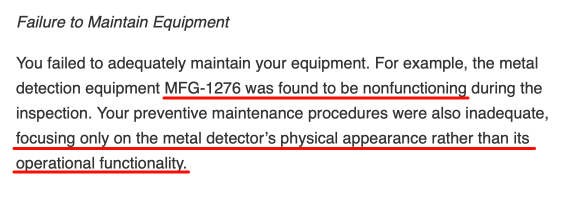
The finding names a specific equipment ID, so it can be recorded against that asset and traced through every later action.
Detailed reports like the letter are important, but all other results should be recorded as well, including passed items, and kept as long as the rules require.
Auditors base their conclusions on written evidence, so an inspection without a maintenance record can’t be confirmed.
The details auditors expect in these records are shown below.
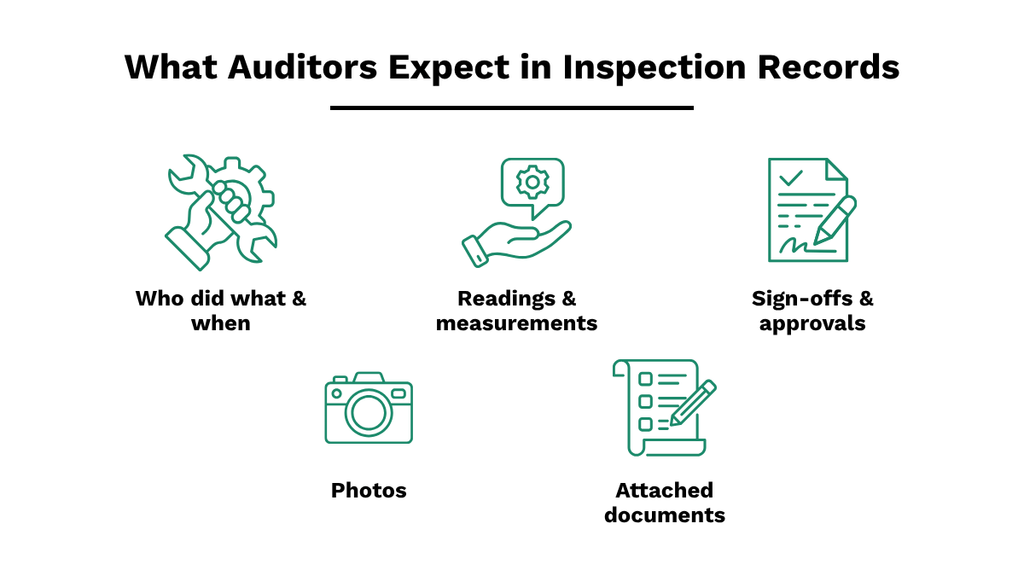
Auditors use these details to confirm each inspection was done on time, correctly, and by a qualified person.
For example, photos and sign-offs show that a problem was seen, assessed, and passed to someone with the authority to act.
Then there’s the maintenance audit trail, an automatic log of who changed a record and when, which auditors check for unexplained edits.
Food, pharmaceutical, and medical device manufacturers should also read the FDA’s Part 11 guidance on electronic records and confirm with their regulator which rules apply.
Every inspection recorded this way produces evidence an auditor can accept.
4. Turn Every Failed Item Into a Tracked Corrective Action
Auditors often focus on what happened after an issue was found, because an unresolved problem means the risk remains.
During inspections, it’s very common for some items to fail.
Once that happens, document the item with a photo and make the asset safe if needed.
The failed item should then lead to a corrective work order with an owner and a deadline, followed by an inspection that confirms the fix.
Some CMMS platforms let you do this directly, as shown below.
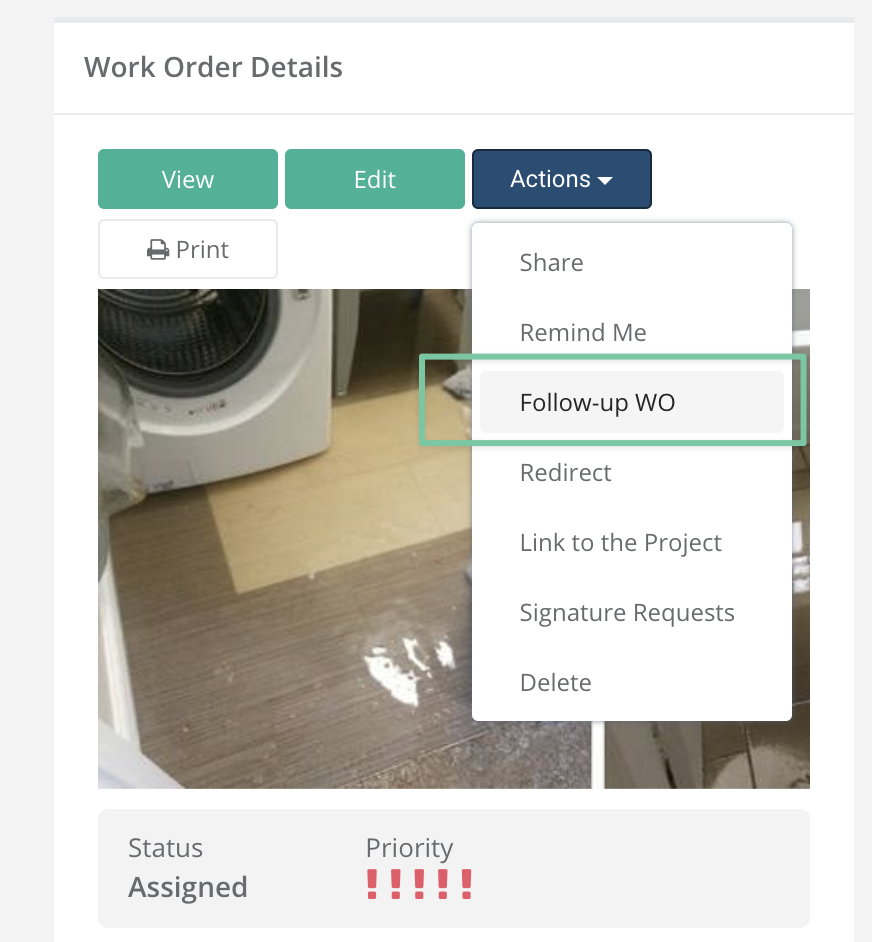
These corrective actions need to be taken seriously, because a finding that reappears at the next audit suggests the first fix didn’t work.
In fact, you should have a detailed process for every failed item.
It can look like the flow shown below.
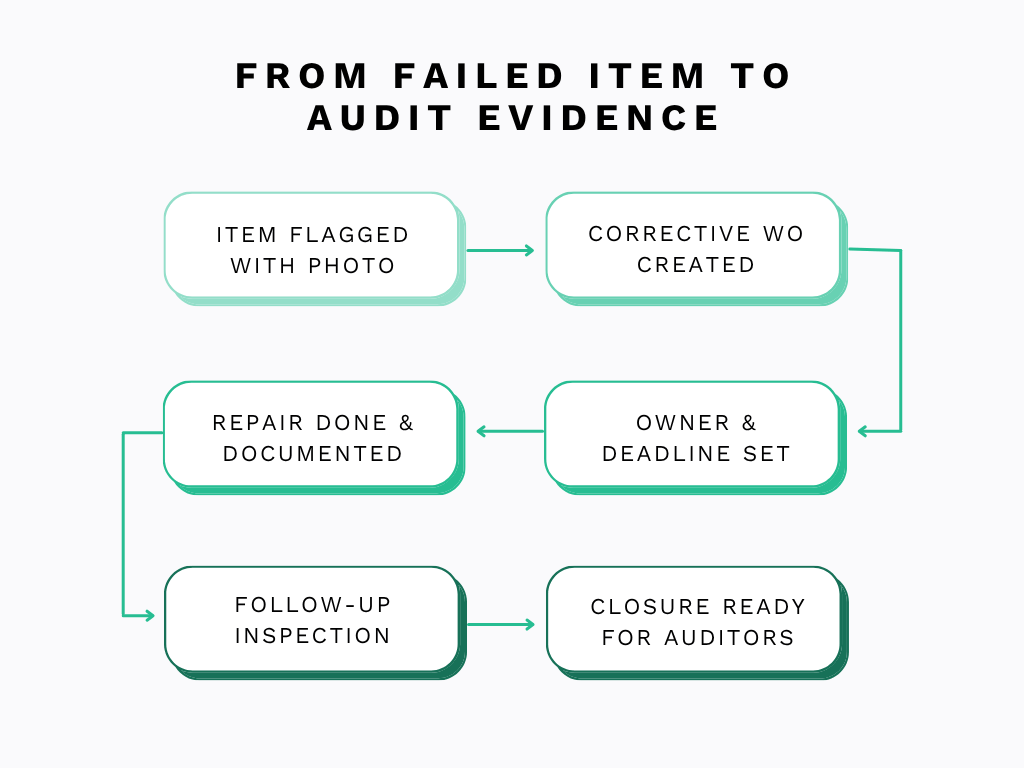
A photo record shows the asset condition before anyone touches the equipment.
After all work is done and documented, don’t forget to schedule a follow-up inspection, which proves the repair worked.
Each step leaves a time-stamped entry in a CMMS, so the full history of any problem can be shown in minutes to auditors.
5. Check Your Readiness on a Regular Schedule
Even a well-built system needs regular checks, as inspections and audits can also happen unexpectedly.
As written in OSHA’s inspections fact sheet, the agency usually arrives unannounced.
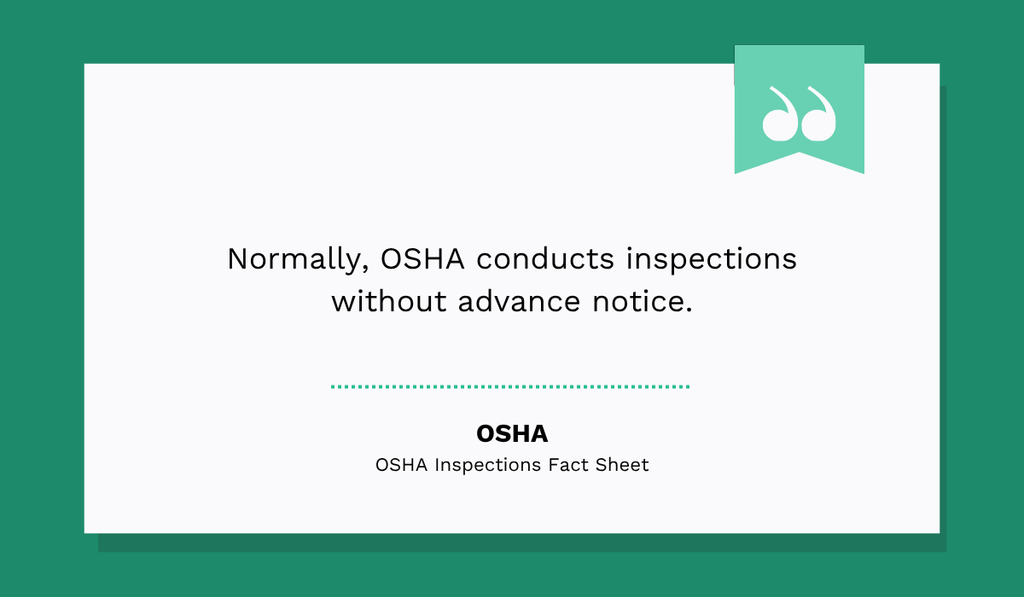
That means you need to be prepared on any working day to avoid violations.
Same goes for the FDA, which already inspects U.S. facilities unannounced and, in May 2025, expanded this practice to foreign facilities.
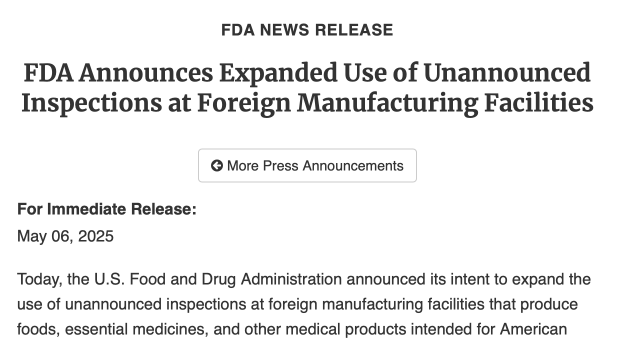
In the announcement, FDA Commissioner Martin Makary noted that American manufacturers are held to rigorous standards “with no such warning.”
The same CMMS features that support compliance also help you stay ready between visits.
For starters, recurring schedules keep inspections on time without anyone having to remember due dates.
But CMMS dashboards and reporting functions can help as well.
For instance, if your CMMS supports filtered views, you can use the three shown below.
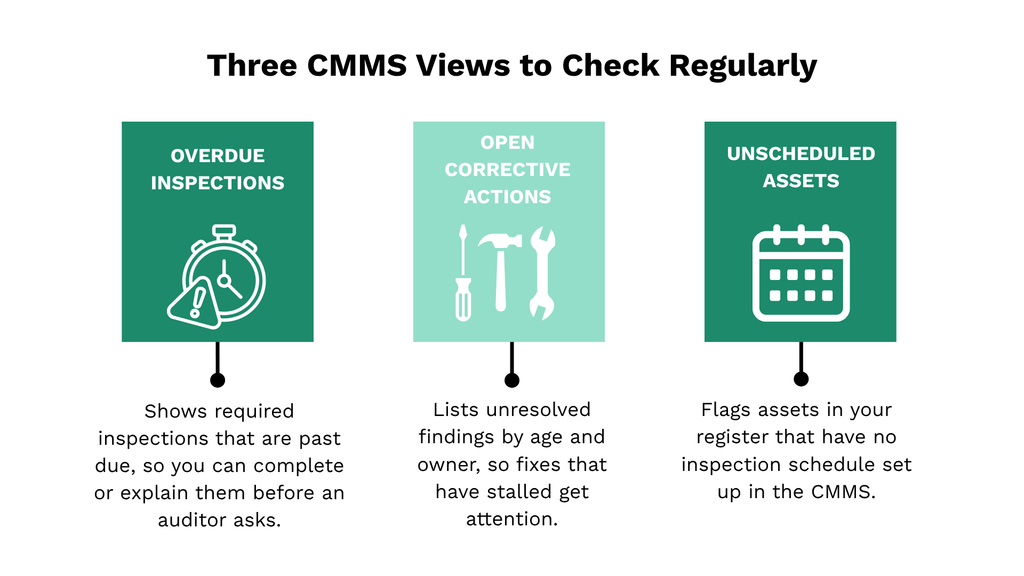
The overdue inspections view, for example, should list every late inspection with its asset, owner, and days overdue.
These are the inspections that carry the most risk if an external inspector or auditor arrives.
This risk was clear in a January 2025 audit by San Diego’s Office of the City Auditor, which reviewed the city’s legally required fleet safety inspections, as shown below.
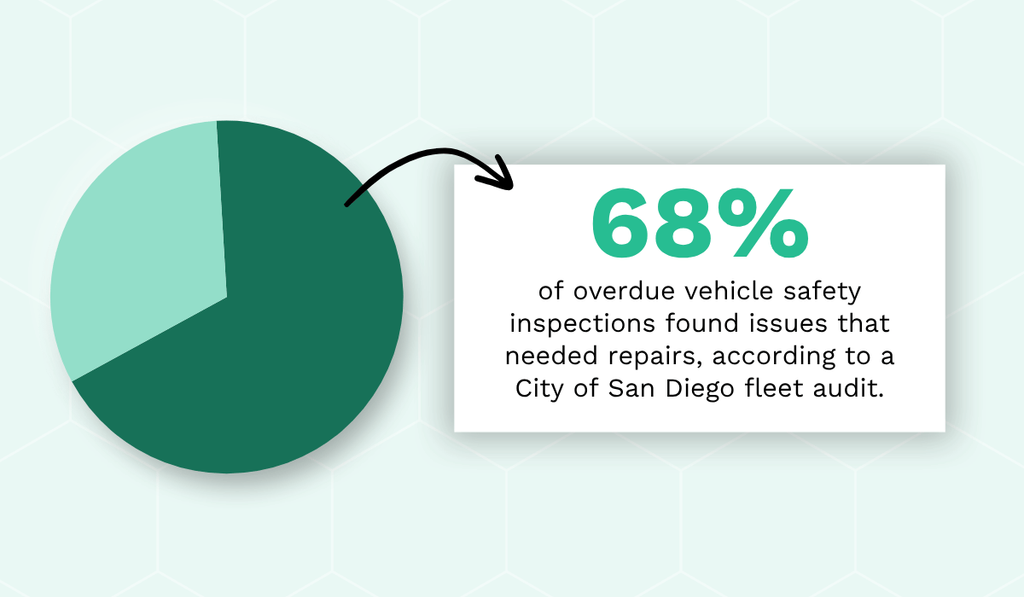
Same goes for the other views, which show unresolved findings and any asset register entry without a schedule.
Ultimately, the maintenance manager should review them on a fixed schedule, for example, overdue inspections weekly, corrective actions monthly, and asset coverage quarterly.
What to Do During and After an Audit
On audit day, you should have one person retrieve records from the CMMS while another stays with the auditor, and log every request with the time and the record provided.
When the auditor asks about an asset, open its record in the CMMS to show its full history of inspections, photos, corrective work, and certificates.
Here, the work your team did during inspections pays off.
In fact, Neil DiSpirito, a Brown Rudnick partner who advises companies on FDA matters, suggests staying close to inspectors in a webinar summarized by Redica Systems.
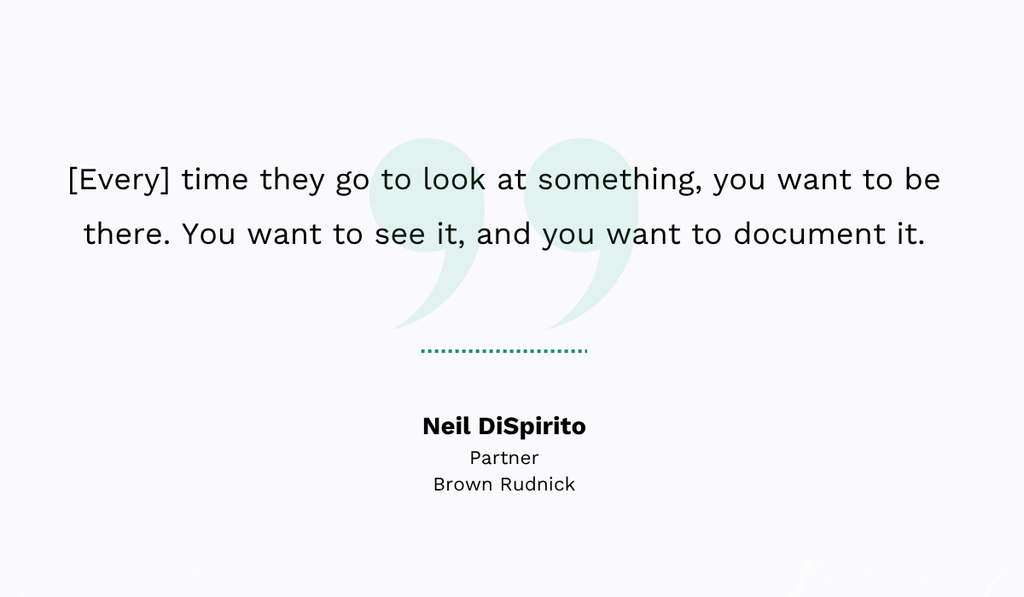
DiSpirito also recommends keeping a log of everything an inspector asks for.
Avoid editing records during a later audit, because the audit trail shows every change, and the auditor may see a late edit as an attempt to hide a gap.
For a genuine error, keep the original entry, add a dated correction with the reason, and tell the auditor about it.
After the audit, the findings follow the general flow shown below.
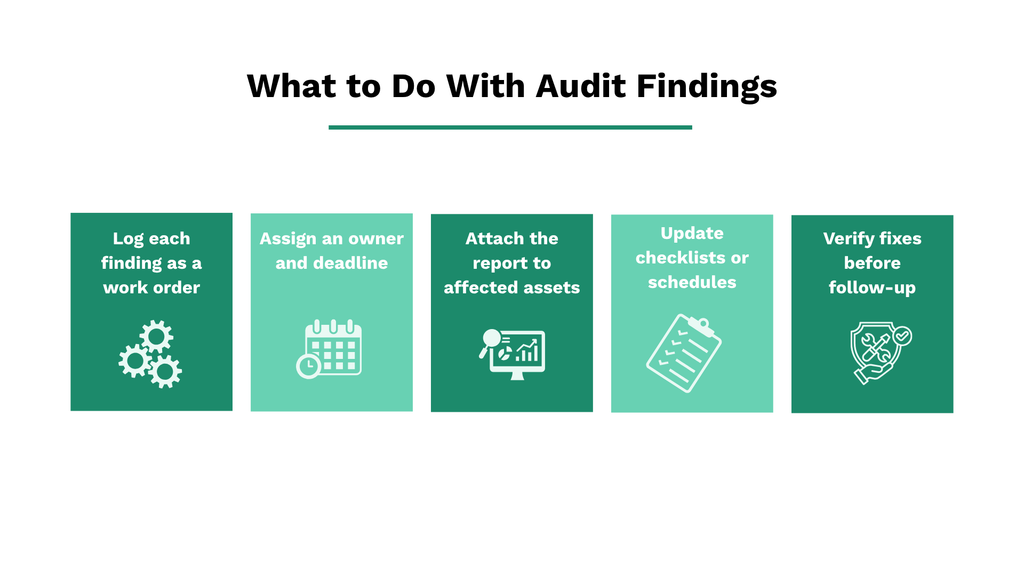
Every finding becomes assigned, tracked work, and what the auditor found is used to improve the inspection program before the follow-up visit.
This should be a similar corrective action process as in step 4, so audit findings and failed inspection items are recorded in a structured way.
Common Gaps Auditors Find in CMMS Records
Even with a CMMS, some record problems appear often during audits.
Unfortunately, some recordkeeping gaps can weaken a team’s position even when the work was done.
Some common issues are shown below.
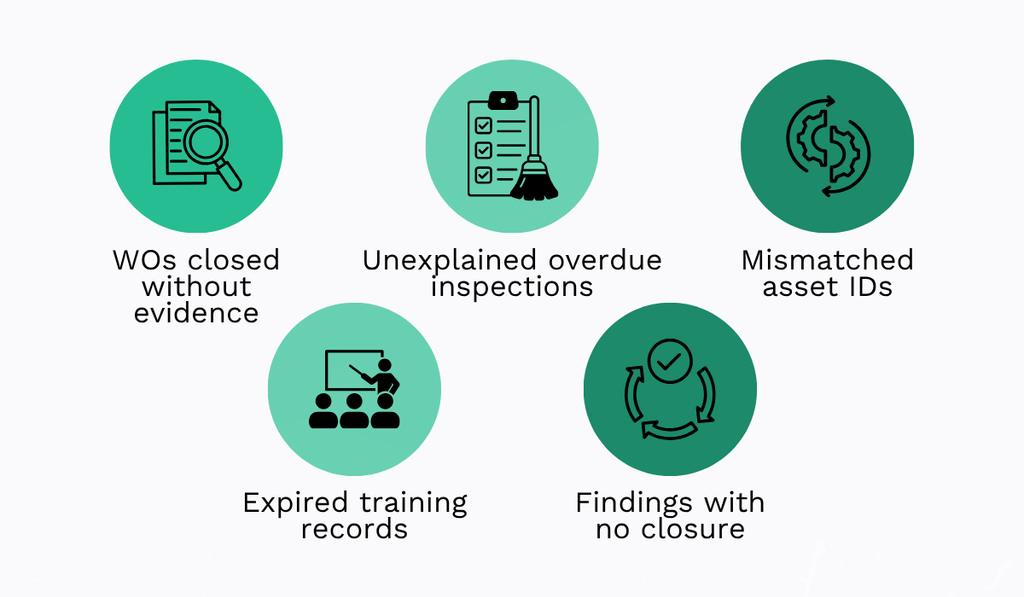
For instance, work orders closed without evidence give the auditor no proof of what was done, so require a note or photo before closing.
Unexplained overdue work is another common issue, as a February 2025 audit of Virginia’s Department of General Services by the state’s Office of the State Inspector General showed.
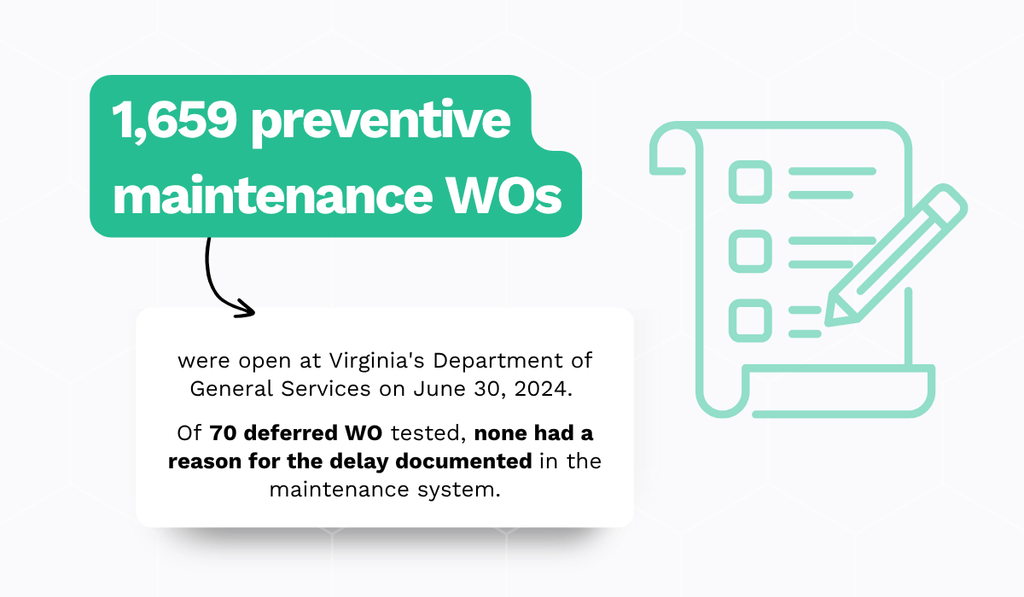
Every deferred work order the auditors tested had been postponed at least once, and one had been postponed four times.
Issues like these mean that even if work was done flawlessly or corrective action was taken, the team can’t prove it.
The auditor has to treat undocumented work as missing, which can lead to findings, citations, or a failed certification audit.
Looking at monthly CMMS reports, such as closed work orders without attachments or overdue items without a recorded reason, can show these gaps before the auditor does.
Correcting them early ensures the team’s work is visible during the audit.
Conclusion
An audit is easier to handle when your team can show what was inspected, what needed fixing, and how the issue was resolved.
A CMMS keeps those records with the asset, so you can retrieve them without searching through spreadsheets or asking technicians to fill in the gaps.
Start with the assets that have the strictest inspection requirements.
Check their schedules, review the last inspection records, and follow up on unresolved findings.
Make those checks part of your routine, rather than work you save for the next audit.