


Get a Free WorkTrek Demo
Let's show you how WorkTrek can help you optimize your maintenance operation.
Try for freeKey Takeaways:
- Minor faults can progress until they damage expensive components.
- Poorly maintained plants lose between 20% and 50% of their compressed air to leaks.
- The type of air compressor you operate determines how often it needs servicing.
Compressed air runs in the background of most facilities, but the equipment producing it is often overlooked until something stops working.
Air compressors need regular attention and maintenance, and the right schedule depends on more factors than most teams expect.
This article covers the benefits of proper compressor maintenance and how to schedule and successfully implement it.
Why Proper Air Compressor Maintenance Matters
Keeping air compressor maintenance on schedule is one of the easiest ways to improve how your operations run.
This practice has three major advantages, which we’ll outline next.
Extended Equipment Lifespan
Routine maintenance reduces wear on the components that work hardest, including filters, belts, bearings, seals, and the motor.
These parts degrade gradually rather than failing at once, so a filter change or belt check on schedule keeps the rest of the machine working in the conditions it was designed for.
When minor faults are corrected early, the compressor keeps operating within its intended specifications, which delays the point at which a major repair or full replacement becomes necessary.
Data from PwC and Mainnovation shows what a proactive approach returns.
The two firms surveyed 268 asset-intensive companies across Belgium, Germany, and the Netherlands, with two key findings shown below.
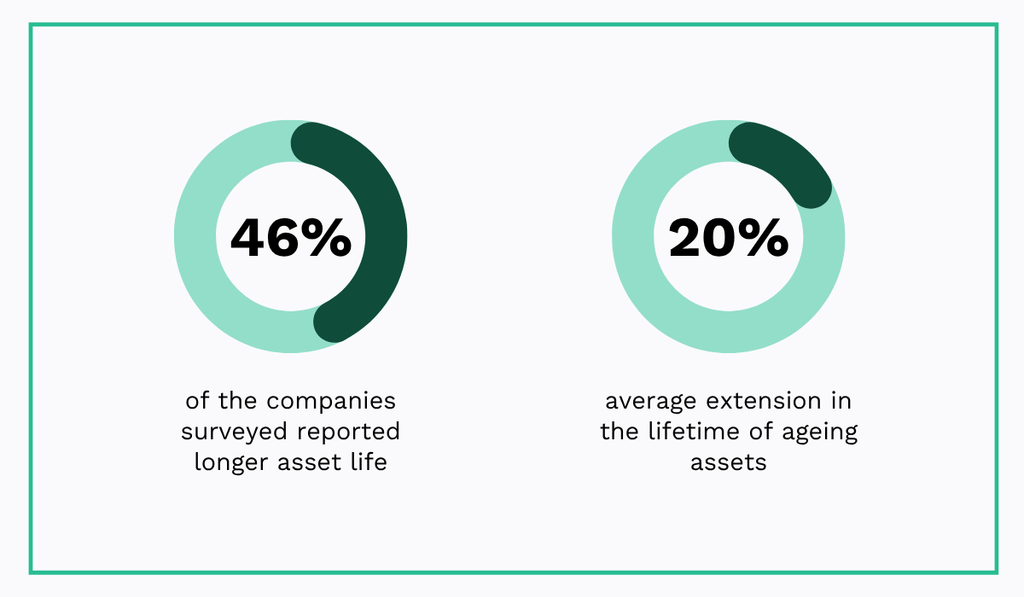
This data applies directly to air compressor maintenance.
Just consider the number of components involved, each with its own service interval and failure pattern.
Even something as ordinary as a compressor lubricant oil has defined conditions for use and a recommended service interval, as this Atlas Copco specification shows.
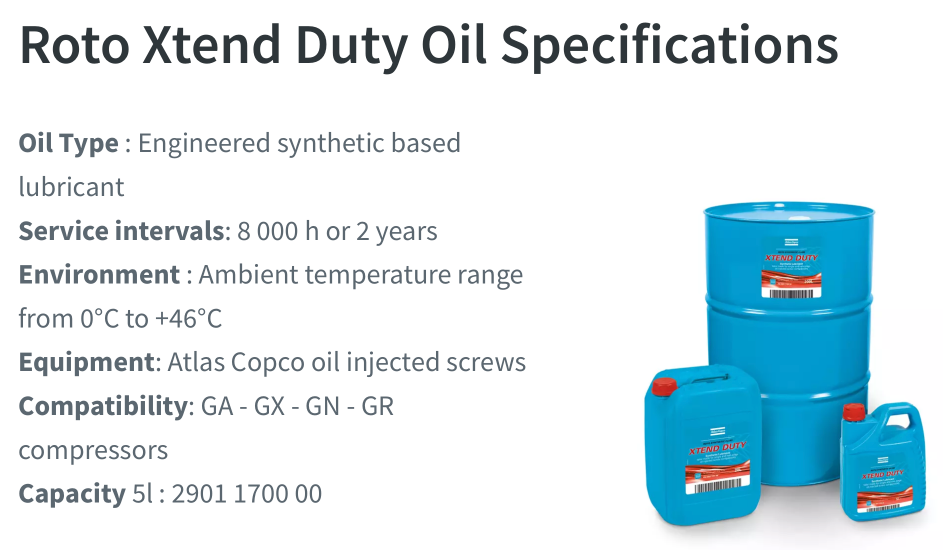
When the oil operates in a different environment, or poor scheduling causes a missed service window, the component starts degrading.
Further along, degraded oil provides less cooling and lubrication, shortening the life of the rotors and bearings it protects.
The same problem appears on a larger scale.
For example, Arthur Pue, President of Engineering Sales Associates, assessed compressed air systems for manufacturers and wrote about what an uncorrected intake restriction does to a compressor.
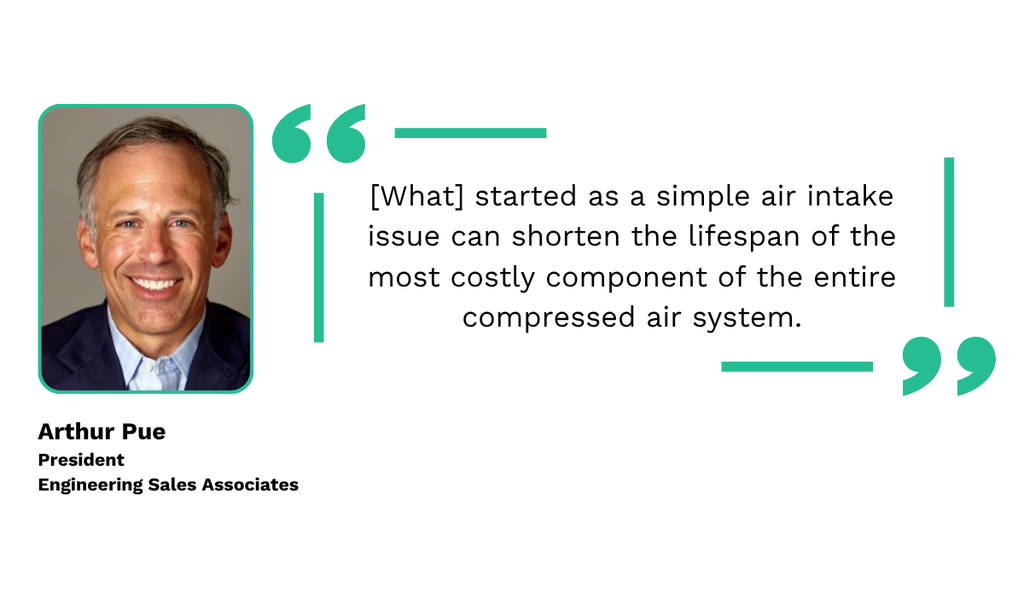
Pue is describing the air end, the part that compresses the air and the most expensive component to replace.
Regular servicing of filters and oil protects it, which is where most of the lifespan gains come from.
Overall, a compressor that receives constant preventive attention will be more likely to reach the end of its design life instead of failing years earlier.
Reduced Downtime
Downtime is a serious problem in facilities that run continuous production because a stopped compressor interrupts every process connected to it.
The disruption is expensive, and it usually happens without warning, which leaves the team repairing equipment under pressure rather than at a convenient time.
What most maintenance leaders agree on, according to data from ABB, a global technology company, is that maintenance prevents a large share of these interruptions.
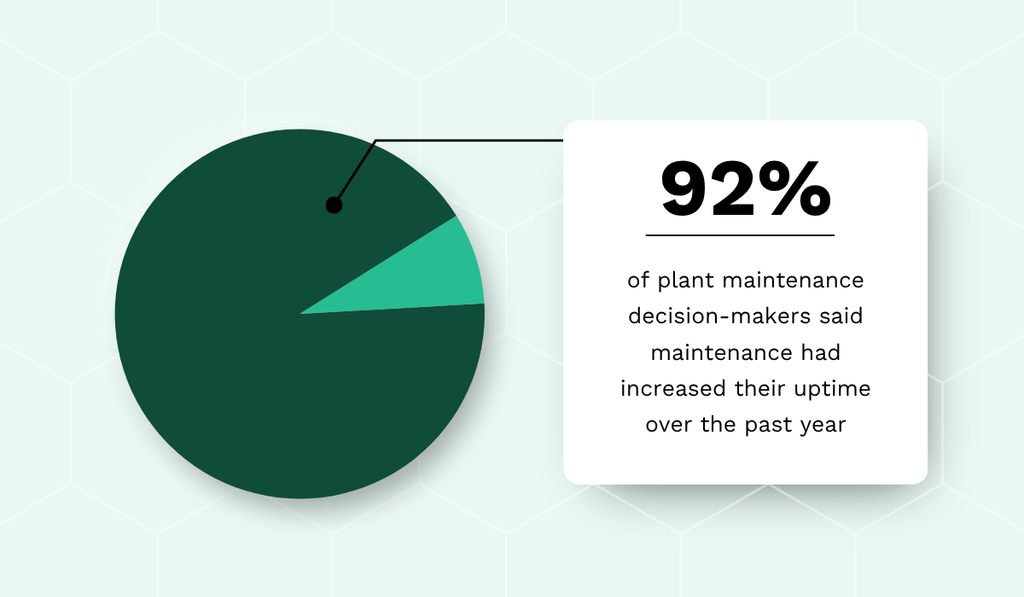
The Swiss engineering firm surveyed 3,215 plant maintenance decision-makers around the world, and the majority reported gains in uptime over a single year.
Air compressors deserve particular attention here because compressed air is connected to so many other machines.
In other words, a compressor failure can therefore mean idle staff, scrapped material, and an emergency repair bill several times the cost of a planned service.
In facilities where compressed air is essential to daily operations, that repair also has to happen immediately, which means paying for parts and labor at whatever price is available that day.
Some warning signs deserve closer attention than others when you are trying to catch a failure early.
Gregory Gilliland, Quality Technician at FS-Curtis, a compressor manufacturer, was asked which readings give the earliest warning of trouble.

According to Gilliland, two readings are especially important.
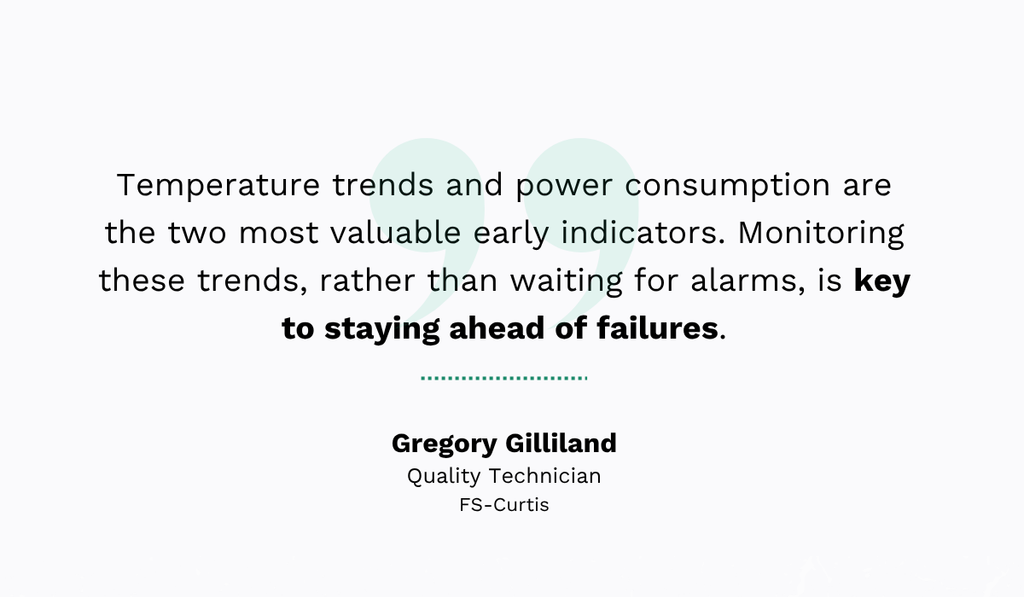
He elaborates that sharp temperature changes can indicate a clogged filter or a lubrication problem, while rising power consumption can signal general degradation across the system.
Regular maintenance can reveal several other signals beyond temperature and power consumption, shown below.
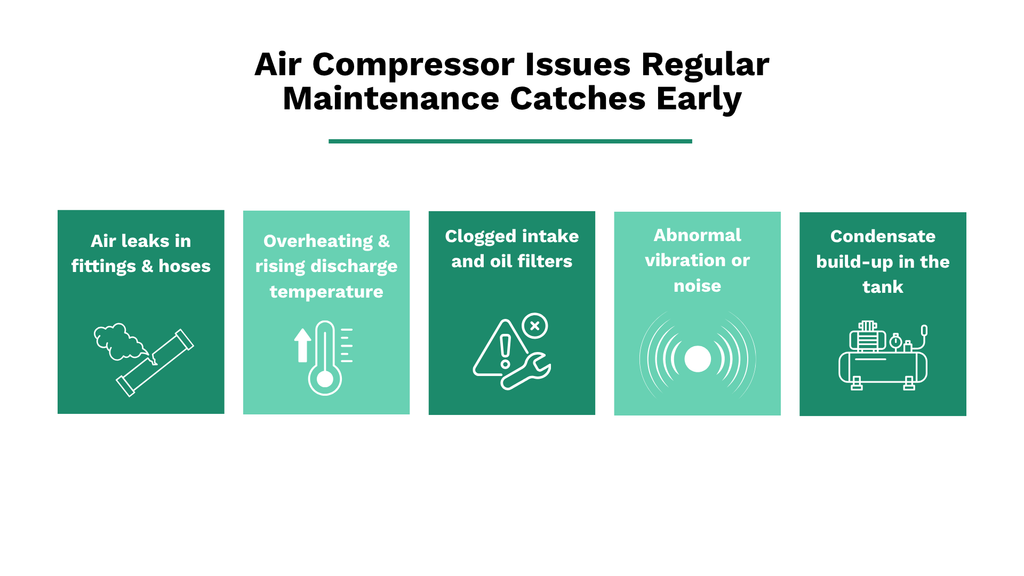
Each of these is better caught early because every one of them can progress from a minor annoyance into a failure that stops the machine.
For instance, a change in vibration can go unnoticed because a compressor is loud and vibrates during normal operation.
However, that change can be related to worn bearings or a misaligned coupling, and it may eventually require downtime you are trying to avoid.
Scheduled inspections give you the chance to act on these signals while the repair is still minor.
Increased Cost Savings
These two previous benefits also directly lower your operation costs.
After all, the money spent on maintenance is predictable, while the money spent on failures is not. Unplanned work always costs more than the same job performed on schedule.
Longer equipment lifespan and less downtime are just two of several direct and indirect savings you can expect from regular air compressor maintenance.
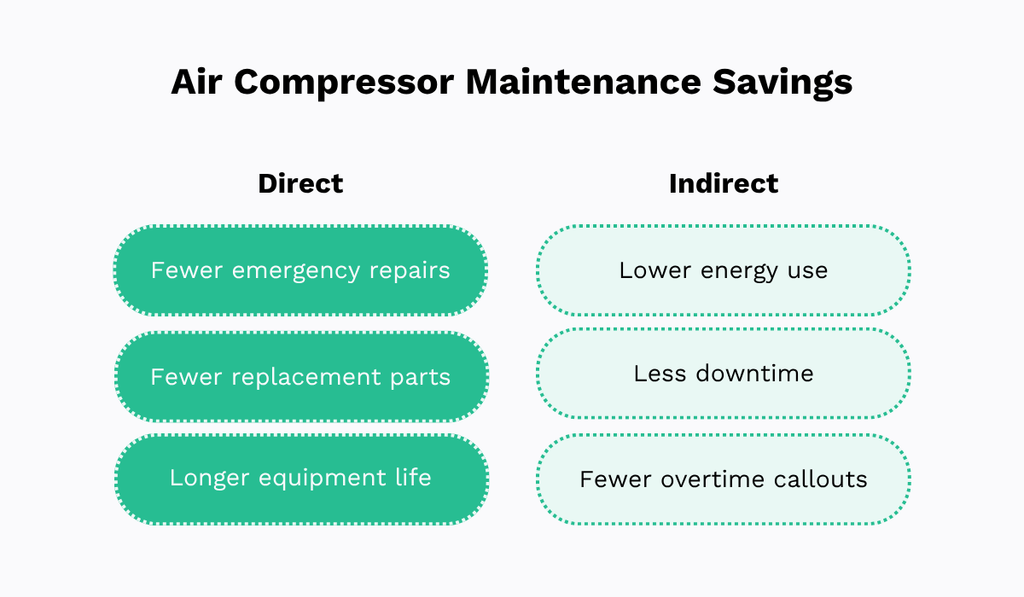
On the one hand, direct savings prevent you from spending resources on extra parts or on emergency reactive maintenance when something breaks unexpectedly.
On the other hand, indirect savings start accumulating through lower energy bills and fewer worker overtime hours, which would have been required during repairs.
Beyond savings, proper maintenance also delivers measurable efficiency gains in the system itself.
If we consider guidance published by ENERGY STAR, the energy efficiency program run by the US Environmental Protection Agency, the scale of the waste becomes clearer.
They found that the condition of a plant’s compressed air system determines how much of its output is lost before it reaches the tools that need it.
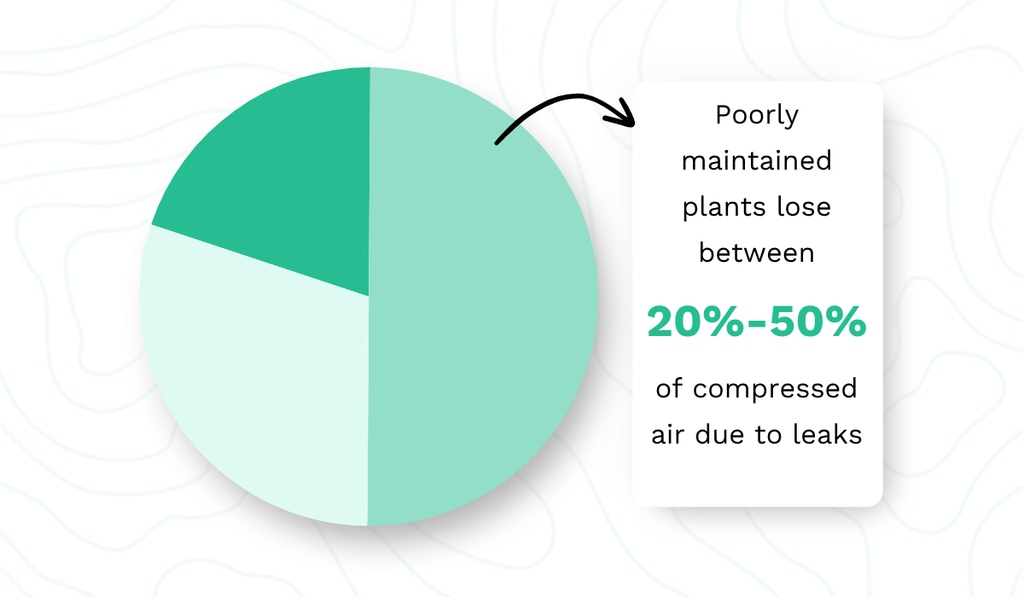
That means a neglected system can waste up to half of everything it produces, and the compressor works harder to make up the difference.
Consistent leak repair and maintenance bring that figure down, which lowers the electricity bill without any change in production.
To see the potential result of proper care for air compressor units, consider the case of Waupaca Foundry, shown below.
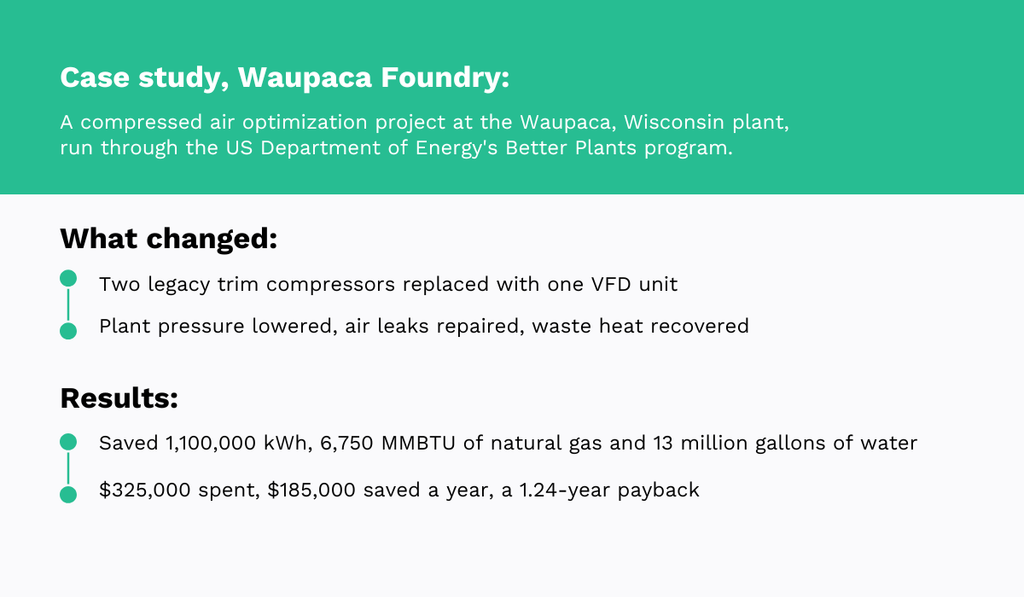
The foundry replaced aging equipment and corrected several long-standing problems in how its compressed air was produced and distributed.
This effort paid off with lower electricity, gas, and water consumption, and a return on the investment in a little over a year.
With regular maintenance, an upfront investment of this size becomes smaller because problems such as leaks and excessive pressure are corrected as they appear instead of accumulating for years.
That means the savings arrive gradually over time rather than through one large capital project.
How Often Is Air Compressor Maintenance Needed?
A logical next question to ask is what an air compressor maintenance schedule should look like.
The benefits are compelling, but resources have to be allocated sensibly, and servicing a machine more often than it needs wastes labor hours that other assets require.
There is no straightforward answer to this question, and it depends on your air compressor type.
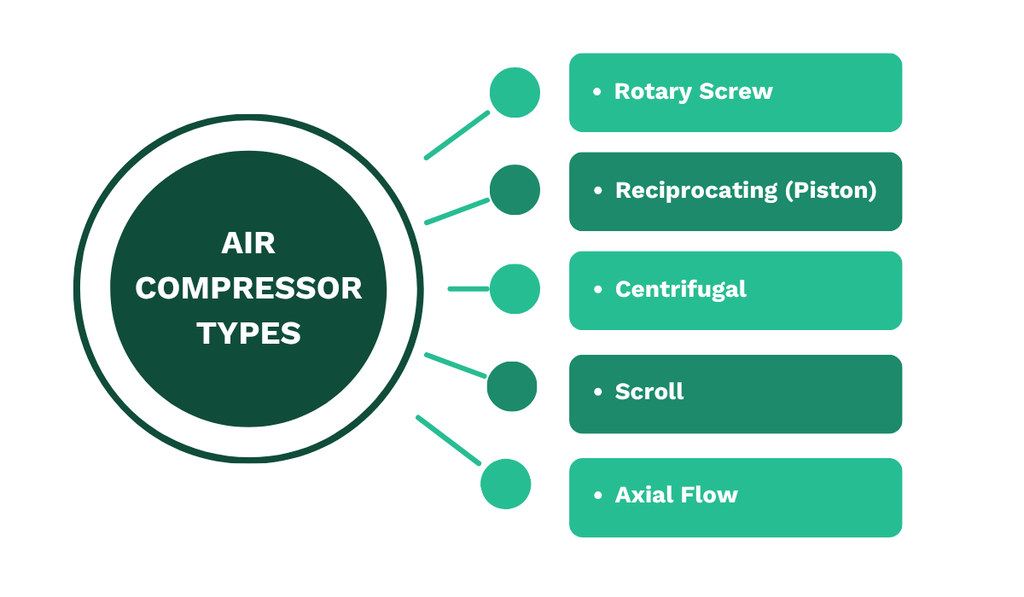
All these types have different requirements because they produce compressed air in different ways and wear differently as a result.
Reciprocating compressors use pistons, valves, and rings that are in constant contact, so they need frequent attention to those wearing parts.
Rotary screw compressors have fewer moving parts, but the oil, separator, and filters need changing on a defined cycle.
Centrifugal compressors have no rubbing parts in the air path, so routine attention moves to the lubrication system, the bearings, and vibration readings.

These are just a few examples to consider. A strong guideline to follow is reading the manual, which gives you the manufacturer’s own view of what each component needs and when.
As an example, shown below is an excerpt from the Ingersoll Rand manual for a rotary screw compressor.
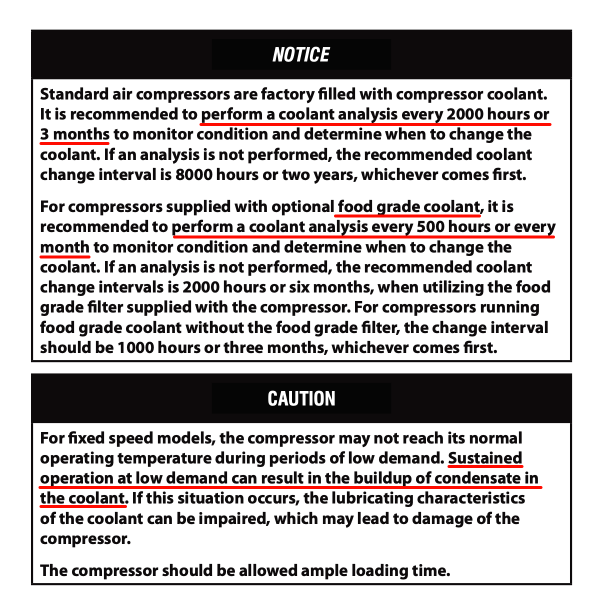
As shown, there are separate maintenance recommendations for the two types of coolant the compressor may use, and the intervals for food grade coolant are considerably shorter.
Plus, the caution is useful information because a compressor running at low demand may need more frequent checks, which is counterintuitive at first.
This last point concerns operating hours, one of several considerations that go beyond the compressor type and the components it uses.
Some other considerations are shown in the next table.
| Operating hours | A unit running 24/7 hits each service interval far sooner than one used a few hours a day |
| Environmental conditions | Dust, heat, and humidity shorten filter and oil life, so intervals tighten |
| Load profile | A compressor near full load most of the day wears faster than one that idles unloaded |
When we take the activity of the compressor and consider the environment it operates in and the intensity it runs at, we get a better idea of how far the manufacturer’s intervals should be adjusted.
With these pieces of information, you can start building a maintenance schedule for the individual components rather than for the machine as a whole.
Each part then receives attention on its own cycle rather than waiting for a single annual service visit.
Air Compressor Preventive Maintenance: The Key to a Successful Implementation
As you can see, the maintenance planning stage can be complex on its own.
But we need to consider that an effective preventive maintenance program requires more than following a checklist.
Maintenance teams need a reliable way to schedule tasks, document inspections, track repairs, and monitor equipment performance over time.
Phillip Schupp, a Multi-Site Reliability Engineer at Mauser Packaging Solutions, reviewed maintenance practices across 25 facilities and described what he found to Plant Services.
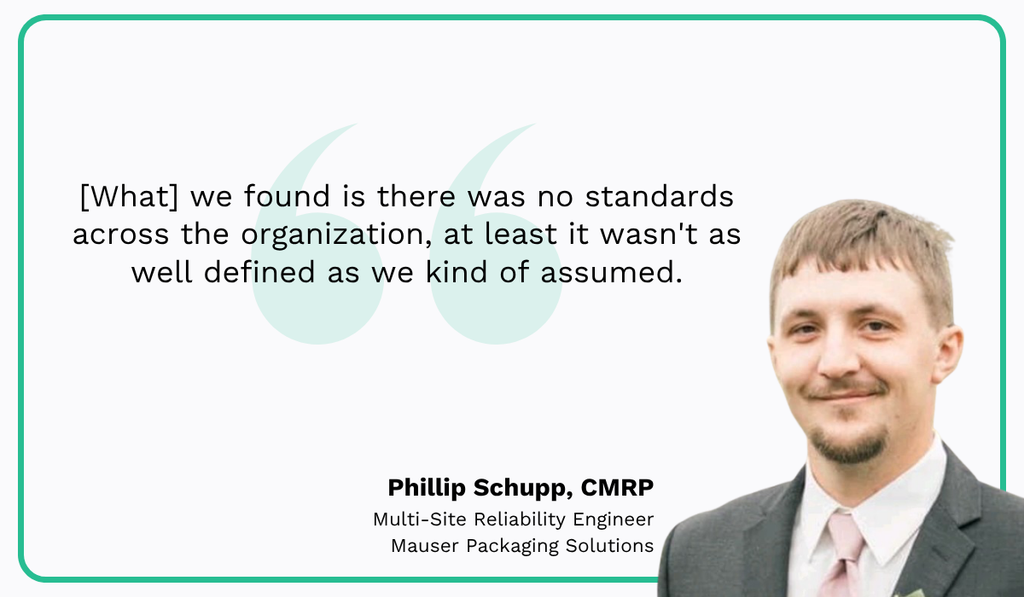
Individual sites had developed their own habits over the years, with some good at planning and others good at documentation.
Documentation is usually the first task to be skipped because it produces no immediate benefit to the technician doing it, and without a shared system nobody notices which practices work.
One way to correct this is to employ a modern computerized maintenance management system (CMMS).
These systems replace paper records and spreadsheets with a single source of maintenance information, and their core features are shown below.
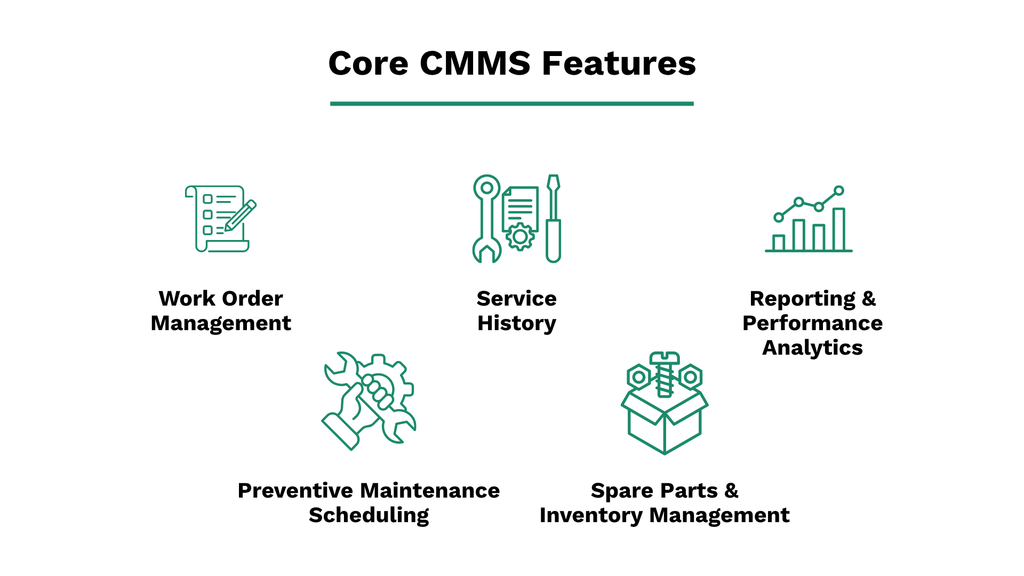
These capabilities cover the entire maintenance process, from the moment a request is raised to the report that shows how the asset performed, and act as a central record for every technician.
As an example, WorkTrek is a CMMS that helps organizations manage air compressor maintenance more efficiently.
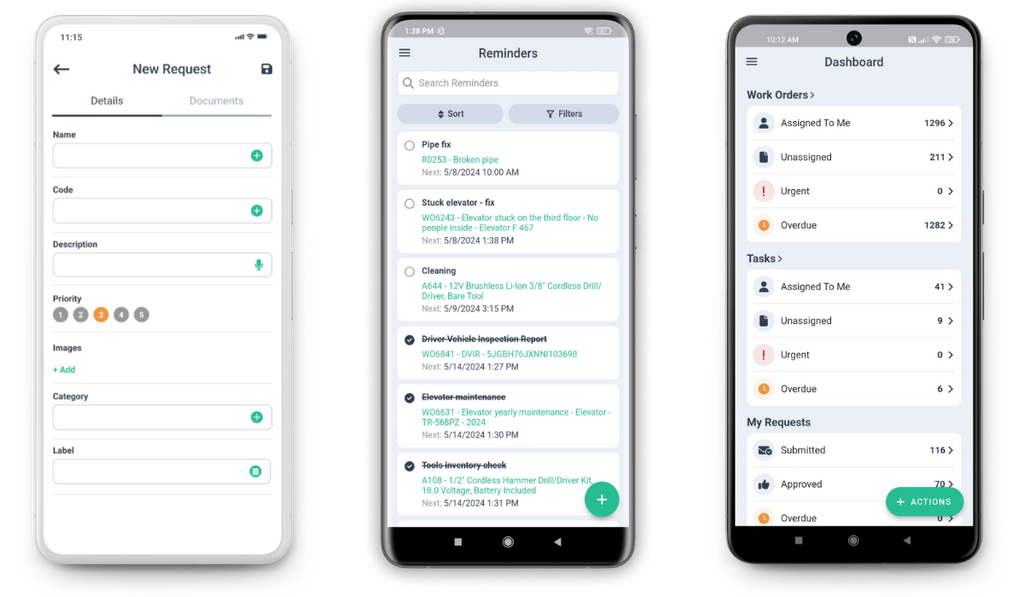
Everything is kept in one place, and the system adds scheduling and automation to the core capabilities described above.
Instead of relying on rough estimates of when a compressor is due for service, you can base prevention on the machine’s own data.
WorkTrek allows you to set triggers based on meter readings, as illustrated next.
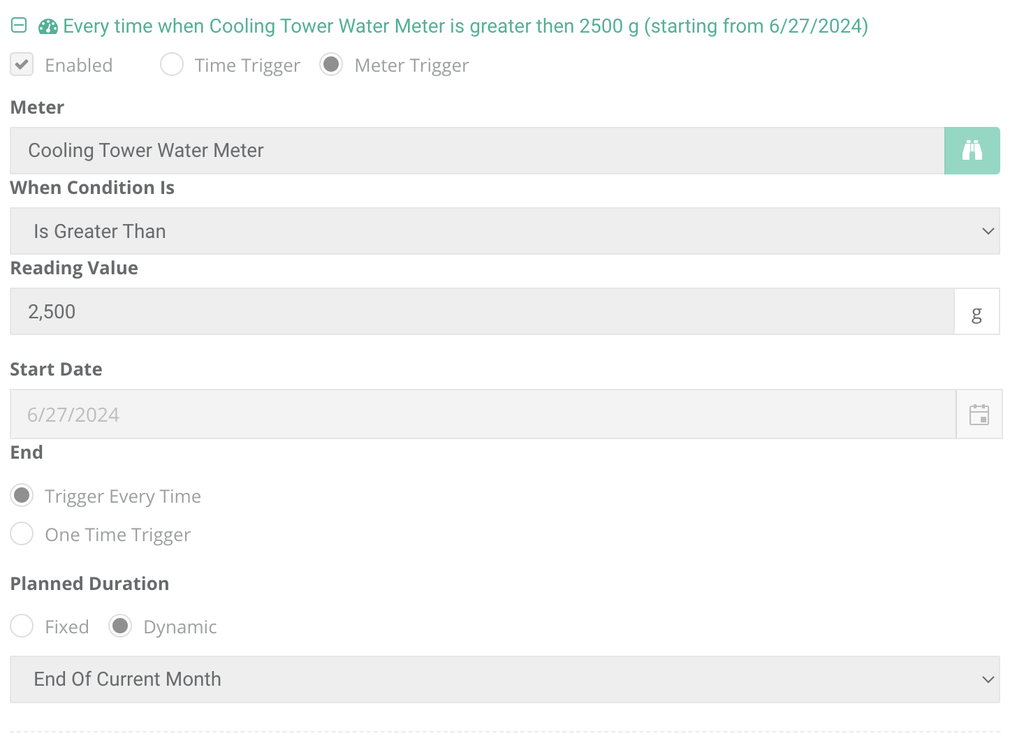
These triggers are configured once and then monitored continuously, with work orders generated automatically and sent to the assigned technician when the reading is reached, so nobody has to check the meter and remember what the number means.
For more routine inspections, scheduling works on time intervals in the same way, so daily and weekly checks appear without anyone remembering to create them.
That means the servicing intervals you established earlier are applied consistently, whoever happens to be on shift.
Conclusion
That covers what regular attention to your compressors returns and how to decide what it should look like.
The main point to remember is that compressed air equipment gives warning before it fails, provided somebody is scheduled to look.
Start with your manuals, adjust for how hard your machines work, and put the schedule somewhere it will be followed.