

Get a Free WorkTrek Demo
Let's show you how WorkTrek can help you optimize your maintenance operation.
Try for freeKey Takeaways:
- Electricity accounts for roughly 76% of what an air compressor costs you over its lifetime.
- You need to stay mindful of typical service intervals, which vary by component.
- Between 75% and 80% of plant failures trace back to human factors.
Your air compressor’s purchase price is about 12% of what it will cost you during its lifetime. Electricity is 76%.
Poor maintenance practices only increase these operational costs.
A clogged filter or saturated separator element can increase your power bill as it degrades months or years before a full breakdown.
If you want to keep your air compressor costs under control, you need to approach maintenance the right way. Below are six efficient habits that keep plant air safe and your costs predictable.
Don’t Overlook the User Manual
Good air compressor maintenance starts with reading on-hand documentation.
Generic checklists pulled from the internet don’t account for your machine’s specific lubricant type, duty cycle, or the ambient temperature in your compressor room.
Therefore, treat the manual as your single source of truth.
The most important thing it tells you is that service intervals are based on running hours, not on the calendar.
As FS-Curtis describes in its guidance on oil-flooded units, service is carried out at whichever comes first, hours or months, and you shorten those intervals by 25% to 50% in dusty, hot, or humid conditions (or when you’re running a food-grade lubricant).
The manual also outlines the safety guidelines for your specific machine, and Atlas Copco emphasizes reading it first, before any other maintenance step.
Different units have different isolation points, and assuming yours matches the last one you worked on is how people get hurt.
| Component | Typical interval | Watch for |
|---|---|---|
| Inlet air filter | ~2,000 hours | Dusty plants need it sooner |
| Oil filter | ~2,000 hours | Long-life variants differ |
| Oil sample for analysis | ~2,000 hours | Often a warranty condition |
| Compressor oil | 4,000 to 8,000 hours or annually | Mineral shorter; synthetic longer |
| Air/oil separator element | 4,000 to 8,000 hours, or 10 psi pressure drop | Every 2 psi of drop adds about 1% to brake horsepower |
| Full PM, airend and valves | 4,000 hours or annually | Hot or dusty rooms shorten the interval |
As Lewis Systems notes in its rotary screw guidance, a separator element left past its pressure-drop threshold costs you horsepower for every hour of operation.
Remember that the manual also often doubles as your warranty contract, meaning ignoring it could further lead to extra expenses.
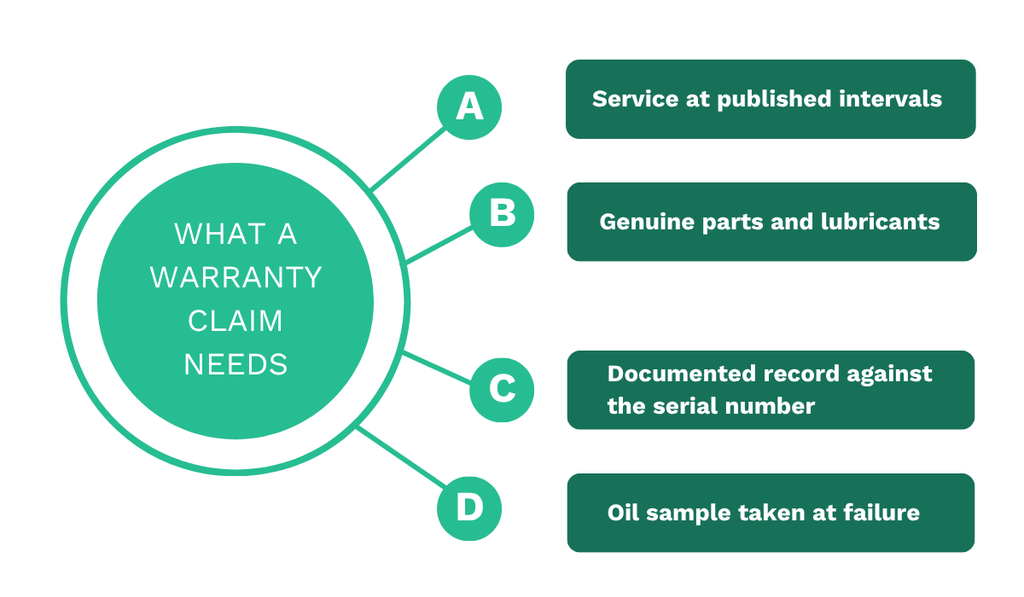
Atlas Copco’s extended warranty terms require that servicing is completed at the published intervals using genuine parts and lubricants, that the record of that work is logged against the specific machine serial number, and that an oil sample is taken at the time of failure for any claim to proceed.
Miss any one of those and a covered failure stops being covered.
So, before you build a schedule, read what the manufacturer already wrote for your machine.
Then plan maintenance around that.
Keep Maintenance on Track with a Checklist
The manual tells you what should happen, but it doesn’t solve issues on its own.
To keep your air compressor safe and secure against malfunctions, you’ll need a robust, readable checklist.
While the specifics of the checklist should depend on your facility, one universal rule worth adopting is the cadence and scope of maintenance actions.
Some technical aspects will require daily inspection; others can be checked on a monthly basis.
Here’s a simple example:
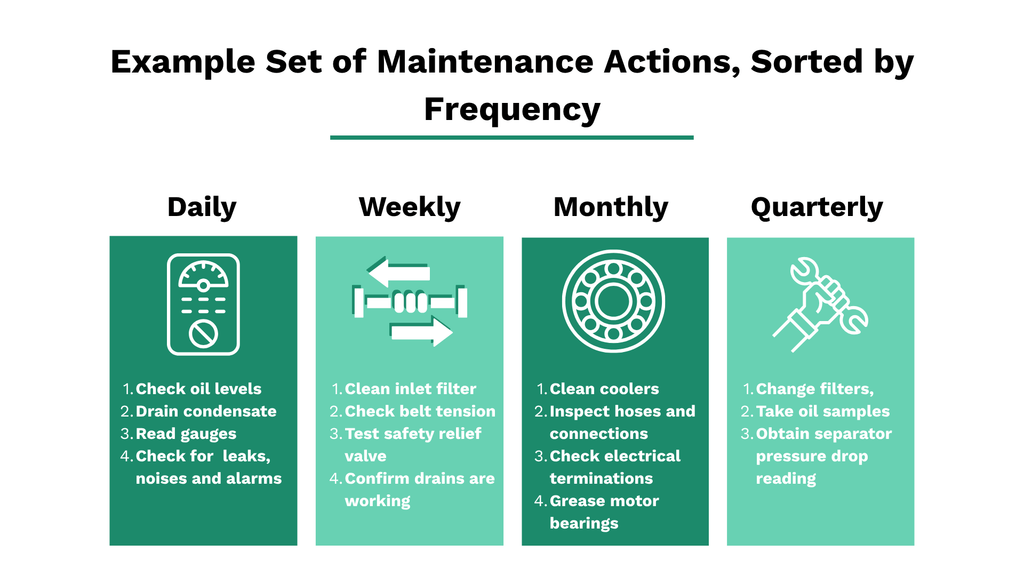
You might be surprised that gauge readings and oil level checks are daily items. This should be standard across many industries because of their function as predictors for deeper-set issues.
As Gregory Gilliland, Quality Manager at FS-Curtis, a manufacturer of compressed air and air treatment solutions, put it in an interview with Reliable Plant:
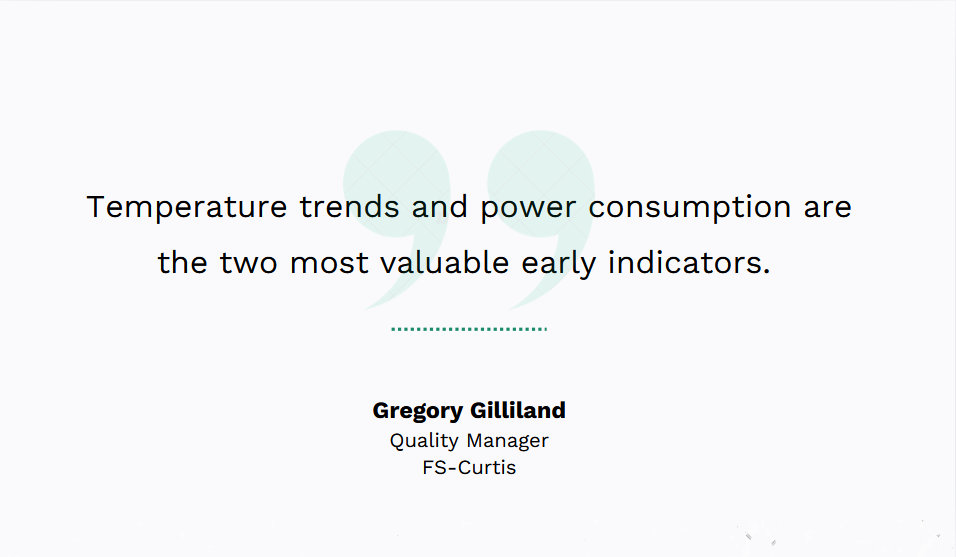
As he asserts, when a compressor’s energy use spikes with no link to something obvious, like increased production demand, “it’s a strong sign that something within the system is degrading or becoming inefficient.”
A structured checklist that can be easily accessed helps catch these issues before they escalate.
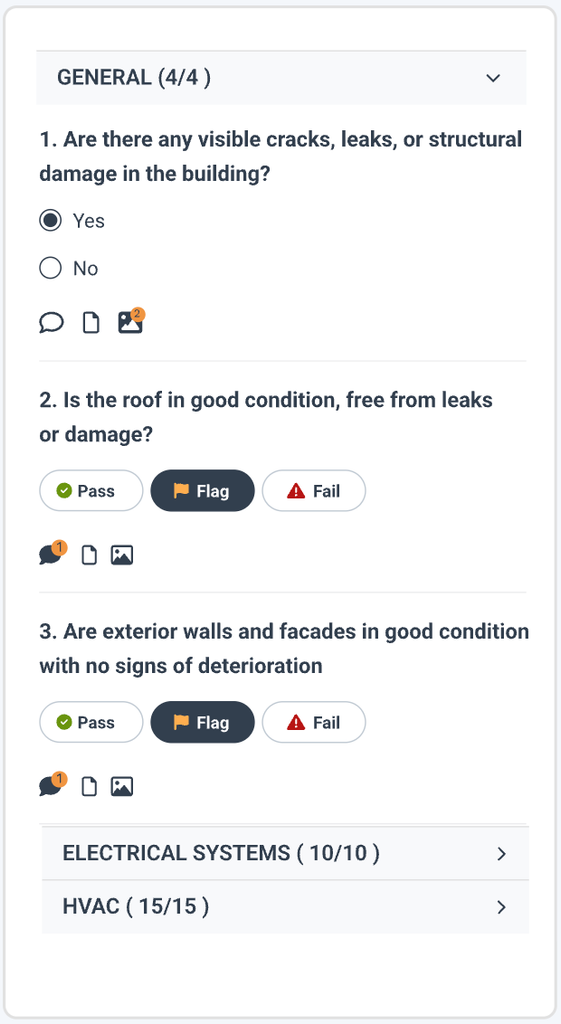
A technician cannot be expected to carry every tolerance and every task in their head, and checklists shouldn’t just provide action items without contextual guidance.

If you want a starting point, this preventive maintenance checklist guide covers the general structure in more detail.
Don’t Underestimate the Power of Lubrication
Oil in a rotary screw compressor does more than reduce friction. It seals the rotors, carries heat out of the airend, and keeps metal off metal.
Get it wrong and the damage lands on the bearings.
SKF puts poor lubrication behind more than 36% of premature bearing failures, with contamination responsible for a further 14%.
Three mistakes account for most of it:
| Treating the oil change as a fixed date | Oil life depends heavily on operating temperature, and as FS-Curtis notes, a compressor running hot burns through its interval faster than what the manual says. |
| Reaching for whatever is on the shelf | Automotive engine oil lacks the anti-foaming and water-separation properties a compressor needs. Always rely only on fit-for-purpose materials |
| Getting the quantity wrong | Too little shows up as high discharge temperature and rising power draw. Too much creates buildup at the separator, and eventually you’ll find oil pushed downstream into your dryers, filters, and tools |
Hence why it’s recommended to take a sample every 2,000 hours.
Remember, however, that none of this will help much if the filter or separator element you use in the first place is the wrong one.
Don’t Cut Corners on Genuine Spare Parts
Atlas Copco warns that replica filters, for example, can produce higher pressure drops than genuine parts, increasing energy consumption and, in the worst case, causing the compressor to fail outright:
“Operating conditions play a crucial role for the lifetime of your air compressor and its components. Compressor oils and filtration parts serve as the first and most important barrier to protect the machine. That is why it is key to safeguard the performance, reliability, and lifetime of your air compressors with genuine parts […].”
Then there is the warranty.
As covered in section one, Atlas Copco’s terms require genuine parts and lubricants, along with documented servicing. Fitting a cheaper equivalent simultaneously risks components and could void your coverage entirely.
The bigger problem is that “aftermarket” and “counterfeit” are not always distinguishable at the loading dock.
US Customs and Border Protection reports that counterfeits are frequently made with substandard materials, and its seizures of fake industrial and automotive components run into hundreds of thousands of dollars at a single port.
A legitimate aftermarket supplier with published specifications is a defensible choice. An unbranded element from a marketplace listing is not.
In practice, it’s worth keeping a minimum backup inventory to avoid rushed substitutions.
Keep part numbers, quantities, and reorder points against each asset in your parts and inventory records to prevent decisions being made under pressure at 2 am.
Make Safety Measures a Priority
Switching off a compressor doesn’t make it safe to work with, as the receiver tank and the lines downstream of it hold energy long after the motor stops.
And that’s not all. Rotating parts, surfaces that haven’t properly cooled down from continuous operation, a live electrical supply – the list of hazards goes on.
This often goes underestimated, and OSHA’s control of hazardous energy standard, 29 CFR 1910.147, covers exactly this problem.
It requires that stored energy be released, restrained, or otherwise rendered safe before servicing begins, not merely that the power be cut.
Interestingly enough, it’s also the fourth most-cited standard in 2025, as reported by the National Safety Council Congress.
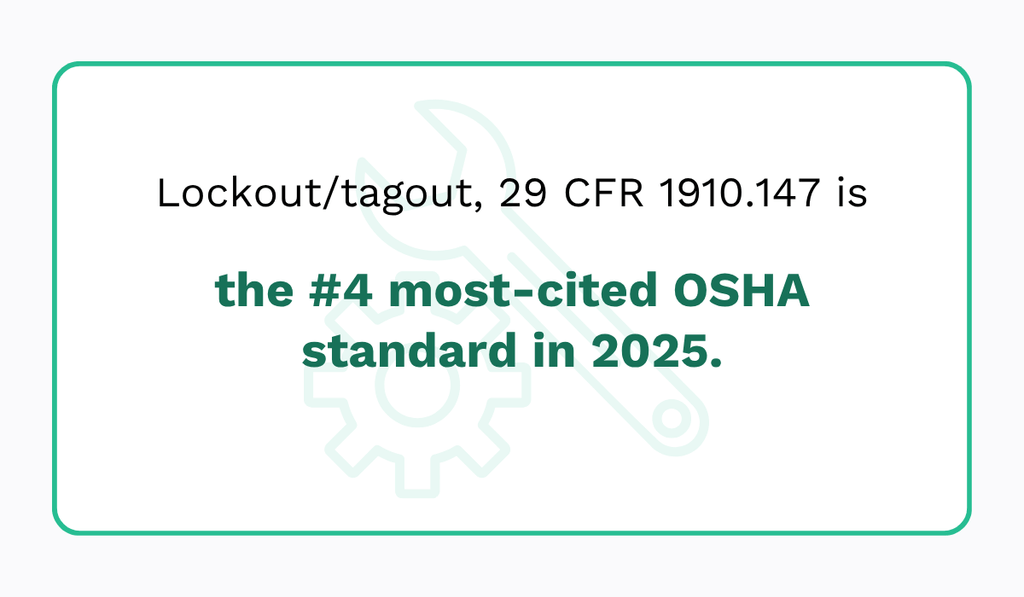
So, a safe compressor shutdown and isolation sequence should look similar to this:
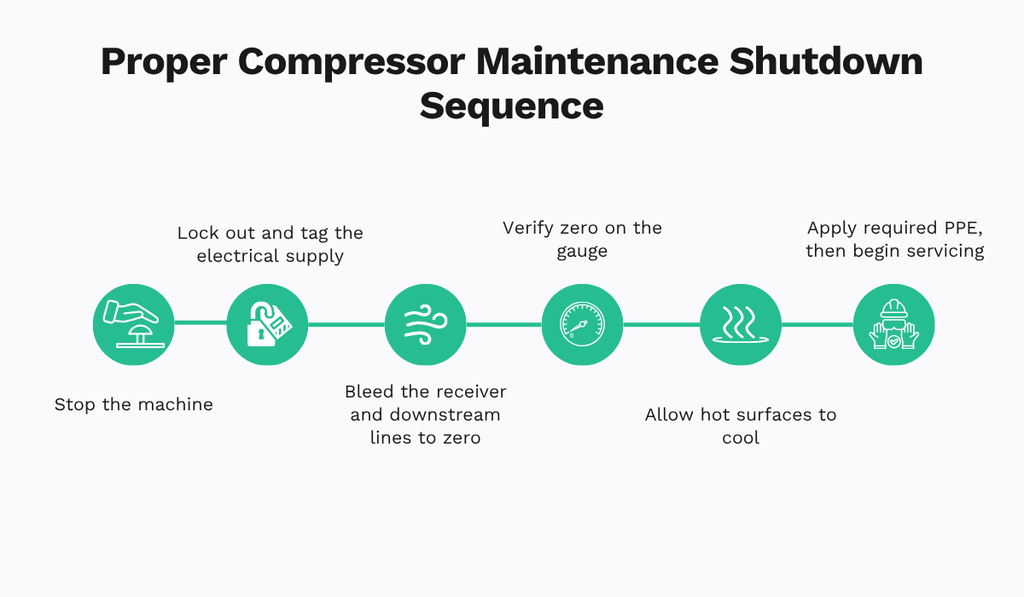
This sequence may look obvious, but if the facility and personnel don’t foster a culture of safety, it’s easy to turn a blind eye to some readings, or skip step three entirely.
Also, it’s just as easy for a contractor who has never seen your installation to miss the second receiver still holding pressure.
A laminated sheet on the compressor room wall won’t catch either of those.
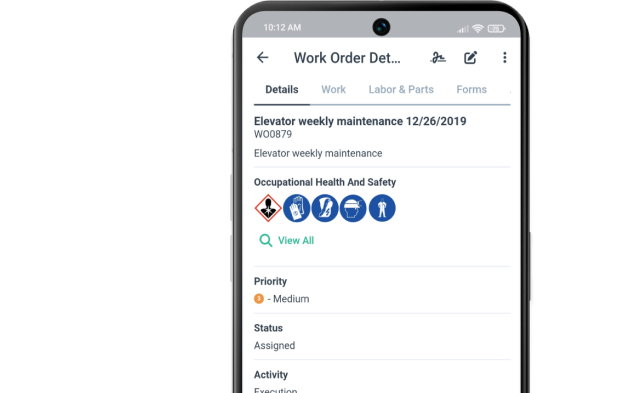
Instead, put the lockout steps and the PPE list inside the work order (as shown below), and the technician reads them on a phone before touching anything, with the closed job recording that they did.
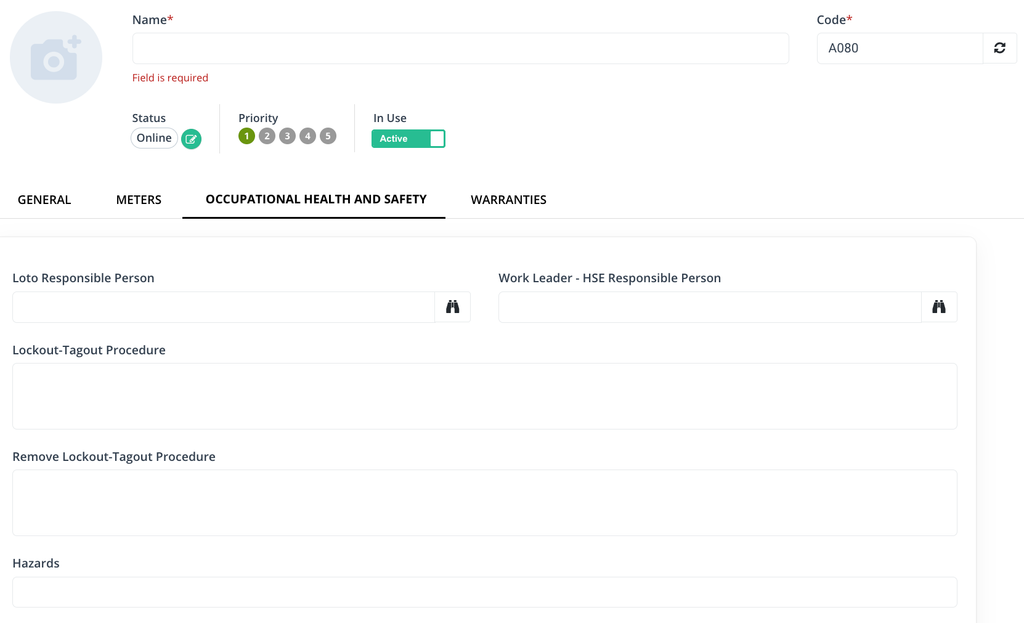
That’s what compliance and safety controls in a maintenance system are for.

These checks constitute easy, reliable fixes and remove the burden of having to memorize steps for semi-annual maintenance procedures from your employees.
Keep a Detailed Maintenance Log
Every habit in this article produces paperwork. Without somewhere to put it, you end up managing the compressor from memory.
You’ll know it had a bad year, but not how many hours it has run since the separator was changed, which derails your manufacturer interval count.
When nobody logs the hours, all you’re relying on is plain guesswork.
A log records critical data, including:
- Service history
- Replacement parts and their numbers
- Running hours tallied at each intervention
- Oil analysis results
- Trend readings from daily checks
Two years of that can tell you plenty about a machine, its state, and whether it might be time for another rebuild.
However, if maintenance logs are so valuable, why are so many teams struggling to keep them?
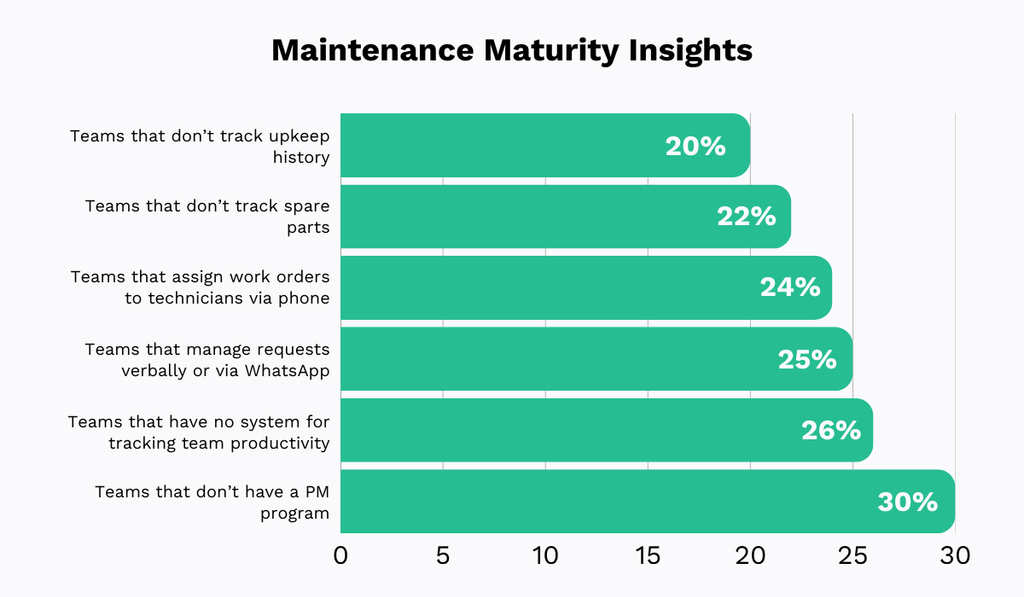
The 2025 Zapium research provides an answer.
It shows that many maintenance teams still operate at a very low level of maturity, relying on manual processes, with no systematic way to track maintenance or assign tasks.
The obvious solution is to move it all into software and digitize your records.
That’s also where most of these projects die, because the technician who has done the job the same way for fifteen years has no interest in learning a system that makes their day longer.
The key is making data tracking easier, not more complicated.
This is where WorkTrek comes in. With our CMMS, you can simplify your records and boost operational efficiency while minimizing friction.
Technicians follow a simple procedure, from opening the work order to recording data off the panel, filling out the necessary information, including attaching photos/documents, and lastly, confirming purchase orders for replacements.
All of this can be done through their phones.
Over time, maintenance history of each asset is created, so every job, part, reading, and completed safety procedure sits in one timeline.

Beyond making planning and maintenance management easier, this timeline also serves as evidence when someone asks for information about audits, insurance, or your recordkeeping measures.
Conclusion
You won’t always see all the problems with your air compressor at a glance, but they will cause damage nonetheless.
They will drive up electricity costs while dragging down production efficiency, not to mention health risks in your facility.
But the six habits we’ve outlined here can make a difference. They will provide you with a structured and repeatable, yet simple system to keep your maintenance on track.
The cumulative savings and peace of mind are worth the initial effort.